A growing number of businesses, particularly in healthcare, professional services, and creative fields, are looking at UWS more deliberately. The neighborhood offers real advantages, but also real constraints. This article covers what's actually available, what it costs, what to watch out for in a lease, and how to search the market efficiently.
Key Takeaways
- UWS offers boutique commercial buildings, older pre-war stock, and flexible coworking options — typically at lower price points than Midtown
- Inventory skews toward smaller footprints, suiting professional services, healthcare, and creative firms over companies needing large Class A blocks
- Pricing, transit access, and limited Class A supply are the three variables to pressure-test before committing
- Many UWS listings don't surface on mainstream platforms, so relationship-driven broker searches are often the only way to find them
- A tenant rep broker costs the tenant nothing and provides significant leverage in a market this opaque
Why Companies Are Looking at the Upper West Side for Office Space
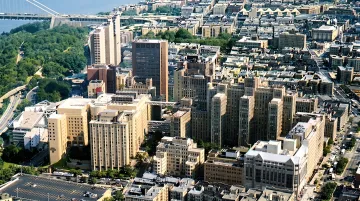
The Neighborhood Profile
UWS isn't a business district — and that's partly the point for certain tenants. The neighborhood draws a dense, highly educated residential population: NYC Planning's Community District 7 profile reports that 75.3% of residents aged 25 and over hold a bachelor's degree or higher, with an unemployment rate of 3.3%. For businesses in healthcare, therapy, education, media, or professional services, that's a meaningful local talent pool.
The institutional anchors reinforce that picture. Mount Sinai Morningside and NewYork-Presbyterian/Columbia University Irving Medical Center anchor the health corridor, while Columbia University, Barnard, Fordham's Lincoln Center campus, Juilliard, and Teachers College all operate within or adjacent to the neighborhood. Companies serving or hiring from these communities have genuine reasons to locate here.
Transit Access
UWS is better connected than its residential reputation suggests. The neighborhood is served by:
- 1/2/3 trains running along Broadway (stations at 59th, 72nd, 79th, 86th, 96th, 103rd, 110th, 116th, and 125th Streets)
- B/C trains along Central Park West (stations at 59th–Columbus Circle, 72nd, 81st, 86th, 96th, 103rd, 110th, and Cathedral Pkwy)
That gives employees coming from Midtown, Lower Manhattan, and most of the outer boroughs a direct ride. Metro-North access is available at Harlem–125th Street, extending the commuter catchment north.
The Trade-Off
UWS is not a primary commercial corridor. Class A inventory is limited compared to Midtown, Hudson Yards, or even the Flatiron District. Companies that need a prestigious address, large contiguous floor plates, or a dense business-district environment will find the neighborhood underwhelming. For everyone else, the calculus deserves a closer look.
Types of Office Space Available on the Upper West Side
Traditional Direct-Lease Buildings
The commercial stock along Broadway and Columbus Avenue includes a mix of older pre-war buildings and some modern boutique properties. Floor plates tend to be small — full-floor opportunities in the 5,000 SF range are common, and large-block availability simply doesn't exist here the way it does in Midtown.
Two examples illustrate the range:
- 1841 Broadway — A Class B building constructed in 1924, with a typical floor size of approximately 11,500 SF. Sublet listings as small as 852 SF have appeared here.
- 1995 Broadway — A modern boutique glass-and-steel property offering 5,000 SF full-floor spaces with column-free floor plates and generous ceiling heights.
Don't assume pre-war means limiting — some of that stock is well-maintained and distinctive. That said, verify mechanical systems and building management quality before signing.
Sublease Space
Subleases — where a current tenant rents out unused square footage — can work well for businesses needing shorter commitments or lower upfront capital. Key trade-offs to know:
- Often come partially or fully built out, cutting both cost and lead time
- Terms are deal-specific, so availability shifts frequently
- UWS sublease inventory is thin compared to Midtown South or Downtown — don't count on finding multiple options
Coworking and Flexible Office
Two verified flexible office providers serve the UWS area:
- Industrious Upper West Side at 1900 Broadway, 7th Floor — private offices, suites, virtual offices, and meeting rooms
- The Yard Columbus Circle at 33 West 60th Street — coworking desks, private offices, dedicated desks, 24/7 access, and on-site management
These are the easiest entry point for small teams or businesses testing the neighborhood before committing to a direct lease. All-in monthly pricing removes the complexity of operating expenses, security deposits, and buildout costs.
Medical and Professional Office Space
UWS has an above-average concentration of medical, therapy, and professional service office spaces. The neighborhood's residential density and proximity to major hospitals create consistent demand from practitioners and clinical groups. A recent example: Mount Sinai signed a 7,000 SF OB-GYN lease at 348 Amsterdam Avenue. Spaces configured for healthcare use typically require specific zoning classifications, dedicated plumbing, and enhanced ventilation — all of which affect buildout scope and timeline.
What Office Space Actually Costs on the Upper West Side
How NYC Office Rents Work
NYC office rents are quoted as annual asking rent per square foot. A 1,500 SF space at $60/SF costs $90,000 per year, or $7,500/month before operating expenses. Whether a lease is structured as gross (one all-in number) or with additional rent covering operating expenses and taxes depends on the building — verify the structure before comparing listings directly.
That distinction matters when evaluating UWS listings, where building classes and lease structures vary more than in core Midtown corridors.
Market Benchmarks
No authoritative source publishes a UWS-specific average asking rent. Here's what verified Q1 2026 data shows for context:
- CBRE Midtown: $84.79/SF
- CBRE Midtown South: $84.37/SF
- CBRE Downtown: $59.08/SF
- Colliers Manhattan overall: $77.55/SF
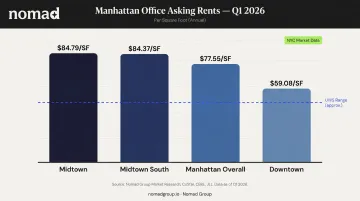
UWS, as a secondary commercial market, generally sits below Midtown pricing — but exact figures vary by building, floor, and whether the space is pre-built or raw. Treat any per-SF number you see in a listing as a starting point for negotiation, not a fixed price.
Costs Tenants Commonly Underestimate
Beyond base rent, budget for:
- Security deposit — typically two months' rent, though this varies with tenant financial profile; a letter of credit can sometimes substitute
- Annual rent escalations — NYC SBS cites 3% annual increases as a common structure in multi-year leases
- Tenant improvement (TI) allowance — landlords in longer-term deals may contribute to buildout costs, but must be negotiated before signing
- Buildout capital — raw spaces require full construction; even "plug-and-play" spaces often need modifications
- Broker fees — in standard NYC practice, the landlord pays the broker commission; tenants using a tenant rep pay nothing out of pocket
Coworking vs. Direct Lease
| Factor | Coworking/Flex | Direct Lease |
|---|---|---|
| Pricing structure | All-in monthly fee | Base rent + operating expenses |
| Upfront cost | Low (deposit only) | Higher (deposit + potential buildout) |
| Term flexibility | Month-to-month to 12 months | Typically 3–10 years |
| Best for | Teams under 15, testing a neighborhood | Established teams with 18+ month visibility |
Key Considerations Before Signing an Office Lease on the Upper West Side
Lease Term and Flexibility
NYC SBS defines short-term leases as five years or less; long-term leases typically run 10 years or more. The trade-off is straightforward: longer terms unlock more landlord concessions — free rent periods, higher TI allowances, better base rent — but lock you in. Shorter terms offer flexibility at a cost premium and fewer concessions.
Match your term to your growth visibility. If you have 12–18 months of funding runway and genuine uncertainty about headcount, a direct 7-year lease is a risk. If you're an established firm with predictable growth, a longer term is worth pursuing for the economics.
When negotiating, consider pushing for: right of first refusal on adjacent space, sublease rights, and termination options tied to specific business milestones.
Zoning and Permitted Use
Not every UWS commercial building is zoned for every use. NYC DCP maps C4-6A zoning along most of Broadway on the Upper West Side, with commercial overlays (C1-5 and C2-5) along Broadway, Amsterdam Avenue, and Columbus Avenue. Professional offices and business uses are generally permitted in these commercial districts — but verify your specific use case, particularly for medical, clinical, or retail-facing businesses.
Use NYC's ZoLa mapping tool to check zoning for any specific address before investing time in lease negotiations. Search by address or tax lot, and toggle the commercial district layers to confirm permitted uses.
Space Condition and Buildout Timeline
Assess honestly whether a space is raw (requiring full buildout) or move-in ready. Raw spaces cost more in time and capital — permits, construction, furniture — and a poorly managed project can delay occupancy by months.
Nomad Group's construction management team works to a 90-day buildout benchmark — and has delivered full office transformations ahead of that mark on projects where conditions allowed. That discipline matters when you're paying rent from day one and need your team operational fast.
If you're considering a raw or white-box space in a UWS building, factor the buildout timeline and management capability into your decision — not just the asking rent.
Landlord Quality
In smaller commercial buildings — the norm on UWS — landlord responsiveness and building management standards vary significantly. Before signing, request references from existing tenants in the building. Ask specifically about maintenance response times, building system reliability, and how the landlord handles lease enforcement. The space matters less than you think; the landlord relationship lasts for years.
How to Find and Secure Office Space on the Upper West Side
Why the Market Is Harder to Search
UWS is not a primary commercial district, and that creates a real search problem: many available spaces don't appear on mainstream listing platforms or CoStar aggregators. Landlords in boutique buildings often lease through direct relationships and word-of-mouth rather than broad marketing campaigns. If you're searching on LoopNet alone, you're seeing a fraction of what's actually available.
A tenant representative with genuine NYC market access — direct relationships with building owners, not just platform logins — surfaces inventory that never hits public listings. Nomad Group's team works across NYC neighborhoods, including less conventional corridors like the UWS, where off-market availability is standard. In practice, that access regularly cuts months off the search timeline.
The Leasing Process Timeline
A realistic NYC office lease timeline, from initial search to signed lease:
- Define your requirements — headcount now and in 12 months, required SF, must-have amenities, budget, preferred term length
- Market search and shortlisting — touring 6–10 spaces, narrowing to 2–3 finalists
- Submit a Letter of Intent (LOI) — a non-binding document outlining proposed rent, term, TI allowance, and key conditions
- Negotiate lease terms — the LOI becomes the basis for the formal lease draft; expect back-and-forth on economic and legal terms
- Execute the lease — review with a real estate attorney before signing; prepare financials, entity documents, and references in advance, as landlords will request them
- Buildout and move-in — timeline depends on space condition and construction scope
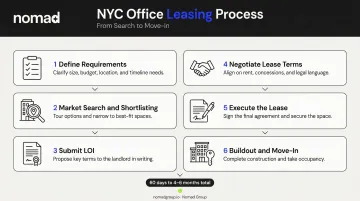
Expect the full process to take anywhere from 60 days for a simple plug-and-play deal to 4–6 months if buildout is required.
Pre-Search Checklist
Answer these five questions before you start touring:
- Current headcount and 12-month projection — this drives your SF requirement
- Required square footage — standard planning assumption is 125–175 SF per person for a hybrid office
- Non-negotiable amenities — dedicated HVAC control, private conference rooms, freight elevator access, etc.
- Maximum monthly budget — all-in, including operating expenses
- Minimum lease flexibility — what's the shortest term you'd accept, and do you need sublease rights?
Walking into tours with clear answers to all five keeps conversations focused on viable options — and gives you real leverage when LOI terms are on the table.
Frequently Asked Questions
How much does office space cost per square foot on the Upper West Side?
No authoritative source publishes a UWS-specific average asking rent. As context, Manhattan overall averaged $77.55/SF in Q1 2026 (Colliers), with Midtown at $84.79/SF and Downtown at $59.08/SF (CBRE). UWS, as a secondary market, typically prices below Midtown. Consult a broker or check current listings for specific building data.
Is the Upper West Side a good location for a business office?
It works well for professional services, healthcare, therapy practices, creative firms, and small teams that prefer a quieter, residential-adjacent setting over a dense business-district environment. It's a poor fit for companies needing large contiguous floor plates, Class A trophy buildings, or a dense business-district environment with significant amenity infrastructure nearby.
What types of office space are available on the Upper West Side?
The main options include:
- Traditional direct leases in boutique commercial buildings (typically under 5,000 SF per floor)
- Sublease space from existing tenants
- Coworking and flex memberships through providers like Industrious and The Yard
- Specialized medical or professional office suites for clinical and service-based practitioners
What is a Letter of Intent (LOI) in a commercial lease?
An LOI is a non-binding document outlining the basic terms a tenant proposes to a landlord — rent, lease term, TI allowance, security deposit, and key conditions — before a formal lease is drafted. Treat it carefully: the terms set here shape everything that follows in negotiation.
How long does it take to lease office space in NYC?
Expect 60 days at the fast end for a pre-built space with straightforward negotiation. A deal requiring buildout, complex lease terms, or significant landlord negotiations can run 4–6 months.
Do I need a broker to rent office space on the Upper West Side?
You're not legally required to use one. But tenant rep brokers are paid by the landlord, not the tenant — so the service costs you nothing directly. In a market like UWS, where many listings are off-market and landlord relationships drive access, working without representation means starting with less information and less negotiating leverage than the landlord has.