Browsing listings without defined requirements, submarket knowledge, or an understanding of how deals are actually structured means you're comparing prices that can't be compared. A high asking rent with a generous tenant improvement allowance may cost less over the lease term than a low-sticker space with no concessions at all.
This guide walks through exactly how to search NYC office listings effectively — from locking in requirements before you search to evaluating deal terms that determine what you'll actually pay.
Key Takeaways
- Define headcount, budget, and target neighborhoods before opening a single listing
- NYC office listings are spread across public platforms, broker networks, and off-market channels — and each source carries different inventory
- Key variables: lease type, price per square foot, build-out condition, and term length all affect true cost
- Tenant rep brokers are paid by landlords, so they expand your access and negotiating leverage at no cost to you
- JLL advises beginning lease discussions 18–24 months before expiration — earlier than most companies expect
How to Browse NYC Office Listings and Rentals
Step 1: Define Your Requirements Before You Search
Two inputs determine which listings are worth your time: headcount and budget.
For headcount, plan for current team size plus 12–24 month projections. A common baseline is 150–200 square feet per person, though this varies by layout density and culture. A 30-person team today that expects to reach 50 in 18 months needs to size accordingly — subletting underused space later is expensive and complex.
For budget, research asking rents by submarket before you set a number. According to Cushman & Wakefield's Q4 2024 Manhattan market report, overall asking rents break down as follows:
| Submarket | Overall Asking Rent | Class A Asking Rent |
|---|---|---|
| Midtown | $78.15/SF | $86.27/SF |
| Midtown South | $77.19/SF | $94.99/SF |
| Downtown | $55.54/SF | $59.22/SF |
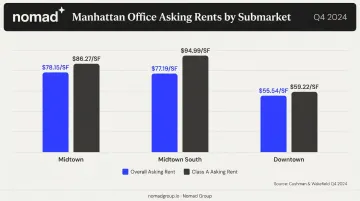
Note that these are asking rents. Actual deal economics depend on free rent periods, TI allowances, and escalation clauses — all negotiable.
Also nail down your preferred neighborhoods and acceptable lease term before you start. Once you have those parameters set, the next question is where to actually find listings — and not all channels surface the same inventory.
Step 2: Choose the Right Listing Channels
NYC office listings are distributed across multiple platforms — CoStar, LoopNet, Crexi, and broker-specific portals among them. Each captures a different slice of the market, and no single public platform shows everything available.
Public platforms tend to emphasize direct leases from active landlord listings. Sublease opportunities, pre-market availabilities, and deals where landlords are testing demand without a formal listing often don't appear until they've been on the market for weeks. By then, other tenants have had first access.
Working with a NYC commercial tenant rep broker expands what you can see. We focus specifically on high-growth company relocations across Flatiron, NoMad, SoHo, Union Square, and Williamsburg — neighborhoods where we have direct landlord relationships and access to inventory before it hits public platforms.
That early access changes the deal quality. Our placement of Optimove into a sublease from Lazard Asset Management at 1407 Broadway — a full floor with a 3,000+ square foot private rooftop — is the kind of deal that rarely surfaces on a listing search.
Step 3: Filter Listings by the Right Criteria
Apply filters in this order of priority:
- Square footage range — based on headcount plus growth buffer
- Price per square foot — normalized to total occupancy cost, not asking rent
- Lease type — direct vs. sublease (more on this below)
- Build-out condition — plug-and-play, pre-built, or raw
- Available date — aligned to your target move-in timeline
One important caution: don't filter too narrowly too early. NYC's inventory is concentrated, and overly rigid parameters can eliminate spaces that would work once you've seen them in person.
Step 4: Tour Shortlisted Spaces with a Checklist
Aesthetics are easy to evaluate on a tour. The factors that affect operational cost and daily experience take more deliberate attention.
When touring, assess:
- Ceiling heights and natural light — both affect how a space feels at scale
- HVAC zoning — who controls it, and what are the after-hours costs?
- Elevator access and loading — relevant for move-in logistics and deliveries
- Transit proximity — directly impacts hiring and retention
- Expansion potential — is additional space available in the building if you grow?
Document each tour with photos and brief notes on deal-breakers vs. negotiables. Touring multiple spaces simultaneously — rather than sequentially — strengthens your negotiating position when you're ready to move.
Step 5: Evaluate the Deal Terms, Not Just the Space
Once a space clears the tour stage, the real evaluation begins. Two spaces with identical asking rents can have very different total costs depending on:
- Tenant improvement (TI) allowance — landlord contribution toward build-out costs
- Free rent periods — months at the start of a lease with no rent obligation
- Escalation clauses — annual rent increases built into the lease
- Landlord vs. tenant responsibilities — who pays for what beyond base rent
CBRE reported that the average TI allowance across U.S. markets fell to $87.51/SF in 2024, down from $97.55/SF the prior year — meaning concessions are tightening, and negotiating them up front matters more than it did two years ago.
The standard next step after a preferred space is identified is to request a letter of intent (LOI) — a non-binding term sheet that outlines the key economic terms before legal counsel drafts a full lease.
What to Know Before You Start Browsing NYC Office Listings
Four variables shape every NYC office search before you look at a single listing: submarket, lease type, rent structure, and timing. Getting these wrong early costs you weeks.
NYC's Three Major Submarkets
Manhattan office space is organized into three primary submarkets, each with different rent benchmarks, building quality, and tenant mix:
- Midtown — financial services, law firms, and enterprise anchors; highest concentration of Class A trophy buildings
- Midtown South — covers Flatiron, NoMad, Chelsea, SoHo, and Union Square; historically drew tech demand and now attracts a broad mix of high-growth tenants; rents above pre-pandemic highs as of late 2025
- Downtown — lowest average asking rents on the island; attracts value-focused tenants and financial services firms
Targeting the wrong submarket costs more than rent. A consumer tech company leasing a Downtown Class C building to cut costs may erase those savings through recruiting friction — the neighborhood and building quality signal something to candidates before they ever meet you.
Direct Leases vs. Subleases
Understanding which lease type fits your situation before searching saves significant time:
| Direct Lease | Sublease | |
|---|---|---|
| Negotiated with | Landlord | Existing tenant |
| Typical term | 3–10 years | 1–3 years |
| Pricing | Asking rate | Often below market |
| Customization | High | Limited |
| Best for | Stable, longer-horizon needs | Flexibility, shorter terms |
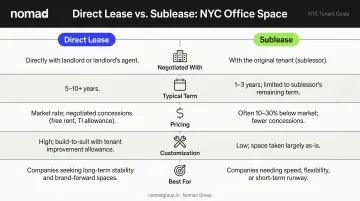
CBRE Q1 2025 data shows the Manhattan average asking rent at $77.46/SF, while the average sublease asking rent sits at $57.50/SF — a meaningful gap worth evaluating if your team's headcount trajectory is uncertain.
How NYC Rent Is Quoted
Not all asking rents are equivalent. Some landlords quote gross rent — all-in, including electricity, cleaning, and building services. Others quote base rent with electricity, cleaning, and operating expense escalations billed separately.
Always normalize listings to a total occupancy cost before comparing. A $75/SF gross lease and a $65/SF base rent lease can end up at the same number — or the gross lease can end up cheaper.
Timing: Start Earlier Than You Think
Most companies underestimate how long the NYC office leasing process takes. JLL's lease-renewal guidance advises tenants to begin discussions 18 to 24 months before lease expiration — a figure that holds up for complex searches or large footprints.
For smaller footprints and faster-growing companies, plan for at least 9–12 months before your target move-in date. Search, negotiation, lease execution, and build-out each take longer than expected — and they rarely overlap cleanly.
Key Factors That Affect Your NYC Office Search Results
The quality of a search outcome depends less on how many listings you view and more on how clearly you've defined the variables before you start.
Neighborhood and Submarket Selection
Flatiron, NoMad, and SoHo continue to attract tech and high-growth companies for specific reasons:
- Transit access and central location within the borough
- Building stock with architectural character
- Proximity to talent pools and peer companies
- Cultural alignment with growth-stage brands
Williamsburg has emerged as a strong alternative. Nomad Group has observed that Brooklyn Class A space can run approximately 40% below comparable Manhattan rents, with newer amenities and access to a distinct talent pool.
Midtown South as a whole is seeing momentum: Colliers reported Q3 2025 leasing demand of 4.29M SF, up 47.8% year-over-year. Inventory in high-demand Midtown South neighborhoods is tightening, which affects how quickly tenants need to move when they find the right space.

Lease Term and Flexibility
Shorter terms (1–3 years) carry a flexibility premium — landlords price uncertainty into the economics. Longer terms (5–10 years) unlock better TI packages and free rent, but require more confidence in headcount projections.
Fast-growing companies should model at least two or three headcount scenarios before committing to a term. A lease sized for 30 people becomes a problem when you close a Series B and need room for 60.
Build-Out Condition and Timeline
Three condition types, each with different cost and timeline profiles:
- Plug-and-play — furnished, move-in ready; fastest path to occupancy, least customization
- Pre-built — landlord-finished to a standard spec; faster than raw, some flexibility
- Raw/shell — full build-out required; most customizable, longest timeline
Nomad Group's in-house construction team has completed build-outs in as little as five weeks in cases where conditions aligned. Their standard 90-day build-out turnaround covers the construction phase; permitting, design, and landlord approval run separately before construction begins.
Common Mistakes When Browsing NYC Office Listings
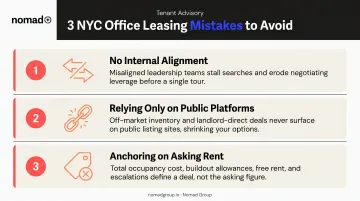
Three mistakes account for the majority of wasted time and suboptimal deals:
No internal alignment before touring. Leadership needs to agree on budget range, acceptable neighborhoods, and required square footage before the first tour. When a strong space surfaces, misaligned decision-makers slow the process — and in a competitive submarket, hesitation costs deals.
Relying only on public platforms. CoStar and LoopNet capture a portion of available inventory, not all of it. Sublease opportunities, pre-market listings, and direct landlord offerings frequently surface through broker networks before public posting. Tenants who skip that channel miss a meaningful slice of the market.
Anchoring on asking rent instead of total cost. An $85/SF listing with 12 months of free rent and a $100/SF tenant improvement allowance can cost less over the lease term than a $72/SF space with no concessions. Model the full economic package — not just the headline number — before comparing options.
When to Work With a Tenant Rep Broker in NYC
Tenant representation brokers work exclusively on behalf of the tenant. They're compensated by the landlord — meaning their services typically come at no direct cost to the tenant.
Three situations make a tenant rep broker especially worth it:
- Companies new to NYC — unfamiliar with submarket dynamics, building quality tiers, and how deals are structured
- Rapidly scaling teams — uncertain headcount makes lease term decisions complex, and off-market sublease access becomes more valuable
- Inventory-constrained neighborhoods — Flatiron, NoMad, and SoHo have limited high-quality available space; broker relationships determine who hears about it first
Nomad Group focuses specifically on this role for high-growth companies. With 300+ tenant buildouts completed and over 2 million square feet leased, they have deep relationships across Flatiron, NoMad, SoHo, Union Square, and Williamsburg.
Their Flex by Nomad model offers an alternative for companies that need move-in-ready space without a long-term commitment — a practical bridge between a coworking arrangement and a permanent headquarters.
Frequently Asked Questions
How much does office space cost per square foot in NYC?
Costs vary significantly by submarket and building class. Per Cushman & Wakefield Q4 2024 data, overall asking rents range from $55.54/SF in Downtown to $78.15/SF in Midtown, with Midtown South Class A averaging $94.99/SF. Total occupancy cost — which accounts for electricity, escalations, and operating expenses — will differ from the asking rent figure.
What's the difference between a direct lease and a sublease in NYC?
A direct lease is negotiated with the landlord for a defined term, typically 3–10 years, with full ability to customize the space. A sublease involves taking over space from an existing tenant — usually at below-market pricing and shorter terms, but with less flexibility to modify the build-out or negotiate lease structure.
How far in advance should I start searching for NYC office space?
Most companies should begin 9–12 months before their target move-in date to allow time for search, negotiation, lease execution, and build-out. Larger footprints or fast-growing teams with shifting headcount needs warrant 18–24 months, per JLL guidance — enough runway to avoid being forced into the wrong space.
Do I need a commercial real estate broker to find office space in NYC?
Tenant rep brokers provide access to off-market listings, deal structuring expertise, and negotiating leverage — and are typically compensated by the landlord, not the tenant. In NYC's inventory-constrained neighborhoods, that access and deal knowledge almost always produces a materially better outcome than going direct.
What NYC neighborhoods are best for tech startups and high-growth companies?
Flatiron, NoMad, SoHo, and Union Square are particularly popular due to transit access, building character, and talent proximity. Williamsburg has emerged as a strong option for companies prioritizing creative culture and competitive rents, with Brooklyn office demand increasingly mirroring Manhattan trends.
What is a letter of intent (LOI) in the NYC office leasing process?
An LOI is a non-binding document outlining the proposed key terms — rent, lease term, TI allowance, and free rent — exchanged after both parties agree on a preferred space, before legal counsel engages on the formal lease draft. It sets the framework that the full lease negotiation builds from.