For a scaling company, getting this decision wrong is expensive — not just financially, but operationally. A space that doesn't fit your growth trajectory, a lease structure you didn't fully understand, or a buildout that drags on for six months can set a business back in ways that take years to unwind.
This guide covers everything you need to walk into the process with clarity: the types of space available, how NYC lease structures actually work, what you'll really pay, how the leasing process unfolds step by step, which neighborhoods make sense for which companies, and the mistakes that consistently cost tenants the most.
Key Takeaways
- NYC office space comes in three formats (direct leases, subleases, and flex arrangements), each suited to a different growth stage
- All-in occupancy costs often run 15–25% above the asking rent per square foot once operating expenses are factored in
- The full leasing cycle — search to move-in — typically takes 6–12 months; starting late eliminates your negotiating leverage
- Tenant rep brokers are paid by the landlord, so expert representation costs you nothing out of pocket
- The costliest mistakes happen before signing — headline rent looks attractive until you factor in lease structure, TI allowances, and buildout timelines
Types of Commercial Space Available in NYC
Direct Leases, Subleases, and Flex
Each lease structure comes with different tradeoffs on cost, flexibility, and control. Here's how they compare:
| Lease Type | Typical Term | Avg. Asking Rent (NYC) | Best Fit |
|---|---|---|---|
| Direct lease | 5–10 years | $80.64/SF | Stable headcount, branded buildout |
| Sublease | 1–3 years | $58.54/SF | Fast move-in, furnished, below-market cost |
| Flex/managed | Month-to-month | Bundled pricing | Early-stage teams, uncertain headcount |
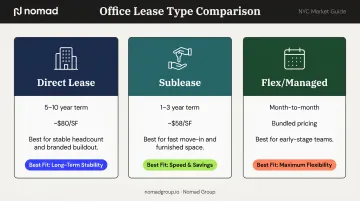
Rental data from Newmark's Q4 2025 Manhattan Office Market report
Direct leases are agreements made straight with the building landlord. They typically run 5–10 years and give you the most control over space design, TI allowances, free rent, and other concessions. For companies with stable headcount and a need for a purpose-built environment, direct leases deliver the most control.
Sublease space comes available when an existing tenant wants to exit early. These spaces are typically furnished, shorter-term, and priced well below direct market rates — Cushman & Wakefield reported Manhattan sublease supply at 13.5M SF in Q4 2025, down from its 2024 peak, meaning the best options are being absorbed quickly. For companies that need space fast without committing to a long-term build, subleases are worth prioritizing in your search.
Flex and managed office space — including Nomad Group's Flex by Nomad model — offers month-to-month access to fully operational spaces with services bundled in. NYC shared office inventory stood at 15.3M SF in Q1 2026 according to Hubble's NYC Office Report, roughly 2.6% of the total market. It's the right starting point when headcount projections are still in flux.
Raw vs. Plug-and-Play Space
The raw vs. pre-built distinction matters a lot for budgeting and timing:
- White box/raw space — unfinished, requires a full buildout. You get maximum customization but must account for architect fees, construction costs, and a longer timeline before you can occupy
- Pre-built or plug-and-play space — move-in ready, often recently renovated by the landlord. Faster to occupy and lower upfront cost, but less flexibility on layout and branding
For fast-moving companies, pre-built can compress the gap between lease signing and day one. Nomad Group has compressed buildout timelines to 90 days or less on many projects — including one Flatiron buildout that went from white box to fully operational in five weeks.
Understanding NYC Commercial Lease Structures
Full-Service Gross (FSG) Leases
The FSG lease is the simplest structure for tenants: one monthly number covers base rent, operating expenses, taxes, and utilities. The landlord absorbs those costs above the lease's baseline year.
FSG leases are common in Class A and Class B buildings across Midtown and Downtown Manhattan. They simplify budgeting — but don't assume the sticker price is your only exposure. The base year provision (more on this below) means costs can still escalate over the lease term.
Modified Gross Leases
Under a modified gross structure, the tenant pays base rent plus certain direct expenses — most commonly electricity. Some leases also shift janitorial costs or after-hours HVAC charges to the tenant.
Modified gross leases are frequent in older and prewar buildings, particularly in neighborhoods like SoHo, Flatiron, and the loft-style product that tech and creative companies tend to prefer. Before signing, clarify exactly which costs are your responsibility — the specific expenses that shift to tenants vary building by building.
Net (NNN) Leases
In a net lease, the tenant pays base rent plus a proportional share of property taxes, building insurance, and operating expenses. NNN leases are less common for NYC office tenants than in other markets, but they do appear in certain buildings. If you encounter one, scrutinize the escalation clauses carefully — your exposure to rising property taxes and operating costs can grow substantially over a 7–10 year term.
Base Year and Expense Stop Provisions
Few lease clauses carry more financial weight than the base year provision — and few get less attention during negotiations.
The base year is the reference year the landlord uses to set a baseline for operating costs and real estate taxes. In years after that baseline, if expenses rise above the base year amount, the tenant pays the difference on a pro-rata basis. NYC SBS defines tax escalations as rent increases tied to the landlord's actual increase in real estate taxes above that baseline.
Here's how the exposure builds in practice:
- Year 1: Costs match the base year — no escalation charge
- Year 3–4: Operating costs and taxes begin to drift above baseline; tenant absorbs the difference pro-rata
- Year 7: Compounded increases can add meaningful dollars per square foot annually on top of base rent
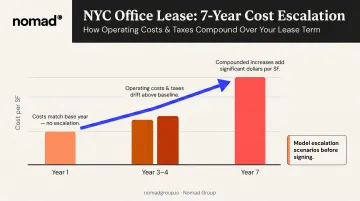
Model escalation scenarios before signing, not after. A 7-year lease in a building with rising NYC property taxes looks very different at renewal than at execution.
Rent Escalations and Free Rent
Most NYC office leases include annual rent escalation clauses — NYC SBS cites 3% as a common example. Free rent periods (rent abatement at the start of the lease) are typically offered as an incentive on longer-term deals.
That said, free rent is shrinking. CBRE reported that average free rent across 12 major U.S. markets including Manhattan fell to 8.9 months in 2024 from 9.6 months in 2023 — a signal that landlord concessions are tightening.
Always model total lease cost over the full term — not just the year-one asking rent. A lease that starts at $80/SF with 3% annual escalations looks very different in year seven.
What Renting Commercial Space in NYC Actually Costs
Current Asking Rents by Submarket
Based on Q4 2025 data, here's what the market looks like across major NYC office submarkets:
| Submarket | Overall Asking Rent | Class A Asking Rent | Availability |
|---|---|---|---|
| Midtown Manhattan | $79.79/SF | $84.98/SF | 13.3% |
| Midtown South | $89.13/SF | $105.64/SF | 17.8% |
| Downtown/FiDi | $59.05/SF | $61.24/SF | 18.0% |
| NoHo/SoHo | $102.07/SF | — | 12.9% |
| Brooklyn | $47.74/SF | — | 20.1% |
Sources: Newmark Q4 2025, Cushman & Wakefield Q4 2025, Colliers Q3 2025
Class B space in Midtown South and SoHo typically runs $15–25/SF below Class A asking rates, though that gap varies by building and condition.
The True Cost of Occupancy
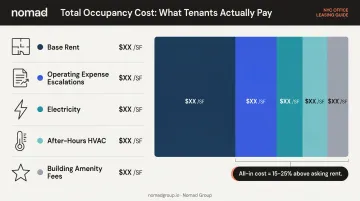
Asking rent is your starting point — not your total cost. Avison Young reported that the gap between Class A base rent and net effective rent in Manhattan reached $30/SF in Q2 2025 — meaning concessions and escalations create a wide divergence between what's advertised and what tenants actually pay over time.
Beyond base rent, budget for:
- Operating expense escalations above the base year (taxes, insurance, maintenance)
- Electricity — often excluded from FSG leases in older buildings
- After-hours HVAC — frequently billed separately in NYC buildings
- Building amenity fees — some newer buildings charge separately for conference space, fitness, or roof access
Tenant Improvement (TI) Allowances
A TI allowance is the landlord's financial contribution toward your buildout, expressed as a dollar amount per square foot. CBRE reported the average TI allowance across 12 major U.S. markets including Manhattan at $87.51/SF in 2024, down from $97.55/SF in 2023.
TI allowances are negotiable. The main factors that affect your position:
- Longer leases unlock higher allowances
- Stronger financials or a letter of credit gives landlords confidence to offer more
- In submarkets with high vacancy, landlords actively compete on TI to attract tenants
Security Deposits and Move-In Costs
NYC commercial security deposits vary widely based on tenant credit profile and lease length. NYC SBS notes deposits are commonly set at a few months of rent, with the specific amount dependent on tenant financial condition and whether a personal or corporate guaranty accompanies the lease.
Many NYC landlords prefer letters of credit over cash deposits, as they simplify accounting for both parties.
Beyond rent and deposit, first-year move-in costs typically include:
- Architect and space planning fees
- Real estate attorney fees for lease review
- Construction costs above the TI allowance
- Furniture, fixtures, and equipment (FF&E)
- AV and IT infrastructure
- Moving costs
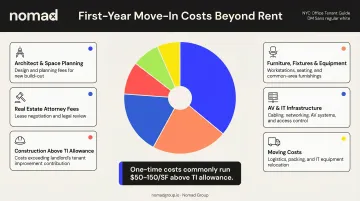
Budget for these as a separate line item from your annual rent obligation. For a full buildout, one-time costs commonly run $50–150/SF on top of the TI allowance, depending on scope and finish level.
Step-by-Step: The NYC Commercial Leasing Process
Step 1 — Define Your Requirements
Before you tour a single space, lock in the following:
- Current headcount and projected headcount at the end of the lease term
- Must-have physical requirements (private offices, conference rooms, open floor plan)
- Preferred neighborhoods and hard location constraints
- Maximum all-in annual occupancy budget
- Target lease start date and preferred lease length
Getting these wrong early means touring spaces that don't fit, losing weeks of runway, and making hasty compromises when your start date is looming.
Step 2 — Engage a Tenant Representative Broker
In NYC, tenant rep brokers are paid by the landlord through a commission, so you get expert representation at no direct cost. The value goes beyond access to listings: it's negotiation leverage, market intelligence, and exclusive advocacy for your side of the deal.
A broker with deep submarket knowledge brings deal flow, landlord relationships, and comparable transaction data that generic search platforms can't provide. Nomad Group's team, for example, has leased over 2 million square feet across NYC's high-growth neighborhoods — that kind of track record translates directly into better terms for tenants.
Step 3 — Tour and Shortlist
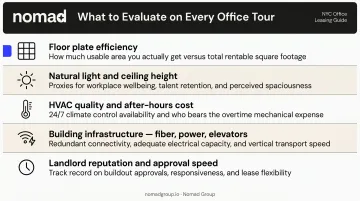
During tours, look beyond aesthetics. What actually matters:
- Floor plate efficiency — how much of your square footage is actually usable vs. lost to columns, irregular shapes, or shared corridors
- Natural light and ceiling height — especially important for talent recruitment and retention
- HVAC quality: confirm whether after-hours access carries additional cost
- Building infrastructure — fiber capacity, power redundancy, elevator ratios
- Landlord reputation: slow approvals and unresponsive management can push your move-in date by weeks
In competitive submarkets, speed matters. Come to tours with clear decision criteria so you can move quickly when the right space appears.
Step 4 — Submit a Letter of Intent (LOI)
An LOI outlines the essential deal terms: rent, lease length, TI allowance, free rent, commencement date, space size, and renewal options. It's not legally binding, but a well-constructed LOI sets the tone for everything that follows.
Tenants typically have the most leverage on: free rent periods, TI allowance amount, renewal and expansion options, and early termination rights. Get these right in the LOI before the formal lease document is drafted.
Step 5 — Negotiate and Execute the Lease
Never sign a commercial lease in NYC without a real estate attorney — separate from your broker — reviewing the document. Key clauses to negotiate beyond rent:
- Assignment and subletting rights — critical if your business is acquired or you need to downsize
- Early termination options — ideally tied to defined business milestones
- Expansion rights — the ability to take additional space in the building as you grow
- Personal guarantee limitations — "good guy" guarantees limit personal liability to the period the business actually occupies the space
Once the lease is signed, buildout begins. Companies working with Nomad Group's in-house construction management team have seen this timeline compressed to 90 days or less, which can mean months of rent savings compared to a delayed buildout.
Top NYC Neighborhoods for Commercial Office Space
Midtown South: NoMad, Flatiron, Union Square
This corridor — what Nomad Group calls "Unicorn Lane" — has become the defining address for high-growth tech, fintech, and AI companies in NYC. Midtown South posted 3.9M SF of leasing demand in Q2 2025, up 26.1% year-over-year, according to Commercial Observer, with average asking rent reaching $83.28/SF.
Recent notable signings tell the story: fintech company Chime took 84,000 SF at 122 Fifth Avenue; Pinterest signed 83,000 SF at 11 Madison Avenue; Samsung doubled its footprint to 71,000 SF at Penn 1. The corridor's appeal is straightforward:
- Exceptional transit access and walkability
- Dense amenity base (restaurants, gyms, coffee shops within steps)
- The talent signal a Flatiron or NoMad address sends to recruits and clients
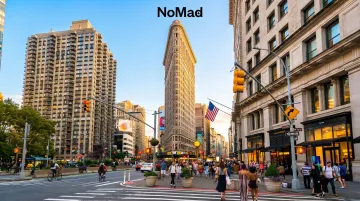
That combination is why Nomad Group has concentrated its deal flow here — clients including Authentic Insurance, Extend, and Nirvana Health have all been placed in buildings along or adjacent to this corridor.
Other Major Submarkets
| Submarket | Profile | Typical Asking Rent |
|---|---|---|
| Midtown Manhattan | Larger floor plates, Fortune 500 presence, conventional Class A | $80–$105/SF |
| Downtown/FiDi | More affordable, post-pandemic repositioning, good for cost-conscious tenants | $59–$65/SF |
| SoHo/NoHo | Creative loft product, attractive for design, media, and creative agencies | $100+/SF |
| Brooklyn/Williamsburg | Cultural appeal, lower costs, proximity to Brooklyn talent pools | ~$48/SF |
Before locking in a submarket, weigh these three factors:
- Commute patterns — where your team actually lives and how they get to work
- Address signal — what the neighborhood communicates to candidates and clients
- Building product — whether modern glass tower or prewar loft fits how your team operates
Mistakes to Avoid When Leasing Commercial Space in NYC
Three mistakes show up repeatedly — and each one costs tenants real money.
Starting the search too late. The full cycle from initial search to move-in takes 6–12 months for mid-size spaces. Companies that start six weeks before lease expiration lose all negotiating leverage and often settle for spaces that don't fit their growth trajectory. Begin 12–18 months before your current lease expires.
Anchoring to headline rent. Model total occupancy cost first — escalations, electricity, and after-hours HVAC included. A lower base rent in a building with a punishing base year structure or slow-approval landlord can cost more over the full term than a higher rate in a better building.
Going unrepresented (or using a dual-agent broker). NYC SBS confirms that brokers are paid by the landlord — so there's no financial reason to go it alone. The broker must represent tenant interests exclusively. Without that, tenants consistently leave value on the table in free rent, TI allowances, and lease flexibility provisions.
Frequently Asked Questions
How much does commercial office space cost per square foot in NYC?
Asking rents range from roughly $59/SF in Downtown/FiDi to over $105/SF in Midtown South Class A buildings. Midtown Manhattan averages around $80/SF. All-in occupancy costs — once operating expense escalations and utilities are factored in — typically run 15–25% above the asking rate.
What is a typical commercial lease length in NYC?
Most direct office leases run 5–10 years. NYC SBS classifies leases of 5 years or less as short-term, with longer-term deals running 10 years or more. Shorter terms (2–3 years) are available in subleases or smaller spaces, while longer commitments typically unlock higher TI allowances and more free rent months.
What's the difference between a gross lease and a net lease for NYC office space?
A gross (FSG) lease bundles rent and operating costs into a single payment, simplifying tenant budgeting. A net lease requires base rent plus a separate share of taxes, insurance, and operating expenses — carrying more variable cost exposure. FSG leases are more common in NYC office buildings; NNN structures appear less frequently.
Do I need a tenant rep broker to lease commercial office space in NYC?
Not legally required, but strongly advisable. Tenant rep brokers represent your interests exclusively, are compensated by the landlord, and bring market intelligence and negotiation power that unrepresented tenants lack. The cost to you is zero; experienced brokers routinely negotiate TI allowances and free rent months that far exceed their implicit cost.
How long does the commercial leasing process take in NYC?
From initial search to move-in, expect 6–12 months for mid-size spaces — covering search, negotiation, lease execution, and buildout. Larger spaces or complex buildouts can take longer. Companies should begin 12–18 months before their current lease expires to maintain negotiating leverage.
What is a tenant improvement allowance and how is it negotiated?
A TI allowance is a landlord-funded contribution toward buildout costs, quoted per square foot. CBRE reported the average at $87.51/SF across major U.S. markets including Manhattan in 2024. Lease length, tenant creditworthiness, and submarket vacancy all affect the number — higher vacancy generally means more landlord flexibility.