This is the lease term decision. It's one of the most consequential choices in the entire leasing process, affecting your flexibility, your cash exposure, and how much the landlord is willing to invest in your space.
This guide covers the typical range of commercial lease terms in NYC, how 3-, 5-, and 10-year options compare, what drives landlord concessions at each length, and the key clauses that interact with your term decision.
Key Takeaways
- NYC commercial office leases most commonly run 5 to 10 years, with 5 years as the most common starting point for direct leases
- Shorter terms (3 years or under) offer flexibility but come with minimal concessions — think paint and carpet, not a full buildout
- Longer terms (7–10 years) unlock meaningful TI allowances, free rent periods, and negotiating leverage
- Your funding runway, growth trajectory, and target submarket should all shape your decision
- Subleases and Flex by Nomad options exist for companies not ready for a direct lease commitment
How Long Are Commercial Lease Terms in NYC?
NYC commercial office leases typically range from 3 to 10 years. Manhattan landlords — particularly in Class A buildings in Midtown — frequently expect a minimum of 5 to 7 years for direct leases. The NYC Department of Small Business Services cites 10 years with a 5-year renewal option as a common benchmark.
Avison Young's Q2 2025 Manhattan market data puts the average direct relocation lease term at 121 months — roughly 10 years — weighted by deal size. That number shifts considerably depending on building class, landlord vacancy situation, tenant credit profile, and submarket.
Direct Leases, Subleases, and Flex Arrangements
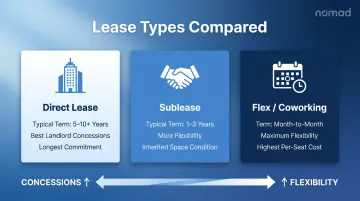
These three options represent very different commitment levels:
| Type | Typical Term | Key Trade-off |
|---|---|---|
| Direct lease | 5–10+ years | Longest commitment; best concessions |
| Sublease | 1–3 years (remaining term) | More flexibility; inherited space condition |
| Flex/coworking | Month-to-month | Maximum flexibility; highest per-seat cost |
The Post-Pandemic Submarket Shift
Midtown South neighborhoods — NoMad, Flatiron, SoHo — tell a specific story right now. After years of elevated vacancy, leasing demand in those submarkets hit 4.43 million SF in Q4 2025, the highest since 2019, with six consecutive quarters of positive net absorption. Availability has tightened to 13.7%, and landlords who were offering shorter terms to fill vacant floors a few years ago have less pressure to do so today.
Lease Commencement vs. Rent Commencement
Lease commencement is when the legal lease starts — the clock on your term. Rent commencement is when you actually start paying. Most NYC landlords grant a free rent period between the two, typically to allow time for buildout. On longer deals, this gap can run 3 to 12 months, which directly affects your cash outlay in year one.
Comparing 3-Year, 5-Year, and 10-Year Office Leases in NYC
Each term length suits a different business profile. Here's how they break down.
The 3-Year Lease: Maximum Flexibility, Minimum Leverage
A 3-year term works for early-stage startups, companies testing a new NYC market, or businesses with genuinely uncertain headcount trajectories. The exposure is limited — if the company shrinks or pivots, you're not trapped for a decade.
The cost of that flexibility: landlords in NYC rarely invest significantly in short-term tenants. On a 3-year deal, expect cosmetic improvements at best — fresh paint, new carpet, maybe some minor reconfiguration. A full custom buildout funded by the landlord is off the table when they can't amortize the investment over enough years.
There's also a renewal risk that catches companies off guard. When a 3-year lease expires in a tightening market, the landlord reprices to current rates with full leverage.
Add moving costs and buildout disruption, and the flexible short term can become unexpectedly expensive.
The 5-Year Lease: The NYC Sweet Spot
Five years is the most practical choice for growth-stage companies. It's long enough for landlords to offer real concessions, short enough that most companies can project their space needs with reasonable confidence.
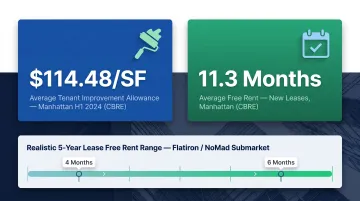
What does a 5-year deal look like today? Manhattan TI allowances averaged $114.48/SF in H1 2024, according to CBRE data. Free rent for new leases averaged 11.3 months over the same period — though that figure skews toward larger, longer deals. A 5-year deal in Flatiron or NoMad might realistically produce 4–6 months of free rent and meaningful TI dollars.
A common structure: a 5-year lease with a 5-year renewal option. This gives tenants the stability of a long commitment while building in a reassessment point. The renewal option doesn't obligate you to stay — it just protects your right to do so.
The 10-Year Lease: Stability and Maximum Concessions
Ten-year leases are best suited for established companies with stable headcounts and a clear long-term vision for their NYC presence. The math is simple: a landlord willing to invest $150–200/SF in your buildout needs the income security of a long term to justify it.
The risk for high-growth companies is real. A startup that signs a 10-year lease may find itself locked into space that's too small in year 3 or too large after a downturn.
Subleasing is an option, but it adds management burden and market risk. Early termination penalties in NYC commercial leases are typically severe — often requiring payment of all remaining rent obligations. Before committing to a decade, confirm your business has the revenue stability and headcount visibility to support it.
What a 10-year deal typically delivers:
- TI allowances at the high end of the market — often $150–200/SF or more for creditworthy tenants
- Extended free rent periods — sometimes 12–18 months on large, long-term deals
- Higher landlord investment in custom buildouts, which amortizes more easily over the term
What Factors Should Drive Your Lease Term Decision?
Growth Stage and Funding Runway
A pre-Series A company has almost no business signing a 10-year lease. Plan for 1.5x to 2x your current headcount over the lease term.
A practical example: a 15-person team evaluating a 5-year lease should assess whether the space can accommodate 25–30 people by year 5. If it can't — or if the company might shrink — that's a signal to either negotiate a shorter term, include an expansion option, or look at sublease arrangements.
Tie lease length to your realistic growth trajectory, not your optimistic one.
NYC Submarket and Building Type
Different neighborhoods have different landlord norms:
- Midtown Class A towers (Park Avenue, Grand Central area): trophy properties at $121/SF expect longer commitments and won't negotiate hard on term length.
- Midtown South (Flatiron, NoMad) has historically attracted tech companies and startups, and landlords in those buildings have shown more flexibility — though tightening availability is shifting that dynamic.
- SoHo loft buildings operate differently than Midtown towers. Smaller, private landlords may offer more flexibility on term in exchange for the right tenant.
Your target neighborhood shapes what leverage you actually have at the table.
The Concession Math
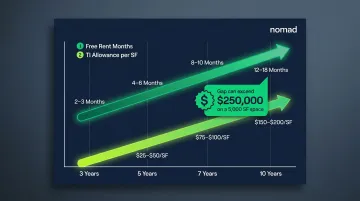
This is where the financial decision often gets made. A reliable benchmark: roughly one month of free rent per year of lease term. That means a 3-year deal might yield 2–3 months free; a 7-year deal could produce 7–9 months.
On a 5,000 SF space at $80/SF, that gap can easily exceed $250,000 in occupancy savings.
TI allowances scale similarly. The longer the term, the more dollars a landlord can justify putting into your space.
Nomad Group's tenant advisory team has completed 300+ buildouts and leased 2M+ SF across Flatiron, NoMad, and SoHo. That experience goes into helping companies model these scenarios before signing, so the term decision is driven by total occupancy cost — not just the monthly rent line.
Key Lease Clauses That Interact With Your Term Length
The term length doesn't exist in isolation. Several clauses change in importance depending on how long the lease runs.
Three Clauses That Matter Most
Renewal option — gives you the right (not the obligation) to extend at a pre-agreed formula. Most NYC leases require notice 6 to 12 months before expiration; renewal rent typically resets to fair market value, though tenants can sometimes negotiate a cap at 90–95%.
Early termination clause — allows an exit under defined conditions, typically after a minimum number of years plus a penalty payment. For growth-stage companies, this is one of the most valuable provisions to negotiate upfront — when you still have leverage.
Expansion option — gives you first right to adjacent space as the company grows, either as right of first refusal or right of first offer. Most relevant in 5-year and longer leases where headcount growth is probable but hard to predict.
Holdover Risk
If you stay in your space after lease expiration without executing a renewal, you convert to a holdover tenancy — typically at 150–200% of your prior monthly rent. On a short lease, the clock moves fast. Start renewal or relocation discussions 12–18 months before expiration. Wait too long and your negotiating position disappears — you're either absorbing the holdover premium or renewing at whatever the landlord asks.
Rent Escalation Structures
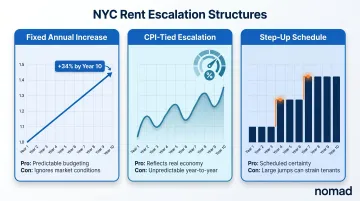
Fixed annual percentage increases are the most common structure in NYC, typically set at 3% per year. On a 3-year lease, that's manageable.
On a 10-year lease, compounding 3% annually means your year-10 rent is roughly 34% higher than year-1. The longer the term, the more carefully you need to negotiate your escalation structure. Common structures to understand before you sign:
- Fixed annual increase — typically 3% per year; predictable but compounds significantly over 10 years
- CPI-tied escalation — rent increases track inflation; lower in soft economies, higher when inflation runs hot
- Step-up schedule — rent jumps at specific years (e.g., year 4, year 7) rather than annually; useful for budgeting
Frequently Asked Questions
How long is a typical commercial lease term?
Nationally, commercial leases generally run 3 to 10 years, with 5 years as the most common benchmark. In NYC, direct office leases often skew toward 5–7+ years, particularly in prime Manhattan submarkets where landlords expect longer commitments from direct tenants.
What is the typical lease term for office space?
NYC office leases most commonly run 5–10 years for direct leases. Subleases run shorter — often 1–3 years — while flex and coworking arrangements can go month-to-month, covering the full spectrum of commitment levels.
What does '$10/SF/yr' mean in a commercial lease for a 2,500 SF space?
It's an annual per-square-foot rent quote: $10/SF/yr × 2,500 SF = $25,000/year, or roughly $2,083/month. NYC office rents are quoted this way but at far higher rates — Manhattan overall averaged $74.85/SF/year in Q4 2025, meaning a 2,500 SF space would run closer to $187,000/year in base rent.
Is a 10-year commercial lease a good term?
For established companies with stable headcounts and long-term NYC plans, a 10-year lease unlocks the best concessions and the most landlord investment in your space. For early-stage or high-growth companies whose space needs may shift significantly, it carries real risk.
What is a 99-year lease called?
A 99-year lease is commonly called a ground lease, where a tenant leases the land itself (often from a government entity or large landowner) and constructs a building on it. Rare in standard NYC office deals, they do appear in institutional and development transactions, including properties like 1407 Broadway.