Introduction
NYC commercial real estate is structurally hostile to early-stage companies. Landlords in Manhattan default to 5–10 year lease commitments, yet most seed or Series A startups can't responsibly forecast where they'll be in 18 months — let alone a decade.
Sign the wrong lease too early and you're either burning cash on empty desks or trapped in an expensive exit negotiation when the business pivots.
According to Belkin Burden Goldman, five years is the most common commercial lease term in Manhattan, with many landlords preferring 3–10 years depending on required buildout. Newer businesses frequently target 1–3 year terms to preserve flexibility—but even that range requires knowing what you're getting into.
This guide covers what "short-term" actually means in the NYC context, the office options available at each growth stage, the real costs beyond rent per square foot, and the lease terms every startup founder must negotiate before signing anything.
Key Takeaways
- Short-term commercial leases in NYC typically span 1–3 years, versus the standard 5–10 year direct lease
- Startups have four real options: subleases, managed/flex offices, coworking suites, and direct short-term leases
- Short-term costs more per square foot but protects runway and limits long-term financial exposure
- Critical negotiation points: personal guarantee structure, security deposit, early termination rights, and renewal options
- A tenant rep broker costs startups nothing (landlords pay the commission) and meaningfully reduces your leasing risk
What "Short-Term" Actually Means in NYC Commercial Leasing
The NYC Baseline Is Different
In most U.S. markets, a two-year lease reads as reasonable. In Manhattan, it reads as a problem. Manhattan commercial leases typically run 5–15 years, and most landlords in Midtown, Flatiron, and prime Brooklyn neighborhoods treat anything under three years as short-term—with the skepticism that label implies. At the negotiating table, a startup requesting a two-year direct lease signals limited operating history, uncertain growth, and higher landlord risk.
Direct Lease vs. Sublease
Two distinct paths exist for startups seeking short-term space:
- Direct lease: Signed with the building's landlord. More control, harder to get on short terms, more financial requirements upfront.
- Sublease: Signed with an existing tenant who has surplus space. The most accessible short-term route for most startups, often coming furnished and wired.
When the tech sector contracted sharply in 2022–2023, subleases flooded the NYC market and became the dominant short-term option for startups. As of Q2 2025, Manhattan sublease supply stood at 13.89 million square feet—down sharply from its 2023 peak but still representing significant availability for startups willing to move quickly on the right space.
Lease Structure Types
Once you know which path you're pursuing, the next question is how costs are structured. What you're paying—and what you're on the hook for—depends on lease type:
| Lease Type | Who Pays Operating Costs | Typical NYC Use Case |
|---|---|---|
| Gross / Full-Service | Landlord | Plug-and-play, coworking suites |
| Modified Gross | Split between parties | Subleases, mid-market direct leases |
| Net (NNN) | Tenant pays most costs | Rare for startup short-term deals |
For cost predictability, gross leases win. Modified gross leases are common in subleases but require careful review of what the operating expense passthrough actually includes.
The Holdover Risk
One overlooked danger: what happens if your lease expires and you haven't signed a renewal or vacated. NYC holdover provisions typically kick in at 150% or more of base rent—sometimes up to 2–3x. That's not a theoretical risk; it's a real cash event if your renewal timeline slips. Plan your exit or renewal at least six months before lease end.
Short-Term Office Options Available to NYC Startups
Startups have more options than they often realize—but each fits a different team size and growth stage.
The Spectrum of Options
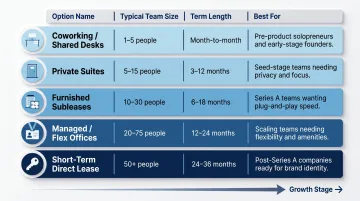
| Option | Typical Team Size | Term Length | Best For |
|---|---|---|---|
| Coworking / shared desks | 1–5 people | Month-to-month | Pre-product, bootstrapped |
| Private suites in coworking | 5–15 people | 3–12 months | Seed stage, testing headcount |
| Furnished subleases | 10–40 people | 1–3 years | Post-seed, needing more permanence |
| Managed/flex offices | 10–50 people | Flexible | Series A, wanting dedicated space without lease complexity |
| Short-term direct lease | 15+ people | 2–5 years | Post-Series A, culture and brand building |
Subleases: Still the Best Short-Term Value
The post-pandemic sublease wave created one of the most tenant-favorable markets in NYC's history. While supply has declined from its peak, sublease space in Midtown Manhattan is still often 20–40% cheaper than comparable direct space, according to NewYorkOffices.com.
Advantages:
- Pre-furnished and already wired — move-in ready
- Shorter terms with below-market rent
Risks:
- No permanent improvements allowed
- Term is capped by whatever remains on the prime lease
- You're exposed if the original tenant runs into financial trouble — always verify their stability before signing
Managed/Flex Offices: The Middle Path
For startups that need a private, professional environment without the complexity of a traditional lease, newer managed office products fill the gap. These go beyond standard coworking: dedicated, brandable space on flexible agreements with IT, furniture, and utilities handled by the operator.
Nomad Group's Flex by Nomad is built on this model — in-house infrastructure with on-the-ground access in Manhattan's core startup neighborhoods. It's designed for companies that want a sophisticated office without the financial exposure of a direct lease.
Direct Short-Term Leases: When to Make the Jump
A direct lease makes sense when your company hits roughly 15+ employees, has closed a Series A, and needs a space that reflects your culture and brand to employees and candidates. At that stage, landlords will typically require:
- Two years of financial statements or tax returns
- A personal guarantee from founders
- 3–6 months of security deposit (more for companies with limited history)
Below that threshold, a managed or flex option will almost always preserve more runway.
Understanding the True Costs of a Short-Term NYC Lease
The headline rent number is just the starting point. Most startups signing their first NYC lease underestimate total occupancy cost by a significant margin.
What's Actually in Your Monthly Bill
Beyond base rent, expect to budget for:
- Electricity: Separately metered in many buildings, adding $3–8/SF annually
- Annual escalations: Fixed percentage increases in Manhattan typically run 3–5% per year, per TWW NYC
- Operating expense passthroughs: In modified gross leases, you pay your pro-rata share of increases above the base year—if base year expenses are $15/SF and rise to $16/SF, a 10,000 SF tenant owes $10,000 annually in escalation costs alone
- Porter's Wage escalation: An NYC-specific mechanism tying rent increases to building staff labor costs—uncommon nationally, standard in many Manhattan leases
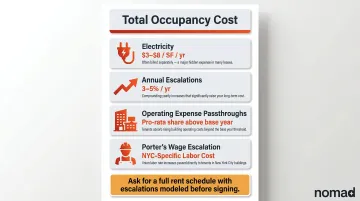
Ask for a full rent schedule with escalations modeled over the full lease term before signing anything.
Security Deposits: Cash vs. Letter of Credit
NYC commercial leases have no statutory cap on security deposits. Established businesses typically provide 3–6 months; startups without a profitability track record often face 6–12 months.
Two structures exist, and the choice directly affects your available cash:
- Cash deposit: Sits in the landlord's account, unavailable to you
- Letter of credit (LC): Bank-backed guarantee the landlord can draw on if you default—but you preserve cash. LCs typically cost 1–2% annually of the face amount
If you have investor capital but limited operating history, negotiate an LC over a cash deposit. Also push for a burn-down provision—a contractual reduction in the deposit amount after consistent, on-time payments in years two and three.
Personal Guarantees: The Most Consequential Term
A standard personal guarantee makes the founder personally liable for all rent through the end of the lease, regardless of what happens to the company. If the business fails in year two of a five-year lease, you owe the remaining three years personally.
Security deposits and personal guarantees are related risks — both tie the founder's exposure to the full lease term unless you negotiate otherwise.
The NYC-specific protection is the Good Guy Clause (Good Guy Guaranty). Under this mechanism, the founder's personal liability ends when the tenant vacates — provided they give 3–6 months' notice, stay current on rent through the surrender date, and leave the space in good condition. The business entity can still be sued for breaking the lease, and the security deposit is typically forfeited, but the founder's ongoing personal exposure stops at the exit date.
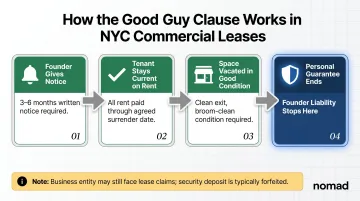
Always push for a Good Guy Clause.
TI Allowances on Short-Term Deals
Landlords amortize Tenant Improvement (TI) allowances over the lease term. On a two-year deal, there's almost no math that makes a significant TI allowance work for the landlord.
Short-term startup deals typically mean taking pre-built space as-is, or negotiating a modest rent-free period to self-fund minor improvements. If a landlord does offer TI, read the construction timeline obligations carefully — delayed delivery can push back your rent-free period in ways that affect your actual cash-in date.
Key Lease Terms Startups Must Negotiate
Early Termination Rights
Every startup lease should include a contractual early termination right. Standard structure: exercisable after a minimum lock-in period (typically 12 months), requiring 3–6 months' written notice, with a termination fee equal to 2–4 months' rent. Without this, a company that raises a large round and needs to expand (or one that downsizes) has no clean exit path outside of litigation or a costly buyout negotiation.
Assignment and Subletting Rights
Short-term leases don't insulate you from assignment issues — two scenarios make this term critical for startups:
- You raise more capital and want to move to larger space mid-lease
- You get acquired, and the acquirer needs to assume your lease
NYC landlords default to requiring written consent for any assignment or subletting. Push the lease language toward a "reasonable consent" standard rather than absolute landlord discretion. Without it, the landlord can block an acquisition close or hold you in space you've outgrown.
One caveat: if the lease is silent on subletting, New York courts generally permit it. Most landlord-form leases are not silent, though. Read before you assume.
Renewal Options with Rent Caps
Even on a two-year lease, negotiate a renewal option at a formula-based or capped rate. If your business grows into the space and relocation would be disruptive 24 months later, you want the right to stay at a known price—not at whatever the landlord decides the market supports.
In a market like NYC, where office rents in Flatiron or NoMad can jump 20–30% between lease cycles, skipping this term means your renewal rate is entirely at the landlord's discretion.
Best NYC Neighborhoods for Short-Term Startup Space
Where you put your office signals something to employees, candidates, and clients. Short-term doesn't mean defaulting to the cheapest available square footage. The neighborhoods below give you a starting frame for where short-term opportunities actually exist — and what each one costs.
The Core Startup Corridor
Midtown South (Flatiron, NoMad, Union Square) is the highest-density startup cluster in NYC. The Flatiron District is the birthplace of Silicon Alley, and the concentration of venture-backed companies along this corridor remains unmatched. Current asking rents run approximately $78–$100/SF/year in Flatiron.
Nomad Group has built much of its portfolio here — what they call "Unicorn Lane" — with deep market relationships and on-the-ground access across the corridor.
Notably, Colliers reported that Midtown South became the first Manhattan submarket to see supply levels fall below pre-pandemic levels as of mid-2025, meaning competition for quality short-term space in this corridor is tightening.
Neighborhood Comparison
| Neighborhood | Approx. Asking Rent | Best For |
|---|---|---|
| Flatiron / NoMad / Union Square | $78–$100/SF/yr | Tech, fintech, Series A+ |
| SoHo | ~$80/SF/yr | Design, media, consumer brands |
| Williamsburg | ~$48/SF/yr | Creative, early-stage, Brooklyn culture |
| Downtown Brooklyn | ~$43/SF/yr | Cost-conscious, Brooklyn-based teams |
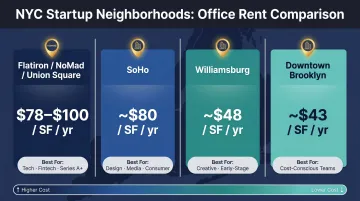
Williamsburg is a strong option for tech and creative startups that want competitive pricing and a product-first culture. Transit access is more limited than Manhattan — the L, G, and J/M/Z lines are the primary options — so map your team's commutes before committing.
Common Mistakes Startups Make with Short-Term Leases
Signing a Direct Lease Too Early
Pre-seed and seed-stage founders often equate a dedicated office with legitimacy and lock into a direct lease before they have the headcount to justify it. Below roughly 10–15 people, managed or flex options almost always deliver better capital efficiency. The space sits half-empty, rent eats runway, and the exit is expensive if the team grows faster—or slower—than projected.
Fixating on Rent Per Square Foot
Headline rent is the number that gets negotiated most aggressively and matters least in the full picture. Personal guarantee exposure, security deposit structure, annual escalations, and exit costs collectively can exceed the rent differential between options.
Model the full-term economics before comparing options:
- Rent through expiration
- Security deposit tied up as cash
- Annual escalations over the full term
- Estimated exit costs if you leave early
Going It Alone Without a Tenant Rep
NYC commercial leasing is a specialized discipline with information asymmetry built into every transaction. The landlord's broker has done this hundreds of times. A first-time startup founder hasn't.
A tenant's representative is compensated by the landlord—no direct cost to the startup—and brings market comparables, negotiating leverage, and transaction experience that changes outcomes.
Nomad Group works exclusively on the tenant side and has completed 300+ buildouts across NYC's startup neighborhoods. Engaging a rep early typically means better deposit terms, more exit flexibility, and a lease structure built around how early-stage companies actually grow.
Frequently Asked Questions
What is considered a short-term commercial lease in NYC?
In NYC, short-term typically means any lease under three years—compared to the market norm of 5–10 years. Unlike month-to-month arrangements or coworking memberships, short-term leases involve a direct agreement with a landlord or primary tenant.
What are typical lease terms for startups in NYC?
Short-term direct leases usually run 1–3 years; subleases typically span 6–24 months depending on what remains on the prime lease. Startups face stricter financial requirements than established tenants. A tenant broker helps calibrate what's realistic given current market conditions and a company's specific financial profile.
Can a startup get a commercial lease in NYC without a long operating history?
Yes, but it typically requires a personal guarantee from founders, a larger security deposit (often 6–12 months for companies with limited history), and financial statements demonstrating runway. Subleases and managed flex offices like Flex by Nomad have lower financial and documentation barriers to entry.
What is a "good guy clause" in a NYC commercial lease?
A Good Guy Clause limits a founder's personal guarantee to the period the company actually occupies the space. Triggering it requires adequate notice (typically 3–6 months), current rent payments, and a clean vacate. It's a NYC-specific protection and one of the most important terms a startup can negotiate.
What is the difference between a sublease and a direct lease in NYC?
A direct lease is with the building's landlord; a sublease is with an existing tenant who has surplus space. Subleases often offer shorter terms, furnished space, and below-market rent—but come with restrictions on alterations and dependency on the original tenant's financial health.
How much office space does a startup typically need per person in NYC?
Current benchmarks run roughly 75–150 square feet per person, depending on density and collaboration model. Hybrid teams averaging 60% daily attendance typically use a desk-sharing ratio of 1 desk per 1.3–1.5 employees, pushing toward the lower end of that range.