What makes NYC different from other markets isn't just the rent. It's how rent is quoted, what landlords expect from early-stage companies, and the city-specific structures — from Porter's Wage escalations to Good Guy Guaranties — that don't appear in generic leasing guides. A lease in NoMad or Flatiron looks fundamentally different from one in Austin or Chicago, and the generic advice founders find online often doesn't apply.
This guide covers the key categories of commercial lease terms NYC startups encounter: lease structures, cost components, flexibility provisions, and the term sheet process — so you can sit at the negotiating table knowing what's standard and what's worth pushing back on.
Key Takeaways
- NYC office leases are quoted in annual dollars per square foot — not monthly flat rates. Convert by multiplying rate × square footage ÷ 12.
- Most startups sign a modified gross lease — know which costs you're absorbing beyond base rent.
- TI allowance, free rent, and operating expense caps can be worth more than a lower base rent — and all are negotiable.
- Negotiate flexibility provisions (subletting, early termination, Good Guy Guaranty) upfront — not as afterthoughts.
- The term sheet (LOI) is where deals are made or lost — get the key terms right before attorneys start billing hourly.
Lease Structure Terms NYC Startups Must Know
The lease structure determines who pays for what beyond base rent. Get this wrong and your monthly burn looks very different from what you modeled.
Gross, Modified Gross, and Net Leases
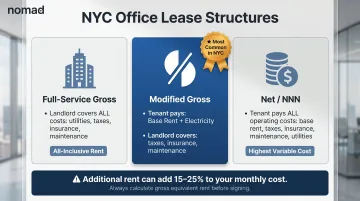
Full-service gross lease: One flat monthly rent covering base rent plus operating expenses — taxes, insurance, utilities, maintenance. Common in multi-tenant NYC office buildings, particularly older Class B stock.
Modified gross lease: The most common structure in NYC Class A/B office buildings. The tenant pays base rent plus specific costs — often electricity — while the landlord covers everything else. The exact split varies by building, which is why you need to read the lease carefully rather than assume.
Net leases (NNN): The tenant pays base rent plus all operating costs directly. Rare in NYC multi-tenant office. You'll see NNN in single-tenant retail and industrial contexts — not in Flatiron or NoMad office buildings. If a broker mentions NNN for a Manhattan office, ask questions.
In a modified gross lease, your "additional rent" obligations can add 15–25% to your monthly cost. A startup that models only the base rent figure will be unpleasantly surprised.
Lease Term Length and Renewal Options
NYC direct office leases typically run 5–10 years. Shorter terms (2–3 years) exist but carry a real premium — landlords amortize tenant improvement allowances and brokerage commissions over the lease term, so shorter deals mean smaller concessions and higher effective rents.
According to CBRE, the average U.S. office lease term has been declining, with AI firms now averaging just 3.5 years. That flexibility comes with a cost: fewer concessions and less landlord investment in your space.
Term length also shapes your leverage on renewal. A renewal option gives you the right to extend at lease expiration, either at a predetermined rent or fair market value.
In high-demand neighborhoods like Flatiron and SoHo, rents can spike significantly between your initial signing and renewal date. Locking in renewal terms at signing protects you from that exposure. NYC commercial landlords are not legally required to renew your lease unless a renewal option is explicitly negotiated.
Key renewal details to nail down at signing:
- Notice period required (typically 6–12 months before expiration)
- How renewal rent is determined (fixed increase vs. fair market value)
- Number of renewal periods available
The Cost Terms That Determine What You Actually Pay
The quoted rent is not your full cost. NYC leases layer multiple cost components on top of base rent, and startups that model only the headline number routinely underestimate their actual occupancy cost.
Base Rent, Additional Rent, and Per-Square-Foot Pricing
NYC commercial rents are quoted annually on a per-square-foot basis — "$75/SF/year," not a monthly number. To convert:
Annual $/SF × Rentable SF ÷ 12 = Monthly rent
So a 2,500 SF space at $75/SF/year = $187,500/year, or $15,625/month.
According to CBRE's Q1 2026 Manhattan data, average asking rents range from $57/SF/year Downtown to $82/SF/year in Midtown. Midtown South — covering NoMad, Flatiron, and Chelsea — sits around $80/SF/year for Class A space.
"Additional rent" covers everything the tenant owes beyond base rent: operating expense escalations, electricity charges, and other pass-throughs. In a modified gross lease, these appear as separate line items — don't mistake the base rent for the all-in number.
Operating Expenses and CAM Charges
Most NYC office leases use a base year structure: the tenant pays base rent in year one, then pays their pro-rata share of any increase in building operating costs above that base year amount. As building costs rise, your annual payment rises with them.
Office operating expenses have been running hot — data from AFIRE shows a 5.5% annual increase over a recent two-year period, well above the historical average of 3.6%. On a 5-year lease at 5.5% annual growth, operating expense pass-throughs can add $4–$8/SF to your effective rent by year five — a number worth stress-testing in your financial model before signing.
NYC also has a unique mechanism: Porter's Wage escalation, which ties rent increases to hourly wage increases for SEIU Local 32BJ building service employees. If you see this in your lease, understand that it's a variable tied to labor contracts, not CPI.
When reviewing operating expense provisions, watch for three things:
- CAM bundling: NYC office leases typically fold CAM charges into operating expenses rather than listing them separately — request a full itemized breakdown
- Expense caps: Push for annual caps on controllable expense increases (3–5% is a reasonable target)
- Audit rights: Negotiate the right to audit landlord expense records annually; overcharges are more common than most tenants expect
Those recurring cost controls set the floor on your ongoing occupancy cost. The next two items — TI allowance and security deposit — determine how much capital you need at the start.
Tenant Improvement Allowance and Security Deposit
TI allowance is cash the landlord provides to fund your buildout — expressed as dollars per square foot. It's one of the most negotiable and financially significant line items in any NYC lease.
The math matters here:
| Lease Term | Typical Manhattan TI Range | Basic Fit-Out Cost |
|---|---|---|
| 5 years | $25–$60/SF | $95–$140/SF |
| 7–10 years | $65–$120/SF | $140–$190/SF (standard professional) |
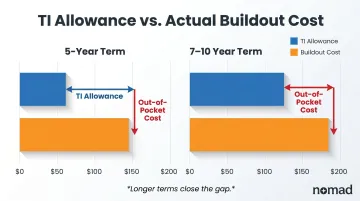
That gap between allowance and actual cost is out-of-pocket. A longer commitment closes it significantly. Working with a broker who has an in-house construction team helps you plan buildouts that deploy TI dollars efficiently — limiting the out-of-pocket gap before you sign, not after.
Security deposit: NYC landlords typically require 3–6 months of rent, but startups with limited operating history may face demands of up to 12 months. New York imposes no statutory cap on commercial security deposits.
The better structure for funded startups is a letter of credit (LOC) instead of cash. It preserves operating capital while giving the landlord the same security. Push for a burn-down provision — a clause that reduces the LOC amount at specified milestones (year 3, year 5) provided you're not in default. This is a standard concession in NYC and worth negotiating every time.
Flexibility and Exit Clauses That Protect Fast-Growing Companies
For a startup that could double headcount or pivot its business model within 18 months, flexibility provisions are often more valuable than a lower base rent. Most are negotiable — but only if you know to ask.
Subletting, Assignment, and Expansion Rights
Sublease rights allow you to lease unused space to a third party. Standard NYC leases prohibit subleasing without landlord consent, but you can negotiate "consent not to be unreasonably withheld, conditioned, or delayed" language. This protection matters if you downsize, get acquired, or need to exit before your term ends.
Watch for the landlord's recapture right — the ability to terminate the lease for the portion you want to sublet. This effectively negates your sublease option. Push back on recapture clauses where possible.
Right of First Offer (ROFO) requires the landlord to offer adjacent space to you before marketing it publicly. Right of First Refusal (ROFR) lets you match a third-party offer on neighboring space. Both are worth negotiating for growing companies — they can prevent a costly relocation when your headcount outgrows your current footprint.
Early Termination and Holdover Clauses
An early termination clause (sometimes called a kick-out clause) lets you exit before the lease term ends, typically in exchange for a penalty — often the landlord's unamortized TI costs plus several months of remaining rent. Push for this option to become exercisable after year 3 of a 5-year lease.
The holdover clause is the most commonly overlooked costly provision in NYC leases. If you stay in your space past lease expiration without a signed renewal or new agreement, NYC landlords can charge holdover rent at 150–200% of your prior monthly rent. Worse, if the landlord loses a new tenant because of your holdover, you may face liability for consequential damages.
Avoiding holdover is straightforward: start renewal or relocation planning at least 12 months before your lease expires, and put the expiration date on your calendar the day you sign.
Personal Guarantees and How to Limit Exposure
NYC landlords routinely require a personal guarantee from startup founders because the company entity — often a newly formed LLC — has no credit history or meaningful assets. The guarantee means if the company can't pay rent, you're personally on the hook. It's standard practice, but every element of it is open to negotiation.
Strategies to limit exposure:
- Good Guy Guaranty (GGG): A NYC-specific structure that releases the guarantor once the tenant provides 3–6 months of advance notice, vacates the space, and returns it broom-clean with all rent paid through surrender. It limits your personal liability to the notice period, not the full remaining term.
- Guarantee cap: Limit the personal guarantee to a set number of months (6–12) rather than the full remaining obligation.
- LOC substitution: Offer a larger letter of credit to reduce or eliminate the personal guarantee requirement.
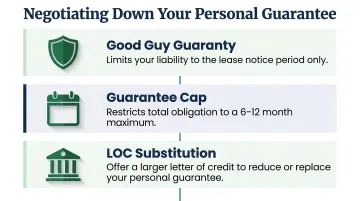
If a landlord presents a standard unlimited personal guarantee, the GGG structure is your most effective first counter — most NYC landlords familiar with startup tenants will accept it.
NYC-Specific Lease Dynamics Startups Often Overlook
Free Rent, Shell Conditions, and Restoration Obligations
Free rent periods are a standard landlord concession — particularly for longer-term leases or in buildings with availability. CBRE data from March 2025 shows the U.S. average free rent period was 8.9 months in 2024, down from 9.6 months in 2023. In Manhattan, a 5-year lease typically yields 3–6 months free; a 7–10 year deal may yield 6–12+ months. Free rent is often used to fund the buildout and meaningfully reduces your effective annual rent over the lease term.
Shell condition determines how much of your TI allowance goes toward base infrastructure versus actual finishes:
- Vanilla/white box shell: Finished drywall, HVAC distribution, drop ceiling with lighting, basic plumbing. TI funds go directly toward your fit-out.
- Warm/gray shell: Base building systems complete but no finishes. More TI needed for distribution and interior work.
- Cold/dark shell: Raw concrete, no electrical distribution, no HVAC. Most TI goes to infrastructure before a single desk is placed.
Don't compare two spaces on rent alone without knowing their shell condition. A lower-rent cold shell can cost more to occupy than a higher-rent vanilla box when you factor in buildout.
Restoration obligations require you to return the space to pre-lease condition at expiration — removing custom walls, built-in furniture, cabling, and finishes. For a custom buildout, this can reach tens of thousands of dollars in end-of-lease costs.
Negotiate a restoration obligation waiver, especially for improvements that enhance rather than degrade the space. Nomad Group's construction team, with 300+ tenant buildouts completed, factors restoration risk into buildout planning upfront, so you know exactly what you'll need to undo before you sign.
Reading Your Term Sheet Before the Formal Lease
The term sheet — also called a letter of intent (LOI) — is a non-binding 1–3 page document that captures the key economic and business terms before the formal lease is drafted. It's the most important document in the leasing process.
Whatever gets agreed in the term sheet becomes the baseline for the formal lease. If you didn't negotiate free rent, expanded sublease rights, or a Good Guy Guaranty in the LOI, adding them later means restarting negotiations after attorneys are already billing hourly.
What a Startup's Term Sheet Should Include
A comprehensive NYC office term sheet should cover:
- Rentable square footage and floor/suite description
- Base rent and annual escalation rate (3%/year is typical in NYC)
- Lease commencement date and term length
- Tenant improvement allowance amount (per SF)
- Free rent period (number of months, and whether partial or full abatement)
- Security deposit/LOC amount and any burn-down schedule
- Operating expense structure (base year, expense stops, what's included)
- Renewal and expansion options (notice periods, rent determination method)
- Sublease and assignment rights (consent language, recapture provisions)
- Personal guarantee structure (full, capped, or Good Guy Guaranty)
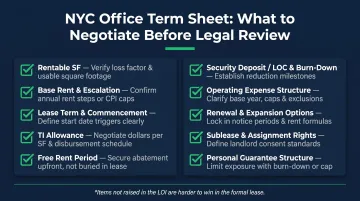
Each of these items is negotiable — but only if you raise them before the formal lease is drafted. Most founders treat the term sheet as a formality and sign the landlord's first draft without pushback. By the time attorneys are engaged, the window to move on free rent periods, TI allowances, or guarantee structure has largely closed. Nomad Group works with NYC startups on term sheet strategy before legal review begins, drawing on deal history across specific buildings and neighborhoods to know what landlords will actually move on.
Frequently Asked Questions
What does $10 per sq ft per year mean in a commercial lease?
It means the annual rent rate is $10 for each square foot of rentable space. Multiply the rate by your total square footage and divide by 12 to get your monthly cost. For context, NYC office rents typically run $57–$82+/SF/year across most submarkets, so $10/SF is a formula illustration, not a realistic Manhattan figure.
What is a term sheet for a lease?
A term sheet (or letter of intent) is a non-binding summary of key deal points — rent, lease term, TI allowance, free rent, security deposit — agreed before the formal lease is drafted. It's the first document a startup signs and sets the baseline for everything that follows.
What should a term sheet include?
A strong term sheet should cover:
- Base rent and escalation schedule
- Lease start date and term length
- TI allowance and free rent period
- Security deposit structure
- Operating expense responsibilities
- Renewal, expansion, and subletting rights
- Personal guarantee terms
Missing any of these creates negotiating gaps when the formal lease is drafted.
Is there a minimum term for a commercial lease?
No legal minimum exists — terms are set by agreement. In NYC, most direct office leases run 3–10 years. Shorter terms are available but typically carry higher per-square-foot rents and fewer landlord concessions. Flexible or month-to-month arrangements are available through coworking and flex office solutions like Flex by Nomad.
Can I walk away from a commercial lease?
Walking away without an early termination clause exposes the company and any personal guarantor to significant liability — typically the full remaining rent balance. Options that limit exposure include negotiating a buyout, subleasing the space, or invoking a Good Guy Guaranty if one was negotiated at signing.
What are the most common clauses in a commercial lease?
The core clauses to know:
- Base rent and escalation
- Operating expense pass-throughs
- TI allowance and security deposit/LOC
- Use clause and subletting/assignment rights
- Personal guarantee and renewal options
- Early termination, holdover provisions, and alterations/restoration obligations