That gap is expensive. Commercial leases carry no standard statutory protections for tenants. New York commercial tenants are treated as sophisticated parties, meaning the written document is essentially the only safeguard you have — so what you don't negotiate, you don't get.
This article breaks down the key commercial lease terms across three functional categories: financial (what you actually pay), protective and structural (what rights and flexibility you have), and buildout (what condition the space is in and who funds the work). Understanding each category before any offer is made is what separates a workable lease from a costly one.
Key Takeaways
- Commercial leases are fully negotiable — the landlord's first draft is a starting position, not a final offer
- Financial terms like base rent, lease type, and CAM charges determine your true monthly cost beyond the headline number
- Protective clauses like renewal options, subletting rights, and holdover provisions define your flexibility when circumstances change
- Buildout terms including tenant improvement allowance and space condition type directly affect your upfront capital requirements
- In NYC's office market, tenants signing multi-year leases have real negotiating leverage on most of these terms
What Is a Commercial Lease Agreement?
A commercial lease is a legally binding contract between a landlord (lessor) and a business tenant (lessee). It grants the right to occupy commercial space for a defined term in exchange for rent — and governs far more than that: operating costs, improvements, maintenance, and risk allocation across the entire lease term.
The critical difference from residential leases: commercial tenants receive minimal implied protections under New York law. The NY Attorney General's residential tenants' rights guide makes clear that residential tenants have an implied warranty of habitability that cannot be waived — no equivalent protection exists for commercial tenants. Your rights depend almost entirely on what's written in the document.
Key Parties and Documents
Before a formal lease is drafted, most deals begin with a term sheet or letter of intent (LOI). As Hodgson Russ describes it, the LOI sets the stage for the lease by identifying key terms — premises, rent, and buildout responsibilities — before attorneys begin drafting. This is where the real negotiation happens.
Key parties to know:
- Lessor — the landlord or property owner
- Lessee — the business tenant
- Guarantor — a person or entity that personally backstops the lease obligations (often required for early-stage companies)
Get a commercial real estate attorney to review the final lease before you sign — this is non-negotiable.
Financial Terms in a Commercial Lease
Base Rent
Base rent is the fixed monthly amount paid to occupy the space, typically quoted per square foot per year in NYC. According to Cushman & Wakefield's Q1 2025 Manhattan market report, the overall Manhattan asking rent was $71.84 per square foot, with Class A space averaging $80.78 per square foot. Midtown South commanded even higher rates — CBRE's March 2025 figures show an average asking rent of $84.42 per square foot in that submarket.
Base rent is rarely your total cost. What gets added on top depends entirely on the lease structure.
Lease Types
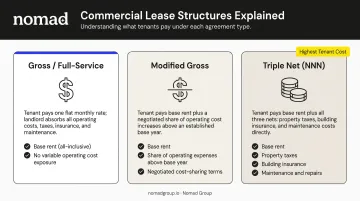
| Lease Type | What the Tenant Pays | Common In |
|---|---|---|
| Gross / Full-Service | One flat rate; landlord covers taxes, insurance, utilities, maintenance | Multi-tenant office buildings |
| Modified Gross | Base rent + tenant's share of increases above a base year | NYC office, multi-tenant buildings |
| Triple Net (NNN) | Base rent + property taxes, insurance, and maintenance | Single-tenant retail and industrial |
Most NYC multi-tenant office leases use a gross or modified gross structure. Under a modified gross (sometimes called a base-year lease), the landlord covers most operating costs but the tenant pays its pro-rata share of increases above the base year. This matters: if operating costs rise significantly after year one, so does your effective rent.
CAM Charges
Common Area Maintenance charges are fees passed through to tenants to cover costs of maintaining shared building spaces. Typical inclusions, per commercial real estate law firm Lowndes, include:
- Real estate taxes and building insurance
- Utilities for shared spaces (lobbies, hallways, elevators)
- Janitorial services and security
- Property management fees
Each tenant pays a pro-rata share based on their portion of the building's total rentable area.
Two protections to negotiate into every lease:
- An annual cap on CAM increases that limits how much landlord-controlled expenses can rise year over year
- An audit right that lets you review the landlord's operating expense statements
Rent Escalation
Rent escalation clauses define how base rent increases over the lease term. Common structures include fixed annual percentage increases, CPI-linked adjustments, or step increases at defined intervals. The compounding effect of annual escalations over a five- to seven-year term can add substantially to total occupancy cost — model this before signing.
Security Deposit
Security deposits in NYC commercial leases are held in trust and, per Akerman's commercial lease law reference, New York has no specific statutory timeline governing return of commercial deposits. Early-stage companies with limited credit history often face higher deposit demands.
A letter of credit (LOC) arrangement, where a bank issues a standby letter instead of cash, is a common alternative that preserves working capital.
Protective and Structural Lease Clauses
Lease Term and Renewal Options
Commercial office leases in NYC typically run three to ten years, with longer terms providing more negotiating leverage on rent and tenant improvement allowances. The tradeoff is flexibility.
Renewal options give tenants the right — not the obligation — to extend the lease at a pre-agreed formula. These must be explicitly negotiated into the lease and exercised within a specific notice window.
Courts strictly construe these deadlines: a missed notice date can mean losing the option entirely. Most leases require renewal notice between six and twelve months before expiration, so tracking these dates is non-negotiable.
Subletting and Assignment
These are two distinct rights that are often lumped together:
- Subletting — you lease some or all of your space to a subtenant but remain liable to the landlord under the original lease
- Assignment — full transfer of your lease obligations to a new tenant; the original tenant is generally released
Cozen O'Connor notes that modern commercial leases commonly restrict both and require landlord consent. For high-growth companies whose headcount can shift dramatically within a five-year term, negotiating broad subletting rights upfront is one of the most valuable protections you can secure.
Other Protective Clauses
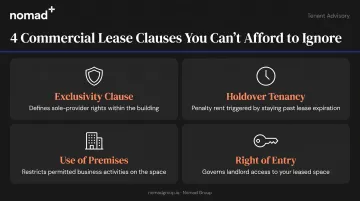
Four clauses that often get overlooked — and cost tenants when they do:
- Exclusivity clause: Your right to be the sole provider of a specific product or service in the building. More common in retail, but relevant in shared office buildings. Define the scope precisely — vague exclusivity language is hard to enforce.
- Holdover tenancy: Staying past lease expiration without a signed renewal triggers penalty rent, typically on a month-to-month basis. The rate is punitive by design. Start renewal conversations well before your notice deadline.
- Use of premises clause: Specifies what the space can legally be used for. Draft this broadly. Companies that pivot mid-lease have been caught by narrow use clauses requiring landlord consent — and renegotiation — just to accommodate business changes.
- Right of entry: Governs when and how the landlord can access the space. This is negotiable in commercial leases; tenants can push for advance written notice requirements.
Buildout and Space Condition Terms
Understanding the condition of a space before you make an offer changes your cost model entirely.
Space Condition Types
| Condition | What's Included | Implication |
|---|---|---|
| Cold Dark Shell | Bare concrete, no HVAC, plumbing, or finishes | Lowest base rent; highest buildout cost |
| Vanilla Shell / Whitebox | HVAC, basic electrical, restrooms, ceilings installed | Closer to move-in ready; higher base rent |
| Second-Generation Space | Previously occupied; existing buildout may transfer | Lowest effective buildout cost |
The true cost of occupying a space can vary by hundreds of thousands of dollars depending on which condition you're starting from.
Tenant Improvement Allowance (TIA)
A TIA is a per-square-foot cash contribution from the landlord to help fund the tenant's buildout. According to Colliers' H1 2025 Manhattan data, the combined weighted value of TIA plus free rent for new Manhattan deals was $230.56 per square foot — down 11.1% from 2024 but still 46.7% above pre-pandemic levels.
Key TIA mechanics to understand:
- Negotiation leverage: Longer lease terms typically yield higher TIA offers
- Disbursement: Usually reimbursed after work is completed or drawn against invoices, not paid upfront
- Ownership: Improvements funded by TIA are typically permanent alterations that become the landlord's property at lease end
Tenant Inducements and Leasehold Improvements
Beyond TIA, landlords may offer broader tenant inducements to attract quality tenants: free rent months, moving allowances, turnkey improvements, or cash contributions toward relocation costs. In slower markets or for tenants with strong credit, these are negotiable.
One distinction that matters at lease end is the difference between leasehold improvements and trade fixtures:
- Leasehold improvements (flooring, built-in cabinetry, wiring, walls) are generally permanent and become the landlord's property at lease end
- Trade fixtures are removable items the tenant installed for business use, such as equipment and technology hardware, and typically remain the tenant's property
The lease should clearly define which category applies to what. Disputes at exit get expensive fast.
For companies navigating a buildout in NYC, Nomad Group's construction team has completed 300+ tenant fit-outs across Manhattan, with a typical 90-day turnaround. That includes coordinating directly with landlords on TIA disbursements — so clients aren't chasing reimbursements while construction is underway.

Common Misconceptions to Watch Out For
"The lease as presented is the lease." It isn't. Commercial leases are negotiable documents — the landlord's initial draft is a starting position. Tenants who sign without negotiating often accept unfavorable CAM caps, narrow use clauses, or insufficient TIA amounts that cost significantly more over the full term.
"The listed rent per square foot is what I'll pay." The per-square-foot figure on a listing rarely reflects true occupancy cost. Your actual cost includes:
- Operating expense pass-throughs and CAM charges
- Annual escalations compounded over the full term
- TIA shortfalls and security deposit carrying costs
- Buildout expenses not covered by the allowance
Always model total occupancy cost over the full lease term before comparing spaces.
"Subletting and assignment rights are secondary." For scaling companies, they're not. These provisions — along with termination options and renewal rights — are often negotiated away or left vague in the final document. A company that grows from 40 to 150 people in three years, or contracts after a restructuring, needs these protections in place before they're needed. Treat them as primary, not supplementary.
Frequently Asked Questions
What are typical commercial lease terms?
NYC commercial office leases typically run three to ten years — five to seven years is most common for mid-sized tenants. Shorter terms offer flexibility but come with higher per-square-foot rent and fewer concessions, while longer commitments give tenants more leverage on rent, TIA, and other deal terms.
What is the 90% rule in leasing?
The 90% rule is an ASC 842 accounting standard: per PwC's lease accounting guidance, if lease payments equal 90% or more of the asset's fair value, the lease is classified as a finance lease rather than an operating lease. It's an accounting criterion — not a commercial lease negotiation term.
What is the difference between a gross lease and a net lease?
In a gross lease, the tenant pays one flat rate and the landlord covers operating costs. In a net lease, the tenant pays base rent plus some or all operating costs — taxes, insurance, and maintenance — separately. Most NYC office leases use a modified gross structure where certain expense increases above a base year are shared.
What is a tenant improvement allowance in a commercial lease?
A TIA is a per-square-foot landlord contribution toward the tenant's buildout, negotiated as part of the lease and typically disbursed as reimbursement after work is completed. Funded improvements are generally treated as permanent alterations and revert to the landlord at lease end.
Can you negotiate a commercial lease?
Yes — commercial leases are fully negotiable. Unlike residential leases, they carry no standard tenant protections, so every term including rent, TIA, CAM caps, exclusivity, subletting rights, and renewal options can and should be negotiated before signing.
What does CAM mean in a commercial lease?
CAM stands for Common Area Maintenance — fees passed through to tenants to cover shared building spaces such as lobbies, hallways, and parking areas. Tenants should negotiate an annual cap on CAM increases and the right to audit CAM expense statements to verify accuracy.
Conclusion
Commercial lease terms fall into three practical categories: financial (what you pay), protective and structural (what flexibility and rights you have), and buildout (what condition the space is in and who funds the work). Understanding each category before negotiations begin is what separates a favorable lease from an expensive one.
For high-growth companies navigating NYC's competitive office market, knowing the terminology is only half the equation. An experienced partner who can interpret these terms, model true occupancy costs, and negotiate on your behalf is what converts that knowledge into a better deal. Nomad Group works with scaling companies across Manhattan's most active neighborhoods — from Flatiron and NoMad to SoHo and Union Square — handling tenant representation, construction management, and ongoing space operations as a single integrated team.