This guide is built for startups and scaling companies navigating their first or second NYC office lease. Whether you're looking at Flatiron, NoMad, SoHo, or Williamsburg, the negotiation principles are the same — but the details matter enormously. Here's what to know before you sign anything.
TL;DR: NYC Commercial Lease Negotiation Checklist at a Glance
- Know your leverage — vacancy rates vary sharply by submarket, and that affects every concession you can extract
- Calculate total occupancy cost — base rent is just the starting point; escalations, operating expenses, and NYC-specific charges add up fast
- Match lease term to your growth trajectory — too short limits TI allowance; too long locks you in past your growth curve
- Negotiate TI allowance before signing — get contractor bids first and push to cover both hard and soft costs
- Watch for red flags — uncapped escalations, vague make-good language, and personal guarantees without burn-down provisions
Before You Negotiate: Understanding Your Leverage in the NYC Market
Your negotiating position depends heavily on where you're looking and when.
Manhattan office availability fell to 16.4% in Q2 2025 — the lowest in four years — but the submarket divergence is striking. Hudson Yards sits at 9.0% availability while Times Square is at 22.8%. Downtown is at 19.3%. That spread matters: a tenant targeting a high-vacancy node has meaningfully more leverage than one competing for space in a tight corridor.
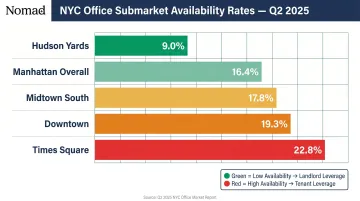
For Flatiron, NoMad, and SoHo — core neighborhoods where firms like Nomad Group concentrate their deal activity — use Midtown South's 17.8% availability as a directional proxy, then verify building-level availability on specific targets.
Clarify Your Space Requirements First
Knowing your market position only helps if you've done the internal work first. Before touring any space, establish:
- Current headcount and projected headcount at 12, 24, and 36 months
- Required square footage — using a planning density of 140–165 rentable square feet per person is a reasonable post-pandemic benchmark
- Preferred neighborhoods and any non-negotiables (transit access, building class, floor preference)
- Hard budget — including all-in occupancy cost, not just base rent
Know the Difference Between Rentable and Usable Square Footage
NYC commercial leases quote rent on rentable square footage (RSF), which includes a "loss factor" covering shared building areas — lobbies, corridors, mechanical rooms. In Manhattan, loss factors typically run 27–40%, with multi-tenant floor layouts skewing toward the higher end.
That means a space quoted at 5,000 RSF might deliver only 3,500–3,700 square feet of actual usable space. At $80/sf/yr, that's a meaningful overpayment if you don't account for it upfront. Always ask for the building's measurement standard and model your rent on both usable and rentable figures.
Understand NYC Lease Types Before You Start
Three structures dominate NYC office leasing:
- Gross/full-service lease — landlord covers operating expenses; tenant pays a flat rent. Most common for office space in Manhattan
- Modified gross lease — tenant pays base rent plus some operating expenses (often electricity). Common in older buildings and some Midtown South product
- Net lease — tenant pays base rent plus all or most operating costs directly. Less common for standard office, more typical in ground-floor or retail configurations
Knowing which structure you're walking into determines what's negotiable and what's already baked in.
Engage a Tenant Rep Broker Early
Landlords almost always have professional representation. Walking into a negotiation without your own broker is a structural disadvantage — you're negotiating against someone who does this daily and has closed hundreds of deals in your target building.
A good tenant rep broker brings market comparables, building-specific intelligence, and negotiating experience. In NYC, broker commissions are typically paid by the landlord, meaning this representation costs you nothing directly.
Nomad Group works exclusively on the tenant side, with concentrated deal activity in NoMad, Flatiron, and SoHo — the neighborhoods where many high-growth companies land. Having closed 2M+ square feet across NYC, their brokers know which landlords are negotiating hard and where there's room to move.
Understanding Rent Structures and NYC-Specific Costs
"Rent" in an NYC commercial lease is rarely just the number on the listing. Budget for every component below or you'll get surprised mid-term.
Base Rent and How NYC Pricing Works
NYC commercial office rent is quoted annually, per rentable square foot. To calculate your monthly cost:
Annual rent per RSF × Total RSF ÷ 12 = Monthly rent
Example: 3,000 RSF at $78/sf/yr = $234,000/year = $19,500/month
Current market benchmarks for Q2 2025:
| Submarket | Avg. Asking Rent |
|---|---|
| Manhattan overall | $76.70/sf |
| Midtown | $82.73/sf |
| Midtown South | $78.21/sf |
| Downtown | $66.90/sf |
| Trophy buildings | $111.06/sf |
| Class B/C | $60.87/sf |
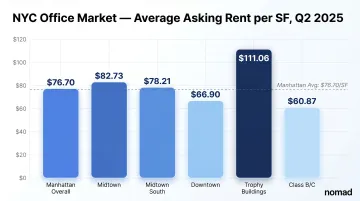
Price your initial offers on net effective comparables, not face rates — the gap between the two averaged $30/sf for Class A space in Q2 2025.
Annual Rent Escalations
Most NYC leases include a fixed annual escalation, commonly around 3% per year. On a 7-year lease, that compounds significantly. A tenant starting at $20,000/month at 3% annual escalation pays over $24,600/month by year seven.
Push for:
- Fixed escalations of 2–3% annually (not CPI-only, which is unpredictable)
- A cap if CPI indexing is used
- Clarity on whether escalations apply to base rent alone or the full occupancy cost
Operating Expenses, Real Estate Taxes, and Porter's Wage
NYC leases typically include three additional pass-through mechanisms tenants must understand:
Operating expense escalations — The lease sets a "base year" for operating costs. Each year actual expenses exceed that baseline, you pay your proportionate share of the increase. Push for the most favorable base year possible (a high-expense year works in your favor) and negotiate a cap on controllable cost increases.
Real estate tax escalations — Same structure: you cover your share of tax increases above the base year amount. NYC property taxes have climbed steadily, so this provision deserves close review.
Porter's Wage clause — This ties certain operating cost escalations to the hourly wage schedule of unionized building service workers under the SEIU 32BJ collective bargaining agreement. A 2026 tentative agreement added $4.50/hr over the agreement term. Model all three pass-throughs in any multi-year occupancy cost analysis.
Free Rent and Security Deposits
Once you understand the full cost structure, the next step is securing concessions that offset it. Free rent and favorable deposit terms are among the most negotiable elements in any NYC office deal.
Free rent: NYC landlords routinely offer rent abatement periods — particularly during buildout. General market guidance by term length:
- 3-year term: 1–2 months free
- 5-year term: 3–6 months free
- 7–10-year term: 6–12+ months free
Always ask for a free rent period during construction. This is one of the most negotiable elements in any NYC office deal.
Security deposits: Expect landlords to request 3–6 months from established tenants and 6–12 months from early-stage companies. Letters of credit are often preferred over cash. Negotiate the deposit size based on your financial profile and push for a burn-down provision tied to on-time payment history.
Lease Term, Renewal Options, and Exit Flexibility
Lease term isn't just a duration — it's a strategic decision that affects your rent, TI allowance, flexibility, and risk exposure.
Choosing the Right Lease Term
| Company Stage | Typical Term | Trade-offs |
|---|---|---|
| Solo/early (1–5 people) | 1–3 years | Maximum flexibility, minimal landlord investment |
| Startup/small team | 3–5 years | Balance of flexibility and concessions |
| Mid-size (20–75 people) | 5–7 years | Lower effective rent, meaningful TI allowance |
| Enterprise | 7–15 years | Best economics, highest commitment |
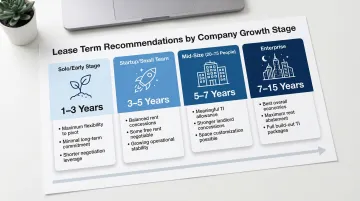
For VC-backed companies, the tension is real: a 3-year term limits the TI allowance a landlord will offer, but a 7-year term is a long time when your headcount or strategy could shift dramatically. One practical solution: negotiate a longer term with a built-in early termination right.
Renewal Options and Early Termination Rights
Renewal options give you the right — not the obligation — to extend at a pre-agreed structure. When negotiating, nail down:
- Number of options and duration of each
- Notice deadline (typically 9–12 months before expiration)
- Whether renewal rent is tied to fair market value, a fixed increase, or CPI with a cap
Early termination clauses (also called kick-out clauses) let you exit before term expiration by paying a predetermined fee — typically several months' rent plus unamortized landlord costs. For fast-growing or VC-backed companies, this clause is essential protection against outgrowing your space at year three of a seven-year lease.
A right of first offer (ROFO) on adjacent or contiguous space gives you priority access to expand without relocating. Worth noting: a poorly drafted ROFO can create obligations rather than options, so get your attorney to review the language closely.
Tenant Improvement Allowance and Buildout Rights
Very few NYC commercial spaces come move-in ready. Most require some level of buildout, and the tenant improvement (TI) allowance is the landlord's contribution toward making the space functional.
Negotiating a Sufficient TI Allowance
TI allowances are quoted as a dollar amount per rentable square foot. Manhattan averages reached $128/sf in 2023 before easing in 2024. Broker guidance by term:
- 5-year term: $25–$60/sf (raw space)
- 7–10-year term: $65–$120/sf (raw space)
Second-generation spaces (already built out) typically command lower allowances than raw shell or white-box space — plan your ask around the space's actual condition.
Before agreeing to any TI figure:
- Get independent contractor bids for your actual buildout scope
- Negotiate the right to apply the allowance to both hard costs (construction) and soft costs (architecture, permits, project management)
- Clarify the disbursement timeline — some landlords pay upon completion; others reimburse in draws
Nomad Group's construction management team has completed 300+ tenant buildouts across NYC — typically white-box to move-in ready within 90 days. That experience matters at the negotiating table: knowing real buildout costs upfront tells you whether a landlord's proposed TI number is realistic before you sign.
Make-Good and Restoration Clauses
TI negotiations don't end with what you build — they extend to what you'll be required to undo. Most NYC leases require tenants to restore the space to its original condition at lease expiration. This can be a significant — and often overlooked — cost. Negotiate to:
- Limit restoration obligations to specialized or non-standard installations (server rooms, custom partitions, raised floors)
- Exclude standard office finishes from make-good requirements
- Define the exact restoration scope in writing before signing — ambiguous clauses routinely add five-figure costs at move-out
Essential Protective Clauses Every NYC Tenant Should Negotiate
Beyond rent and term, these clauses protect you when circumstances change.
Use clause: The permitted use language defines what activities you can conduct in the space. Push for broad language: "general office use and any lawful purpose." Narrow, business-specific descriptions can restrict future pivots or ancillary activities that don't exist yet.
Assignment and subletting rights — This clause is critical for startups facing acquisition or downsizing scenarios. Change any "sole discretion" language to "consent not to be unreasonably withheld, conditioned, or delayed" and include a defined landlord response timeline — typically 30 days.
SNDA agreement: A Subordination, Non-Disturbance, and Attornment agreement protects your right to remain in the space under the same lease terms if the landlord's lender forecloses on the building. Many NYC leases include automatic subordination without non-disturbance protection — that's not the same thing. Request an SNDA from the landlord's lender directly.
Red Flags to Watch for in an NYC Commercial Lease
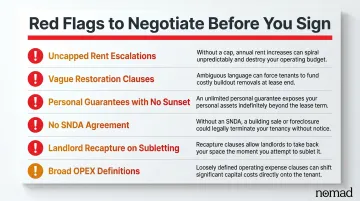
Every clause below has cost tenants real money. Push back on all of them before you sign:
Uncapped rent escalations — CPI-only structures with no ceiling can quietly compound into a budget crisis over a 7-year term. Insist on a fixed escalation rate or a hard CPI cap.
Vague restoration clauses — Without a defined scope, landlords will interpret make-good obligations as broadly as possible at expiration. Get the exact restoration requirements spelled out in writing before signing.
Personal guarantees with no sunset — Full-term founder liability is high-risk exposure. The Good Guy Guarantee is the standard NYC alternative: liability ends when the tenant vacates and surrenders the space. Push for this structure, and pair it with a burn-down provision tied to on-time payment history.
No SNDA offered — Without a Subordination, Non-Disturbance and Attornment agreement, you're exposed to displacement if the building is sold or goes into foreclosure. Require one before execution.
Landlord recapture rights on subletting — Some leases let landlords reclaim your space the moment you request a sublet. That clause eliminates your exit option entirely. Strike it, or limit recapture to specific circumstances with tenant consent.
Broad OPEX definitions with no audit rights — Without exclusions, landlords can pass through capital expenses, management fees, and one-time costs as operating expenses. Negotiate specific carve-outs and secure the right to audit OPEX statements annually.
Frequently Asked Questions
What does $24.00/sf/yr mean in a commercial lease?
It's the annual rent rate per rentable square foot. To find your monthly cost, multiply by your total square footage and divide by 12. For example: $24/sf × 5,000 sf = $120,000/year, or $10,000/month.
How do you negotiate a commercial lease?
Start with current market comparables for your target submarket, define your non-negotiables, and work with an experienced tenant rep broker. Address rent, TI allowance, lease term, escalations, and protective clauses before you're under time pressure from a landlord's deadline.
What are the key rules for commercial lease negotiation?
Always use professionals — both a broker and a real estate attorney. Never treat the landlord's first draft as final, and negotiate all concessions during the LOI stage before execution. Calculate total occupancy cost over the full lease term, not just monthly base rent.
What are common red flags in a commercial lease?
Watch for these deal-breakers:
- Uncapped escalations
- Personal guarantees without a burn-down provision
- Vague restoration obligations with no defined scope
- Missing SNDA clause
- Landlord's unilateral right to block assignment or subletting
Do I need a tenant rep broker for a NYC commercial lease?
Not legally required, but strongly advisable. Landlords always have professional representation, and an experienced tenant rep brings market data, building-specific leverage, and NYC lease expertise — typically at no direct cost to you, as broker commissions are paid by the landlord.