Introduction
In NYC's commercial real estate market, the Letter of Intent isn't a formality—it's your best negotiating moment. Once the formal lease process begins, landlord attorneys take over, and the terms you failed to capture in the LOI become harder to win back.
Manhattan's availability rate fell to 13.9% in Q4 2025, down from 23.6% just 18 months prior, marking the seventh consecutive quarter of tightening supply. That means tenant leverage is narrowing fast. The tenants who secure the best terms are the ones who negotiate hard at the LOI stage—not after attorneys get involved.
With that in mind, this guide covers what a commercial lease LOI is, which NYC-specific terms to push for, how submarket conditions affect your position, and the mistakes that cost tenants the most money.
TLDR
- The LOI is non-binding but sets the benchmark for every lease term that follows
- Free rent, TI allowance, and Good Guy Guaranty language must be captured at the LOI stage
- Manhattan availability is tightening—negotiate promptly once you identify a target space
- Never accept a landlord's LOI without countering, especially on escalations and guaranty terms
- From signed LOI to signed lease typically takes 4–10 weeks in NYC
What Is a Commercial Lease Letter of Intent?
A commercial lease LOI (sometimes called a term sheet) is a preliminary document that outlines the fundamental deal points—rent, lease term, security deposit, and concessions—before attorneys draft the formal lease. Think of it as a handshake on paper: both sides confirm they're on the same page before anyone spends money on legal drafting.
Non-Binding, With Important Exceptions
LOIs are generally non-binding in New York, but the legal picture is more nuanced than most tenants realize. New York courts apply a four-factor test evaluating:
- Whether the LOI contains express intent to be bound
- Whether all material terms are agreed upon
- Whether partial performance has occurred
- The type of agreement typically reduced to writing
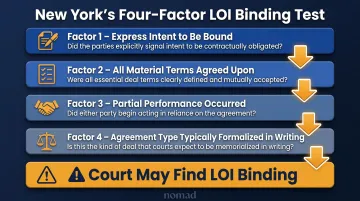
When all four factors lean toward commitment, courts have found LOIs binding—even when the parties assumed otherwise. A poorly drafted LOI can become enforceable before you've signed a lease. Avoid definitive language like "agree" or "shall"—use "presently intends" or "expects" instead, and include an explicit non-binding statement.
Even so, certain provisions are legally binding from day one:
- Exclusivity clauses — prevent the landlord from negotiating with other tenants
- Confidentiality provisions — protect information shared during due diligence
- Expense allocation clauses — establish who pays costs if the deal falls through
Who Drafts the LOI?
In NYC, the tenant or their tenant-rep broker typically initiates the LOI. Going first lets you frame the terms rather than reacting to a landlord-favorable document. If the landlord issues the LOI, treat it as an opening position, not a standard form.
What to Include in Your NYC Commercial Lease LOI
A well-constructed LOI covers six core areas. Leaving any of them vague creates risk that surfaces during lease drafting.
Party and Property Details
Specify the full building address, floor and suite number, usable square footage, the landlord's legal entity name, and your company's legal name. NYC buildings frequently have multiple ownership entities—confirming the correct legal name early prevents complications when it's time to execute.
Lease Term and Commencement Date
NYC office leases commonly run 3–10 years. Post-pandemic, smaller tenants have trended toward shorter commitments: median terms have dropped from four years to around three. State your desired term, requested rent commencement date, and any free occupancy period needed for buildout—and tie that free period to realistic NYC construction timelines.
Rent Structure
State base rent in dollars per square foot annually, as is NYC convention. Also specify:
- Annual escalation terms (typically 2–3% fixed or CPI-based)
- Whether the deal is modified gross or direct net
- How electricity is handled (NYC leases typically address this via submetering or a direct utility inclusion—worth nailing down early)
Most NYC office leases are modified gross, where the tenant pays a base rent covering taxes and operating expenses for a base year, with increases passed through thereafter.
Tenant Improvement Allowance
TI is one of the highest-value line items in any NYC LOI. Benchmarks from Q1 2023 show Class A large deals averaging $145/SF, with the Manhattan-wide average at $128/SF. Class B deals typically land in the $40–80/SF range.
Your LOI should specify:
- Dollar amount per square foot
- Whether hard costs only are covered, or if soft costs, permitting, and FF&E qualify
- Who controls construction (landlord-supervised or tenant-directed)
Vague TI language is the most common source of funding gaps once the landlord's work letter arrives.
Security Deposit and Guaranty Structure
NYC security deposits typically run 3–6 months of rent, with the range stretching from 2 to 12 months depending on tenant credit profile. Deposits can be structured as cash or a Letter of Credit—landlords generally prefer the latter for larger deals.
For startups, address two things explicitly in the LOI:
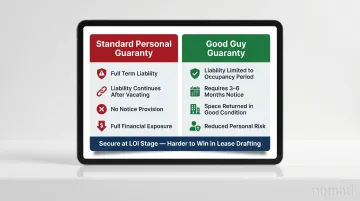
- Good Guy Guaranty: Limits the guarantor's personal liability to the period of actual occupancy, provided proper notice (typically 3–6 months) is given and the space is vacated in good condition. Secure this at the LOI stage—it becomes significantly harder to negotiate once lease drafting begins.
- Burndown schedule: Proposes that the deposit or guaranty reduces after a defined period of on-time payment (for example, after 24 consecutive months). Leave this out of the LOI and landlords won't offer it in the lease.
Key NYC-Specific Terms to Push For
Free Rent
Free rent is a standard NYC negotiating lever—and the benchmark scales clearly with lease length:
| Lease Length | Typical Free Rent |
|---|---|
| 10-year | 10–12 months (Class A large deals averaged 16 months in 2023) |
| 5-year | 5–6 months |
| 3-year | 1–3 months |
Push for free rent to be front-loaded to offset buildout costs, and capture the specific number of months in the LOI before formal lease drafting begins.
Electricity and Operating Expense Structure
Unlike most other markets, NYC office leases frequently separate electricity from base rent. Three structures exist:
- Direct metering — tenant billed directly by the utility
- Submetering — landlord meters individual usage and charges the tenant, often with an administrative fee
- Rent inclusion — flat charge built into base rent, typically around $3–4/SF
Nail this down in the LOI. "Electricity to be addressed in the lease" is a phrase that routinely leads to monthly cost surprises.
Expansion and Contraction Rights
For companies that might grow — or shrink — over a 5–7 year term, two provisions are worth locking in at the LOI stage:
- Right of First Offer (ROFO) on adjacent or nearby space before it's marketed to third parties
- Contraction or early termination option, typically requiring 90–180 days' notice and payment of 3–6 months of rent plus unamortized lease-up costs
Miss them in the LOI and you're unlikely to get them in the lease.
Exclusivity
Include an exclusivity clause preventing the landlord from negotiating with other prospective tenants while lease documentation is prepared. This provision is binding even in an otherwise non-binding LOI—and backing out of it creates legal liability under New York law.
NYC Market Factors That Shape Your Negotiating Leverage
Submarket Conditions Vary Considerably
Tenant leverage isn't uniform across NYC — current data shows clear divergence by neighborhood:
| Submarket | Key Metric | Period |
|---|---|---|
| Flatiron/NoMad | All-class availability: 16% (down from 18%) | Q2 2025 |
| Flatiron/NoMad | Class A availability: 19% (down from 22%) | Q2 2025 |
| SoHo | Sublet avg rent: $65.11/SF vs. $80/SF direct | Aug 2025 |
| Manhattan overall | Availability rate: 13.9% | Q4 2025 |
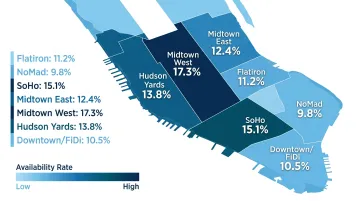
Tech-favored submarkets like SoHo, Flatiron, and Union Square have seen property values increase, while traditional Midtown East corridors declined. Where supply is tighter, concession packages are thinner—entering LOI negotiations without your submarket's numbers puts you at an immediate disadvantage.
The Sublease Market as Leverage
Sublease availability dropped to 11.41 million SF in Q4 2025, the lowest level since October 2019. Discounts still exist, though: SoHo subleases average roughly 19% below direct asking rents. When negotiating a direct lease LOI, documented sublease alternatives give you a credible fallback—landlords respond to competition, even implied competition.
Your Company's Financial Profile
Class A landlords conduct detailed financial reviews. Startups with limited operating history should prepare:
- Recent financial statements
- Funding documentation and investor references
- A clear runway narrative
Strong financial documentation directly reduces security deposit demands and can shift guaranty negotiations in your favor. Nomad Group works with venture-backed companies across Flatiron, NoMad, and SoHo on this kind of pre-LOI financial positioning — before a single term sheet is submitted.
Artificial Urgency
Financial preparation gets you to the table — but landlord tactics can still undermine your position once you're there. NYC landlords sometimes manufacture urgency to push tenants toward weaker terms. An experienced tenant-rep broker will cross-reference actual leasing velocity in the building, check how long the space has been on the market, and verify whether competing interest is real. Nomad Group, which has leased over 2 million square feet across the city, brings that market visibility to every LOI negotiation.
Common LOI Mistakes NYC Tenants Make
A few patterns consistently cost NYC tenants leverage — or money — before the lease is even drafted.
Leaving TI scope vague. Stating a TI dollar amount without specifying what qualifies — hard costs only, soft costs, permitting, furniture — creates a funding gap once the landlord's work letter arrives. Be specific.
Accepting the landlord's LOI without countering. Landlord-issued LOIs are written to protect the landlord. Rent escalations, guaranty terms, and concession packages are all tilted in the landlord's favor. Every landlord LOI should be reviewed and countered, particularly on these three points.
Omitting operational terms. These items are frequently left out of LOIs and become significantly harder to negotiate once lease drafting begins:
- After-hours HVAC access and per-hour cost
- Signage rights (floor directory, building lobby, exterior where applicable)
- Building amenity access
- Sublease and assignment rights
If something is non-negotiable for your business, raise it at the LOI stage—not after the landlord's attorney has drafted 80 pages of lease language.
From LOI to Signed Lease: What Comes Next
The LOI-to-Lease Timeline
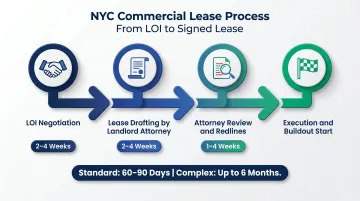
Once both parties sign the LOI, the landlord's attorney typically drafts the formal lease. In NYC, the full process breaks down as follows:
| Stage | Typical Duration |
|---|---|
| LOI negotiation | 2–4 weeks |
| Lease drafting and attorney review | 2–8 weeks |
| Total (standard deal) | 60–90 days |
| Total (complex deal) | Up to 6 months |
Engage a real estate attorney immediately upon LOI execution. The lease should be reviewed line by line against the LOI—landlord attorneys routinely add provisions or subtly alter economic terms that weren't flagged in the non-binding document.
Start Buildout Planning at LOI Execution
NYC Department of Buildings plan reviews for office fit-outs typically take 4–8 weeks before construction can begin. Waiting until the lease is signed to start design and permitting work adds two months of delay to your move-in date.
Nomad Group's in-house construction management team typically delivers tenant buildouts within 90 days — one client went from white-box to fully operational in five weeks. To hit that kind of timeline, the buildout process needs to start at LOI execution, not after lease signing.
Key steps to kick off at LOI:
- Submit preliminary design plans to your architect
- Begin NYC DOB pre-filing research
- Align contractor bids with your target move-in date
- Coordinate landlord work letter obligations before lease finalization
Frequently Asked Questions
Is a commercial lease LOI legally binding in New York?
Generally no—but specific carve-outs like exclusivity and confidentiality provisions can carry legal weight even within an otherwise non-binding LOI. New York courts may also treat a well-documented LOI as creating a duty to negotiate in good faith. Always include an explicit non-binding statement in your LOI language.
What are the 4 golden rules of negotiation?
Four principles that hold in most commercial lease negotiations:
- Know your walk-away point before you start
- Never concede without getting something in return
- Keep multiple issues in play rather than resolving them one at a time
- Anchor to your underlying interests, not just your stated positions
What is the difference between an RFP and an LOI?
An RFP is issued to multiple landlords during the comparison phase to generate competitive proposals. An LOI comes after you've identified a specific space and outlines agreed-upon terms between one tenant and one landlord ahead of formal lease drafting. The RFP precedes the LOI in the leasing process.
How long does it take to go from a signed LOI to a signed lease in NYC?
Typically 4–10 weeks, depending on deal complexity, how closely the lease tracks the LOI, and the responsiveness of both parties' legal teams. More complex deals with significant buildout components or unusual lease structures can take longer.
Can a NYC landlord reject or walk away from an LOI?
Yes. Because the LOI is non-binding, either party can walk away before a formal lease is signed. A signed LOI signals alignment on business terms—it does not guarantee a deal. The stronger your LOI, the less room there is for surprises during lease drafting.
What is a free rent period and how much is typical in an NYC office lease?
Free rent is a period at lease commencement when the tenant occupies the space but pays no base rent. The NYC benchmark is roughly one month per year of lease term — so expect 10–12 months on a 10-year deal, 5–6 months on a 5-year deal, and 1–3 months on a 3-year term.