While the process may appear straightforward, outcomes vary enormously based on market knowledge, preparation, and which terms you actually push on. For example, negotiating a 3% fixed annual escalation cap instead of a CPI-linked increase can prevent unexpected rent spikes—CPI-linked escalations hit 8% in 2022 during inflationary periods, while fixed caps protect tenants from volatility.
This guide covers the 12 most important negotiation tips, from pre-negotiation prep to protecting long-term flexibility, with specific context for office tenants in competitive markets like NYC.
Key Takeaways
- Research market rents and comparable properties before entering negotiations to establish leverage
- Rent, escalation clauses, TI allowances, rent-free periods, and exit terms are all negotiable
- Lease type (gross, net, modified) determines who pays what—understand this upfront to prevent surprise costs
- Working with a tenant broker and commercial attorney significantly improves outcomes
- Strong lease terms protect your flexibility to scale, restructure, or exit as your business evolves
Before You Negotiate: How to Prepare
Preparation is the most underleveraged phase of commercial lease negotiation. Tenants who arrive informed have concrete grounds to push back on unfavorable terms, while those who rely solely on landlord-provided information often accept unfavorable terms without realizing it.
Define your space needs before approaching landlords:
- Current and projected headcount (12-month and 24-month outlook)
- Layout preferences (open workspace vs. private offices)
- Timeline flexibility (can you wait for buildout or need immediate occupancy?)
- Growth scenarios (will you need adjacent space within the lease term?)
**Research comparable leases and market vacancy data** to benchmark against asking rents. In markets like NYC, neighborhood-level data varies significantly. Midtown South Class A office space averaged $106.91/sf in Q4 2024, while Class B space in the same area averaged $67.23/sf—a 59% difference.
Submarkets shift that picture further: Chelsea/Flatiron commanded $125.34/sf for Class A space, while SoHo averaged $89.13/sf. These benchmarks give you objective grounds to challenge above-market quotes. Note that asking rents and achievable rents often diverge in tighter markets—your research should reflect deals that are actually closing, not just listing prices.
That research is most powerful with the right advocate in your corner—engage a specialized tenant broker early. A broker with deep market relationships can surface off-market options, provide honest comparable rent data, and advocate for your interests before a single counter-offer is made. This is distinct from a landlord's broker, who represents the property owner's interests, not yours. Firms like Nomad Group, with deep expertise in NYC neighborhoods including Flatiron, NoMad, and SoHo, can create leverage by presenting competing options and negotiating on your behalf—and the landlord typically covers the broker fee, not you.
Tips 1–6: Negotiate the Financial and Structural Terms
Tip 1: Understand the Lease Type Before You Negotiate Anything
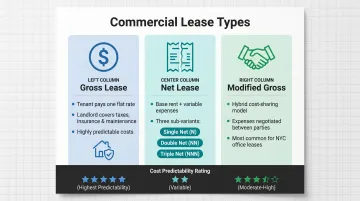
The lease type fundamentally determines your total occupancy cost, not just the base rent figure. There are three main types:
Gross Lease:
- Tenant pays one flat rate covering rent and operating expenses
- Landlord is responsible for taxes, insurance, and maintenance
- Provides predictable monthly costs but typically higher base rent
Net Lease:
- Tenant pays base rent plus some share of taxes, insurance, or maintenance
- Variants include single net (taxes), double net (taxes + insurance), and triple net/NNN (taxes + insurance + maintenance)
- Lower base rent but variable monthly costs
Modified Gross:
- Hybrid structure where costs are split between landlord and tenant
- Terms vary by lease—some tenants pay utilities and janitorial, landlord covers taxes and insurance
- Most common for NYC office space
Understanding which lease type you're negotiating affects every other financial term. A $50/sf gross lease may actually cost less annually than a $40/sf modified gross lease with significant operating expense pass-throughs.
Tip 2: Research Market Rents Independently
Landlords typically quote above-market rates initially, knowing there's room to negotiate. Obtaining current market rent data before countering any offer gives you leverage.
Manhattan's overall office asking rent averaged $73.13/sf in Q1 2026, with Midtown at $81.62/sf and availability at 15.3%. But these are asking rents—what landlords are requesting. Effective rents (what tenants actually pay after concessions) tell a different story. The gap between base rent and net effective rent for Class A properties reached a record high of $30/sf, meaning landlords were offering substantial concessions to close deals.
Work with a broker who has access to closed deal data, not just public listings. This shows you what comparable tenants actually negotiated, giving you realistic grounds to counter.
Tip 3: Negotiate the Base Rent and Escalation Cap Together
Base rent reduction is only half the equation. Annual rent escalation clauses compound significantly over a 3–5 year lease and should be negotiated alongside base rent.
Fixed-percentage escalations are preferable to CPI-linked escalations:
- Fixed escalations: Typically 3% annually for mid-tier office space, 3–4% for premium space
- CPI-linked escalations: Average 2–3% in normal years but spiked to 8% in 2022
Negotiate a ceiling on annual increases—typically 3–5%—and consider negotiating a floor of 1–2% to provide predictability in both directions. On a $10,000/month lease, a 4% annual escalation adds over $250,000 in additional rent over 10 years compared to a flat rate.
Tip 4: Understand and Audit All Operating Costs
In net and modified gross leases, tenants often pay a share of operating expenses including:
- CAM (Common Area Maintenance) charges
- Property taxes
- Insurance premiums
- Utilities
Operating expenses in NYC average $8–15/sf annually, adding $8–15/sf to your effective rent. These should be itemized, audited, and capped where possible.
Key protections to negotiate:
- Cap annual increases at a fixed percentage (typically 3–5%) to limit exposure as operating costs rise
- Negotiate gross-up terms to 75–80% occupancy rather than the landlord-preferred 95–100%—this reduces your share of variable expenses like janitorial and utilities (standard gross-up provisions explained here)
Request an itemized list of operating expenses and clarify which costs are subject to gross-up. Fixed expenses like taxes and insurance typically aren't grossed up, while variable expenses are.
Tip 5: Push for a Tenant Improvement Allowance (TIA)
A Tenant Improvement Allowance is a landlord-funded budget for tenant buildout costs. Negotiating a sufficient allowance upfront is critical because it directly offsets the cost of customizing the space to your needs.
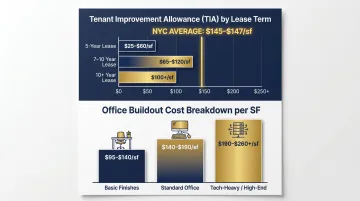
Landlords are often more willing to offer TIA than reduce headline rent, making it a valuable concession point. National average TIA was $87.51/sf in 2024, but NYC office space commanded $145–147/sf, with Midtown and Midtown South averaging $148/sf.
TIA typically varies by lease term:
- 5-year lease: $25–60/sf
- 7–10 year lease: $65–120/sf
- 10+ year lease: $100+/sf
Clarify whether unused TIA can be applied to rent or returned, and ensure the scope of permitted improvements is written into the lease.
Buildout costs in NYC range from:
- $95–140/sf for basic finishes
- $140–190/sf for standard office buildouts
- $190–260+/sf for tech-heavy or high-end spaces
Negotiate TIA amounts that reflect actual buildout costs, not landlord estimates. For companies with complex buildout needs, working with a firm that has in-house construction management can help you anchor TIA requests to real numbers—Nomad Group, for example, has completed 300+ tenant buildouts in NYC with a typical 90-day turnaround.
Tip 6: Request a Rent-Free Period
Rent-free periods cover the gap between lease signing and the day your team is actually working in the space—and most tenants leave them on the table by not asking.
National average rent-free periods reached 8.9 months in 2024, down from a peak of 9.6 months in 2023 but still significantly higher than the pre-pandemic average of 6.7 months. In NYC, rent-free periods can extend up to 14 months, with the Midtown area averaging 17 months in some reports.
Typical rent-free period ranges by lease term:
- 3-year lease: 1–2 months
- 5-year lease: 3–6 months
- 7–10 year lease: 6–12+ months
Rent-free periods are most achievable when the space has been vacant for a while or significant tenant improvements are required. Frame the request around the time needed to build out and fully occupy the space.
Tips 7–12: Secure Flexibility, Protection, and Favorable Conditions
Tip 7: Negotiate Lease Length Strategically
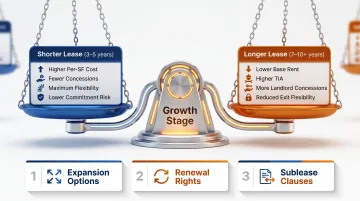
Lease length involves a core trade-off: shorter leases provide flexibility but typically come with higher per-square-foot costs and fewer landlord concessions. Longer leases offer lower rates and more TIA but lock you in.
Manhattan office leases averaged 107 months for prime space and 86 months for non-prime locations in 2024. Class A deals over $100/sf averaged 10-year terms. Yet renewals represented 42% of H1 2024 deals versus 31% pre-pandemic, suggesting tenants are increasingly opting for renewal flexibility over long initial terms.
For growing companies:
- Weigh your growth trajectory against commitment risk
- Consider rights like expansion options to balance both needs
- Negotiate shorter initial terms (3–5 years) with favorable renewal options
- Avoid over-committing to space you may outgrow or underutilize
Tip 8: Secure an Expansion Option and Right of First Refusal
Fast-growing companies — particularly startups scaling headcount — should negotiate a right of first refusal or first offer on adjacent or available space in the building. This preserves the ability to grow without relocating entirely, which is expensive and disruptive.
Key expansion terms to negotiate:
- Right of first refusal on adjacent floors or suites
- Right of first offer (landlord must offer you space before marketing it)
- Pre-negotiated rental rate for expansion space (typically at market rate or a modest premium)
- Defined timeframe to exercise the right (typically 5–10 business days)
These provisions are most achievable in buildings with multiple available floors or in neighborhoods like Flatiron, NoMad, and Union Square where Nomad Group has successfully negotiated expansion rights for high-growth companies.
Tip 9: Negotiate Early Termination and Sublease Rights
An early termination clause is one of the most valuable protections a tenant can secure. It lets you exit the lease under defined conditions (typically with a fee or notice period) rather than paying out the full remaining rent.
Typical early termination structures:
- 6–12 months' notice required
- Termination fee: Often 3–6 months' rent or a percentage of remaining lease value
- Specific exercise windows (e.g., after year 3 of a 7-year lease)
Sublease rights offer an alternative exit if business conditions change. Landlords may resist, but reasonable terms are achievable — especially for longer leases. Avoid leases that require paying out the full remaining balance as the only termination option. That eliminates all flexibility.
Tip 10: Review and Negotiate Renewal Terms Now
Flexibility at exit means nothing if you're locked into bad renewal terms. Renewal options and the rent-reset conditions attached to them are far easier to negotiate before signing than at renewal time.
Key renewal terms to negotiate:
- Options to renew at a defined rent or with a cap (e.g., "not to exceed 110% of then-current market rate")
- Clear notice windows (typically 6–12 months before lease expiration)
- Number of renewal options (one 5-year renewal vs. two 3-year renewals)
Exercising a renewal option can cost 20% more than renegotiating because landlords know you have limited leverage once locked into the option. Negotiate favorable renewal terms upfront and consider renegotiating rather than automatically exercising the option.
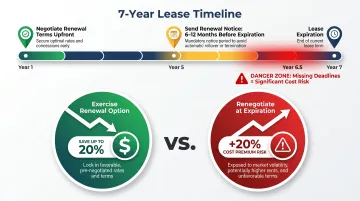
Missing a renewal notice deadline can trigger automatic renewals at market rates or month-to-month terms at significantly higher rent. Some leases give you as little as 14 days to respond to landlord rent notices. Calendar your deadlines early.
Tip 11: Ask for Protective Clauses (Competitor, Co-Tenancy, Use)
Three clause types can protect your business interests without requiring ongoing landlord negotiation:
- Competitor exclusivity: Bars the landlord from leasing to a direct competitor in the same building — protects market position and reduces internal tension
- Co-tenancy protection: Triggers rent reduction or early exit rights if the building drops below a set occupancy threshold; especially valuable in multi-tenant buildings where anchor tenants drive foot traffic or prestige
- Broad permitted-use language: Covers your current and likely future business activities without requiring landlord consent for each pivot — avoid clauses narrowed to a single function like "software development only"
Tip 12: Don't Rush — Review the Full Draft with a Commercial Attorney
Landlords submit their own lease draft as the starting point. Standard boilerplate often contains significant hidden liabilities around:
- Maintenance obligations
- Personal guarantees
- Assignment restrictions
- Force majeure provisions
- Default and cure periods
A commercial attorney (not a general lawyer) should review and redline the document before signing. Commercial lease law is highly specialized, and attorneys familiar with NYC office leases will catch issues that generalists miss.
Rushing to sign often means accepting terms that look minor but carry real financial costs over a 5- or 10-year term. A few weeks of diligence now is worth more than years of unfavorable obligations later.
Common Mistakes When Negotiating a Commercial Lease
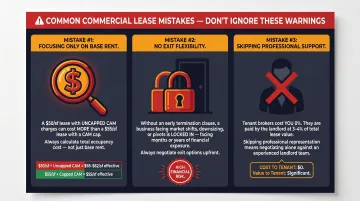
Focusing only on base rent while ignoring total occupancy costs: Operating cost escalations, CAM charges, and maintenance responsibilities can inflate total costs significantly over a multi-year term. A lease with $50/sf base rent but unlimited CAM increases may cost more than a $55/sf lease with capped operating expenses.
Failing to negotiate exit flexibility upfront: Many tenants assume they can work something out later if circumstances change. Without an early termination clause or sublease right written into the original lease, tenants face the full cost of remaining rent. Business conditions shift — funding rounds fall through, headcount projections change — and a lease that doesn't account for that becomes a liability.
Skipping professional support: Going directly to the landlord without a tenant broker or signing without attorney review is one of the most costly errors, especially for first-time commercial tenants unfamiliar with market-standard terms. Tenant brokers are typically compensated by the landlord at 3–4% of total lease value, meaning professional representation costs you nothing directly.
Frequently Asked Questions
What to ask when negotiating a commercial lease?
Focus on these key questions: What are the base rent and annual escalation terms? What operating expenses am I responsible for, and are they capped? What TIA amount is available, and what scope of work does it cover? Is a rent-free period negotiable, and for how long? What lease term and renewal options are available? Do I have early termination rights or the ability to sublease?
Which components of a lease are likely to be most negotiable?
Rent-free periods, TIA amounts, annual escalation caps, lease term length, renewal options, and early termination clauses tend to have the most negotiating room. While base rent itself is negotiable, landlords often prefer concessions in non-rent areas because these don't affect the headline rental rate used for building valuation.
How to ask for a rent-free period?
Request a rent-free period in the initial Letter of Intent (LOI), framing it around the time needed to build out and occupy the space. It's most effective when the space has been vacant for a while or significant tenant improvements are required, since landlords generally prefer a tenant in place over continued vacancy.
What are some red flags in a lease agreement?
Key warning signs include: unlimited CAM charge escalations with no cap, full remaining rent liability as the only termination option, overly narrow permitted-use clauses that restrict business activities, landlord right to relocate the tenant without consent, vague or missing maintenance responsibility language, and personal guarantee clauses that should always be reviewed with an attorney.
What is the rent-free period for a commercial lease?
Rent-free periods for commercial office leases typically range from 1 to 6 months, though NYC averages ran 8.9 months nationally in 2024 and up to 14 months in Manhattan. They're almost always granted upfront, covering the gap between lease signing and when the space is fully operational.
How to negotiate a new commercial lease?
Start by evaluating your business needs and researching market rents in your target neighborhoods. Engage a tenant broker to source options and build leverage with competing offers. Then negotiate financial terms (rent, TIA, rent-free periods, escalations) and protective clauses (termination rights, sublease rights, expansion options) with a commercial attorney before signing.