
Introduction: Why Your Leasing Strategy Can Make or Break Your Startup
For most high-growth startups, office rent ranks as the second-largest expense after payroll—consuming 10-15% of operating costs compared to employee salaries at 50-75%, according to Silicon Valley Bank. A poorly structured lease can burn through months of runway or lock your company into a space it outgrows long before the term ends.
NYC's commercial real estate market moves fast. Manhattan availability has declined for seven straight quarters, with trophy space sitting at just 3.4% vacancy—which means startups face real competition for quality space and shrinking windows for landlord concessions.
In that environment, the difference between a strategic leasing approach and an emotional decision can mean tens of thousands of dollars in hidden costs, inflexible terms that stifle growth, or buildout delays that eat through free rent.
This guide breaks down 11 actionable commercial real estate tips written specifically for high-growth startups navigating NYC's office market, covering everything from initial planning through move-in day.
TLDR: 11 Commercial Real Estate Tips for Startups
- Define your space needs before touring—know headcount projections, square footage, must-have amenities, and true budget ceiling
- Use a dedicated tenant broker at no cost to you — landlord-paid commissions mean representation is free
- Match lease length to your growth stage — 3-5 years is the sweet spot for most Series A-B companies
- Understand all-in costs beyond base rent—operating expenses add $10-$20 PSF annually
- Negotiate TI allowances and free rent together — treat them as one package, not separate asks
Before You Search: Setting Your Leasing Foundation (Tips 1–2)
Tip 1: Define Your Space Requirements Before Touring
Arrive at the NYC market with a clear brief: target headcount for the lease term, desired square footage per person, must-have amenities (conferencing, phone booths, server room), and your hard budget ceiling—not just the asking rent you can afford.
NYC tech startups now plan for 125-150 rentable square feet (RSF) per employee in modern open layouts, according to Spaces Commercial Real Estate, down from pre-pandemic norms of 200+ RSF per person.
That shift goes hand-in-hand with a change in how companies size their space: most now plan for 70-80% of full headcount rather than 100%, since peak attendance on Tuesday-Thursday drives actual space needs more than total team size.
Risks of skipping this step:
- You anchor on the wrong properties and waste weeks touring spaces that don't fit
- Negotiations become emotional rather than strategic when you've fallen in love with a space before understanding its true cost
- You miss critical budget items beyond base rent that should inform your ceiling
Before your first tour:
- Project headcount 3-5 years out (see Tip 3)
- Calculate square footage needs: 30-person team × 135 RSF × 75% peak attendance = ~3,000 SF minimum
- List non-negotiable amenities vs. nice-to-haves
- Establish your all-in monthly budget (see Tip 6)
Tip 2: Work With a Dedicated Tenant Broker (Not the Listing Agent)
With your requirements defined, the next foundational decision is who negotiates on your behalf. A listing broker represents the landlord and is compensated to maximize rent and minimize concessions. A tenant broker works exclusively for you—and in NYC, the landlord pays tenant broker fees, meaning this expertise costs you nothing out of pocket.
What a specialist tenant broker brings beyond listings:
- Insider knowledge on which landlords are startup-friendly and which buildings have recurring issues
- Actual comparable lease data — what similar companies paid, not just asking rents
- Real negotiating leverage: landlords extend better concessions to brokers who consistently bring them deals
Nomad Group has leased over 2 million square feet of NYC office space for high-growth companies and completed 300+ tenant buildouts. In practice, that track record translates to negotiated outcomes — TI allowances, free rent periods, and sublease rights — that founders rarely secure when going direct.
Common mistake: Going direct to landlords to "save commission" actually disadvantages you. The landlord has already budgeted for broker fees—they simply keep that budget themselves and have zero incentive to share savings with you. You lose access to market data and representation without saving a dollar.
Choosing the Right Space for Growth (Tips 3–5)
Tip 3: Plan for Your Headcount Trajectory, Not Your Headcount Today
A lease signed for your team of 20 becomes a liability when you're 45 people two years later. Right-size your space by projecting headcount growth based on your funding stage, hiring plan, and realistic attrition.
How to project growth:
- Series A companies typically double headcount every 18-24 months
- Apply your peak attendance percentage (70-80%) to projected headcount, not 100%
- Factor in flex desking and hybrid schedules to reduce footprint
Realistic scenario: A 30-person startup signing a 5-year lease should size for roughly 45-50 people at peak attendance. At 135 RSF per person and 75% peak occupancy, that's approximately 5,000 SF—not the 4,000 SF your current headcount suggests.
Why this matters: Undersizing forces a costly, disruptive sublease or early renegotiation. Oversizing burns cash on empty desks. The right approach builds moderate buffer while negotiating expansion options (Tip 8) for flexibility.
Tip 4: Match Lease Length to Your Business Stage
Short-term leases (1-3 years) preserve flexibility but carry higher per-square-foot rates and fewer landlord concessions. Long-term leases (5-7 years) lock in favorable pricing and larger TI packages but create exit risk if your trajectory changes.
NYC data: Most early-stage tech startups sign 3-5 year leases, with post-COVID average terms for spaces under 10,000 RSF running 55-60 months.
When each makes sense:
- 3-year terms: Seed stage, teams under 20, uncertain growth trajectory
- 5-year terms: Series A-B companies with proven growth curves—the sweet spot for moderate TI and free rent
- 7-10 year terms: Series C+ companies with stable headcount models—unlocks maximum landlord concessions
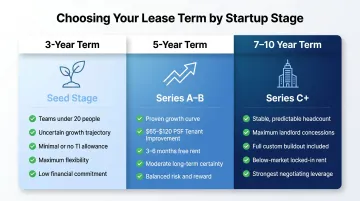
TI and concession impact: A 5-year term typically yields $65-$120 PSF in TI allowance for Class A raw space plus 3-6 months free rent. A 10-year term can deliver full custom build-outs and up to 12 months free rent. Shorter terms rarely justify meaningful TI investment from landlords.
Alternative path: Flex by Nomad offers an alternative for teams not yet ready to commit to a direct lease, providing plug-and-play solutions with operational support built in.
Tip 5: Choose a Location That Serves Your Team and Your Brand
In NYC, neighborhood selection directly affects recruiting, culture, and daily commute. Submarkets like Flatiron, NoMad, and SoHo attract talent differently than Midtown or outer boroughs.
What to evaluate:
- Transit access: Proximity to major subway lines (4/5/6, N/Q/R, L trains) determines who can reasonably commute
- Peer density: Concentration of tech companies, coffee shops, gyms, and lunch spots matters for culture and collaboration
- Brand signal: Your address sends a message to candidates and clients
Submarket snapshot (Q4 2025 asking rents per Savills):
| Submarket | Asking Rent | Profile |
|---|---|---|
| Flatiron | $70.67 PSF | Value positioning, high-character buildings |
| Union Square | $91.84 PSF | Startup energy, excellent transit |
| Chelsea | $88.03 PSF | Creative vibe, tech cluster |
| Hudson Yards | $135.09 PSF | Trophy buildings, premium brand signal |
| Financial District | $58.10 PSF | Budget-conscious, emerging tech scene |
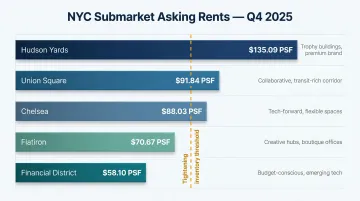
AI and tech concentration: AI companies leased over 1.0 million SF in 2025, primarily targeting Midtown South neighborhoods. If you're competing for space in Flatiron, NoMad, or Chelsea, move quickly—inventory at sub-$80 PSF in these corridors is tightening.
Decoding What Your Startup Actually Pays (Tips 6–7)
Tip 6: Understand All-In Cost, Not Just the Asking Rent
Base rent is the headline number, but your actual occupancy cost includes operating expenses that can add $10-$20 PSF above the quoted rate.
Lease structure types:
- Full-service gross: Landlord covers operating expenses; you pay one fixed rate (most common in Manhattan office buildings)
- Modified gross: You pay base rent plus increases in taxes, insurance, and maintenance above a "base year" amount
- Triple-net (NNN): You pay base rent plus proportional share of all property taxes, insurance, and operating costs (rare for NYC office, common in retail)
Additional cost line items founders overlook:
- Electricity: $3.00-$3.50 PSF annually for standard office use
- After-hours HVAC: Charged per hour when you need climate control outside standard building hours
- Janitorial: Often an addback unless negotiated into the lease
- Internet infrastructure: Build-out and monthly service costs
- Building fees: Security, loading dock access, after-hours access cards
Example: A 5,000 SF space at $65 PSF base rent = $325,000 annually ($27,083/month). Add $15 PSF in operating expenses = $75,000 more annually ($6,250/month). Your true monthly occupancy cost is $33,333, not $27,083.
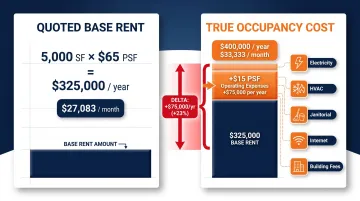
Action: Request a full operating expense breakdown from the landlord before signing anything, and run your budget against the all-in number — that's the figure that actually hits your bank account each month.
Tip 7: Negotiate TI Allowances and Free Rent — These Are Real Money
Tenant Improvement (TI) allowances are landlord-funded contributions to buildout costs, expressed in dollars per square foot. On a 5,000 SF deal, even a $20 PSF swing in TI can mean $100,000 more — or less — available for your build.
Current NYC benchmarks (mid-2025):
- Class A raw space: $65-$120 PSF
- Class B raw space: $40-$80 PSF
- Downtown Manhattan raw space: $130-$170 PSF
- Prebuilt space: $10-$30 PSF (Class A), $0-$20 PSF (Class B)
Free rent periods offset buildout downtime — typical ranges by lease term:
- 5-year lease: 3-6 months free rent
- 10-year lease: 6-12 months free rent
- Rule of thumb: ~3 months free rent per 5 years of term
Negotiate as a package: Negotiate TI and free rent together, not in isolation. Example: "We'll commit to a 5-year term in exchange for $100 PSF TI allowance plus 6 months free rent."
Important conditions: TI allowances often require:
- Landlord approval on all vendors and contractors
- Compliance with building standards and union labor requirements (in many NYC buildings)
- Strict draw schedules with reimbursement milestones
Miss a TI reimbursement milestone and you risk forfeiting that landlord contribution entirely. Build your construction timeline before you sign, not after (see Tip 11).
Negotiating Flexibility and Protecting Your Startup (Tips 8–10)
Tip 8: Build Flexibility Clauses Into the Lease From Day One
Flexibility provisions are far easier to negotiate at lease signing than to add later. Request these three clauses:
Expansion option: Right of first offer on adjacent space if your startup grows. Locks in your ability to stay in the building without starting a new search.
Early termination clause: Ability to exit after a set period (often year 3 of a 5-year term) if the company is acquired, downsizes, or pivots. Usually requires a termination fee (e.g., 3-6 months' rent), but provides an escape hatch.
Sublease/assignment rights: The ability to sublease excess space to a third party or transfer the lease in an M&A event. Ensure the lease states the landlord must be "reasonable" in granting consent—without this language, landlords can arbitrarily block subleases.
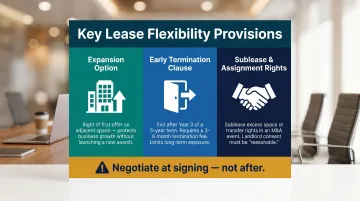
Most startups don't think about these provisions until an acquisition forces office consolidation or hybrid work leaves half the floor unused. By then, you have no leverage to add them.
Tip 9: Know Your Leverage — and Your Landlord's Motivations
Landlord motivations vary widely and shape your negotiation approach.
What to research before negotiating:
- A landlord sitting on 30% vacancy has different motivations than one at 95% occupancy — high vacancy means more leverage for tenants
- Institutional landlords (REITs, pension funds) prioritize long-term stable tenants and may concede heavily on economics
- Private owners tend to be more flexible on creative deal structures but typically require stronger credit assurances
- Landlords may require a personal guarantee or letter of credit from a startup without a long operating history — negotiate a "burn-down" provision where the guarantee reduces as you hit revenue milestones or maintain timely payments
Current NYC market dynamics (Q1 2025): Manhattan office vacancy sits at 12.7% overall, the second-lowest among 82 primary U.S. markets. However, availability rates (including space coming available within 12 months) remain elevated at 13.9-15.5%. Trophy space at 3.4% availability means fierce competition, but Class B buildings still offer tenant leverage.
For startups: move quickly on quality space, but don't abandon negotiating leverage — concessions remain very much available in Class B inventory.
Tip 10: Read the Lease for Red Flags Before Signing
Engage a commercial real estate attorney to review the lease before execution. The cost is small relative to a multi-year financial commitment.
Most common red flags:
- Annual increases tied to CPI or fixed percentages without a ceiling can balloon costs unpredictably
- Relocation clauses that let the landlord move you within the building at their discretion — unacceptable for most startups
- Restrictive use clauses that limit what the space can be used for ("general office use only" may prohibit hosting events or running a podcast studio)
- A personal guarantee without a burn-down provision leaves the founder personally liable for the full lease term — negotiate a carve-out after 12-24 months of timely payments
Good Guy Guaranty (NYC-specific): A common provision where the guarantor is not personally responsible for rent after you vacate, provided you give timely notice and surrender the space in good condition. This limits founder downside risk.
From Lease Signing to Day One: The Buildout Reality (Tip 11)
Tip 11: Plan Your Buildout Timeline Before You Sign, Not After
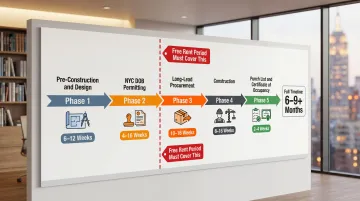
The most common startup mistake after signing a lease is underestimating how long a buildout takes. Permitting, design, construction, and inspections in NYC routinely take 6-9 months for a standard fit-out—not the 3-6 months commonly assumed.
Phase-by-phase breakdown:
- Pre-construction & design: 6-12 weeks (space planning, construction documents, MEP coordination)
- NYC DOB permitting: 4-16 weeks depending on filing type (Alt-2 standard: 4-6 weeks; Alt-1 major changes: 8-16 weeks)
- Procurement of long-lead items: 10-16 weeks (custom millwork can take 12-16 weeks alone)
- Construction: 8-16 weeks (demolition, framing, MEP rough-in, finishes)
- Punch list & Certificate of Occupancy: 2-4 weeks (final inspections, DOB processing)
NYC-specific delays:
- Landmarked buildings require Landmarks Preservation Commission (LPC) approval, adding months
- Older buildings have inaccurate as-built drawings, causing "above-ceiling surprises"
- Failed rough-in inspections add 1-2 weeks each for rescheduling
- A 2-4 week gap exists between construction completion and legal occupancy (C of O processing)
Critical action: Engage a construction manager or end-to-end real estate partner alongside lease negotiations, not after execution. When evaluating buildout partners, ask for a concrete turnaround track record — Nomad Group's in-house construction team, for example, has completed 300+ tenant buildouts with a 90-day turnaround, a useful bar to pressure-test any firm you're considering.
Two financial risks that catch startups off guard:
- Free rent misalignment: If you negotiate 6 months of free rent but your buildout takes 7 months, you'll start paying rent before you can occupy the space. Build the full timeline into your free rent period, plus a buffer.
- TI expiration: Landlord TI allowances have deadlines and reimbursement requirements. Construction delays can cost you TI dollars you've already locked in.
Both risks come back to the same principle: know your buildout timeline before you sign, not after.
Frequently Asked Questions
What is a leasing strategy?
A leasing strategy is a structured plan for how a company acquires, structures, and manages its real estate commitments to support operational and financial goals. For startups, it means aligning lease terms, location, and buildout with your funding runway, headcount growth, and exit flexibility—not just finding a space.
What is the best lease type for commercial property?
For most NYC startups, a full-service gross lease offers the most predictable all-in cost and is the most common structure in Manhattan office buildings. The landlord covers operating expenses, and you pay one fixed rate, simplifying budgeting and eliminating surprise addbacks.
What are common red flags in a lease agreement?
Four red flags to watch for:
- Uncapped rent escalations that compound annually without a ceiling
- Broad landlord relocation rights allowing forced moves within the building
- Restrictive use clauses that limit how you can use the space
- Personal guarantees without burn-down provisions, leaving founders personally liable indefinitely
What does $10/sf/yr mean in a commercial lease?
This is the annual rent per square foot. A 2,000 SF space at $10/SF/yr equals $20,000/year or approximately $1,667/month. NYC office rates are quoted in annual per-square-foot terms and typically range from the high $50s to $100+ PSF depending on building class and submarket.
What is lease advisory?
Lease advisory (or tenant advisory) is a professional service where a broker or advisor represents the tenant's interests from search through negotiation and execution. In most NYC commercial deals, the landlord pays the broker commission, so this service costs the tenant nothing directly.
What do the 1%, 1.25%, 2% and 90% rules mean in leasing?
These are underwriting benchmarks used by real estate investors and landlords, not startup tenants. Instead, focus on all-in occupancy cost as a percentage of total operating expenses — most startups target 10-15%.
Ready to navigate NYC's office leasing market with an expert tenant broker on your side? Nomad Group has helped hundreds of high-growth startups secure strategic office space, negotiate landlord concessions, and deliver buildouts on time and on budget. Contact our team to start your search with a clear strategy and zero out-of-pocket broker fees.