
Introduction
Your lease renewal isn't just paperwork — it's a six-figure financial moment. For startups facing this milestone, a few strategic moves can unlock years of flexibility, save substantial capital, and position your team for sustainable growth. Unlike enterprise companies with dedicated real estate teams, most startups approach renewal unprepared, under time pressure, and at risk of getting locked into unfavorable terms — all because they waited too long to act.
The stakes are real: tenants who skip market evaluation pay a 15% to 25% renewal premium compared to what new tenants secure. This guide delivers 7 actionable tips built around your actual priorities — protecting runway, managing headcount uncertainty, and keeping your options open as you scale.
Key Takeaways
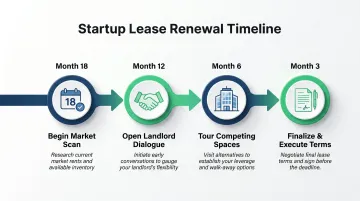
- Start renewal conversations 12-18 months before expiration to maximize leverage
- Right-size your space using hybrid work data and desk-sharing ratios, not outdated headcount formulas
- Negotiate beyond base rent — free rent, TI allowances, expansion rights, and sublease flexibility add significant value
- Tour competing spaces to create credible alternatives and understand submarket concessions
- Use a startup-focused CRE broker at no direct cost; the landlord covers the commission
Start the Process 12 to 18 Months Before Your Lease Expires
Most startups start too late. Founders assume renewal is straightforward and underestimate the timeline required for market evaluation, space tours, and negotiation — especially in competitive markets like Manhattan, where availability dropped from 17.3% to 14.6% year-over-year through Q1 2026.
What "starting early" actually looks like:
- Review your current lease for renewal notice requirements and hidden option clauses
- Set a decision timeline that works backward from your expiration date
- Initiate a market scan to understand competing spaces and landlord concessions
- Begin documenting your evolving space needs (headcount, hybrid policies, layout preferences)
Opening dialogue with your landlord 12–18 months out signals preparation — and preparation is what earns you real negotiating position. With renewals dropping from 50% of Manhattan leasing activity in 2023 to just 20% in Q1 2026, landlords know tenants are willing to move. That gives you standing to push for longer free-rent periods, higher tenant improvement allowances, or flexible early-termination clauses — but only if you've built enough runway to walk away.
Reassess Your Space Needs Through a Startup Lens
Startups face a uniquely difficult space-sizing challenge. You likely signed your original lease at a different headcount, funding stage, and work model than where you are today. Your next lease term may cover an even more uncertain growth period, making flexibility essential.
Address Hybrid Work Reality
57% of Manhattan office workers attend the workplace on an average weekday, and 69% of companies globally use desk sharing, targeting 1.01 to 1.49 people per seat. Ask yourself:
- How many employees are in-office on peak days (not average days)?
- Can a flexible layout — hot-desking, modular furniture, shared collaboration zones — reduce required square footage without sacrificing capacity?
- What's your actual space-per-employee ratio versus the stabilized 2024 benchmark of 146 sq ft, down from 161 sq ft pre-pandemic?
Right-Sizing Opportunities at Renewal
Renewal isn't an all-or-nothing decision. You can:
- Give back underused space if your team has shrunk or gone more remote
- Expand into adjacent square footage if you're scaling rapidly
- Add expansion rights that allow growth without relocating — pre-agreed options to take more space at defined terms
The right-sizing option you choose will shape your term length strategy — and that decision has real financial consequences.
Lease Term Length Strategy
Longer terms unlock bigger landlord concessions (Manhattan tech tenants secured 13.3 months of free rent and $131.70/sf in TI allowances in 2025). Shorter terms preserve flexibility. Think carefully about your 3-5 year growth trajectory:
- Post-Series A/B: Consider 3-5 year terms with expansion rights if you're scaling aggressively
- Pre-funding or uncertain runway: Prioritize 2-3 year terms or negotiate early termination clauses
Build-to-Suit Negotiation at Renewal
Startups can negotiate landlord-funded space improvements as part of renewal terms, especially when the space needs updating. Staying and negotiating TI avoids the moving costs, broker fees, and operational downtime that relocation typically triggers. A partner with in-house construction management — like Nomad Group's 90-day buildout model — can execute TI-funded improvements on a tight timeline, so your team isn't displaced while the work gets done.
Know What's Actually Negotiable (Most Startups Leave This on the Table)
Most first-time negotiators focus only on base rent. Experienced tenants know the total economic package includes many more levers — and landlords are often more willing to move on non-rent items than on headline rent.
Here are the key items most startups overlook at the negotiating table:
Key Negotiable Items for Startups
Free rent periods (rent abatement): Landlords often offer 1-3+ months free at renewal, particularly in higher-vacancy markets. Sample Manhattan office leases showed 3 to 5 months of free rent, structured either upfront or staggered across the term.
Tenant improvement (TI) allowance: A landlord-funded budget for buildout or renovation. At renewal, startups can negotiate TI to refresh or reconfigure space. NYC averages ranged from $104/sf pre-pandemic to $147/sf in 2022, with tech tenants averaging $131.70/sf in 2025.
Expansion and contraction rights: Pre-agreed options to take more or less space without renegotiating from scratch — critical for startups navigating growth uncertainty.
Sublease and assignment rights: Essential if you may pivot, downsize, or get acquired. Sublease rights provide "a safety valve that transforms excess space from a fixed liability into a manageable cost" through third-party occupancy.
Reinstatement obligations: Many leases require tenants to restore space to its original condition at lease end — a significant hidden cost. Negotiate to limit or eliminate this obligation before you sign.
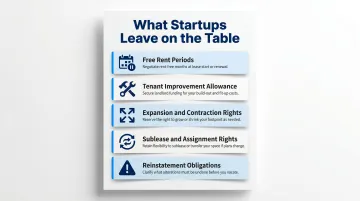
In practice, stacking two or three of these concessions often delivers more financial benefit than shaving a few dollars off the base rent.
Build Leverage by Understanding the Market and Your Landlord
Tip 4: Research Competing Spaces — Even If You Plan to Stay
Touring alternative spaces puts real market intelligence in your hands and gives you a credible walk-away option — both of which force landlords to sharpen their offers.
NYC's office market conditions vary significantly by neighborhood:
| Submarket | Availability Rate | Direct Asking Rent |
|---|---|---|
| Hudson Yards | 5.3% | $129.45/sf |
| Flatiron/Gramercy | 12.4% | $83.23/sf |
| Chelsea | 25.9% | $81.07/sf |
| Financial District | 18.4% | $64.16/sf |
Source: Avison Young Q1 2026
Understanding submarket vacancy rates and competing landlord concessions gives you specific data points to reference in negotiations.
Tip 5: Understand Your Landlord's Financial Position and Vacancy Exposure
Landlords are far more motivated to retain existing tenants than most tenants realize. Vacancy means lost rent, renovation costs, and leasing commissions that can add up to 12-18+ months of rent equivalent.
Before you open negotiations, dig into three things:
- Your building's vacancy rate (public records or broker intelligence)
- Ownership structure — institutional fund or private owner
- Landlord debt obligations, which often constrain how much flexibility they can offer
Knowing who you're dealing with shapes your entire approach. Institutional landlords typically protect net rent and push for longer terms to satisfy investor reporting requirements. Private landlords tend to prioritize steady cash flow over squeezing every dollar — meaning they're often more open on rate, free rent, or lease duration.
If your landlord is private and the building has meaningful vacancy, lead with occupancy certainty as your value proposition, not just price.
Form a Strategy and Get the Right Representation
Tip 6: Build a Negotiation Strategy Before Approaching Your Landlord
The most common mistake: signaling too early that you definitely want to stay, which eliminates the landlord's motivation to offer concessions.
How to frame early conversations:
- Keep discussions exploratory, not committed
- Reference market alternatives without revealing your preference
- Document your "must-haves" vs. "nice-to-haves" before entering any negotiation
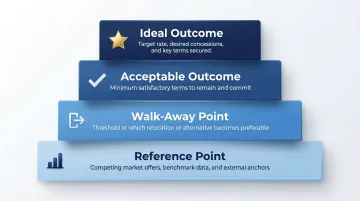
Basic negotiation strategy structure:
- Ideal outcome: Rate, concessions, term, flexibility clauses you want
- Acceptable outcome: Minimum terms you'd accept to stay
- Walk-away point: Clear threshold where relocating makes more sense
- Reference point: Align all three against competing offers and market data gathered in earlier steps
That strategy is only as strong as the market intelligence behind it. A startup-savvy broker gives you both.
Tip 7: Work With a Startup-Savvy CRE Broker — It Costs You Nothing
In NYC commercial real estate, the landlord pays the broker's commission, meaning startups get expert representation at no direct cost. A good broker brings market data, negotiation experience, and landlord relationships that dramatically shift the balance in your favor.
Choose a broker who specializes in startups and understands unique needs — including growth planning, buildout execution, and flexible space structures. Nomad Group works exclusively with high-growth NYC companies — 300+ tenant buildouts completed, 2M+ sq ft leased — covering everything from lease negotiation through buildout and ongoing space management.
Frequently Asked Questions
Can you negotiate rates and terms when renewing a commercial lease?
Yes, all standard aspects of a commercial lease renewal are negotiable — including base rent, free rent periods, TI allowances, lease length, expansion/contraction rights, and sublease flexibility. Tenants with competing offers and market data negotiate from the strongest position.
How do you negotiate a commercial lease renewal?
Start 12-18 months early and assess your space needs, growth trajectory, and flexibility requirements. Research the market, identify every term you want to negotiate beyond base rent, and enter discussions with a clear strategy — ideally with a broker advocating on your behalf.
How far in advance should a startup start lease renewal negotiations?
12-18 months before expiration for most NYC startups. Earlier timelines allow for proper market research, space evaluation, and negotiation without the pressure of an imminent deadline that forces rushed decisions.
What concessions can startups realistically ask for in a commercial lease renewal?
The most impactful concessions include free rent periods (rent abatement), tenant improvement allowances for space upgrades, expansion/contraction rights, favorable sublease provisions, reduced reinstatement obligations, and flexible lease term lengths.
Should a startup renew its lease or relocate when the lease expires?
The right answer depends on whether the current space still fits your headcount, culture, and growth trajectory. Researching alternatives is valuable even if you plan to stay, because it informs negotiation and occasionally reveals a better option.
What is a tenant improvement allowance and can you negotiate it at renewal?
A TI allowance is a landlord-funded budget for renovating or reconfiguring your space. Yes, it's negotiable at renewal — particularly when the space needs updates. Landlords generally prefer funding improvements over losing a tenant to relocation.