
The information gap is real. Startups face headcount projections that can change quarter to quarter, tight runways that make every dollar of operating expense count, and culture requirements that make "any desk will do" not an option. Yet most have no dedicated real estate function internally.
This article covers what a commercial real estate broker actually does for a startup, why the stakes are higher than most founders realize, and what separates the right broker from a transactional one.
Key Takeaways
- A tenant rep broker works exclusively for you — not the landlord — and is typically paid by the landlord at no direct cost to your startup
- Commercial lease searches take 90 to 180 days minimum; engaging a broker early keeps timelines from derailing your business
- Rent is the second-largest startup expense after payroll — expert negotiation directly affects your runway
- Beyond the lease, the right broker coordinates buildout, facilities, and long-term space strategy as you scale
- In NYC, neighborhood dynamics, landlord relationships, and deal pace vary block by block — local expertise shapes what you pay and how fast you close
What Is a Commercial Real Estate Broker?
A commercial real estate broker is a licensed professional who handles the leasing, buying, or selling of commercial properties. The role is fundamentally different from residential real estate.
Commercial leases come with layers residential deals don't: multi-year terms, tenant improvement allowances, NNN structures, personal guarantees, operating expense escalations, and renewal option mechanics — each of which can meaningfully affect your costs and flexibility.
Landlord Rep vs. Tenant Rep
There are two sides to every commercial lease deal:
- Listing (landlord) brokers represent building owners — their goal is maximizing rent and securing the most favorable terms for the landlord.
- Tenant rep brokers represent occupiers — they find the right space, run the market analysis, and negotiate the best economic package on your behalf.
For a startup, the relevant relationship is with a tenant representative. A good tenant rep works exclusively in your interest — not the landlord's, and not their own commission target.
Who Pays the Broker?
Most startup founders are surprised to learn that you typically don't pay your tenant rep broker directly. In standard commercial lease transactions, the landlord pays both the listing broker and the tenant rep's commission — usually 3% to 6% of the total lease value, split between the two brokers involved.
If you negotiate without representation, the landlord doesn't lower your rent. They simply keep that fee — and you negotiate alone against someone who does this every day.
The Core Responsibilities of a CRE Broker for Startups
Space Search and Market Intelligence
Publicly available listing platforms show a fraction of what's actually available. Experienced brokers maintain access to off-market inventory, sub-lease opportunities, and direct landlord relationships that surface options most tenants never see.
For a startup, this matters because space requirements can shift dramatically with headcount. A team growing from 10 to 50 people at 150 square feet per person needs to scale from roughly 1,500 to 7,500 square feet — a 5x increase that demands real market knowledge, not just a LoopNet search.
In Manhattan, the variance across micro-markets is significant. Midtown South asking rents range from $86.86/sf overall to $105.19/sf in Greenwich Village, while SoHo maintains the lowest vacancy at 14.1% in that submarket. A broker who knows these dynamics can save a startup material dollars before a lease is even drafted.
Lease Negotiation
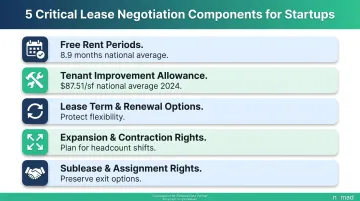
Rent is just the starting point. The economic package a broker negotiates typically includes:
- Free rent periods — Currently averaging 8.9 months nationally (down from a 2023 peak of 9.6 months), these periods can extend runway during buildout
- Tenant improvement allowances (TI) — NYC TI allowances peaked at $147/sf in 2022 and have since declined; national averages dropped from $97.55/sf in 2023 to $87.51/sf in 2024. Skilled negotiation is increasingly critical as the concession window tightens
- Lease term and renewal options — Shorter initial terms with renewal options protect a startup's optionality; landlords often push for longer terms when providing significant TI
- Expansion and contraction rights — Critical for companies whose headcount projections may change within a 3-5 year lease window
- Sublease and assignment rights — Standard lease forms often restrict these; a broker knows to push for them explicitly
That review doesn't happen in isolation. The broker also coordinates between your legal counsel, architects, and construction teams — keeping timelines aligned and preventing the scope drift that pushes move-in dates back by months.
Why Startups Specifically Need a CRE Broker
The Financial Exposure Is Larger Than It Looks
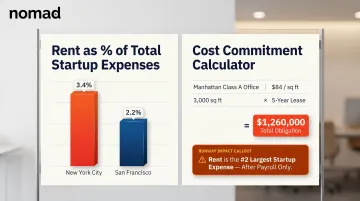
According to Kruze Consulting's analysis of startup financials, NYC startups allocate 3.4% of total expenses to rent — 50% higher than San Francisco startups at 2.2%. Rent is the second-largest expense after payroll.
Unlike a SaaS subscription you can cancel next month, a commercial lease is a multi-year obligation that goes directly onto your balance sheet under ASC 842 accounting standards. It affects your financial statements, fundraising conversations, and runway calculations simultaneously.
Manhattan asking rents currently average $78.80/sf across all classes, with Class A space at $84/sf. For a 3,000 sf office on a 5-year term, you're committing to a lease worth over $1.2M. A single misstep in that negotiation — a missed rent cap, an absent termination clause — can cost more than a full hiring cycle.
You're Negotiating Against a Professional
The landlord's listing broker is an expert negotiator. Their sole job is to maximize rent and minimize landlord concessions. When a startup negotiates without tenant representation, they're sitting across the table from that professional without one of their own.
Deal data, market comps, and landlord relationships take years to build. A tenant rep brings all three on day one. The landlord budgets for that commission regardless — the question is whether you capture the value or not.
That negotiating gap matters most when it comes to the lease provisions that protect your company as it grows.
Flexibility Provisions That Protect Your Growth
Startups need clauses that most founders don't know to ask for:
- Sublease rights — If the team goes hybrid or downsizes, the ability to sublease space can be the difference between a manageable situation and a severe cash drain
- Right of first offer/refusal on adjacent space — These typically require a 5-10 business day response window; negotiating them upfront is far easier than after signing
- Early termination options — Most leases don't include these by default; a broker can negotiate a pre-agreed buyout structure rather than leaving the startup exposed to full lease liability
- Rent escalation caps — Annual increases capped at 2-3% provide cost predictability across a multi-year term
NYC Market Complexity
Manhattan recorded 41.92 million square feet of leasing volume in 2025 — the highest in six years. In a market moving at that pace, deals get done quickly and competitive spaces don't wait. Neighborhood dynamics within Manhattan vary sharply: a NoMad Class B building operates differently than a Flatiron Class A, in terms of landlord expectations, concession packages, and deal pace.
Knowing which buildings have hands-on ownership, which landlords are offering aggressive tenant improvement (TI) packages, and where vacancy is creating leverage is information that takes years to accumulate. Nomad Group's focus on the NoMad–Flatiron–Union Square corridor — what they call "Unicorn Lane" — is built on exactly that kind of ground-level market knowledge.
Beyond the Lease: Full-Service Support for Growing Companies
The lease signing isn't the finish line. For most startups, it's when the operational complexity actually begins.
Buildout and Construction Management
NYC office fit-out costs average $193/sf in the Tri-State area, compared to a national average of $149/sf — a 30% premium that makes construction management a financial decision, not just a logistical one. The typical buildout timeline runs 4-6 months from design through move-in, with approvals and permitting accounting for a significant share.
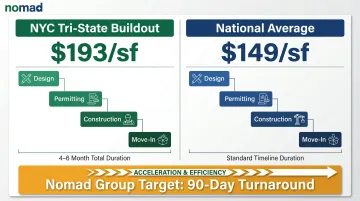
Nomad Group's in-house construction management targets a 90-day buildout turnaround — a meaningful compression of the standard timeline. For startups with a hard move-in deadline (an expiring WeWork agreement, a team that's outgrown its current space), that speed is the deciding factor.
Ongoing Facilities and Long-Term Strategy
For startups that want to stay focused on building their business, a full-service partner can manage day-to-day facilities operations, vendor coordination, and maintenance, keeping leadership out of the weeds entirely.
That ongoing relationship compounds in value as the company grows. From Series A through Series B, the right broker helps plan for headcount expansion, evaluates sublease opportunities when hybrid work shifts space needs, and eventually negotiates the larger headquarters lease that reflects a company's new scale. Nomad Group positions itself as that long-term partner — clients like dbt Labs, Optimove, and Fever are a reflection of what that model looks like in practice.
How to Choose the Right CRE Broker for Your Startup
Not all brokers are the right fit. A few specific criteria matter for startups:
- Tenant-rep focus. Ask directly: what percentage of their deals are tenant representation, and what size companies do they typically serve? Landlord reps and investment sales brokers have different incentives — and it shows.
- Early-stage experience. A broker who works primarily with established corporations may not understand the flexibility requirements and tight capital constraints of a Series A company. Ask specifically about early-stage clients.
- Relationship-first approach. Brokers at large firms with volume quotas tend to push toward quick closings on high-commission deals. A startup needs someone who'll think through a 3-year growth plan, not just the immediate transaction. The best signal: a good broker asks more questions than they answer in the first meeting.
- Full-service capabilities. If the broker can only help you find and sign a space, you'll coordinate separately with architects, contractors, and facilities vendors. A firm that covers brokerage, buildout, and ongoing operations removes that burden — which matters when your ops team is two people.
Frequently Asked Questions
What should I look for when choosing a commercial real estate broker?
Look for tenant-rep specialization, genuine startup experience at your funding stage, and deep knowledge of your target neighborhoods. Relationship-first firms not driven by volume quotas tend to negotiate more thoughtfully for early-stage companies. Full-service capabilities — buildout, facilities, long-term advisory — are a meaningful bonus.
What does a commercial leasing broker do?
A leasing broker guides tenants through finding, evaluating, and negotiating commercial space. That includes market research, space tours, financial analysis of lease terms, landlord communication, and due diligence on lease language. The goal is an informed decision without the tenant managing every moving piece.
How do commercial real estate brokers find clients?
Primarily through referrals, VC and investor networks, and direct outreach. In the NYC startup ecosystem, the best tenant rep brokers are typically found through founder-to-founder recommendations — so ask peers who've recently completed a lease search who they used and whether they'd go back.
Do startups have to pay a commercial real estate broker?
In most commercial lease transactions, the landlord pays the tenant rep's commission — typically 3% to 6% of total lease value. Startups get expert representation without paying out of pocket. If you go without a broker, the landlord keeps that commission rather than passing the savings to you.
When should a startup hire a commercial real estate broker?
Ideally 6 to 12 months before your target move-in date. The search, negotiation, permitting, and buildout process takes longer than most founders expect. Starting late compresses your options and weakens your negotiating position.
What is a tenant rep broker?
A tenant representative broker works exclusively on behalf of the tenant — not the landlord — to find the right space and negotiate the most favorable lease terms. Their interests are aligned with yours: they want the best deal for your company, not the fastest commission for themselves.