Introduction
Signing an office lease in New York City is one of the biggest financial commitments a company will make. Lease terms typically run five years or longer — Commercial Observer reports that even tech firms averaged 5.3-year terms in H1 2025 — and with Manhattan asking rents averaging $78.93 per square foot as of early 2026, the financial stakes are substantial.
Yet many founders and operations leaders enter this process without understanding who's actually sitting across the table — or whether the broker they're talking to is working for them.
This guide breaks down what a CRE broker is, the different types, what they do for tenants, how they're paid, and what to look for when navigating NYC's tight office market.
A few things worth knowing upfront:
- CRE brokers are licensed professionals who facilitate commercial property transactions
- Tenant rep brokers work exclusively for you — not the landlord
- The landlord typically pays both brokers' commissions, so tenant representation costs you nothing out of pocket
- Choosing the right broker can mean the difference between a lease that supports your growth and one that constrains it
What Is a CRE Broker?
A commercial real estate broker is a licensed professional who acts as an intermediary between buyers and sellers, or landlords and tenants, in commercial property transactions. According to the New York State Department of State, a real estate broker is any person or entity that, for compensation, lists, sells, buys, rents, or negotiates real estate for another party.
CRE covers a wide range of property types: office, retail, industrial, and multifamily. This guide focuses specifically on office leasing, where the complexity and financial risk are highest for growing companies.
CRE vs. residential real estate: The differences matter more than most people expect. Commercial transactions involve:
- Higher dollar values and longer timelines
- Complex lease structures with TI allowances, rent abatement, personal guarantees, and renewal options
- Significant legal and financial implications that make professional guidance critical
- No consumer protection laws equivalent to those in residential transactions
Broker vs. Agent: What's the Difference?
The terms are often used interchangeably, but they're not the same.
In New York, a broker must complete 152 hours of approved qualifying education, pass a broker exam, and have at least two years of experience as a licensed salesperson (or three years in the real estate field). A salesperson (also called an agent) requires only 77 hours of education and must work under a licensed broker's supervision. Brokers can operate independently and employ agents; agents cannot.
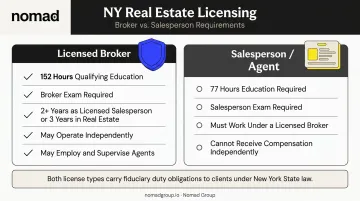
This distinction matters when you're signing a multi-year lease. A licensed broker carries a fiduciary duty to their client: they must act in your best interest, maintain confidentiality, and disclose potential conflicts. That's a legally enforceable standard — one that gives you real recourse if the broker prioritizes their commission over your deal.
For a company signing its first Manhattan lease, this matters more than most realize. A five-year lease in Flatiron or NoMad can easily represent $2M+ in total commitment — the credentials of who's at the table are worth scrutinizing before you sign anything.
Types of CRE Brokers Explained
Before engaging anyone, understand who represents whom. Not all brokers are on your side.
Tenant Representation Brokers
A tenant rep broker advocates exclusively for the company renting or buying space. Their job is to find suitable properties, negotiate the most favorable lease terms, and protect the tenant's interests throughout the entire process.
The financial structure makes this particularly valuable: tenant rep brokers are typically paid by the landlord, meaning businesses access experienced, dedicated representation at no direct out-of-pocket cost. For startups and scaling companies watching their budgets, this is significant.
Nomad Group works exclusively on this model, representing tenants from initial space search through lease signing — with no competing obligation to the landlord.
Landlord Representation (Listing) Brokers
Listing brokers represent property owners. Their goal is to market available spaces, attract qualified tenants, and negotiate terms that maximize the landlord's returns.
Their fiduciary duty runs to the property owner — not to you. A listing broker can deal honestly and in good faith with tenants while still working to protect the landlord's interests. These aren't contradictory; they're legally distinct.
A Note on Dual Agency
Dual agency — where one broker represents both sides in the same transaction — is legal in New York but requires informed written consent. NY DOS warns explicitly that a dual agent cannot provide the full range of fiduciary duties to both parties.
For tenants, this is a meaningful risk. Prioritize exclusive representation wherever possible.
What Does a CRE Broker Do for You?
For a company signing a five- or ten-year lease on thousands of square feet, the broker's role extends well beyond pulling listings. A good tenant rep broker is a strategic partner across the entire process.
Property Search and Site Selection
A broker translates your company's needs — headcount projections, culture, budget, commute accessibility — into a targeted search. This includes off-market spaces that never appear on public listing platforms, which can represent some of the best opportunities in a competitive market.
In a market like NYC, broker relationships are what unlock those off-market deals. Nomad Group's concentration in Flatiron, Union Square, NoMad, SoHo, and Williamsburg means they're often the first call when a space opens up — before it ever hits a listing platform.
Lease Negotiation
Commercial lease negotiation is materially more complex than anything in residential real estate. A skilled tenant rep fights for:
- Tenant improvement (TI) allowances to fund your buildout — Savills reports TI allowances increased 112% from 2016 to 2025
- Free rent periods that provide cash flow relief during construction
- Renewal and termination options that protect you as your business evolves
- Rent escalation caps that prevent unexpected cost spikes mid-lease
- Assignment and sublease rights that provide optionality if your needs change
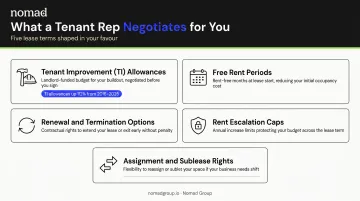
Avison Young reported that Manhattan Class A concessions equaled 24% of total rent over the lease term — a number a tenant negotiating alone is unlikely to capture in full.
Market Analysis and Due Diligence
Brokers bring data-driven guidance on comparable rents, vacancy trends, and market timing. Without this context, tenants are negotiating blind against landlords who price space every day.
NYC SBS flags these lease terms as the most consequential — and the most commonly misunderstood by tenants going it alone:
- Renewal and expansion options
- Escalation clauses and rent bumps
- Assignment and sublease rights
- Good-guy guaranties
- Accelerated-rent clauses
Each one carries real financial risk if poorly negotiated or overlooked entirely.
From Search to Move-In: The Full-Service Difference
Most brokers close the deal and move on. What happens between signed lease and functioning office — the buildout, the coordination, the operations — is usually left to you.
Nomad Group's model extends through construction management, buildout coordination, and ongoing facilities management. With 300+ completed tenant buildouts and a 90-day average turnaround, they've helped companies like Extend go from white-box to fully operational in five weeks.
Flora (FloraFauna AI) was ready to double their footprint within 30 days of move-in. That kind of speed doesn't happen by accident — it's what in-house construction and project management actually delivers.
How CRE Brokers Are Compensated
CRE brokers earn a commission based on the total transaction value — either the sale price (for a purchase) or the aggregate value of a lease over its full term.
Who Pays the Commission?
In most commercial leasing transactions, the landlord pays both the listing broker's and the tenant rep's commissions. Tenants don't write a check to their broker. This structure makes professional tenant representation accessible even for early-stage companies without dedicated real estate budgets.
Because broker commissions are tied to deal size, there's a theoretical incentive to push toward larger, more expensive spaces. When evaluating a broker, watch for:
- Direct fee disclosure — they explain exactly how they're paid before you tour a single space
- Right-sized recommendations — suggestions match your headcount and growth plan, not the highest available rent
- No pressure on timelines — a trustworthy broker won't rush you toward a decision that benefits their commission
A broker who leads with transparency on compensation is almost always easier to work with throughout the whole deal.
Tenant Rep vs. Landlord Rep: What's the Difference?
When your company is searching for office space, you need a tenant rep broker — not the broker representing the building you're touring.
The listing broker's job is to protect the landlord's interests. Touring a space with the listing broker is fine; relying on them for negotiation is a problem. Without independent representation, you have no one fighting exclusively on your behalf, which frequently results in:
- Fewer concessions and weaker lease terms
- Missed renewal and termination protections
- Unfavorable escalation structures
- Less negotiating leverage overall
Dedicated tenant representation means having an expert whose only job is securing the best possible outcome for your company — not the landlord's. The landlord has a professional in their corner. Nomad Group makes sure you do too, working with scaling companies across NYC neighborhoods including Flatiron, NoMad, SoHo, and Williamsburg.
How to Choose the Right CRE Broker
Not every broker who works in commercial real estate is the right fit for a scaling company. Before you engage anyone, evaluate them on these five criteria:
Key Evaluation Criteria
- Focuses specifically on your property type and target neighborhoods — not just "Manhattan" broadly
- Has completed leases with companies at your headcount and growth stage, not just enterprise deals
- Holds deep landlord relationships that unlock off-market spaces and carry weight at the negotiating table
- Represents tenants exclusively — or is fully transparent when they don't
- Offers post-lease support: construction coordination, facilities management, or ongoing space operations
Questions to Ask Before Hiring
Use these questions to pressure-test any broker before signing an engagement agreement:
- How many office leases have you completed in my target neighborhoods in the past two years?
- Can you share references from companies with similar headcount and growth trajectory?
- Do you offer services beyond lease signing — construction coordination, facilities management?
- How do you handle conflicts of interest if you also represent landlords? (This matters more than most tenants realize.)
- What market data and tools do you use to advise on comparable rents and timing?
Green Flags vs. Red Flags
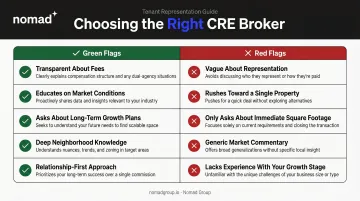
| Green Flags | Red Flags |
|---|---|
| Transparent about fees and commission structure | Vague about who they actually represent |
| Educates you on market conditions before pushing spaces | Rushes toward a single property early in the process |
| Asks about your long-term growth plans | Only asks about immediate square footage |
| Deep neighborhood knowledge with specific examples | Generic market commentary without specifics |
| Relationship-first approach, not deal-volume driven | Lacks experience with companies at your growth stage |
Frequently Asked Questions
What is a CRE broker?
A CRE broker is a licensed professional who acts as an intermediary between buyers and sellers, or landlords and tenants, in commercial property transactions. In New York, brokers must complete 152 hours of qualifying education and meet experience requirements set by the NY Department of State.
What is the difference between a CRE broker and a real estate agent?
A broker holds a higher-level license requiring more education, experience, and a more rigorous exam, and can operate independently. A real estate agent (salesperson) must work under a licensed broker's supervision and cannot receive compensation except through their associated broker.
How do CRE brokers get paid, and who pays the commission?
CRE brokers earn a commission based on the transaction value. In most NYC commercial leasing deals, the landlord pays both the listing broker's and the tenant rep's commissions, meaning tenants typically receive professional representation at no cost to them.
What is a tenant representation broker in commercial real estate?
A tenant rep broker exclusively advocates for the business leasing or buying space, handling property search, lease negotiation, and due diligence on the tenant's behalf. Their fees are typically paid by the landlord, making the service accessible regardless of company size.
Do I need a CRE broker to lease office space in NYC?
Not legally required, but practically essential. Without a tenant rep, you're negotiating against the landlord's experienced broker with no advocate of your own. No one at the table is there to secure concessions for you.
How do I know if my CRE broker is working in my best interest?
Look for these signals:
- Confirms they represent only you (no dual agency)
- Shares market data proactively, before showing spaces
- Is upfront about their commission structure
- Asks about your growth plans, not just your headcount