
Introduction
Picking a commercial real estate broker in New York City isn't as simple as responding to the first cold call you receive. Different brokerage models exist — each with distinct roles, contractual obligations, and loyalties that directly affect what you get out of the relationship.
For high-growth companies navigating tight timelines, multi-year lease commitments, and a Manhattan office market where average asking rents hit $77.89 per square foot in Q4 2025, the type of brokerage service you engage can influence your lease terms, negotiating leverage, and total occupancy costs.
This article breaks down the **three primary types of commercial real estate brokerage services**, what functions each one performs, and how to evaluate which model fits your company's situation — before you sign anything.
Key Takeaways
- Brokerage services connect tenants and landlords with the right spaces and deal terms — but not all brokers work for the same party
- Three primary types: tenant representative, landlord representative, and full-service brokerage
- Each type serves a different principal — tenant reps fight for the renter, landlord reps protect the owner, and full-service firms handle both sides of the lifecycle
- Misreading who your broker represents costs you leverage at the negotiating table
- The right match comes down to your growth stage and how much real estate support you need beyond the signed lease
What Are Brokerage Services in Commercial Real Estate?
Commercial real estate brokerage is a licensed professional service in which a broker facilitates transactions between parties — typically a tenant and a landlord — in exchange for a commission. In most office lease transactions, that commission is paid by the landlord at lease signing, which means tenants can typically engage a tenant rep at no direct out-of-pocket cost.
The New York Department of State defines a real estate broker as a person or firm who, for a fee or commission, rents or offers to negotiate a rental of an interest in real estate. In practice, brokerage services span a wide range:
- Sourcing available space and conducting market analysis
- Evaluating financial terms and comparing comparable deals
- Negotiating lease terms on behalf of a client
- Managing due diligence through lease execution
- In some models, overseeing construction and ongoing space management
Those services sound straightforward — until you consider who's actually delivering them. Two brokers can carry the same license but operate under entirely different mandates: one working exclusively for you, another working exclusively for the landlord. Knowing which side of the table your broker sits on before negotiations start is what separates a good deal from a costly one.
Why Brokerage Services Matter for High-Growth Companies
For companies scaling quickly — particularly Series A and B startups signing their first real office lease — the stakes are high. Commercial leases in NYC routinely run five to ten or more years, often include personal guarantees, and require significant build-out investment before the space is usable.
The NYC Small Business Services commercial lease guide makes one thing clear: commercial landlords are not legally required to renew a lease or limit rent increases unless the lease explicitly contains those provisions. What you negotiate upfront is what you're stuck with.
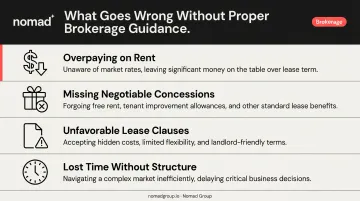
What typically goes wrong without proper brokerage guidance:
- Tenants overpay on base rent without access to comparable deal data
- Negotiable concessions — tenant improvement allowances, free rent periods, renewal options — go unasked
- Leases get signed with unfavorable clauses around assignment, subletting, or escalation
- Months are lost searching without structure, submarket intelligence, or landlord access
Most of these outcomes trace back to a single structural problem: the brokerage model chosen determines whose interests are legally being served. Every property shortlist, every recommendation, every negotiating position — they all follow from that alignment.
Types of Commercial Real Estate Brokerage Services
Brokerage services are not one-size-fits-all. The type of broker you engage determines not just what services you receive, but who that broker is contractually obligated to serve.
Understanding the three primary types helps companies avoid conflicts of interest and select a model that matches their goals.
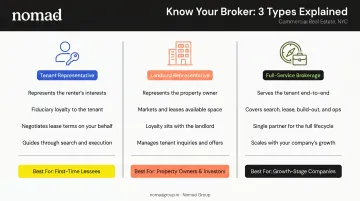
Tenant Representative Brokerage
A tenant rep broker — sometimes called a tenant advocate — is hired exclusively to represent the interests of the company leasing space. They conduct the space search, evaluate options, and lead negotiations entirely on behalf of the tenant.
According to the New York DOS Landlord/Tenant Disclosure Form, a tenant's agent owes fiduciary duties including reasonable care, undivided loyalty, confidentiality, full disclosure, obedience, and duty to account — all oriented toward the tenant.
Best suited for: Companies without in-house real estate expertise, those searching across multiple submarkets, or anyone entering a lease negotiation for the first time.
Key strengths:
- Full advocacy in negotiations with no allegiance to any landlord
- Access to off-market listings and comparable deal data
- Objective property evaluation across the full market
- Ability to negotiate concessions (TI allowances, free rent, renewal options) without conflicts
Limitations to know: The commission structure — typically paid by the landlord — can create a subtle incentive to close deals faster rather than hold out for better terms. Always review the engagement letter to understand how your broker is paid and what tail protection provisions exist if you switch brokers mid-search.
Landlord Representative Brokerage
A landlord rep broker — also called a listing broker — is engaged by the property owner to market their building or suite, find qualified tenants, and negotiate leases that favor the landlord's terms.
Per the same NY DOS disclosure form, a landlord's agent owes the same fiduciary duties listed above — but oriented entirely toward the owner. They may co-broke with a tenant rep and split the commission, but their loyalty stays with the landlord throughout the process.
This model serves property owners, asset managers, and institutional investors who need professional representation to market, price, and lease commercial space. It is not a substitute for a tenant's own representation.
Key strengths:
- Deep knowledge of the specific property and ownership priorities
- Ability to structure deals within landlord constraints
- Established relationships that can accelerate deal timelines
The critical risk for tenants: A landlord rep working with an unrepresented tenant creates a serious information asymmetry. That broker knows the ownership's floor and negotiating position. You don't. Tenants who engage directly with listing brokers without their own representation routinely leave money on the table — on rent, on concessions, and on lease flexibility.
Full-Service Commercial Real Estate Brokerage
A full-service commercial real estate firm goes beyond transaction brokerage to provide end-to-end support across the entire office lifecycle — from market analysis and site selection through lease negotiation, space design, construction management, and ongoing facilities operations.
This model is structurally different from traditional brokerage. Traditional tenant or landlord reps typically disengage after lease signing. Full-service firms stay active through build-out, occupancy, and renewal — functioning more as an integrated real estate department than a transactional intermediary.
Nomad Group operates under this model in NYC, having completed 300+ tenant build-outs and leased over 2 million square feet as part of their integrated platform. Their process continues through construction coordination, furniture and vendor management, and ongoing facilities management — covering the full lifecycle rather than stopping at lease execution.
Best suited for: High-growth companies without dedicated real estate or facilities teams; companies executing complex build-outs on tight timelines; organizations that want a single accountable partner across search, construction, and space management.
Key strengths:
- Continuity eliminates hand-off inefficiencies between brokers, designers, and contractors
- Single point of accountability reduces risk of delays or budget overruns
- Submarket expertise compounds over time through accumulated deal data
Limitations: Full-service firms may not be necessary — or cost-effective — for simple single-suite transactions where only transactional brokerage is needed. Before engaging, confirm whether construction management is truly in-house or subcontracted.
How to Choose the Right Brokerage Type
The right brokerage type depends on your company's internal capacity, the complexity of the lease, and what you'll need once the ink is dry.
| Factor | Consider Tenant Rep | Consider Full-Service |
|---|---|---|
| Internal real estate expertise | Experienced team, multiple prior leases | First major lease, no dedicated RE staff |
| Lease complexity | Single suite, straightforward terms | Custom build-out, tight timeline |
| Post-lease needs | Internally managed | Need build-out + ongoing operations |
| Submarket depth required | Multiple submarkets, general search | Specific corridors like NoMad or Flatiron |
Key evaluation criteria:
- Read the engagement agreement before signing — confirm exclusivity clauses, commission structures, and tail protection provisions to understand who the broker actually works for
- First major office commitment? A full-service partner delivers more than a transactional rep when your team has no dedicated real estate staff
- Anticipating a custom build-out or future expansion? A firm that manages construction and facilities removes the need to source vendors mid-process
- In NYC, brokers with concentrated deal history in specific corridors (NoMad, Flatiron, SoHo, Williamsburg) surface off-market opportunities that generalists never see
Nomad Group's concentration in these Manhattan and Brooklyn submarkets translates directly to results for tenants: landlord relationships built over hundreds of deals, access to spaces that never hit listings, and build-out benchmarks drawn from 300+ completed projects in the same buildings.
Common Mistakes Companies Make When Selecting a Broker
Avoid these four errors — each one is common, and each one is costly:
- Choosing by firm name, not service fit. Large national firms may assign junior brokers to smaller tenants while chasing higher-volume deals. Find out who will actually work your deal before signing.
- Skipping the engagement letter. This document defines what your broker is accountable for. According to SIOR, office lease commission agreements routinely cover post-termination protections, renewals, expansions, and payment timing — all details that disappear when companies sign without reading.
- Treating the relationship as one-and-done. Companies that disengage their broker at lease signing often manage build-out and vendor coordination on their own — and frequently run over budget and behind schedule as a result.
- Going directly to the listing broker. The landlord's broker owes fiduciary duties to the landlord, not to you. Even if they seem helpful, they already know the ownership's floor on rent. You don't.
Conclusion
Commercial real estate brokerage services are foundational to how companies find, secure, and operate their office space — but the type of brokerage model you engage determines whose interests are served, how much support you receive, and what outcomes are realistically achievable.
Tenant rep, landlord rep, and full-service brokerage each address different needs. Evaluate them against your company's stage, complexity, and internal real estate capacity. Price and familiarity are starting points, not deciding factors.
Knowing what each model actually delivers — and who it's designed to serve — puts you in a stronger position before you ever sit across from a broker. Firms like Nomad Group operate as full-service partners across the entire real estate lifecycle, from initial search through buildout and ongoing operations, which is worth weighing against a traditional single-transaction broker when your needs extend beyond signing a lease.
Frequently Asked Questions
What is a brokerage engagement agreement?
A brokerage engagement agreement is a written contract between a broker and their client that defines the scope of services, duration, commission structure, exclusivity terms, and the broker's duties. Review it carefully before signing — it determines what the broker is legally obligated to deliver, not just what was discussed verbally.
What should be included in an engagement letter?
Key elements to look for:
- Duration and termination rights
- Exclusivity provisions
- How and when compensation is paid
- Scope of agency (who the broker represents)
- Tail protection period after engagement ends
- Specific services the broker commits to perform
What is the difference between a tenant rep broker and a landlord rep broker?
A tenant rep works exclusively for the company leasing space and advocates for the best possible lease terms on their behalf. A landlord rep is hired by the property owner to market and lease their building — meaning their loyalty sits with the owner, not the tenant.
How do commercial real estate brokers typically get paid?
In most commercial lease transactions, the broker's commission is paid by the landlord as a percentage of total lease value at signing. Tenants can typically engage a tenant rep at no direct cost — though understanding the commission structure helps clarify the broker's incentives.
Can a broker represent both the tenant and the landlord in the same deal?
Yes. This is called dual agency, and while it's legal with proper disclosure and consent, it inherently limits the broker's ability to fully advocate for either side. The NY DOS Legal Memorandum LI12 warns that in dual agency, both the tenant and landlord give up the right to undivided loyalty — weigh this carefully before agreeing.
What should a high-growth company look for when choosing a commercial real estate broker?
Look for:
- Confirmed tenant-only representation (no dual agency)
- Demonstrated deal history in your target submarkets
- Transparency about commission structure
- Clear scope of services beyond the lease, including build-out support
The engagement letter should hold the broker accountable for deal quality, not just space identification.