Introduction
Signing your first commercial lease in New York City isn't like any other business decision you'll make as a startup founder. A residential lease locks you in for a year or two. A commercial lease commits you for 3-5 years minimum, often tying up capital, defining your culture, and constraining headcount flexibility at precisely the moment your business needs maximum agility.
The terminology is opaque, deal structures vary building by building, and landlords negotiate these transactions every day. You're doing it for the first time.
That challenge looks roughly the same regardless of where you are:
- A first-time founder signing your first lease
- A Series A company outgrowing shared workspace
- A scaling team planning 2-3 years ahead
This guide walks you through how commercial real estate brokerage actually works — what brokers do, how to engage them, and how to make decisions that protect your runway and support your growth.
Key Takeaways
- CRE brokerage connects tenants with landlords through licensed professionals who manage search, negotiation, and execution
- Work with a tenant rep broker who represents your interests exclusively — not the landlord's
- NYC submarkets vary dramatically — knowing your lease types and negotiation leverage early saves real money
- Expect 6-12 weeks for a standard lease, plus 8-14 more weeks if you need a buildout
- Choose a brokerage with startup experience, transparency, and end-to-end capabilities
What Is Commercial Real Estate Brokerage?
Commercial real estate (CRE) brokerage facilitates the leasing, buying, and selling of non-residential property — offices, retail, industrial, and mixed-use spaces — through licensed professionals who represent one or both parties in a transaction.
Broker Roles You'll Encounter
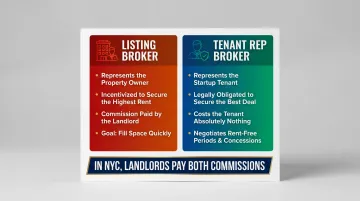
Startups typically interact with two types of brokers:
- Listing broker — Represents the landlord, markets the space, and is incentivized to secure the highest rent and most favorable terms for the property owner
- Tenant rep broker — Represents you, the company searching for space, with a legal and financial obligation to negotiate the best possible deal on your behalf
In NYC commercial leasing, landlords pay broker commissions — typically a percentage of base rent over the lease term. This means tenant representation costs you nothing directly while giving you professional advocacy throughout negotiations.
Property Types Startups Encounter
Understanding property categories helps you and your tenant rep broker narrow the search quickly. The four main CRE property categories are:
- Office — The primary category for most tech, SaaS, and knowledge-work startups
- Retail — Street-level storefronts and consumer-facing spaces
- Industrial/Warehouse — Logistics, manufacturing, and distribution facilities
- Mixed-Use — Buildings combining office, retail, residential, or other uses
Office leasing in dense markets like NYC involves factors that don't apply elsewhere: floor plate efficiency, elevator infrastructure, HVAC capacity, and building amenities each affect your day-to-day operations and long-term lease economics. For most startups, office space is where the complexity is highest — and where the right broker guidance matters most.
What Startups Should Know Before Engaging a CRE Broker
Many first-time founders approach commercial leasing with a residential mindset — browse listings, tour a few spaces, pick one, sign.
Commercial leases are multi-year legal commitments with rent escalations, buildout costs, operating expense pass-throughs (costs like taxes and maintenance billed directly to tenants), and termination clauses that can cost you hundreds of thousands of dollars if negotiated poorly.
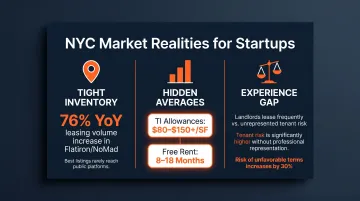
Three NYC Market Realities That Catch Startups Off Guard
Tight inventory in the right neighborhoods: Flatiron/NoMad leasing volume surged 76% year-over-year in Q2 2025. The best listings in Flatiron, NoMad, SoHo, and Williamsburg rarely sit on public platforms long — by the time a space shows up in a search, it's often already in negotiation.
The averages hide what actually matters: TI allowances in Manhattan averaged $132.57 per square foot in 2024, but some landlords offer $150+/SF while others offer $80/SF. Free rent periods ranged from 8 to 18 months — knowing which buildings lean generous requires market access, not just a search tool.
Your landlord negotiates this every day. You don't. Property owners and their teams close dozens of leases per year. Unrepresented tenants consistently miss expansion rights, accept unfavorable expense pass-throughs, or agree to restoration obligations that run six figures at lease end.
What to Clarify Before Your First Broker Meeting
- Honest headcount projection — Current team size and realistic growth forecast for 18-24 months
- Budget range including buildout — Not just monthly rent; account for construction costs, furniture, and operating expenses
- Preferred neighborhoods — Tied to team commute patterns, talent density, or brand identity
- Flexibility priorities — Will you need expansion options? Early termination rights? Shorter lease terms for agility?
Brokers who specialize in startup tenants — like the team at Nomad Group — can move faster and negotiate harder when they understand your constraints upfront. Ambiguity at this stage typically costs time, not just tours.
Why Startups Benefit from Working with a CRE Broker
Market Access
A well-networked tenant rep broker has visibility into off-market listings, upcoming availabilities, and landlord preferences that never appear on CoStar or LoopNet. In tight corridors like NoMad and SoHo, this access is a material advantage. For example, Nomad Group helped Authentic Insurance secure a full-floor space at 30 West 21st Street through direct landlord relationships, delivering a character-rich office 30% under comparable coworking costs.
Negotiating Leverage
Brokers understand what's actually negotiable in a lease:
- Rent-free periods to offset buildout time
- TI allowances to reduce out-of-pocket fit-out costs
- Expansion rights to adjacent space
- Early termination clauses tied to funding milestones or acquisitions
- Operating expense caps and audit rights
Startups negotiating directly almost never know what the market rate actually is, let alone what landlords will concede. TI allowances remain 27% above pre-pandemic levels, creating significant savings potential for represented tenants.
Time and Risk Reduction
Your leadership team should focus on product, hiring, and revenue — not parsing 40-page lease documents or coordinating contractor bids. A broker manages the search, coordinates tours, flags problematic lease clauses (restoration obligations, relocation rights, personal guarantees), and works with your legal counsel to close the deal without derailing operations.
Fit Beyond the Four Walls
A good tenant rep matches space to company stage, culture, and trajectory — not just available square footage. Startups need brokers who understand whether you need a raw space you can build to culture, a plug-and-play furnished option, or something in between.
Nomad Group brings this matchmaking capability alongside full-service delivery, having completed 300+ tenant buildouts and leased over 2 million square feet across NYC.
How to Work with a CRE Broker: Step by Step
The process moves faster when you come in with clear inputs. Vague requirements, shifting headcount projections, or budget ambiguity are the most common causes of delayed decisions.
Step 1 – Define Your Space Requirements and Timeline
Before meeting a broker, document:
- Current and projected headcount (12-18 months out)
- Target square footage range — use 150-200 SF per person as a benchmark for NYC open-plan offices
- Preferred neighborhoods
- Must-haves vs. nice-to-haves (natural light, floor plate layout, transit access)
- Move-in date by which you need to be operational
Validate your budget against current market rates. Manhattan asking rents range from $58/SF in the Financial District to $90/SF in SoHo, with Brooklyn averaging $55/SF. This research grounds expectations in reality.
Step 2 – Engage a Tenant Rep Broker
Reach out to tenant representation firms with demonstrated startup experience in your target market. Ask:
- What recent deals have you completed with companies at our stage?
- How well do you know the specific neighborhoods we're targeting?
- Do you offer services beyond brokerage (construction management, space planning)?
Critical question: Confirm your broker works exclusively on the tenant side for your search. Dual agency creates conflicts of interest that work against you — your broker's advice may be compromised if they also represent the landlord.
Step 3 – Tour Spaces and Build a Shortlist
Expect to tour 6-10 spaces to develop a calibrated sense of the market before narrowing to 2-3 serious contenders. Your broker should brief you on:
- Each space's leasing history
- Landlord reputation and negotiation style
- Known issues (infrastructure, elevator capacity, HVAC limitations)
Evaluate spaces against your defined requirements, but also consider:
- Natural light and floor plate efficiency
- Building infrastructure (power, HVAC, elevators)
- Proximity to transit and neighborhood amenities
Step 4 – Negotiate the Lease
Your broker will submit a Letter of Intent (LOI) outlining key deal terms:
- Rent structure and escalation schedule
- Lease term and commencement date
- TI allowance or landlord work letter
- Free rent period
- Renewal options
- Expansion or early termination rights
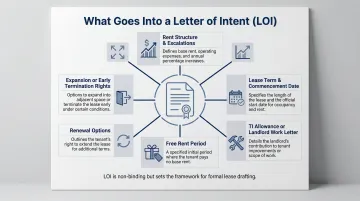
The LOI is generally non-binding but sets the framework before formal lease drafting begins.
What's negotiable right now: Current market data shows TI allowances averaging $132.57/SF and free rent averaging 13.6 months for new deals — both down from 2023 peaks but still elevated compared to pre-pandemic norms. Your broker should provide comparable deal data to benchmark the landlord's initial offer. Use that data to press on the levers that matter most for startups:
Common negotiation levers:
- Longer free rent periods to offset buildout time
- Larger TI allowances to reduce out-of-pocket costs
- Expansion rights to adjacent floors or suites
- Early termination clauses tied to business milestones (acquisition, funding)
Step 5 – Plan Your Buildout and Move-In
Once the lease is signed, the buildout phase begins — and it moves faster or slower depending almost entirely on who manages it. Secure a contractor or construction management partner who understands commercial tenant buildouts and can commit to a realistic timeline before you sign.
In NYC, standard office buildouts run 8-14 weeks depending on scope. Costs range from $330-$360/SF for moderate specification work, with high-end buildouts exceeding $500/SF.
Firms that handle both brokerage and construction management — like Nomad Group, which targets a 90-day turnaround across 300+ completed buildouts — can close the gap between lease execution and move-in that trip up most startups.

What to Look for in a CRE Brokerage Firm for Your Startup
Tenant-Side Alignment
Confirm the firm has a clear tenant representation practice and does not primarily serve landlords. In CRE, brokers who also represent landlords face a real conflict of interest — their incentive is to fill space, not to negotiate your best terms. Work with brokers whose success metrics align with getting you the best deal, not the fastest close.
Startup-Specific Experience
Look for a firm with a demonstrable track record at your stage. Early-stage startups need lease flexibility, fast buildouts, and brokers who understand the cultural weight of the space decision. Ask for references from other startups the firm has worked with and review case studies that show outcomes, not just listings.
Depth of Market Knowledge
Your broker should know your target neighborhoods at the building and landlord level — not just what appears on listing platforms. In NYC, deep familiarity with corridors like NoMad, Flatiron, SoHo, and Williamsburg includes knowing which landlords offer flexible deal terms, which buildings have upcoming availabilities, and which spaces match your growth trajectory.
End-to-End Capability
Market knowledge gets you to a signed lease. What happens next is where many startups run into trouble. A firm with in-house construction management, space planning, and facilities support eliminates the handoff gaps that cause delays between lease execution and move-in day.
When evaluating firms, ask specifically about buildout timelines and who owns project management post-signing. A capable firm should be able to commit to a concrete turnaround — for example, Nomad Group's in-house team operates on a 90-day buildout standard across its NYC portfolio.
Conclusion
Commercial real estate brokerage exists to close the information gap between startups and landlords — but only when you have the right representation. Tenant-focused brokers with startup experience and deep market knowledge deliver measurably better outcomes: lower effective rent, stronger lease protections, and spaces built to support your growth rather than constrain it.
The most important decisions happen before the lease is signed: clarity on your space needs, selecting the right broker, and knowing what's negotiable. In NYC's competitive office market, where firms like Nomad Group have helped hundreds of startups navigate everything from initial search to buildout, the pattern is consistent — companies that engage early and engage strategically come out ahead. Start there.
Frequently Asked Questions
What is a CRE brokerage?
A CRE brokerage is a firm of licensed real estate professionals that facilitates the leasing, buying, and selling of non-residential commercial properties (offices, retail, industrial, and mixed-use spaces) by representing either the landlord, the tenant, or both parties in a transaction.
What does a CRE broker do?
A CRE broker manages the full transaction process: identifying properties, analyzing market comparables, negotiating lease or sale terms, and coordinating due diligence through closing. For tenant reps specifically, the job is finding the right space and securing the best possible deal for the occupying company.
What is the difference between a commercial real estate agent and a broker?
A broker holds a higher-level license than an agent, can operate independently, and can run their own firm — agents must work under a licensed broker. The terms are used interchangeably in CRE. What matters more to startups is whether the person represents tenants or landlords.
What are the 4 types of commercial real estate?
The four main categories are office, retail, industrial/warehouse, and multifamily/mixed-use. Startups primarily interact with the office segment, though some (wellness, retail, logistics) may also lease retail or industrial space.
Why use a commercial real estate broker?
A tenant rep broker gives startups access to off-market listings, negotiation expertise, and market data they wouldn't have independently. Since broker fees in most NYC leasing transactions are paid by the landlord, working with a broker costs the startup nothing while meaningfully improving the outcome.
How do I find the right CRE broker for my startup?
Look for tenant representation firms with proven deal history at your company stage, deep knowledge of your target neighborhood, and end-to-end capabilities beyond lease negotiation — firms like Nomad Group, which has completed 300+ tenant buildouts across NYC. Ask for references from other startups before signing any engagement agreement.