If you've never leased commercial real estate before, the stakes are uncomfortably high. A poorly negotiated lease can lock you into inflexible terms just as your business pivots. A wrong neighborhood choice can make recruiting harder. Skipping crucial buildout details can blow your budget by 30% or more. And without the right advisor, you're negotiating against a landlord's broker whose job is to maximize the landlord's return — not protect your interests.
This guide covers what a commercial real estate broker actually does, what to look for when hiring one, the questions you must ask, and the red flags that should make you walk away.
Key Takeaways
- A tenant rep broker works exclusively for you, not the landlord — critical protection for any founder signing their first commercial lease
- Look for brokers with startup experience, deep knowledge of your target neighborhoods, and total transparency about compensation
- Ask about their track record with companies at your stage, landlord relationships, and post-signing support
- Red flags: pushing specific buildings too quickly, representing landlords in your target area, or refusing to provide startup references
What a Commercial Real Estate Broker Does — and Why Startups Need a Specialized One
A commercial real estate broker is a licensed professional who helps businesses find, evaluate, negotiate, and secure office space. Unlike residential agents who focus on lifestyle and family needs, CRE brokers work with business-focused metrics: price per square foot, lease flexibility, tenant improvement allowances, and escalation clauses.
In New York State, becoming a licensed broker requires at least two years of experience as a salesperson or three years in general real estate work, plus 152 hours of education and a state exam. But credentials alone don't make a broker right for your startup.
Types of Commercial Real Estate Brokers
The most important distinction in CRE: landlord's broker vs. tenant rep broker.
A landlord's broker (also called a listing broker) is hired by the property owner to fill their building at the best possible terms — for the landlord. Their loyalty lies with the building, not with you.
A tenant rep broker works exclusively for you. They shop all available options, negotiate aggressively on your behalf, and never steer you toward a building where they earn a listing commission. In NYC, the landlord typically pays all brokerage fees, so tenant rep services cost you nothing directly.
Watch out for dual agency — when one broker represents both sides. This structure is common at large firms like JLL and CBRE, but it requires the broker to remain neutral, which eliminates the aggressive advocacy a startup needs. A broker who can't negotiate hard on your behalf isn't working for you.
Why Startups Have Unique Leasing Needs
Startups face leasing challenges that established corporations don't. That distinction matters when choosing who represents you.
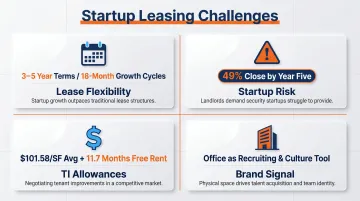
- Commercial leases typically run 3-5 years or longer — but a 15-person team can hit 50 employees inside 18 months, making flexibility essential
- About 49% of startups close by year five, so long, rigid lease terms carry real financial risk
- Free rent and buildout allowances aren't perks — they're budget necessities. Manhattan TI allowances averaged $101.58/SF in 2020, with free rent periods averaging 11.7 months
- Your office doubles as a recruiting tool and brand signal — not just square footage
A broker who specializes in law firms or financial services won't understand these priorities. You need someone embedded in the startup ecosystem.
What to Look for When Hiring a Commercial Real Estate Broker
With dozens of brokers competing for your business in NYC, the difference between a great hire and a costly mistake comes down to these five factors.
Exclusive Tenant Representation
This is your first filter. A broker who also lists properties has a conflict of interest. A true tenant rep's only job is to advocate for you — shopping all options objectively, negotiating hard, and never steering you toward a building where they earn a listing fee.
Startup and Growth-Stage Experience
Sector fit matters. A broker who regularly works with high-growth companies understands:
- Structuring flexible lease terms with expansion options or early exit clauses
- Planning for headcount growth and space scalability
- Prioritizing neighborhoods that attract top talent
Ask for specific examples: Which startups have they represented at your stage? What outcomes did they achieve? If they can only name enterprise clients, they don't have the startup-specific experience you need.
Deep, Hyperlocal Market Knowledge
Real estate is hyper-local. In NYC, conditions vary block by block. A broker embedded in your target neighborhoods — Flatiron, NoMad, SoHo — will know:
- Which landlords are flexible on buildout allowances
- Which buildings have recurring issues
- Which spaces are coming to market before they're publicly listed
Off-market access is especially valuable in low-inventory markets. As of April 2026, Manhattan's overall availability rate was 13.4% — the lowest since October 2020.
Transparency on Compensation and Process
In NYC commercial leasing, the landlord customarily pays all brokerage fees. Commission is calculated on a sliding scale based on lease duration:
| Lease Year | Commission Rate |
|---|---|
| Year 1 | 5% |
| Year 2–3 | 4% |
| Years 4–5 | 3% |
| Years 6–10 | 2.5% |
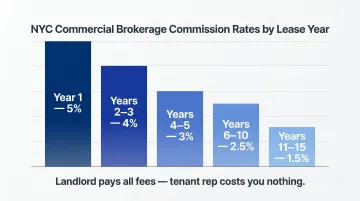
The tenant's broker receives one full commission; the landlord's broker receives half. A trustworthy broker explains this upfront without hesitation. If they're vague about how they get paid or who else they're representing, that's a problem.
Full-Service Capability Beyond Finding Space
Knowing exactly how your broker gets paid makes the next question easier to ask: what else do they do? For startups, lease signing is just the beginning. The right broker should support you through:
- Buildout coordination and construction management
- Space planning and design
- Ongoing facilities management once you're in
That full-cycle support matters more than most founders expect. Managing three separate vendors — broker, contractor, facilities — across a single buildout is where timelines slip and budgets blow out.
Questions to Ask a Broker Before You Commit
Interview brokers like you would a key hire. These questions separate relationship-first advisors from transaction-volume brokers.
"Have you worked with companies at our stage — and what did the outcomes look like?"
Listen for:
- Specific companies (ideally named, with comparable headcount and funding stage)
- Concrete lease terms achieved (below-market rent, significant TI allowances, flexible exit options)
- Honest accounting of deals that were challenging
A broker who can only name big enterprise clients may not have the startup playbook you need.
"Which landlords and buildings do you have active relationships with in our target neighborhoods?"
The answer tells you how deep their local network actually runs. Brokers with strong landlord relationships can:
- Get you into spaces before they hit the market
- Secure faster responses to proposals
- Negotiate more creatively on concessions
"How do you get paid, and are there any situations where your compensation could create a conflict?"
This forces full transparency. A reputable tenant rep will clearly describe the landlord-paid commission structure and flag any situations where they might also have a listing relationship. Deflection or vague answers? Walk away.
"What does your process look like from initial search to signed lease — and how long does it typically take?"
A broker with a clear, repeatable process (market survey → tours → shortlist → proposal → negotiation → due diligence → signing) will save you time and reduce decision fatigue.
"Can you support us beyond the lease — buildout, renewals, and future expansions?"
This distinguishes transactional brokers from long-term partners. A firm with in-house construction and facilities teams — the kind that can turn around a buildout in 90 days and manage your space long after you've signed — means you're not re-pitching your needs to a new vendor every 18 months.
Red Flags to Watch Out For
Not every broker who pitches you is working for you. These patterns are worth catching early.
They're Pushing Spaces Too Quickly
A good broker runs a comprehensive market survey before recommending spaces. If they start with a handful of listings before understanding your needs — or keep steering conversations back to a single building — they may have a listing relationship or be chasing a faster commission.
They Represent Landlords in Buildings You're Considering
Even if they claim neutrality, a broker with a listing agreement in a building you're touring cannot fully advocate for you in that negotiation. Always ask directly about listing relationships in your target area.
They Can't Provide References from Startups They've Served
A proven tenant rep who regularly works with high-growth companies will have no problem connecting you with past clients. Reluctance to provide references — or references that are all large corporations — means you have no way to verify their track record with companies at your stage.
How Nomad Group Helps NYC Startups Find and Build the Right Space
Nomad Group is a full-service commercial real estate partner built for high-growth companies in New York City. Unlike high-volume brokerage firms driven by transaction quotas, Nomad works as a relationship-first advisor that stays with clients through the entire real estate lifecycle — from initial search through buildout and ongoing space management.
The firm has completed 300+ tenant buildouts and leased 2M+ square feet across NYC, with deep expertise in neighborhoods like Flatiron, NoMad, SoHo, Union Square, and Williamsburg.
What makes Nomad different:
- Exclusive tenant representation with no conflicts of interest
- In-house construction and design teams capable of 90-day buildout turnarounds
- Flex by Nomad, a managed flexible office solution built on in-house infrastructure and on-the-ground NYC access

Nomad's client roster includes dbt Labs, Snappy, and Fever — startups that needed space built around their headcount growth and team culture, not off-the-shelf leases.
If you're beginning your office search — or want a second opinion on a deal already in progress — connect with the Nomad team for a no-obligation conversation.
Frequently Asked Questions
What is the standard brokerage fee for a commercial lease?
In most NYC commercial leases, the landlord pays the broker's commission — typically 3-6% of total lease value, calculated on a sliding scale by year. Tenant rep services are generally free to the tenant, though you should confirm the fee structure with any broker before engaging.
Do I need an agent for a commercial lease?
Technically, no — but leasing without one means negotiating directly with the landlord's agent, who works against your interests. A tenant rep gives you market knowledge, negotiating leverage, and access to off-market opportunities that are especially valuable for first-time commercial tenants.
Why hire a commercial real estate broker?
A broker saves time, prevents costly mistakes, and typically delivers better lease terms than a tenant can negotiate alone — including lower base rent, higher TI allowances, free rent periods, and flexible exit options. For startups, the right broker also acts as a strategic advisor on how rapid growth affects space planning.
What's the difference between a tenant rep and a landlord broker?
A landlord broker is hired by the property owner to fill their space at the best possible terms for the landlord. A tenant rep works exclusively for the tenant, shopping all available options and negotiating on your behalf.
When should a startup start looking for a commercial real estate broker?
Most advisors recommend beginning 6-12 months before your target move-in date. Starting early gives you time to run a thorough market survey, negotiate effectively, and complete any buildout before your lease or headcount forces a rushed decision.