
](https://file-host.link/website/nomadgroup-3tddn4/assets/refined-images/1779194232682000_b21c2d2e70114bf182b8c2f52fe6c792/360.webp)
- Ask about deal volume in your target neighborhoods and client types to confirm market specialization
- Verify whether the broker represents tenants exclusively or also works with landlords (dual agency creates conflicts)
- Request references from companies at your growth stage to assess experience with flexible lease structures
- Understand the broker's negotiation approach for TI allowances and concessions in the current market
- Confirm what happens after lease signing—buildout support, expansion help, and facilities management matter
Introduction
Most companies spend weeks touring office spaces before they spend a single hour evaluating the broker leading the search. In a market like NYC, that sequence can be costly.
The broker you choose shapes the spaces you see, the terms you're offered, the leverage you have, and how smoothly everything unfolds from search to signature. A broker whose incentives don't match yours can quietly cost you six figures — in missed concessions, unfavorable lease terms, or time lost on the wrong spaces.
This article lays out 10 specific questions to ask before you commit to a broker — covering how they work, who they represent, what they know, and how they get paid. The answers will tell you quickly whether you're working with the right partner or just the most available one.
Why Vetting Your Broker Matters Before the Search Begins
Not all commercial real estate brokers operate with your best interests at heart. In New York State, dual agency is legally permitted in commercial transactions, including office leases—but it requires full written disclosure. This means a broker can represent both the landlord and the tenant in the same deal, creating an inherent conflict of interest.
A landlord's broker (or listing broker) is legally representing the building owner's interests: maximizing rent, minimizing concessions, and securing the longest possible lease term. A tenant rep broker, by contrast, works exclusively for the company leasing space and owes you fiduciary duties of loyalty, confidentiality, and full disclosure.
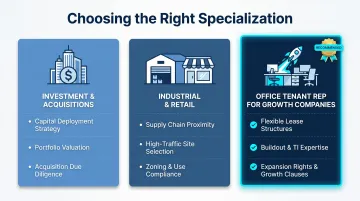
Representation structure is only part of the picture. Brokers also vary widely by specialization—and using the wrong one is a common, costly mistake. Common broker focuses include:
- Investment sales and acquisitions
- Industrial or retail leasing
- Office tenant representation for scaling startups and tech companies
If your company needs flexible expansion rights, shorter initial terms, or buildout expertise, a generalist broker simply won't have the depth to negotiate those effectively.
The ten questions below cut through the sales pitch and surface whether a broker's experience, incentives, and market knowledge are actually a fit for your situation.
Questions About Experience, Track Record, and Specialization
Question 1: How many deals have you closed in our target neighborhoods, and what types of companies do you typically work with?
Volume of completed deals in a specific market matters more than years in the industry. A broker who has closed multiple transactions in Flatiron or SoHo in the last two years will have sharper insight into current landlord appetite and market pricing than one who closed deals there a decade ago.
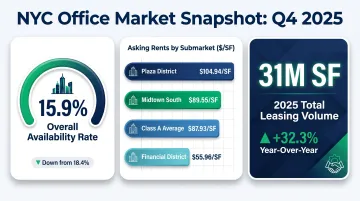
Manhattan leasing activity surged to nearly 31 million square feet in 2025, up 32.3% from 2024—the highest annual volume since 2019. In a market moving this quickly, recent transaction experience is critical.
Understanding the broker's typical client profile also tells you whether they've navigated the specific pressures high-growth companies face:
- Are their clients startups taking 2,000–5,000 square feet, or enterprises leasing 20,000+?
- Have they worked with venture-backed companies managing rapid headcount changes?
- Do they understand tight timelines and flexible lease structures?
For example, Nomad Group has completed 300+ tenant buildouts across NYC's core neighborhoods, with deep experience serving Series A-C funded tech companies in Flatiron, NoMad, Union Square, and SoHo. That track record signals domain expertise in the specific challenges scaling businesses encounter.
Question 2: Do you specialize in a particular type of commercial space or submarket?
Specialists who focus on NYC office space for tech and growth-stage companies have cultivated relationships with relevant landlords, know which buildings are flex-friendly, and understand what concessions are realistically available in that segment.
A generalist covering retail, industrial, and office across multiple cities rarely has that depth—which matters when you have specific buildout requirements or culture expectations.
Ask whether the broker focuses on:
- Do they know Williamsburg's Class A rent advantage over Midtown, or Flatiron's high-character loft inventory?
- Do they specialize in trophy buildings, creative lofts, or tech-friendly spaces—or all three?
- Do they primarily serve startups, enterprises, or a mix, and does that match where you are?
A broker who can answer these questions with specific building names and recent deal examples—not generalities—has the depth you need.
Question 3: Can you share references or case studies from tenants similar to us?
References from companies at a similar growth stage and size reveal whether the broker can handle the pace, flexibility, and specific deal structures relevant to scaling businesses—things like expansion rights, shorter initial terms, or early termination clauses.
Go beyond names and phone numbers. Ask for specific examples of challenges they helped clients navigate:
- A deal that fell through late—how did they recover?
- A compressed timeline where a company needed to move in within 60 days
- A negotiation where significant TI allowance or rent concessions were secured
How a broker handled a deal under pressure tells you more than a list of completed transactions. When Optimove faced a timing gap between coworking expiration and new space availability, Nomad Group secured temporary swing space within days—mobilizing furniture, Wi-Fi, and cleaning services to ensure zero operational downtime.
Questions About Market Knowledge and Negotiation Strategy
Question 4: How do you see the NYC office market moving right now, and how does that affect our leverage as a tenant?
A knowledgeable broker should speak fluently about current vacancy trends, rent trajectories, and concession levels in the specific submarkets you're considering—not just offer generic optimism.
Here's what the data shows as of Q4 2025:
- Manhattan overall availability fell to 15.9%, down from 18.4% one year earlier
- Class A asking rents averaged $87.93/SF, with significant neighborhood variation (Plaza District at $104.94/SF vs. Financial District at $55.96/SF)
- Midtown South availability sits at 18.7%, with Class A asking rents at $89.55/SF
The best brokers use this data to tell you something specific: which submarkets give you more leverage right now, where landlords are still offering meaningful concessions, and whether your timeline works in your favor or against it. If the answer is vague or relentlessly optimistic, that's information too.
Question 5: What's your approach to negotiating lease terms, tenant improvement allowances, and landlord concessions?
Tenant improvement (TI) allowances cover your buildout costs up to a negotiated cap — and they're among the most valuable terms you can fight for. National average TI allowances dropped to $87.51/SF in 2024 from $97.55 in 2023, but NYC runs considerably higher, with allowances peaking at $147/SF in 2022.
Push any broker you're evaluating to describe their specific strategy for:
- Securing maximum TI allowances
- Negotiating free rent periods (which averaged 8.9 months nationally in 2024)
- Structuring expansion rights or early termination clauses
- Balancing base rent, effective rent, and total lease economics
A broker who can walk through each of these with specifics — actual numbers from recent deals, not general reassurances — is someone who negotiates from a position of knowledge rather than habit.
Question 6: How do you manage the search process from initial requirements to signed lease—and what does the timeline look like?
A structured, transparent process is a strong indicator of a professional broker. They should walk you through:
- How they define your requirements (space size, layout, amenities, budget)
- How they identify and vet options (market analysis, property tours)
- How they evaluate proposals (financial modeling, lease comparison)
- How they manage negotiations (LOI, lease drafting, attorney coordination)
For scaling companies with headcount decisions tied to move-in dates, the timeline question matters as much as the process itself. A realistic search-to-signature window looks like this:
- Weeks 1-2: Requirements gathering and market analysis
- Weeks 3-4: Property tours and shortlist creation
- Weeks 5-6: Lease negotiation and LOI execution
- Weeks 7-8: Lease finalization and signing
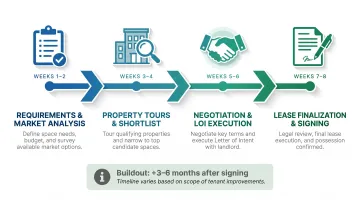
Buildout runs another 3–6 months after signing, depending on scope and permitting — which means the clock starts well before your current lease expires.
Questions About Services, Buildout, and Long-Term Support
Question 7: Do you have experience managing office buildouts, and what does that process look like for a company like ours?
Many tenants underestimate how much complexity lives after lease signing. Buildout coordination, contractor management, design approvals, and punch-list completion can take months and significantly affect when a team actually moves in.
A broker with in-house or closely integrated buildout capabilities offers a meaningful advantage. Ask them directly about:
- Realistic timelines: What does a typical buildout take from lease execution to move-in?
- Expected costs: How do TI allowances map to actual construction budgets?
- Contractor relationships: Do they work with vetted contractors who can accelerate delivery?
Nomad Group has completed 300+ tenant buildouts in NYC, including a 90-day buildout turnaround model specifically designed for high-growth companies. For Extend AI, they transformed a white-box space into a fully built office—including HVAC installation—in just five weeks.
That kind of result only happens when the broker stays engaged through construction—not just through TI negotiation. It's worth asking directly whether they remain involved from lease execution through move-in day, or step back once the deal closes.

Question 8: Do you offer any services beyond the lease—like facilities management, space planning support, or help if we need to expand or sublease?
For scaling companies, the need to adjust space is inevitable. Headcount grows, teams split across floors, or a pivot triggers a sublease need.
A broker or firm that can support the full real estate lifecycle—not just the initial transaction—is far more valuable than one who disappears after closing. Ask whether they offer:
- Facilities management: Day-to-day operations, maintenance, cleaning
- Space planning: Redesigns or reconfigurations as your team evolves
- Expansion support: Negotiating additional floors or adjacent spaces
- Sublease assistance: Marketing and managing sublease agreements when you need to offload space
Most brokers handle the transaction and move on. Full-service firms like Nomad Group stay involved across brokerage, construction management, asset management, and facilities management—so you're not starting from scratch every time your space needs change.
Questions About Representation and Fees
Question 9: Do you exclusively represent tenants, or do you also represent landlords and building owners?
Dual representation—where a broker represents both a landlord and a tenant in the same transaction—creates an inherent conflict of interest. Under New York State law, dual agency requires full written disclosure and informed consent from both parties.
A broker who exclusively represents tenants (pure tenant rep) has no financial incentive to favor one building over another and can negotiate more aggressively. They owe you fiduciary duties of undivided loyalty, confidentiality, and full disclosure.
This question also helps you understand whether the broker's recommendations are being shaped by:
- Pre-existing landlord relationships
- Exclusive listing agreements with certain buildings
- Higher commissions from preferred landlords
A broker working both sides of the table simply cannot advocate fully for you. Their loyalty is divided — and that affects every negotiation.
Question 10: How are you compensated, and is there anything we as tenants would be expected to pay directly?
In most commercial office leases in NYC, broker commissions are paid by the landlord out of the lease economics, so the tenant typically pays nothing directly. Standard commission rates run 3-5% of aggregate rent for years 1-5, declining to approximately 2% for years 6-10, split between the landlord's broker and the tenant's broker.
However, there are exceptions:
- Consulting-only engagements where the tenant pays an hourly or flat fee
- Short-term lease advisory where traditional commission structures don't apply
- Situations where the landlord doesn't offer a co-broke (commission split)
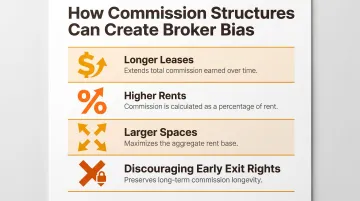
Understanding the compensation structure also helps reveal whether the broker has financial incentives that could bias them toward:
- Pushing longer leases, which increase total commission
- Accepting higher rents, since commission is calculated as a percentage
- Recommending larger spaces to maximize the aggregate rent base
- Discouraging early termination rights, which can reduce commission longevity
This structural conflict exists under the traditional commission model. Ask your broker to put their compensation structure in writing before signing any representation agreement.
Frequently Asked Questions
What questions should I ask a commercial real estate broker?
Cover these areas in your first conversation:
- Experience and track record in your target NYC neighborhoods
- Current market knowledge and vacancy trends
- Negotiation approach for TI allowances and concessions
- Whether they represent tenants exclusively
- How they handle buildouts and post-lease support
- How they're compensated
How do commercial real estate brokers get paid?
In most NYC office leasing transactions, the landlord pays broker commissions — typically 3–5% of total rent for years one through five. Tenants pay nothing directly, with the exception of consulting or advisory-only arrangements.
What's the difference between a tenant rep broker and a landlord's broker?
A tenant rep broker works exclusively on behalf of the company leasing space and owes fiduciary duties to advocate for your interests. A landlord's broker represents the building owner and is incentivized to maximize rent and minimize concessions.
Should I interview multiple brokers before choosing one?
Yes — talk to at least two or three brokers to compare their market knowledge, process, and client references. The right one will feel like a genuine advisor who understands your business goals, not someone rushing to fill a calendar with property tours.
How do I know if a commercial real estate broker has experience with startups or high-growth companies?
Ask directly about the types of companies they've represented and the deal sizes they're most active in. Find out whether they've structured flexible leases with expansion rights, shorter initial terms, or early termination clauses — these are common needs for growth-stage businesses.