The CRE broker selection process isn't intuitive. Most companies default to the biggest name or the first broker they meet, without understanding what separates a truly aligned partner from a commission-motivated middleman. A strong broker surfaces better opportunities, negotiates stronger terms, and protects your interests when landlords bring their own experts to the table.
This guide lays out exactly what a commercial real estate broker does, the key factors to evaluate before choosing one, and the questions and red flags that can save your company from a costly mistake.
Key Takeaways
- Broker quality varies widely — specialization, local focus, and whose interests they represent determine the outcome
- Look for commercial-only experience, verified NYC market knowledge, a track record you can check, and access to off-market listings
- Verify whether a broker represents tenants exclusively or also works for landlords—dual representation creates conflicts of interest
- Interview at least two or three brokers, ask for references, and watch for red flags like slow response times or vague answers
- For high-growth NYC companies, a full-service partner covering brokerage, buildout, facilities, and ongoing space management provides significantly more value than a traditional broker
What Does a Commercial Real Estate Broker Actually Do?
A commercial real estate broker is a licensed professional who represents buyers, sellers, landlords, or tenants in transactions involving non-residential property—including office, retail, industrial, and mixed-use spaces. Unlike residential agents who focus on lifestyle factors, CRE brokers work primarily with business data: lease rates, concession packages, buildout costs, and market comparables.
Tenant Rep vs. Landlord Rep: Know the Difference
The distinction between tenant representation brokers and landlord brokers is fundamental. Tenant rep brokers work exclusively on behalf of companies seeking space, advocating for your interests throughout the search and negotiation. Landlord or listing brokers represent the property owner, focusing on securing the best terms for the landlord.
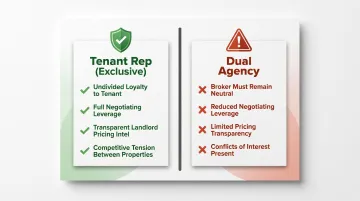
Working with a dedicated tenant rep is in your company's best financial interest. When the same brokerage—or worse, the same agent—represents both sides, you face dual agency. This creates inherent conflicts: the broker must remain neutral rather than advocating for you alone.
In practice, dual agency reduces your negotiating leverage, limits what the broker can share about the landlord's pricing expectations, and eliminates competitive tension between properties.
Core Services Your Broker Should Provide
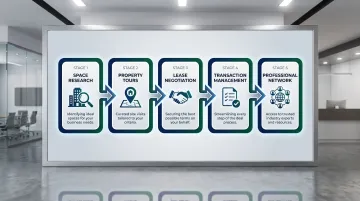
Once you're working with a properly aligned tenant rep, here's what you should expect them to handle:
- Research and identify spaces matched to your growth trajectory, budget, and team size
- Coordinate tours across properties that meet your criteria
- Negotiate lease terms—rent abatement, tenant improvement allowances, expansion rights, and renewal options
- Manage the transaction from letter of intent through lease execution
- Connect you with attorneys, architects, and construction managers needed to close
Broker commissions are typically paid by the landlord, calculated as a per-square-foot amount per month of lease term or as a percentage of total net rents. While this means tenant rep services are effectively free to you, understanding the compensation structure upfront helps you assess whether incentives align with getting you the best deal.
Key Factors to Consider When Choosing a Commercial Real Estate Broker
Choosing a CRE broker isn't one-size-fits-all. The right fit depends on your company's size, growth stage, market, and space complexity. The following factors help connect broker qualifications to real business outcomes.
Commercial-Only Specialization
Commercial real estate expertise is fundamentally different from residential. CRE involves complex lease structures, zoning regulations, buildout negotiations, and market data analysis that generalist or primarily residential agents aren't equipped to navigate. Ask directly what percentage of their business is commercial — and walk away if the answer isn't close to 100%.
The broker's specialization should also match the property type you need. A broker who primarily handles industrial warehouses won't be well-suited to negotiate a Class A NYC office lease for a scaling tech company.
Look for credentials that signal serious commercial expertise:
- CCIM (Certified Commercial Investment Member) requires rigorous coursework in financial analysis, market analysis, and user decision analysis, plus a portfolio demonstrating 2-5 years of full-time CRE experience
- SIOR (Society of Industrial and Office Realtors) demands high annual production standards and comprehensive ethics training, with fewer than 4,000 members worldwide
Both designations require demonstrated mastery of investment analysis, financial modeling, and complex deal execution — not just coursework completion.
Deep Local Market Knowledge
Local expertise — meaning firsthand knowledge of specific neighborhoods, micro-markets, landlord reputations, and vacancy trends — directly impacts the quality of options a broker can surface and the leverage they generate in negotiations.
NYC market dynamics vary dramatically by neighborhood:
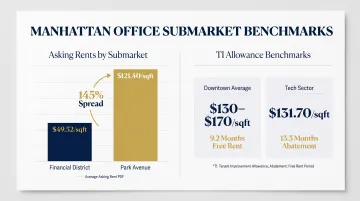
Within Manhattan alone, asking rents range from $49.52 per square foot in the Financial District to $121.40 in prime Park Avenue locations — a 145% spread within a single borough. Midtown South maintains the lowest availability at 13.7%, while overall Manhattan vacancy sits at 22.0%.
A broker without hyperlocal expertise may miss better-fit spaces or fail to anticipate how submarket conditions affect deal structure. The difference shows up directly in lease economics: Downtown Manhattan TI allowances average $130–$170 per square foot with 9.2 months of free rent, while tech sector deals carry weighted average TI allowances of $131.70 per square foot and 13.3 months of rental abatement. Only brokers tracking these benchmarks can negotiate terms that reflect true market value.
Verified Track Record and Client References
Past deal volume, client retention, and reference quality are the most reliable predictors of broker performance. Request specific comparable transactions — similar company size, property type, and lease term — and ask references whether they would use the broker again. Confirm that the broker's stated expertise matches their actual closed-deal history.
The size of a broker's firm matters far less than their individual track record. Boutique firms with deep deal histories in a specific market often outperform larger national brands that assign junior agents to mid-size tenant accounts. "Clients follow the individual broker rather than the firm," meaning the broker's personal relationships and expertise drive outcomes more than brand recognition.
Communication Style and Transparency
Communication responsiveness is consistently the top complaint tenants have about brokers. A broker who is slow to respond during the courtship phase will almost certainly be slower once they have your signed representation agreement. Test responsiveness before committing.
Transparency separates trustworthy brokers from the rest:
- Proactively surfaces potential downsides of a deal, not just upsides
- Discloses how they are compensated and identifies any potential conflicts
- Gives honest assessments of market conditions even when the news is unfavorable
Remember that commission structures in CRE are typically paid by the landlord, which can create subtle conflicts that only transparent brokers acknowledge openly. If a landlord refuses to pay commission, the tenant may cover all or part of the fee — a scenario you should clarify upfront.
Access to Off-Market Opportunities and a Strong Network
The most valuable deals often aren't listed on LoopNet or CoStar. They exist in a broker's relationships with landlords, building owners, and other brokers. A well-connected broker can surface pre-market opportunities that never reach competitive bidding, which is particularly valuable in tight markets like NYC.
While no authoritative industry-wide statistic quantifies the percentage of CRE leases completed off-market, qualitative evidence shows the pattern clearly. Downtown Manhattan's adjusted availability is estimated 4–5% lower than stated rates due to approximately 2 million square feet of unleasable space and 3 million square feet undergoing residential conversion — spaces that appear in listings but aren't genuinely available. Only broker intelligence beyond published data reveals these realities.
A broker's network also extends to professionals you'll need throughout the leasing process:
- Construction managers
- Architects
- Real estate attorneys
- Facilities vendors
A broker who makes warm introductions to vetted professionals across the deal lifecycle delivers tangible value well beyond the lease signing — and saves you weeks of vetting strangers from scratch.
Questions to Ask a CRE Broker Before You Hire Them
Interviewing two to three brokers using a consistent set of questions is the best way to surface real differences in capability, transparency, and fit before making a commitment.
What types of companies and properties do you specialize in, and can you share recent comparable transactions?
This question reveals whether the broker's actual deal history matches your company's size, stage, and space type—not just their claimed expertise. Ask for specifics on each example:
- Company size and growth stage
- Property location and neighborhood
- Lease term, square footage, and outcome
A broker working primarily with enterprise tenants won't have the nuanced understanding of startup challenges, and vice versa.
Do you represent tenants exclusively, or do you also represent landlords?
Brokers who represent both sides of transactions may have competing loyalties. A tenant-only representative has undivided loyalty to your company's interests. Dual agency is common at large full-service firms like JLL and CBRE, where the same brokerage—sometimes the same agent—represents both landlord and tenant. This structure requires the broker to remain neutral, which eliminates the exclusive advocacy tenants need.
How will you search for space and how often will you provide updates?
Pay attention to process specifics. A broker worth hiring will describe off-market outreach, landlord relationship activation, and a regular update cadence. Vague answers—or a promise to "send you listings as they come up"—are a sign they'll be reactive rather than proactive.
How are you compensated, and are there any potential conflicts of interest I should know about?
CRE brokers are typically paid by the landlord, but commissions can vary in structure. Understanding this upfront allows you to assess whether incentives are aligned with getting you the best deal. Hesitation or evasiveness here is a red flag worth taking seriously.
What happens after the lease is signed—do you have resources to support buildout or ongoing space management?
Most brokers stop at the signed lease. The better question is what comes next. Construction management, facilities coordination, and ongoing space optimization determine whether you actually occupy the space successfully—not just secure it on paper.
Red Flags That Signal the Wrong Broker
Certain behaviors—often visible during early interactions—reliably predict a poor broker relationship and should prompt you to keep looking rather than proceed out of convenience.
Watch for these warning signs:
- The broker talks more than they listen and shows little curiosity about your business goals
- They push toward quick decisions without explaining the tradeoffs
- They are vague or evasive when asked about compensation or conflicts of interest
- They have thin or unverifiable deal history in your target market
- They only surface listed properties rather than demonstrating access to off-market options
A bigger brand name is not a proxy for better service. Large national firms often assign junior agents to accounts below a certain transaction size, meaning high-growth companies often get less attention than they need when headcount and lease decisions are moving fast. The individual broker's track record, market expertise, and communication style matter far more than the logo on their business card.
How Nomad Group Can Help
Nomad Group is a NYC-based commercial real estate firm built specifically to serve high-growth companies—from early-stage startups to enterprise organizations. The firm has completed 300+ tenant buildouts and leased over 2 million square feet across NYC's most dynamic neighborhoods, offering a full-service model that goes well beyond traditional brokerage.
That model is built on a relationship-first philosophy: client outcomes over transaction volume. Because the firm isn't driven by shareholder pressure or deal quotas, brokers give honest market assessments and surface spaces that are the right fit—not just the easiest to close. Tenant interests stay front and center through every stage of negotiation.
What Sets Nomad Group Apart
- Covers NoMad, Flatiron, SoHo, Williamsburg, and Grand Central with ground-level knowledge of micro-market vacancy trends, landlord reputations, and off-market opportunities
- Delivers a 90-day buildout turnaround through in-house construction and design teams—transforming white-box spaces into fully operational offices with HVAC, furniture, and custom finishes, with no vendor coordination required from the client
- Provides ongoing space management through Flex by Nomad, covering day-to-day operations, maintenance, and cleaning so companies can stay focused on growth
- Keeps clients informed from search to signature with regular market updates, clear deal timelines, and a single point of accountability throughout the leasing process

Conclusion
Choosing a commercial real estate broker is one of the highest-leverage decisions a growing company makes. The right broker finds better opportunities, negotiates stronger lease terms, and protects your interests at every stage — the landlord across the table is almost always represented by an expert, and you should be too.
The goal is not to find the most well-known broker or the largest firm, but to find the broker whose specialization, market knowledge, communication style, and incentive structure genuinely align with where your company is going.
Your real estate needs will evolve as your company scales. The best broker relationships are built on trust and continuity — the kind where your broker already understands your growth trajectory before you pick up the phone. At Nomad Group, that long-term, relationship-first approach is exactly how we work with high-growth companies across NYC.
Frequently Asked Questions
How do you choose a commercial real estate broker?
Vet for commercial-only specialization, local market depth, a verifiable track record with comparable clients, responsive communication, and full transparency on compensation. Interview at least two or three candidates before committing, and ask for references you can contact directly.
What is the difference between a tenant rep broker and a landlord's broker?
A tenant rep broker works exclusively on behalf of the company seeking space, while a landlord's broker represents the property owner. Working with a dedicated tenant rep eliminates the conflict of interest that arises when one broker attempts to serve both sides.
How are commercial real estate brokers typically compensated?
In most commercial leasing transactions, broker commissions are paid by the landlord as a percentage of total lease value—meaning tenant rep services are free of charge to the tenant. However, clarify compensation structure upfront to identify any potential conflicts.
What questions should I ask a commercial real estate broker before hiring them?
Come prepared with pointed questions:
- What comparable transactions have you closed recently?
- Do you represent tenants exclusively, or landlords too?
- How do you source off-market opportunities?
- How are you compensated on this deal?
- What support do you provide after the lease is signed?
Should I use a broker to find office space in NYC?
Yes. Given NYC's competitive, hyper-local market dynamics, navigating office leasing without a broker who has deep neighborhood expertise and landlord relationships puts a tenant at a significant informational and negotiating disadvantage.
How do I know if a broker is truly working in my best interest?
A broker working in your interest will proactively disclose their compensation, surface the pros and cons of each option, and prioritize your timeline over deal speed. They stay accessible and communicative well past the initial pitch—through every step of the process.