It matters enormously. Choosing the wrong type of broker can cost your company hundreds of thousands of dollars in missed lease concessions, unfavorable buildout terms, and operating expenses that quietly drain your budget for years. According to CBRE's 2024 office market analysis, tenant improvement allowances averaged $87.51 per square foot and free rent periods averaged 8.9 months—negotiable value that requires specialized expertise to capture.
Both commercial and residential brokers hold real estate licenses, but they operate in fundamentally different worlds. They serve different clients, handle different property types, and bring entirely different skill sets to the table. This guide breaks down what each type of broker does, compares them side-by-side across key dimensions, and gives businesses a clear framework for choosing the right professional for their real estate needs.
Key Takeaways
- Commercial brokers specialize in business properties (office, retail, industrial); residential brokers focus on homes and small multi-family dwellings
- Commercial leases involve TI allowances, CAM charges, and multi-year terms that require specialized expertise residential agents don't have
- Per-deal commissions are higher in commercial, but deal volume is lower than in residential
- Businesses seeking office, retail, or industrial space should hire a commercial broker — a residential agent lacks the expertise to represent them effectively
- In NYC, sub-market expertise (NoMad vs. Flatiron vs. SoHo) drives material deal outcomes through landlord access and local knowledge
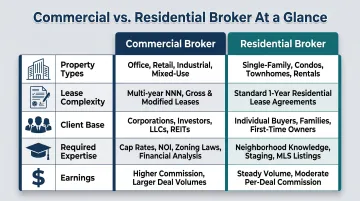
Commercial vs. Residential Real Estate Broker: Quick Comparison
| Dimension | Commercial Broker | Residential Broker |
|---|---|---|
| Property Types | Office buildings, retail storefronts, industrial facilities, warehouses, 5+ unit multi-family | Single-family homes, condos, townhomes, 2-4 unit multi-family |
| Lease Complexity | Multi-year leases (5-10 years typical) with TI allowances, CAM charges, rent escalations, expansion rights; 60-120 days to close | Shorter leases (1 year typical) or purchases (30-60 days to close); minimal financial complexity |
| Client Base | Businesses, corporations, startups, landlords, institutional investors | Individuals and families buying, selling, or renting homes |
| Required Expertise | Financial metrics (NOI, cap rates, ROI), zoning regulations, lease structuring (NNN vs. gross), buildout negotiations | Home valuations, comparable market analysis, buyer/seller negotiation |
| Earnings | Fewer transactions, higher commissions; NY State brokers average $153,070 annually | Higher transaction volume, smaller commissions; median broker income $72,280 nationally |
Property Types: The Five-Unit Threshold
The distinction between commercial and residential property types hinges on a simple rule: properties with five or more units are classified as commercial. Properties with two to four units fall into the residential category. This threshold affects financing, valuation methods, and the expertise required to transact.
Commercial property categories:
- Office buildings (ranging from single-tenant to high-rise towers)
- Retail storefronts and shopping centers
- Industrial properties and warehouses
- Hospitality (hotels and motels)
- Multi-family buildings with 5+ units
Residential property categories:
- Single-family homes
- Condominiums and co-ops
- Townhomes
- Duplexes, triplexes, and fourplexes
Lease & Transaction Complexity
Commercial office leases typically run 5-10 years, and no two are alike. Every clause is negotiated individually, covering:
- Tenant improvement (TI) allowances for buildout costs
- Common area maintenance (CAM) charges
- Rent escalation schedules and rent-free periods
- Expansion rights and early termination options
Commercial transactions take 60-120 days to close due to extensive due diligence, complex financing, and multi-party negotiations. Residential transactions close in 30-60 days, with far less financial modeling and legal complexity.
Client Base Differences
Commercial brokers work with:
- Scaling startups (Series A-C companies looking for first offices)
- Enterprise corporations (relocating or expanding operations)
- Landlords and property investors (filling vacancies or acquiring assets)
- Institutional investors (real estate funds and REITs)
Residential brokers serve:
- Families relocating or purchasing homes
- Individual homeowners selling properties
- Renters searching for apartments
- Small-scale residential investors
Earnings Potential: Volume vs. Value
According to BLS data from May 2024, real estate brokers earned a median annual wage of $72,280 while sales agents earned $56,320. New York State brokers averaged $153,070 annually, the highest figure in the country.
How brokers reach those numbers varies by path:
Commercial brokers:
- Close fewer transactions per year (often 5-15 deals)
- Earn 4-6% commissions on properties with a $1.7M+ median value
- Build long-term client relationships that span multiple transactions
Residential brokers:
- Handle approximately 10 transactions per year on average
- Earn smaller per-deal commissions (5.44% average combined rate on median $408,800 homes)
- Rely on higher transaction volume to generate income
What is a Commercial Real Estate Broker?
A commercial real estate broker is a licensed professional who represents businesses, investors, and landlords in buying, selling, and leasing income-producing or business-use properties—including office space, retail locations, industrial facilities, and multi-family buildings with five or more units.
Unlike residential agents, commercial brokers must master financial analysis that directly affects deal outcomes. They evaluate properties through metrics like Net Operating Income (NOI), capitalization rates (cap rates), and return on investment.
Lease structure expertise matters just as much. A skilled broker helps tenants choose between a NNN (triple net) lease—where the tenant pays property taxes, insurance, and maintenance—or a gross lease where the landlord absorbs operating expenses.
Commercial Lease Expertise
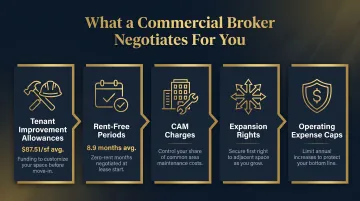
Commercial leases aren't standardized documents. A skilled commercial broker knows how to negotiate:
- Tenant Improvement (TI) Allowances: Landlord contributions to buildout costs, averaging $87.51/sf nationally in 2024
- Rent-Free Periods: Concessions averaging 8.9 months nationally, giving tenants breathing room during buildout and move-in
- CAM Charges: Shared operating expenses for lobbies, parking, and landscaping—split pro rata by square footage
- Expansion rights to lease adjacent space as the company grows
- Annual caps on operating expense pass-throughs from landlord to tenant
Sub-Market Expertise in Dense Urban Markets
In New York City, knowing the difference between leasing in Midtown South versus Grand Central isn't just geography—it's economics. Manhattan asking rents range from $56.40/sf in Downtown to $83.06/sf in Midtown South, with Class A spaces commanding $104.73/sf in Midtown South.
Hyperlocal knowledge affects:
- Off-market listings sourced through existing landlord relationships
- Which buildings historically offer stronger TI allowances
- Neighborhood-specific amenities — transit access, foot traffic, talent pool proximity
- Faster negotiations backed by established landlord trust
Full-Service Commercial Brokerage
The best commercial brokers extend beyond transaction execution. They offer space planning, construction management, buildout oversight, and ongoing facilities management. Nomad Group follows this model — a full-service commercial real estate partner that has completed 300+ tenant buildouts and leased over 2 million square feet across NYC, helping high-growth companies not just find space, but build and operate it.
Use Cases of a Commercial Real Estate Broker
Primary use case: A tech company scaling from 15 to 60 employees needs a larger NYC office. A commercial broker identifies suitable spaces in NoMad or Flatiron, structures the Letter of Intent (LOI), and negotiates a $75/sf TI allowance covering most buildout costs. The result: a 7-year lease with 6 months free rent, structured around the company's growth trajectory.
Additional use cases:
- Startups securing their first dedicated office after outgrowing coworking space
- High-growth companies renegotiating or restructuring existing leases ahead of expansion
- Landlords filling commercial vacancies with creditworthy, long-term tenants
- Investors acquiring income-producing office properties for portfolio diversification
What is a Residential Real Estate Broker?
A residential real estate broker is a licensed professional who helps individuals and families buy, sell, or rent homes—including single-family houses, condos, co-ops, townhomes, and small multi-family properties of four units or fewer. Their expertise centers on home valuations, neighborhood comparables, and buyer-seller negotiation.
Core Residential Skill Set
Residential brokers excel at:
- Comparative Market Analysis (CMA): Pricing homes against recent sales of similar properties in the same neighborhood
- Staging and presentation: Preparing homes visually and physically to attract competitive offers
- Coordinating showings: Managing schedules for buyer tours and open houses
- Navigating emotional negotiations: Balancing seller attachment and buyer enthusiasm in high-stakes personal transactions
Training for residential brokers is less financially intensive. They don't model cap rates, analyze operating expenses, or negotiate multi-year lease clauses. Their focus is consumer psychology and transactional efficiency.
Limited Overlap with Commercial Real Estate
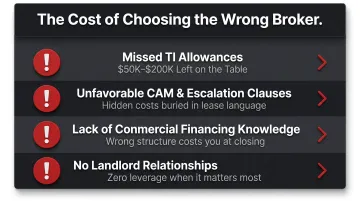
Those limitations matter when a business enters the picture. A residential license allows an agent to transact on any property — but it doesn't equip them to negotiate a commercial office lease. Using a residential broker for a business real estate transaction carries specific financial risks:
- Missed negotiation points on TI allowances (potentially leaving $50K-$200K on the table)
- Unfavorable lease clauses around CAM charges or rent escalations
- Lack of awareness of commercial financing structures
- No relationships with commercial landlords or property managers
Use Cases of a Residential Real Estate Broker
- Families relocating and purchasing a home in a new city
- Homeowners selling a property and maximizing sale price
- Individuals searching for rental apartments
- Small businesses in residential-type properties, such as a home-based daycare or studio in a single-family home
Commercial vs. Residential Broker: Which One Does Your Business Need?
If you are a company looking for office, retail, or industrial space of any size, a commercial broker is the only appropriate choice. The stakes—both financial and operational—are too high to rely on a professional trained primarily for residential transactions.
The Lease Complexity Argument
Commercial leases average 5-10 years and involve complex financial obligations that can add up to hundreds of thousands of dollars over the lease term:
- CAM charges that escalate annually
- Rent escalations tied to CPI or fixed percentages
- Operating expense caps that limit pass-through costs
- TI buildout terms that determine who pays for construction
- Expansion rights that lock in future pricing
A commercial broker doesn't just understand these clauses—they negotiate them actively in your favor. A residential agent lacks both the training and the experience to do so effectively.
The Financial Stakes Argument
The median commercial office transaction is valued at $1.7 million, compared to a $408,800 median residential home sale. Even a modestly sized NYC office lease represents a multi-year, multi-hundred-thousand-dollar commitment.
Consider a 5,000 square foot office in Midtown South at $83.06/sf:
- Annual rent: $415,300
- 7-year lease commitment: $2.9 million+
- Plus CAM charges, escalations, and buildout costs
Errors in negotiation at this scale are costly. Missing out on 6 months of free rent alone represents over $200,000 in value left on the table.
Situational Guidance
Choose a commercial broker for:
- Any business-use space (office, retail, warehouse, industrial)
- Multi-family properties with 5+ units
- Investment properties generating business income
- Spaces requiring buildout or customization
Choose a residential broker for:
- Personal home purchases or rentals
- Small multi-family investments (2-4 units)
- Residential properties in low-complexity markets
In rare cases, businesses operating out of residential properties in small towns may work with residential agents—but even then, commercial expertise is preferable for lease negotiation.
NYC Market Expertise: A Competitive Advantage
In New York City, where vacancy rates range from 11.1% on Park Avenue to 29.9% in SoHo, working with a commercial broker who has deep neighborhood expertise can mean:
- Access to off-market listings before they hit public platforms
- Better lease concessions through existing landlord relationships
- Faster occupancy through negotiations that move without delays
- Strategic placement in neighborhoods aligned with talent recruitment
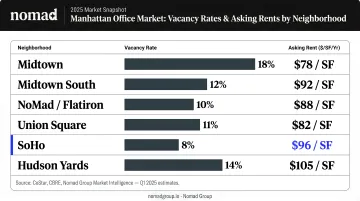
That neighborhood-level knowledge is what separates a good deal from a great one. Nomad Group's work across NoMad, Flatiron, SoHo, and Williamsburg gives high-growth companies access to off-market subleases, landlord relationships built over years, and in-house construction teams that consistently deliver buildouts in 90 days.
Conclusion
Commercial and residential brokers are not interchangeable. They serve different clients, handle different property types, and operate with fundamentally different skill sets. For any business evaluating office space in NYC, choosing a commercial broker isn't just a preference—it's the strategically correct decision.
The right commercial broker does more than find available space. Look for someone who brings:
- Financial analysis and total occupancy cost modeling
- Sub-market knowledge specific to your industry and headcount needs
- Lease negotiation experience with landlords in your target neighborhoods
- End-to-end support from site selection through buildout and ongoing space management
That breadth of service directly affects your costs, timeline, and long-term operations. Commercial leases are multi-million-dollar commitments — the broker you choose should be equipped to treat them that way.
Firms like Nomad Group, which have completed 300+ tenant buildouts and leased over 2 million square feet across NYC, demonstrate what full-service commercial representation actually looks like in practice. When you're ready to find office space, work with someone who specializes in it.
Frequently Asked Questions
Is there a difference between commercial and residential real estate agents?
Yes. While both typically hold the same real estate license in most states, commercial and residential agents differ significantly in training, expertise, and transaction types. Commercial agents specialize in business properties and complex lease structures; residential agents focus on homes and consumer transactions.
What does a commercial real estate broker do?
A commercial broker helps businesses and investors find, lease, buy, or sell commercial properties—managing financial analysis, lease negotiation, and transaction execution from start to finish. Full-service firms like Nomad Group extend that further to include buildout coordination and ongoing space management.
Can a real estate agent do both commercial and residential?
A licensed agent can transact in both areas, but most clients are better served by a specialist. Commercial transactions require financial modeling and lease knowledge that residential agents rarely develop, giving dedicated commercial brokers a clear edge in negotiations and deal structure.
Do commercial or residential realtors make more money?
Commercial brokers typically earn more per transaction due to higher property values and larger commission checks — New York State data shows brokers averaging $153,070 annually — though they close fewer deals per year. Residential agents rely on higher transaction volume with smaller per-deal commissions.
What type of license does a commercial real estate broker need?
In most U.S. states, including New York, the same real estate license covers both commercial and residential transactions. The key distinction is the on-the-job training, business education, and specialized experience (such as CCIM or SIOR designations) that commercial brokers acquire—not a separate license.
Why should a growing company use a commercial broker instead of a residential agent for office space?
Commercial office leases are legally and financially complex documents involving TI allowances, CAM charges, multi-year terms, and buildout negotiations. These require a broker trained specifically in commercial real estate to navigate effectively and secure favorable terms on your behalf.