Introduction
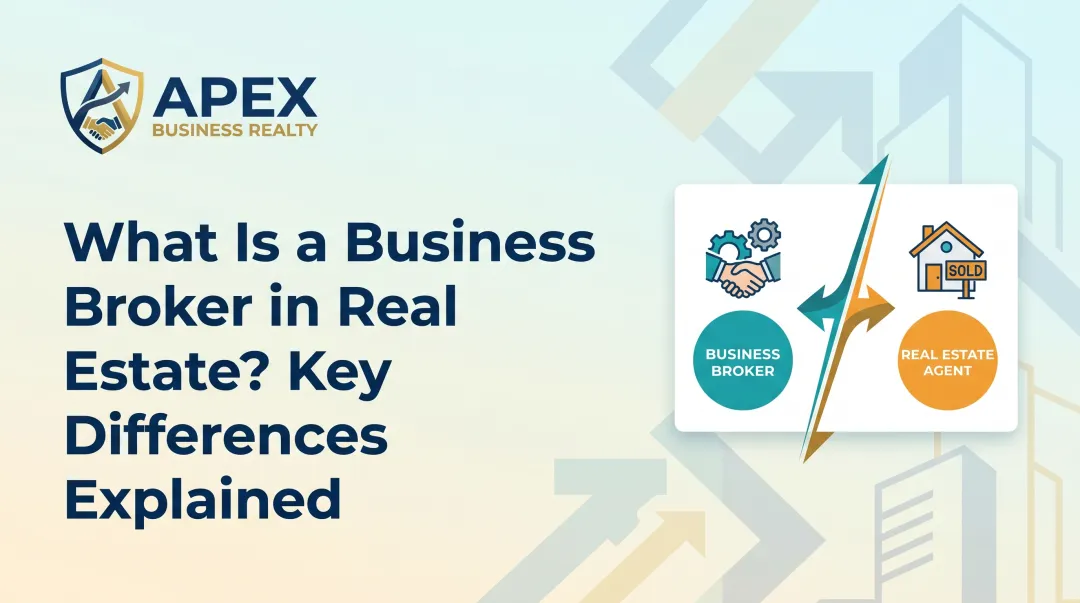
In commercial real estate, "agent" and "broker" get used interchangeably—but they aren't the same thing. Each title carries different legal authority, different responsibilities, and different accountability when a deal gets complicated.
For tenants leasing office space in New York City, that distinction has real consequences.
The stakes are substantial. Manhattan's office market processed 23.0 million square feet of new leasing through Q3 2025—a 37.6% jump year-over-year. Meanwhile, asking rents range from $49.52/sf in Financial West to $121.40/sf on Park Avenue. When lease economics swing that widely, experienced representation matters.
Knowing who holds legal authority to structure your deal—and who is ultimately liable if something goes wrong—determines the quality of representation you actually receive.
Key Takeaways
- Commercial real estate agents are licensed to represent clients in transactions but must work under a supervising broker
- A broker holds a higher-level license, can operate independently, supervise agents, and assumes legal responsibility for deals
- In CRE, "broker" is informally used for both roles—making it critical to understand actual license levels and authority
- Broker-led tenant representation adds strategic depth and legal oversight that agent-only support typically can't match
- When vetting a CRE firm, confirm whether you're working with a licensed broker—not just an agent operating under one
Commercial Real Estate Broker vs. Agent: Quick Comparison
| Factor | Commercial Real Estate Agent | Commercial Real Estate Broker |
|---|---|---|
| License Level | Salesperson license (77 hours education in NY) | Broker license (152 hours education + 2 years experience in NY) |
| Works Independently | No—must operate under a sponsoring broker | Yes—can open and run their own brokerage |
| Legal Accountability | Supervised by broker; broker holds liability | Assumes direct legal responsibility for all transactions |
| Can Supervise Others | No | Yes—can hire and supervise agents |
| Scope of Services | Property tours, client communication, transaction execution | All agent functions, plus deal structuring, compliance oversight, and contract authority |
| Ideal For | Day-to-day client interaction, transaction coordination | Strategic advisory, complex negotiations, multi-year lease structures |
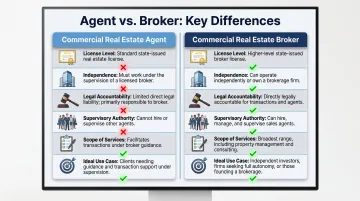
One thing worth knowing: in commercial real estate, "broker" is commonly used as a catch-all for all CRE professionals regardless of actual license type — which creates real confusion for clients trying to understand who they're working with. Most U.S. states, including New York, do not issue separate "commercial" licenses — the same license covers both residential and commercial transactions. That's why advisory depth and specialization matter more than the title alone.
What Is a Commercial Real Estate Agent?
A commercial real estate agent is a licensed professional authorized to facilitate the leasing and selling of income-producing property. They must operate under the supervision and liability of a licensed broker.
Agents are the front-line professionals in most CRE transactions, handling client-facing activities and transaction execution while their supervising broker maintains legal oversight.
Licensing Requirements for Agents
To become a commercial real estate agent in New York State, candidates must:
- Be at least 18 years old
- Complete 77 hours of state-approved prelicensing education (increased from 75 hours to include Fair Housing/implicit bias training)
- Pass the state real estate salesperson exam (90-minute multiple choice format)
- Secure sponsorship from a licensed New York broker who approves the application
- Pay $65 application fee plus $15 exam fee
- Maintain a current NYS photo driver's license or non-driver ID
Exam results are valid for two years, giving candidates time to find a sponsoring broker and complete their application. Unlike some professions, there's no separate "commercial" track. The same salesperson license covers both residential and commercial real estate activity.
What Do Commercial Real Estate Agents Do?
Agents handle the execution layer of a transaction:
- Property searches and site selection – identifying spaces that match budget, location, and square footage requirements
- Coordinating property tours – scheduling visits, highlighting features, answering operational questions
- Market research – gathering comparable lease data, vacancy rates, and submarket trends
- Preparing initial proposals – drafting letters of intent and preliminary lease terms
- Managing client communication – serving as the primary point of contact throughout the leasing process
Agents are the boots-on-the-ground professionals handling day-to-day transaction activities. Final contract authority and legal decisions stay with the supervising broker.
That means clients are always working under the broker's oversight — even if they never interact with the broker directly. The agent executes; the broker is ultimately liable.
What Is a Commercial Real Estate Broker?
A commercial real estate broker has completed advanced education, passed a higher-level state licensing exam, and earned the legal authority to operate independently. That means they can own or manage a brokerage, supervise agents, and take direct legal responsibility for transactions — none of which an agent can do on their own.
Licensing Requirements for Brokers
Becoming a licensed broker in New York requires more preparation than obtaining an agent license — more coursework, a longer exam, and prior field experience:
- Be at least 20 years old
- Complete at least 2 years as a licensed real estate salesperson OR 3 years in the general real estate field, or a qualifying combination
- Complete 152 hours of state-approved broker education (75-hour broker curriculum, 32-hour supplemental curriculum, and Law of Agency course)
- Pass the broker-level licensing exam (2.5 hours)
- Submit proposed business names for state approval
- Pay $185 application fee plus $15 exam fee
The experience requirement is significant—New York demands a minimum two-year apprenticeship under a licensed broker before granting independent authority.
What Do Commercial Real Estate Brokers Do?
Brokers can perform all the same functions as agents—property tours, lease negotiation, client communication—but additionally have the authority to:
- Structure complex deal terms involving tenant improvement allowances, expansion rights, and termination clauses
- Manage escrow or trust accounts
- Oversee legal compliance on transactions
- Supervise agents working under them
- Sign binding agreements on behalf of the brokerage
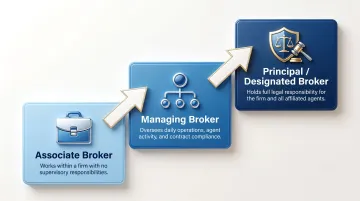
Three common broker types in CRE:
- Associate Broker – Licensed at the broker level but works within another firm; no supervisory responsibilities
- Managing Broker – Runs daily operations, reviews contracts, and ensures compliance across an office or team
- Principal/Designated Broker – Carries full legal responsibility for the firm's transactions and agents; every brokerage must designate one
Beyond closings, brokers advise on portfolio strategy, market positioning, and risk — making them the senior decision-makers on complex deals. For a company signing a seven-year Manhattan lease with a $200/SF tenant improvement allowance and phased expansion rights, having a broker's legal authority and market depth in the room matters.
Broker vs. Agent: Which One Does Your Business Actually Need?
For most standard leasing scenarios, a skilled agent operating within a strong broker-led firm can handle the full client experience. That said, broker-level oversight becomes critical in these situations:
- High-value leases ($500K+ annual rent)
- Multi-site portfolios requiring coordinated lease expirations
- Complex buildout agreements with significant tenant improvement allowances
- Markets with competitive dynamics requiring strategic positioning
For most office tenants, the agent-versus-broker distinction matters less than understanding who your representative works for. Tenant reps advocate exclusively for the occupier's interests, while landlord reps prioritize building owners. That fiduciary distinction has a larger impact on outcomes than license level.
Tenant representatives negotiate for lower lease rates and better concessions, while landlord representatives have a legal duty to maximize rental income for property owners—these are opposing mandates within the same transaction.
Situational Guidance
Choose agent-led teams for:
- Straightforward, single-site lease searches
- Defined budget and timeline
- Spaces under 10,000 square feet
- Standard lease structures with minimal customization
Choose broker-led or full-service representation for:
- Deals involving complex lease structures (percentage rent, profit participation, co-tenancy clauses)
- Above-market negotiations requiring leverage and strategic positioning
- Buildout requirements exceeding $50/sf
- Long-term strategic planning across multiple locations
Nomad Group structures its teams to deliver both capabilities: broker-level strategic oversight paired with the responsiveness of a dedicated transaction team. For scaling companies in NYC, that combination matters — the senior advisor you need for complex negotiations is the same team executing your buildout. With 300+ tenant buildouts completed and 2M+ square feet leased, the firm has built its model around exactly this kind of continuity.
Conclusion
The agent vs. broker distinction matters most when it comes to legal authority, deal complexity, and accountability. But for most tenants, the practical experience is shaped more by the quality of the firm they choose and whether their representative works exclusively in their interest.
For high-growth companies in NYC navigating multi-year office leases, the right choice is less about job titles and more about finding a team with deep NYC market knowledge, a genuine tenant-first orientation, and the capacity to support you from initial search through buildout and beyond. Firms like Nomad Group are built around exactly that model — no volume quotas, no divided loyalties, just focused advocacy for companies navigating complex leasing decisions. Understanding the licensing structure helps you ask sharper questions. Finding the right partner is what actually moves the needle.
Frequently Asked Questions
What is the role of a commercial real estate broker?
A commercial real estate broker is a senior-licensed professional who can operate independently, supervise agents, and take legal responsibility for transactions. Their work covers market advisory, deal structuring, lease negotiation, and compliance oversight.
What are the different roles in commercial real estate?
The main roles include agents (licensed salesperson working under a broker), brokers (independently licensed, can run a firm), associate brokers, managing brokers, and tenant/landlord representatives. In CRE, these roles often carry different titles across firms.
Can a commercial real estate agent work independently?
No, agents must be sponsored by and operate under a licensed broker. They cannot open their own brokerage, hold escrow funds, or take sole legal responsibility for a transaction without a broker license.
Do I need a broker or an agent to lease commercial office space?
Either can help facilitate a lease, but the key is ensuring your representative is a dedicated tenant rep (not a landlord rep) and is backed by a broker-led team with experience in your market and deal type.
What is tenant representation in commercial real estate?
Tenant representation means your broker or agent works exclusively for you—the occupier—not the landlord. Their job is to negotiate the best possible lease terms on your behalf, including rent, tenant improvement (TI) allowances, and buildout scope.
How are commercial real estate agents and brokers paid?
Both are typically paid on commission (a percentage of the total lease value), usually funded by the landlord. In most commercial leases, tenant representation costs the tenant nothing directly, as the commission is split between the listing broker and the tenant rep broker.