
Introduction
You're ready to find office space in New York City. You search online, ask around, and immediately run into a terminology problem: should you call a "broker," an "agent," or a "brokerage firm"? Does it matter? And in a market like Manhattan, where full-year 2024 leasing volume hit 33.34 million square feet — a five-year high — does who you work with actually change your outcome?
It does — especially in commercial real estate, where the wrong partner can lock your company into an eight-year lease at the wrong terms.
What follows covers what a real estate brokerage firm actually is, how it's structured, what it does, and the difference between a residential brokerage and the kind of commercial firm that can guide a growing company through the entire real estate lifecycle.
Key Takeaways
- A real estate brokerage firm is a licensed business entity that provides the legal and operational infrastructure for brokers and agents to represent clients in property transactions
- Brokers hold higher-level licenses and carry legal responsibility for all transactions under the firm's name
- Commercial brokerage firms handle office, retail, and industrial space — with far more complex deal structures than residential transactions
- Strong commercial firms cover the full lifecycle: lease negotiation, buildout, and ongoing space management — not just the deal itself
- Choosing the right firm comes down to market expertise, service scope, and whether their incentives align with yours
What Is a Real Estate Brokerage Firm?
A real estate brokerage firm is a licensed business entity — registered with the state — that provides the legal and operational infrastructure for real estate professionals to represent buyers, sellers, landlords, and tenants in property transactions.
The firm is the legal shell; the brokers and agents are the people operating inside it.
The Hierarchy Inside a Brokerage
Three distinct roles sit within a typical firm:
- The brokerage firm — the licensed entity itself, registered with the state and legally accountable for all transactions conducted under its name
- Brokers — individuals who hold the qualifying license that allows the firm to operate; they can hire agents, manage escrow funds, and bear legal responsibility for transactions
- Agents (salespersons) — licensed professionals who represent clients day-to-day but must affiliate with a licensed brokerage to operate legally
That last point matters more than most people realize. Under New York Real Property Law Article 12-A, no salesperson can receive compensation from anyone other than a duly licensed broker with whom they're associated. Every U.S. state has an equivalent requirement. Agents cannot legally operate independently — full stop.
Firm vs. Broker: Not the Same Thing
A single broker can own and run a firm solo. A large firm can employ hundreds of brokers and thousands of agents. The "firm" is the business structure; the "broker" is the individual holding the qualifying license that makes the firm functional.
That distinction shapes everything about how a firm operates — and how much it can offer clients. Consider the range:
| Firm Type | Structure | Typical Scope |
|---|---|---|
| Solo boutique | One broker, no agents | Niche market, single specialty |
| Mid-size independent | One or more brokers + agents | Local or regional coverage |
| National franchise | Corporate brand, local operators | Multi-market, standardized services |
| Full-service firm | Brokers + specialists (construction, management, etc.) | End-to-end transaction and operations support |
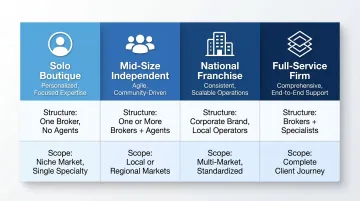
The type of firm you work with — not just the individual agent — determines what support you actually get.
What Does a Real Estate Brokerage Firm Do?
A brokerage firm connects buyers with sellers and tenants with landlords — but that description undersells what a well-structured firm actually provides.
Core Functions
Transaction facilitation — Licensed professionals handle sourcing, negotiation, contracts, and closing on behalf of clients.
Compliance and legal oversight — The firm's principal or managing broker reviews contracts, manages escrow accounts, and ensures every transaction adheres to state law and professional ethics standards.
Agent training and development — Brokerage firms provide onboarding, continuing education, and transaction coaching. This matters for clients: a well-run firm produces better-prepared advisors.
How Brokerage Firms Generate Revenue
Most firms use one or more of these models:
- Commission splits — the firm takes a percentage of each transaction fee earned by affiliated agents
- Desk fees — fixed monthly fees charged to agents in exchange for using the firm's infrastructure and brand
- Transaction fees — per-deal administrative charges on top of the commission structure
The Full-Service Model
Revenue model aside, how a firm structures its services tells you far more about the value it delivers. Some firms have moved well beyond pure transaction work.
Nomad Group, for example, operates as a comprehensive commercial real estate partner in NYC — offering brokerage, construction management, facilities management, and asset management under one roof. When a company signs a lease, the relationship doesn't end there. Buildout coordination, day-to-day operations, and long-term space planning all continue through the same team.
For high-growth companies navigating rapid headcount changes and multiple lease cycles, that continuity is worth more than any single deal.
Broker vs. Real Estate Agent vs. Realtor: Key Differences
These three terms get used interchangeably in casual conversation. They mean very different things legally.
Broker vs. Agent
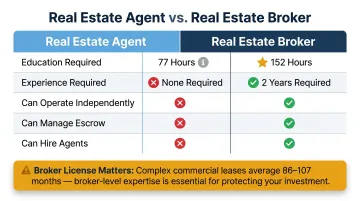
| Real Estate Agent | Real Estate Broker | |
|---|---|---|
| Education (NY) | 77 hours | 152 hours |
| Experience required | None | 2 years as licensed agent |
| Can operate independently | No | Yes |
| Can manage escrow | No | Yes |
| Can hire agents | No | Yes |
The broker license requires nearly double the education and documented transaction experience. For complex commercial leases — where average terms run 86 to 107 months — that gap in qualification is meaningful.
Three Types of Brokers Within a Firm
- Principal/Designated Broker: the firm's licensed "CEO," bearing ultimate legal responsibility for all transactions
- Managing Broker: handles day-to-day operations and supervises agents
- Associate Broker: holds a broker license but chooses to work under another broker rather than run their own firm
The Realtor Distinction
"Realtor" is not a license level. It's a trademarked membership designation from the National Association of Realtors — available to both agents and brokers who join NAR and agree to its Code of Ethics.
Roughly 1.5 million professionals hold the Realtor designation nationally, out of 532,200 total employed brokers and agents (BLS, 2024). The gap exists because NAR counts part-time members; BLS counts active workers.
Being a Realtor and being a broker are entirely separate credentials. When evaluating a firm, the broker license — not the Realtor membership — is what determines legal authority and accountability.
Commercial vs. Residential Brokerage Firms
This is where the differences become consequential for any company looking for office space.
Fundamentally Different Businesses
Residential brokerage firms handle homes, condos, and multi-family properties for individual buyers and sellers. Commercial brokerage firms handle office space, retail properties, industrial facilities, and investment properties for businesses and investors.
The transaction structures, timelines, and expertise requirements aren't in the same category — and the deal complexity below shows why.
Deal Complexity in Commercial Leasing
A residential purchase closes in 30–60 days. A commercial office lease in Manhattan involves:
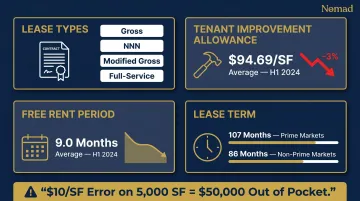
- Lease type negotiations — gross, triple net (NNN), modified gross, or full-service structures all allocate operating costs differently between landlord and tenant
- Tenant improvement (TI) allowances — averaged $94.69/SF in H1 2024 (down ~3% from 2023), according to CBRE's analysis of 3,900 lease transactions
- Free rent periods — averaged 9.0 months in H1 2024, also declining
- Lease terms — prime buildings averaged 107 months (nearly 9 years); non-prime averaged 86 months
Getting the TI negotiation wrong by even $10/SF on a 5,000 SF space means $50,000 out of pocket — on a commitment that could run nearly a decade.
The Client Relationship Looks Different Too
In residential real estate, the relationship typically ends at closing. In commercial real estate — especially for growing companies — the best brokerage firms become ongoing advisors: space planning for headcount growth, renewal negotiations, buildout management, and adapting to market shifts all follow the initial lease.
That ongoing relationship is especially critical in NYC, where hyper-local expertise is what actually moves the needle. Manhattan average asking rents fell to $73.42/SF in Q4 2024, yet rents rose in 11 of 18 submarkets during the same period. A borough-wide average tells you almost nothing when you're deciding between NoMad and Flatiron.
What to Look for in a Real Estate Brokerage Firm
Choosing the wrong commercial brokerage partner is an expensive mistake. Here's what separates firms that deliver from firms that just facilitate.
Market Expertise You Can Verify
Generic market knowledge isn't enough. Look for:
- Completed transactions in your target neighborhoods (not just claims)
- Established relationships with specific landlords and building operators
- Access to off-market or pre-market opportunities
- Submarket-level pricing intelligence, not just borough averages
Scope of Services
Ask whether the firm handles only the transaction or a broader set of needs:
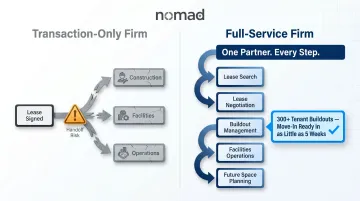
- Transaction-only firms hand you off after lease signing — you coordinate vendors, construction, and buildout logistics yourself
- Full-service firms can manage the buildout, handle ongoing facilities operations, and advise on future space needs through a single point of contact
For a fast-scaling company, vendor coordination across multiple parties introduces real risk. One team managing search, buildout, and operations eliminates handoff risk entirely. Nomad Group, for example, has completed over 300 tenant buildouts tied directly to their brokerage work — including white-box to move-in ready spaces delivered in as little as five weeks.
Transparency and Alignment
Volume-driven brokerages are incentivized to close deals quickly — not necessarily the right ones. The right firm's incentives are aligned with your long-term outcome, not just the transaction fee.
Questions worth asking:
- Is this firm representing tenants exclusively, or both sides of transactions?
- Are they operating under shareholder pressure to hit deal quotas?
- Do they offer honest guidance on market tradeoffs, or mostly encourage you to move forward?
Frequently Asked Questions
What is the difference between a broker and a brokerage firm?
A broker is an individual licensed professional who has completed advanced education, documented transaction experience, and passed a higher-level state exam. A brokerage firm is the licensed business entity through which brokers and agents legally operate The firm is the company structure; the broker is the person whose license makes it functional.
What does a brokerage firm do?
A brokerage firm facilitates real estate transactions by providing licensed professionals, legal oversight, compliance infrastructure, and client representation. In full-service commercial firms, this also includes construction management, facilities management, and long-term space strategy well beyond the initial lease.
How is a broker different from a Realtor?
A broker is a licensing level — it indicates additional education, experience, and a higher-level state exam. A Realtor is a membership designation from the National Association of Realtors, available to both agents and brokers who agree to its Code of Ethics. The two are entirely separate; you can be a broker without being a Realtor, and vice versa.
Do brokers make a lot of money?
Income varies widely by market and specialization. The national median for brokers is $72,280 according to BLS Occupational Outlook Handbook data, but the NYC metro mean reaches $166,730 — roughly 2.3x the national figure — reflecting the deal complexity and financial scale of major market transactions.
What is the difference between a commercial and residential brokerage firm?
Residential firms focus on homes and properties for individual buyers and sellers, with transactions that typically close in weeks. Commercial brokerage firms handle business properties — offices, retail, industrial — with multi-year leases, complex financial negotiations (TI allowances, free rent, buildout timelines), and an advisory relationship that extends well beyond a single deal.