

The short answer: they're fundamentally different professionals who handle entirely different types of transactions. A business broker helps you sell or buy an operating company — customers, revenue, staff, intellectual property, and goodwill included. A real estate broker helps you lease, buy, or sell physical property. Choosing the wrong one can cost you time, money, and the deal itself.
Understanding this distinction matters. In markets like New York City, where high-growth companies lease over 10.3 million square feet quarterly and business sales range from $250,000 to millions, knowing which advisor you need can determine whether your transaction succeeds or stalls.
Key Takeaways
- Business brokers sell entire operating companies — revenue, customers, and goodwill included — while real estate brokers handle property transactions like leasing or buying space
- When a business sale includes property, both professionals may be required — but the lead should match the transaction type
- Business brokers charge success-based commissions of 8–12% for smaller businesses, paid only at closing
- Scaling companies leasing office space need a commercial real estate broker — not a business broker
- Always verify licensing: 17 states require real estate licenses for business brokerage before hiring anyone
What Is a Business Broker?
A business broker is a licensed intermediary who facilitates the buying and selling of privately held businesses — not just physical property, but the entire operating entity. This includes revenue streams, customer relationships, intellectual property, employees, and goodwill.
According to the International Business Brokers Association (IBBA), a business broker is "a professional intermediary dedicated to serving clients and customers who desire to sell or acquire businesses," providing "information and business advice to sellers and buyers, maintaining communications between parties, and coordinating the negotiations and closing processes."
Market Segmentation
Business brokers typically serve the "Main Street" market — businesses valued under $2 million, which account for roughly 90% of all U.S. businesses. Average transaction values range from $250,000 to $300,000. For businesses valued above $5 million, the intermediary is usually called an M&A advisor or investment banker, handling mid-market and enterprise deals.
Licensing Requirements Vary by State
17 states require business brokers to hold a real estate license, including California and Florida. In Florida, Statute 475.01 explicitly includes "business enterprises or business opportunities" in the definition of regulated brokerage activity. Other states have no formal licensing requirement at all.
This patchwork creates real compliance risk. Before hiring a business broker, verify their credentials in the state where your transaction will close.
Agency Relationships
Business brokers can represent either side of a deal — or neither:
- Seller's agent (most common): represents the business owner exclusively throughout the sale
- Buyer's representative: helps a buyer identify, evaluate, and acquire a business
- Transaction broker: facilitates the deal without representing either party exclusively
State laws govern how these relationships are defined and disclosed, so clarify the broker's role before signing an engagement agreement.
What Does a Business Broker Actually Do?
Business brokers handle a fundamentally different scope of work than real estate agents — one that goes well beyond finding a buyer and negotiating a price:
Valuation and Pricing
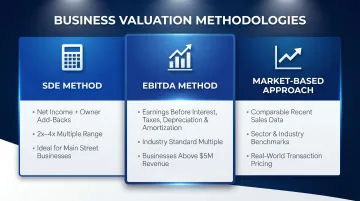
Business brokers analyze financial statements, tax returns, profit and loss data, and market comparables to determine a realistic asking price. They use methodologies like:
- Seller's Discretionary Earnings (SDE): Net income plus owner compensation, interest, depreciation, and discretionary expenses. SDE multiples typically range from 2x to 4x depending on cash flow stability.
- EBITDA (Earnings Before Interest, Taxes, Depreciation, and Amortization): Used for larger businesses above the Main Street threshold.
- Market-Based Approach: Comparing the subject business to similar businesses that have sold recently.
BizBuySell 2025 data shows how much multiples vary by sector: restaurants at 2.26x, IT services at 2.99x, and laundromats at 4.12x.
Real estate appraisal works entirely differently. It values physical property through comparable sales, cost, and income approaches focused on square footage and location — not cash flows or owner compensation.
Confidential Marketing
Unlike property listings publicly posted on MLS, business brokers market businesses without revealing the name or location until a buyer signs a Non-Disclosure Agreement (NDA). Public disclosure can unsettle employees, customers, and suppliers, immediately damaging business value.
Business-for-sale listings appear on platforms like BizBuySell, BizQuest, and LoopNet's business section as "blind" listings that require NDA execution before identity disclosure.
Buyer Screening and Qualification
Business brokers vet buyers for both financial capability and relevant skill set before introducing them to the seller. This protects the owner's time and sensitive business data. Brokers assess:
- Financial capacity to close (liquid assets, financing pre-approval)
- Industry experience or transferable skills
- Serious intent versus casual browsing
Negotiation and Deal Structuring
Brokers negotiate not just price, but deal structure — including:
- All-cash offers versus seller financing
- Earn-outs tied to future performance
- Which assets and liabilities transfer
- Non-compete agreements
- Consulting or transition services
Acting as a buffer between buyer and seller keeps emotion out of the process and increases the likelihood of closing.
Transaction Coordination Through Closing
Once deal terms are agreed, brokers coordinate due diligence with attorneys, accountants, and both parties, managing all documentation through to signed closing. This requires contracts that standard real estate agreements simply don't include: asset purchase agreements, NDAs, and letters of intent.
Business Broker vs. Real Estate Agent: Key Differences
Expertise and Asset Type
A real estate agent (residential or commercial) is trained to sell or lease physical property — land, buildings, office space. A business broker is trained to sell operating companies. Using one for the other's job leads to costly mistakes because the valuation methods, contracts, and marketing strategies don't overlap.
Confidentiality Practices
Real estate agents publicly advertise property addresses on MLS to maximize exposure. Business brokers must do the opposite — marketing without disclosing identity — because revealing that a business is for sale can immediately damage its value by triggering employee departures, customer uncertainty, and supplier concerns.
Financial Analysis Skills
Business brokers interpret tax returns, EBITDA, seller's discretionary earnings, and working capital to build a valuation case. Real estate agents assess property value through comparable sales and market rates.
For example, a business broker must understand how to separate personal expenses from business expenses, adjust for one-time costs, and normalize cash flows. A real estate agent values property based on price per square foot, cap rates, and rental comps — an entirely different methodology.
Buyer Representation Norms
Real estate agents routinely represent buyers, showing multiple properties and conducting broad searches. Business brokers typically represent specific listings and do not run open-ended buyer searches — buyers must come to them.
Practical implication: Buyers looking to acquire a business should reach out to multiple brokers and use platforms like BizBuySell to identify listings, rather than expecting a broker to conduct a comprehensive search on their behalf.
Contracts and Legal Documentation
The legal contracts used in a business sale are fundamentally different from property transactions:
| Business Sale | Real Estate Transaction |
|---|---|
| Non-Disclosure Agreement (NDA) first | Purchase and Sale Agreement first |
| Letter of Intent (LOI) before binding contract | Terms embedded in PSA |
| Due diligence before Purchase Agreement | Due diligence after PSA signed |
| Asset Purchase Agreement + non-compete, promissory notes, lease assignments | Deed, title, closing statement |
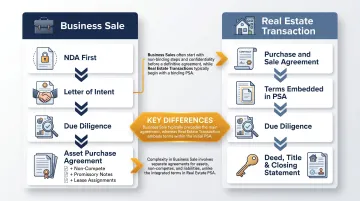
According to Coepio Legal, parties who apply real estate transaction sequences to business acquisitions risk "unnecessary legal expenses, such as drafting detailed purchase and sale agreements, exhibits, and closing documents in the event the transaction is terminated during due diligence."
Business brokers maintain access to the correct documentation; real estate agents do not.
The Real Estate Dimension: When Property Is Part of the Deal
Some business sales include real estate — such as a restaurant owner selling the business and the building, or a manufacturer selling the company along with the production facility. In these cases, the business and property must be valued and transacted separately, and the broker must be equipped to handle both.
Three dimensions make these deals more complex than a standard business sale: licensing requirements, financing structure, and tax treatment.
Licensing
California Business and Professions Code Section 10131 and Florida Statute 475.01 both require a real estate license to sell a business that includes real property. A dual-licensed business broker can manage both sides of these combined transactions without handoffs.
Financing Terms
Including real estate in a business acquisition can improve financing terms. SBA 7(a) loans offer up to $5 million in total financing, but the repayment term changes significantly depending on what's included:
- Business acquisition without real estate: up to 10-year term
- Acquisition including owner-occupied real estate: up to 25-year term
The longer term lowers monthly payments and improves cash flow — which is why real estate-inclusive deals often appeal more to buyers.
Tax Allocation
When a business sale includes real property, the IRS requires Form 8594 to allocate the purchase price across seven asset classes using the residual method. Real estate falls in Class V; goodwill falls in Class VII. Both buyer and seller must file this form, and the allocation affects taxes for both parties.
Who Should Lead the Deal?
The answer depends on where most of the value sits:
- Business value exceeds property value: Business broker should lead
- Property value dominates: Commercial real estate specialist should lead
- Balanced transaction: Both professionals may be required, with clear coordination
How Business Brokers Get Paid
Most business brokers are paid a commission only when the sale closes, aligning their incentive with the seller's outcome.
Commission Structures:
According to the IBBA Guide, commissions range from 8–15% of the final sale price for Main Street businesses, with larger deals using modified Lehman formulas:
| Fee Structure | Typical Application | Rate |
|---|---|---|
| Flat Percentage | Main Street (<$1M) | 8–12% of sale price |
| Double Lehman | $1M–$10M | 10/8/6/4/2% on successive millions |
| Minimum Fee Floor | Small transactions (<$100K) | $10,000–$50,000 flat fee |
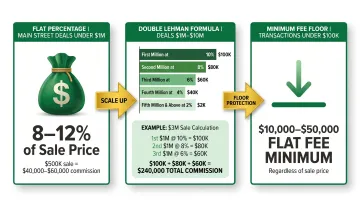
Example: A $3 million business sale using Double Lehman would generate: $100,000 (10% on 1st million) + $80,000 (8% on 2nd million) + $60,000 (6% on 3rd million) = $240,000 total commission.
Upfront Fees:
Not all brokers work on pure commission. Some charge an upfront retainer or preparation fee, usually credited toward the closing commission — a different structure worth understanding before you sign anything.
Watch out for brokers who charge large non-refundable upfront fees, push unrealistic valuations to win the listing, or use high-pressure tactics. A trustworthy broker will explain their fee structure clearly and put it in writing from the start.
Do You Need a Business Broker or a Commercial Real Estate Broker?
- Selling or buying a company (operations, customers, cash flow, goodwill) = Business broker
- Leasing, subleasing, or managing commercial office space for your operations = Commercial real estate broker
For high-growth companies — particularly startups and scaling tech firms in NYC — the more pressing decision isn't selling the business. It's finding and building out the right office space to support growth and culture.
NYC Market Context
The numbers reflect how active these markets are:
- CBRE reported Manhattan Midtown South — Flatiron, NoMad, Union Square — saw 885,000 sq ft of leasing activity YTD, up 63% year-over-year
- Avison Young reported NYC-wide Q1 2026 leasing reached 10.3 million square feet
Navigating that volume requires expertise in tenant representation, lease negotiation, buildout management, and ongoing facilities operations. That's not a business broker's domain.
Nomad Group, for example, has helped companies lease over 2 million square feet across NYC, managing everything from lease negotiation and construction to facilities and asset management. Their track record — 300+ completed tenant buildouts, typically delivered in 90 days — reflects what it actually takes to get a scaling company into the right space and operational.

When Both Are Needed
One scenario calls for both professionals at once: a company acquisition where the buyer needs to assume or renegotiate an existing commercial lease. The business broker handles the transaction; the commercial real estate advisor manages the lease transition, landlord consent, and any renegotiation of terms.
Frequently Asked Questions
What is a business broker in real estate?
A business broker operates in the real estate context when a business sale includes property, but their primary expertise is selling the operating business — not the real estate itself. They differ from real estate agents who focus solely on property transactions and lack the financial analysis and confidentiality skills required for business sales.
What is the difference between a real estate agent and a business broker?
Real estate agents sell physical property and advertise it publicly to maximize exposure. Business brokers sell entire operating companies, prioritize confidentiality to protect business value, and possess financial analysis skills (valuing cash flows, SDE, EBITDA) that real estate agents are not trained for.
What is a significant difference between business property brokerage and real property brokerage?
Business property brokerage involves selling an entire enterprise — operations, goodwill, intellectual property, and staff — while real property brokerage transfers land or physical structures. The two transactions use different valuation methods, contract types, and marketing approaches: cash flow multiples and confidential NDAs on the business side versus price per square foot and public MLS listings on the property side.
What is the purpose of a business broker?
A business broker connects qualified buyers and sellers of privately held businesses, protects seller confidentiality, and ensures accurate valuation based on financial performance. They also manage the full transaction process from listing to closing, coordinating attorneys, accountants, due diligence, and legal documentation.
How does a business broker get paid?
Most business brokers earn a success fee — a commission paid only upon closing — typically between 8–12% of the final sale price for smaller businesses. This performance-based structure means their incentive is aligned with achieving the best outcome for the seller.
Is it worth using a business broker?
Sellers who work with experienced business brokers typically achieve faster sales and better outcomes than those who sell independently. Industry research indicates business owners who self-represent have a 60–70% lower chance of successfully completing a sale, because brokers bring valuation expertise, a vetted buyer network, and negotiating experience that most business owners lack.