?](https://file-host.link/website/nomadgroup-3tddn4/assets/blog-images/e8ae72ad-224f-44d4-9bcd-c11fade91bfc/1780509842907015_0fb96802b73f4dc1a0b9fd4335eb1584/360.webp)
No broker was involved. The listing agent — representing the landlord — was friendly, helpful, and motivated to close.
This is the scenario NYC's Small Business Services warns against when it advises business owners to secure professional help before reviewing lease terms, not after. Commercial leases carry obligations that residential experience doesn't prepare you for: base rent plus additional rent tied to operating expenses, escalation clauses, default provisions, assignment restrictions, and personal guaranties that survive the business itself.
So: do you need a commercial real estate broker? Not legally. But the question worth asking is whether you can afford not to have one.
Key Takeaways
- You're not required to use a broker, but commercial lease complexity — multi-year terms, hidden costs, legal obligations — makes going solo a real risk for most businesses
- A tenant representation broker works exclusively for you, not the landlord, and in most NYC deals the commission is paid by the landlord
- The right broker brings negotiation leverage, market access, and deal insight that can translate into meaningful savings over a lease term
- For scaling companies, space decisions directly affect culture, hiring, and runway — the wrong lease can cost you more than rent
What Does a Commercial Real Estate Broker Actually Do?
Tenant Rep vs. Listing Broker — Not the Same Thing
When you call the number on a "for lease" sign, you're calling the landlord's broker. That person is legally working for the building owner, not you. New York's broker conduct rules require brokers to make clear which party they represent — and a listing broker's obligation runs to the landlord alone.
A tenant representation broker works exclusively for you. Their job is to find the right space, evaluate deal terms on your behalf, and advocate for your interests from first tour through lease execution. As NYC Small Business Services describes it, a tenant rep represents the tenant's interests — not the landlord's — throughout the commercial lease process.
What a Tenant Rep Actually Handles
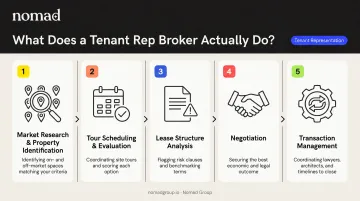
The scope goes well beyond finding available listings:
- Market research and property identification — including off-market opportunities and sublet inventory that never appears on public platforms
- Tour scheduling and evaluation — comparing multiple options against your headcount, growth plans, and budget simultaneously
- Lease structure analysis — flagging hidden costs like CAM charges, tax escalations, and inflated rentable-area calculations
- Negotiation — advocating for free rent periods, tenant improvement (TI) allowances, renewal options, expansion rights, and favorable escalation structures
- Transaction management — coordinating with landlords, attorneys, and buildout teams so you can stay focused on running your business
For Nomad Group clients, the work continues after lease signing. The firm's in-house construction management team tracks TI allowances through the buildout process to confirm landlords deliver what was negotiated — something many tenants only realize they needed after the fact.
Why Most Business Owners Benefit from Hiring One
Commercial Leases Are Not Like Residential Ones
The complexity gap is significant. NYC SBS notes that commercial tenants may owe base rent plus additional rent tied to landlord operating expenses, real estate taxes, or fixed annual escalations — and that rentable area (what you pay for) can include bathrooms, hallways, and shared building spaces that your team never uses.
CBRE data shows that prime Manhattan office leases averaged 107 months between 2021 and 2024. That's nearly nine years. When you sign a lease that long without understanding the default provisions, assignment restrictions, or personal guaranty terms, the downside isn't a bad apartment — it's a liability that follows you.
Landlords Come Prepared. Most Tenants Don't.
Landlords and their leasing teams negotiate deals every week. Most business owners negotiate a lease once every several years. That experience gap alone creates a structural disadvantage, and adding emotion to a high-stakes decision only compounds it.
A broker removes that dynamic. They know what's market, they've seen where landlords leave room, and they can spot when "standard" terms are anything but standard.
The LoopNet Problem
The "I'll just search online myself" instinct makes sense on the surface. Platforms like LoopNet list plenty of properties. What they don't show:
- Off-market availability and sublease inventory
- Landlord history and building management reputation
- Neighborhood vacancy context that affects your negotiating position
- Hidden costs embedded in lease terms that change the effective rent substantially
Manhattan asking rents currently range from $59.05/SF in Downtown to $134.02/SF on the Far West Side, according to Newmark's Q4 2025 market report. The asking price tells you what landlords want. Submarket knowledge tells you what they'll actually accept.
Ongoing Value After Signing
A good broker doesn't disappear after the lease is executed. Nomad Group's process, for example, runs through buildout and space delivery — ensuring commitments made at the negotiating table actually show up in the finished space.
When Authentic Insurance engaged Nomad, the outcome was concrete: a dedicated full-floor Flatiron office, delivered at 30% under comparable coworking costs, with deal terms negotiated directly with building ownership.
When Going Without a Broker Seems Tempting (and the Hidden Risks)
The most common reasons businesses skip representation:
- "It'll cost me more" — it typically won't (the next section explains why)
- "I can negotiate directly" — you can, but you're up against professionals who close dozens of leases a year
- "The landlord's broker was friendly and helpful" — helpful to the landlord, specifically
The Dual Agency Problem
New York's Department of State is direct on this: dual agency creates an inherent conflict because the same broker is representing parties with opposing interests. Even with disclosed consent, a dual agent cannot fully advocate for either party. When you engage a listing broker without your own representation, you're relying on someone whose fiduciary obligation runs to the other party.
What Unrepresented Tenants Miss
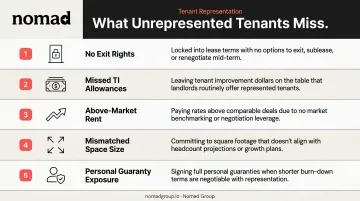
Without a broker, specific and costly mistakes show up repeatedly:
- Signing leases with no termination or exit rights, leaving no options when business needs change
- Missing available TI allowances — money the landlord may have offered if asked
- Agreeing to above-market rents in neighborhoods with meaningful vacancy
- Locking into space too small (or too large) for a growth trajectory that was entirely foreseeable
- Overlooking personal guaranty structures that expose founders to rent liability well after they've vacated
NYC SBS identifies all of these — base rent, additional rent, escalations, guaranties, assignment rights, and construction obligations — as terms to review carefully before signing. Without someone who reads these documents daily, most of that review simply doesn't happen.
How Commercial Real Estate Brokers Get Paid
In most NYC commercial leasing transactions, the landlord pays the broker's commission. NYC SBS describes a typical structure as a percentage of annual base rent — using an illustrative example of 5% for year one and 4% for years two through five on a five-year lease — split between the listing broker and the tenant rep.
In practice, this means tenants usually pay nothing out of pocket for representation. The commission comes from the landlord's side of the deal regardless of whether a tenant rep is involved. If there's no tenant rep, that portion of the commission often stays with the listing broker, so the money is allocated either way.
A few things to confirm upfront:
- Who pays the commission? In most cases it's the landlord, but smaller or unusual deals can have different structures
- Is there a minimum fee? Some brokers apply minimums on smaller transactions
- Is the broker commission-only or fee-based? Commission-only structures align incentives toward closing; understand what that means for deal quality
One reasonable concern: a commission-based broker earns more on a higher-value deal, which can push toward a larger or pricier space than you need. The protection is straightforward — work with a broker whose business runs on repeat clients and long-term relationships, not transaction volume.
Nomad Group is built on that model. The firm carries no shareholder pressure or deal quotas, and the principals treat each engagement as the start of an ongoing relationship, not a one-time close.
How to Choose the Right Commercial Real Estate Broker
What to Look For
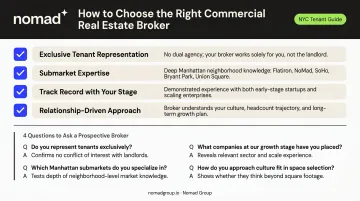
- Exclusive tenant representation — not dual agency, not a firm that also represents the buildings you're touring
- Submarket expertise — Manhattan asking rents vary by more than $75/SF depending on neighborhood; local knowledge matters
- Track record with companies at your stage — a broker who works with early-stage startups navigates very different priorities than one focused on enterprise relocations
- Relationship-driven approach — asks about your culture, team trajectory, and three-year growth plan before discussing square footage
Questions Worth Asking
- Do you represent landlords in any buildings we might tour?
- What's your experience with companies at our stage and headcount?
- How do you handle the buildout phase after lease signing?
- Can you walk me through a recent deal where you negotiated meaningful concessions for a tenant?
Those questions should have clear, specific answers. If they don't, that's a signal.
For NYC-based high-growth companies, Nomad Group's tenant representation covers the full arc — neighborhood selection, lease negotiation, buildout management, and ongoing space operations. With over 2 million square feet leased and 300+ tenant buildouts completed across Flatiron, NoMad, SoHo, Union Square, and Williamsburg, the work extends well beyond the lease signing.
Frequently Asked Questions
Can you lease or sell commercial real estate without a broker?
Yes, it's legally possible — no rule requires a tenant or owner to hire a broker for their own transaction. The practical challenge is that pricing, negotiating terms, and reviewing complex lease obligations are significantly harder without professional expertise, and the cost of mistakes in a multi-year commercial deal tends to be substantial.
Does a tenant have to pay a commercial real estate broker?
In most NYC commercial leasing deals, the landlord pays the commission, typically split between the listing broker and the tenant's broker. Tenants usually pay nothing directly, though specific terms vary — always confirm the arrangement before engaging.
What is a tenant representation broker?
A tenant rep broker works exclusively on the tenant's behalf — not the landlord's — to identify suitable space, negotiate favorable lease terms, and manage the transaction from search through execution. Their legal obligation runs to you, not the building owner.
How do I know if a broker is representing me or the landlord?
Ask directly at the first conversation — New York's broker conduct rules require brokers to disclose which party they represent. If there's any ambiguity, or if the broker also represents the building you're considering, engage your own tenant rep to ensure unambiguous advocacy.
What should I look for when choosing a commercial real estate broker?
Prioritize tenant-only representation, deep expertise in your NYC neighborhoods, and experience with companies at a comparable stage. A broker who asks about your culture and growth plans — not just your budget and square footage — is operating at the right level.
Is it worth using a broker for a small office lease?
Yes — even on smaller leases, a tenant rep can negotiate concessions (free rent, TI allowances, favorable escalation caps) that far exceed any perceived cost. Since the commission is typically landlord-paid, the barrier to entry is low and the downside of going without representation is real.