
Many founders and operators assume that going directly to a landlord — or searching listings independently — saves time and money. The reality is the opposite. The landlord already has a professional negotiating on their behalf. If you don't, you're walking into an asymmetric negotiation with no market data, no leverage, and no advocate in your corner.
This article covers exactly why tenant representation matters, what brokers actually do, and how much the right representation is worth in real dollars.
Key Takeaways
- A tenant rep broker works exclusively for you — not the landlord — throughout the entire transaction
- Commercial listings are fragmented and off-market deals exist; brokers access inventory that never surfaces publicly
- Skilled brokers negotiate TI allowances, free rent, and lease protections worth far more than any commission
- In most NYC transactions, the landlord pays the broker fee so tenant representation typically costs you nothing out of pocket
- Nomad Group covers the full lifecycle — from initial search and lease negotiation through space delivery
What Is a Commercial Real Estate Broker?
A commercial real estate broker is a licensed professional who acts as the intermediary between tenants and landlords during a leasing transaction. The distinction that matters most: not all brokers work for you.
When you call the number on a listing or respond to a CoStar posting, the broker who answers has a fiduciary duty to the landlord. Under New York State law (DOS 175.7), brokers must disclose which party they represent — but that disclosure doesn't change whose interests they're protecting.
A landlord's broker is obligated to deal honestly with a tenant. Their primary loyalty, however, is to the property owner.
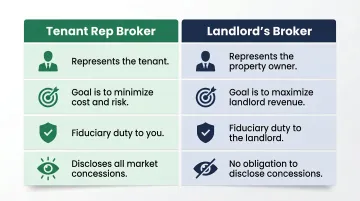
Tenant Rep vs. Landlord's Broker
| Tenant Rep Broker | Landlord's Broker | |
|---|---|---|
| Represents | You (the tenant) | The property owner |
| Goal | Minimize your cost and risk | Maximize landlord revenue |
| Fiduciary duty | To you | To the landlord |
| Discloses market concessions? | Yes | No obligation to |
A tenant representative broker works exclusively on your side. They analyze the market, shortlist options, negotiate terms, and advocate for your interests — not the landlord's. With a dedicated tenant rep, you're not just getting representation — you're getting someone whose compensation depends on getting you a better deal.
Key Advantages of Using a Broker When Buying Commercial Real Estate
These advantages aren't theoretical. They show up in lease terms, dollars saved, time recovered, and risks avoided — outcomes that directly affect your company's ability to operate and grow.
Market Knowledge and Access to Off-Market Opportunities
Commercial real estate in NYC does not have a centralized MLS the way residential properties do. The market is highly fragmented and proprietary — industry data confirms that commercial listing information is spread across private databases, brokerage platforms, and personal networks, with no single shared system for tenants to search independently.
Experienced brokers maintain access to deals that never surface on public platforms. Off-market and pocket listings are common — owners withhold inventory to maintain privacy, create exclusivity, or move space before committing to a full marketing campaign.
Nomad Group's work in Flatiron illustrates this directly: they secured an off-market penthouse floor at 30 West 21st Street for Authentic Insurance — 5,500 square feet with premium finishes — that wasn't available through standard listing searches. Access came through direct ownership relationships built over years of neighborhood transactions.
This advantage matters most for:
- Companies with specific size, configuration, or timeline requirements
- Businesses entering NYC for the first time without established market relationships
- Fast-scaling teams that can't afford months of independent searching
Negotiation Power and Lease Protection
Commercial leases are not standard documents. They contain dozens of negotiable clauses covering rent escalations, tenant improvement allowances, sublease rights, early termination options, and operating expense structures. Many tenants have no clear sense of which terms are market-standard and which are landlord-favorable.
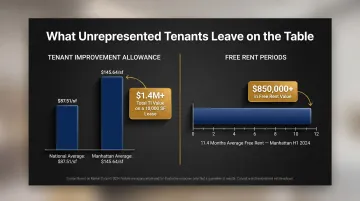
The numbers are substantial. According to CBRE data, the national average tenant improvement allowance in 2024 was $87.51 per square foot. In Manhattan, that figure runs considerably higher — Newmark data puts it at $145.64/sf for new leases of 10+ years in Q2 2024. Free rent periods in top-tier Manhattan space averaged 11.4 months in H1 2024.
On a 10,000-square-foot lease, those concessions represent over $1.4 million in TI support and potentially $850,000+ in free rent. Unrepresented tenants routinely leave both on the table.
Landlords and their brokers negotiate leases daily. Tenants do it once every five to ten years. Average Manhattan lease terms now exceed 118 months — nearly 10 years — meaning a poorly negotiated deal compounds for a long time.
A tenant rep broker removes emotion from the process, knows the landlord's pressure points, and understands what's actually achievable. Every clause below is negotiable; most tenants never ask.
Key negotiable terms an experienced broker addresses:
- Rent escalation structure (fixed 2.5-3% vs. CPI-linked with caps)
- Tenant improvement allowances and build-out timing
- Free rent periods during construction
- Operating expense caps and audit rights
- Sublease and assignment rights
- Early termination and contraction options
End-to-End Deal Management and Post-Signing Support
A broker's value doesn't stop when heads of terms are agreed. The period between signing and move-in is where deals frequently go sideways — missed TI commitments, construction delays, lease milestone gaps.
Strong tenant rep brokers stay engaged through due diligence, coordinate legal review, track critical lease milestones, and ensure the buildout is delivered as promised. Firms that integrate brokerage with in-house construction management take this further.
Nomad Group has completed 300+ tenant buildouts across NYC, with the construction team working directly alongside the brokerage team rather than operating as a separate vendor. That integration removes the hand-off risk that causes most post-signing delays.
Two examples show what this looks like in practice. When Optimove faced a three-month gap between their expiring coworking agreement and their new space at 1407 Broadway, Nomad coordinated temporary swing space at 11 East 44th Street, moved furniture, installed Wi-Fi, and had the team operational with zero downtime. When Extend needed their NoMad office delivered fast, Nomad went from white-box to fully built (including HVAC) in five weeks.

This matters most for:
- High-growth companies doing their first major office buildout
- Teams working to a tight occupancy timeline
- Companies managing multiple location decisions simultaneously
The Real Cost of Working with a Broker
The most common reason tenants skip representation is cost. It's also the most misunderstood part of commercial real estate.
In the vast majority of NYC commercial transactions, the landlord pays the broker fee. The tenant does not write a check. When a tenant rep broker is involved, the outside broker receives a full commission and the landlord's broker receives a reduced co-brokerage share — both paid by the landlord.
When a tenant is unrepresented, the landlord's broker captures the full allocation. The landlord does not reduce the rent by the amount of the saved co-brokerage fee.
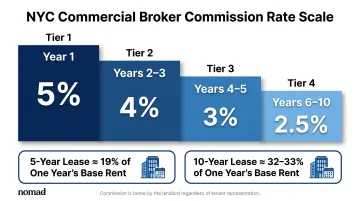
NYC commercial brokerage commissions follow a declining-rate scale calculated on base rent:
- Year 1: 5%
- Years 2-3: 4%
- Years 4-5: 3%
- Years 6-10: 2.5% per year
On a five-year lease, that equals roughly 19% of one year's base rent. On a 10-year lease, approximately 32-33%. The landlord bears this cost regardless of whether you're represented.
Even in atypical structures where fees are shared differently, a skilled negotiator typically recovers more in concessions — free rent periods, tenant improvement allowances, reduced escalations — than any broker cost would represent. At the start of any engagement, ask your broker to walk you through their specific fee arrangement so there are no surprises at the finish line.
What Happens When You Skip the Broker
Going directly to a landlord's listing agent puts you across the table from a professional whose fiduciary duty is to the property owner. They have no obligation to share market rates, flag problematic lease clauses, or tell you what concessions are on the table. Under NY law, they must deal honestly with you — but honest isn't the same as helpful.
The practical consequences for unrepresented tenants are consistent:
- Missing off-market inventory that would have been a better fit at a better price
- Accepting above-market rents without knowing comparable deals in the submarket
- Signing unfavorable escalation clauses — the difference between 3% and 2.5% annual escalations on a 10-year Manhattan lease at $75/sf for 10,000 sf compounds to over $190,000
- Receiving insufficient TI allowances — the gap between $60/sf and $130/sf market rate is $700,000 in unrealized buildout support on 10,000 sf
- Forfeiting free rent — missing standard concessions of 9-13 months at that rent level represents $675,000-$975,000 in lost value
Each of those gaps compounds across a 5-, 7-, or 10-year term. A suboptimal lease isn't a short-term inconvenience — it's a fixed cost structure your business carries for years, with no exit until expiration.
How to Get the Most Out of Your Broker Relationship
Broker relationships produce the best results when you're clear upfront. Before the search begins, communicate:
- Headcount trajectory over the next 24-36 months
- Budget range including total occupancy cost, not just asking rent
- Target neighborhoods and any location requirements tied to transit, clients, or talent
- Timeline — when you need to be operational, working backward from buildout duration
- Operational requirements — floor plates, natural light, infrastructure, private offices vs. open floor
This framing lets your broker function as a strategic advisor rather than a listing aggregator. The difference in outcomes is significant.
What to Look for in a High-Value Broker
Not all commercial brokers operate the same way. The qualities that distinguish a genuinely useful broker from a transactional one:
- Proven transaction history in your target neighborhoods — not just market awareness, but active deal flow
- Tenant-only representation — no conflicts from also representing landlords in the same buildings
- Fee transparency — willing to explain their compensation structure before you engage
- Post-transaction capability — can support the deal through buildout, not just lease signing
Few firms meet all four criteria. Nomad Group is one that does. The firm pairs brokerage with in-house construction management, facilities support, and ongoing space management, giving clients continuity from the first neighborhood conversation through day-one occupancy and well beyond the lease signing.
The companies that navigate NYC commercial real estate most effectively treat their broker as a long-term partner. That relationship pays off most visibly at renewal — when knowing what's available before it hits the market is often the difference between a favorable renegotiation and a forced move.
Frequently Asked Questions
Do you need a broker for commercial real estate?
No legal requirement exists, but going without one puts you at a real disadvantage. The landlord's listing broker represents the landlord's interests — not yours. Going unrepresented means negotiating without market data, without knowledge of available concessions, and without someone whose job is to protect your terms.
Is a 3% broker fee standard?
Commercial broker commissions in NYC typically range from 3-6% of total transaction value, calculated on a declining scale based on lease term. The exact amount depends on deal size, market, and lease length. This fee is most often paid by the landlord rather than the tenant.
Does the landlord pay the broker fee?
In most NYC commercial transactions, yes. The landlord covers both the listing broker's fee and the tenant rep broker's fee as part of standard deal terms.
What is the difference between a tenant rep broker and a landlord's broker?
A landlord's broker is legally obligated to represent the property owner's interests first. A tenant rep broker works exclusively for you — advocating for your terms, your buildout allowances, and your flexibility options.
Can a commercial broker help with more than just finding a space?
Yes. Experienced brokers support the full transaction — lease negotiation, due diligence, TI allowance negotiation, and buildout coordination. Full-service firms extend this through construction management and space delivery, well past lease signing.
How do I choose the right commercial real estate broker in NYC?
Prioritize brokers who check these boxes:
- Active transaction history in your target NYC neighborhoods
- A clear tenant-only representation model
- Upfront fee transparency and the ability to coordinate the buildout, not just the lease