Introduction
You've just closed your Series B. The team is at 60 people and growing fast, and the WeWork arrangement that made sense 18 months ago no longer fits. Now you need real office space — in New York City, on a timeline, with a lease you'll live with for the next several years.
Then the broker calls arrive. Three firms want to show you spaces. One sends a 40-slide deck before you've even spoken. Another drops a dozen listings in your inbox with no context.
You don't know who represents the landlord, who represents you, or whether any of these people have the expertise to evaluate a lease as the financial commitment it actually is.
This is where most growing companies get into trouble — not because they make bad decisions, but because they don't know what a commercial brokerage actually does, what credentials signal genuine expertise, or how to tell a deal-focused broker from a long-term real estate partner.
This post breaks down what a commercial brokerage actually does, what the CCIM designation signals about expertise, and the specific qualities that separate a transactional broker from a firm worth trusting with a multi-year commitment.
Key Takeaways
- A commercial brokerage does far more than match tenants to listings — it guides companies through site selection, lease negotiation, buildouts, and ongoing space management.
- CCIM (Certified Commercial Investment Member) is one of commercial real estate's most respected credentials, covering financial analysis, market analysis, and investment decision-making.
- Earning CCIM requires completing a rigorous curriculum, passing a comprehensive exam, and documenting qualifying transaction experience.
- When evaluating a brokerage, look beyond credentials: ask about market depth, end-to-end capabilities, and whether their interests align with yours.
What Does a Commercial Brokerage Actually Do?
A commercial brokerage is a firm — or individual broker — that facilitates the leasing, buying, selling, or management of commercial properties on behalf of tenants, buyers, landlords, or investors. The definition is straightforward. What brokers actually do day-to-day is considerably more involved.
Tenant Representation vs. Landlord Representation
The most important distinction most clients don't understand upfront: whose side is the broker on?
A tenant rep broker works exclusively for the occupying company. As JLL describes it, tenant representation covers the full lease planning lifecycle — from sourcing the right location to negotiating favorable lease terms. The tenant rep's job is to advocate for your interests, not the landlord's.
A landlord broker (also called a listing broker) represents the property owner. Their goal is to fill the space at favorable terms for the landlord. Under the NAR's 2026 Code of Ethics, brokers must protect and promote their client's interests while treating all parties honestly — but a landlord broker's client is the building owner, not you.
The same brokerage firm may represent both sides of the market, but individual brokers typically specialize in one to avoid conflicts of interest.
The Full Lifecycle of Services
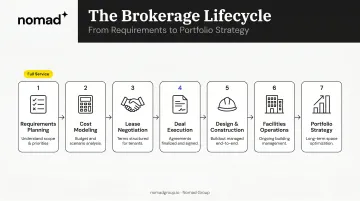
Once you know who a broker represents, the next question is how much they actually do. A modern commercial brokerage often goes well beyond finding and leasing a space:
- Defines space requirements, budget, and target neighborhoods before you tour a single building
- Models total occupancy costs, compares lease structures, and evaluates concessions like free rent or fit-out contributions
- Negotiates terms covering rent-free periods, tenant improvement allowances, and break clauses
- Coordinates with your attorneys and financial advisors through deal execution
- Manages design, contractors, and construction timelines after the lease is signed
- Handles day-to-day operations, maintenance, and cleaning once you're in
- For landlords and investors: manages portfolio performance and long-term asset strategy
Transactional vs. Full-Service
Most brokers close a deal and move on. That's not a criticism — it's just how the traditional model works. A transactional broker's incentive ends at signing. What happens after is someone else's problem.
A full-service firm stays involved through construction, operations, and ongoing space decisions. Nomad Group, for example, has completed over 300 tenant buildouts and leased more than 2 million square feet across NYC. Their Flex by Nomad model and in-house construction teams mean a client can move from signed lease to fully operational office without juggling multiple vendors or handoffs.
When one client's permanent space wasn't ready on time, Nomad placed them in temporary swing space at one of their own managed buildings, coordinating furniture, Wi-Fi, and cleaning while the permanent sublease was finalized. That kind of response is only possible when a firm's infrastructure extends well past the closing table.
What Is CCIM Certification and Why Does It Matter?
CCIM stands for Certified Commercial Investment Member — a designation awarded by the CCIM Institute, a National Association of REALTORS® affiliate, since 1967. It's widely regarded as commercial real estate's global standard for professional achievement.
Who Holds CCIM and What It Covers
The designation isn't limited to brokers. CCIM holders include leasing specialists, asset managers, appraisers, developers, corporate real estate executives, institutional investors, and commercial lenders. It's a cross-disciplinary credential that signals analytical and strategic competence across commercial real estate functions.
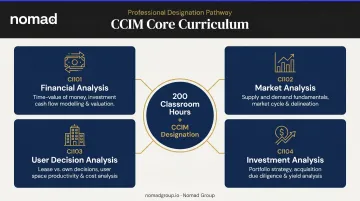
The CCIM curriculum covers four core areas:
- Financial analysis (CI101): cash flows, financing structures, and returns
- Market analysis (CI102): supply, demand, and submarket dynamics
- User decision analysis (CI103): occupancy decisions evaluated as financial choices
- Investment analysis (CI104): performance assessment of income-producing properties
Earning the designation requires 200 classroom hours plus professional experiential requirements — a commitment well beyond what a standard real estate license demands.
How Rare Is CCIM?
There are currently more than 13,000 CCIM Designees worldwide, with over 20,000 professionals having completed the program since 1967. Against the full universe of licensed commercial practitioners — brokers, agents, lenders, developers, and property managers — that's a small share. Serious practitioners pursue it; it never became a checkbox credential.
CCIM vs. a Basic License
Any licensed broker can legally represent a client in a commercial transaction. A license covers the legal authority to transact. CCIM covers the analytical skill to do it well.
A licensed-but-uncredentialed broker can show you spaces and write a lease. A CCIM-designated broker is trained to evaluate a lease as a financial instrument — analyzing net present value across options, total occupancy costs, and concession structures in ways a generalist may not approach.
What Are the Requirements to Earn CCIM Certification?
Earning the CCIM designation requires meeting three core requirements as established by the CCIM Institute:
1. Complete the Core Curriculum
Candidates must complete all four core courses — CI101 through CI104 — plus negotiations training and an ethics course. Coursework is available in-person and online.
2. Pass the Comprehensive Exam
After completing the curriculum and submitting a qualifying portfolio, candidates must pass the CCIM Comprehensive Exam. Portfolio approval remains valid for two years — candidates must attempt the exam within that window or approval is voided.
3. Submit a Portfolio of Qualifying Experience
Candidates must document real-world commercial real estate transaction or management activity. The 2024 CCIM Portfolio Handbook defines three qualifying paths:
| Path | Transaction Count | Dollar Volume |
|---|---|---|
| Option 1 | 3 or more activities | $30M or more |
| Option 2 | Exactly 10 activities | $10M or more |
| Option 3 | 20 activities | No dollar threshold |
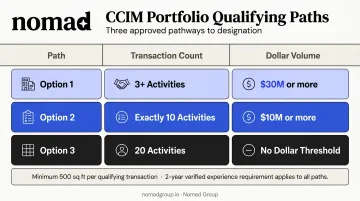
Lease transactions must involve at least 500 square feet (effective January 1, 2022) to count. Candidates need at least two years of full-time commercial real estate experience before submitting a portfolio.
Beyond the experience and exam requirements, it's worth knowing what the program costs — and how long it realistically takes to complete.
Time and Cost
Total investment runs roughly $8,300 for CCIM members and nearly $12,000 for non-members. Timeline varies: some candidates finish in a year, others spread coursework and qualifying transactions over several years.
2026 CCIM Cost Schedule:
| Item | Member | Non-Member |
|---|---|---|
| Candidate Membership | $695 | $695 |
| CI101 | $1,299 | $2,299 |
| CI102 | $1,529 | $2,329 |
| CI103 | $1,499 | $2,299 |
| CI104 | $1,499 | $2,299 |
| Negotiations Training | $370 | $475 |
| Portfolio Submission Fee | $175 | $175 |
| Comprehensive Exam + Review | $1,220 | $1,220 |
| Total | $8,286 | $11,810 |
Source: CCIM Institute 2026 fee schedule
Beyond Credentials: What to Look for in a Commercial Real Estate Partner
Credentials matter — but a CCIM designation with no local market depth in your target neighborhoods is only part of the picture. Here's what else to evaluate.
Market Specialization
NYC's office submarkets are genuinely distinct. Midtown asking rents averaged $84.79 per square foot in Q1 2026, with Midtown vacancy hitting a 20-quarter low of 18.3%. SoHo sat at $76.96 per square foot with higher vacancy at 27.4%. Brooklyn came in at $44.48 per square foot — a meaningful difference in both cost and tenant profile.
A broker who knows Flatiron, Union Square, and NoMad deeply — who has real landlord relationships and understands which buildings are flexible on buildout allowances — will outperform a generalist working from a database.
Nomad Group concentrates its work along what the firm calls "Unicorn Lane," the corridor spanning Flatiron, NoMad, and Union Square where many of NYC's high-growth tech companies have planted flags. That geographic focus translates directly into landlord access and deal leverage that a broader practice simply can't replicate.
The Alignment Question
Tenant rep brokers are typically paid by the landlord via commission, not by the tenant. That structure is standard and not inherently problematic, but it means you should understand your broker's incentives clearly. A broker paid on deal size has some incentive to push you toward larger, faster transactions.
Before signing on with any broker, ask directly:
- Who is paying you, and how is your commission calculated?
- Are you representing any landlords in spaces you're showing me?
- Will you disclose if that changes during our search?
Under NAR standards, brokers must disclose compensation sources and obtain informed consent before accepting payment from multiple parties. A trustworthy firm will answer these questions without hesitation.
End-to-End Capability
If your company needs not just a lease but a fully operational office (built, staffed, and running), brokerage alone isn't enough. The handoff from broker to architect to contractor to facilities manager is where timelines slip and costs escalate.
A firm with in-house construction, design, and facilities teams removes those handoff gaps entirely. Nomad's 90-day buildout turnaround is one example of what integrated capability produces. When Extend AI needed a white-box space converted to a fully built office (including HVAC), Nomad's in-house construction and design teams completed the project in five weeks. That kind of result isn't achievable by assembling vendors from scratch after lease signing.

Frequently Asked Questions
How much does CCIM certification cost?
The total investment is $8,286 for members and $11,810 for non-members, based on CCIM Institute's 2026 fee schedule. This includes tuition for all four core courses, negotiations training, portfolio submission, and the comprehensive exam. Member pricing applies to NAR members and existing CCIM candidates.
What are the requirements to earn CCIM certification?
Three requirements: completing the CCIM core curriculum (CI101–CI104), passing the comprehensive exam, and submitting a portfolio of qualifying commercial real estate transaction experience that meets the CCIM Institute's volume thresholds. Candidates need at least two years of full-time CRE experience before portfolio submission.
How long does it take to earn CCIM certification?
The CCIM Institute notes candidates can finish in as little as one year, though most take two to three — especially when building the required transaction volume. Pace depends on how quickly coursework is completed alongside active deal experience.
Is CCIM certification worth it?
For commercial real estate professionals, CCIM ranks among the field's most respected credentials — the designation combines rigorous analytical training with demonstrated transaction experience and a strong professional network. For clients, a CCIM-designated broker signals deeper expertise, particularly when navigating complex, multi-year lease commitments.
What is the difference between a commercial broker and a tenant representative?
A commercial broker is a broad term covering any licensed professional transacting in commercial real estate. A tenant representative specifically advocates for the occupying company's interests — serving as the tenant's advisor rather than the landlord's agent. Not all commercial brokers offer true tenant representation.
Do all commercial real estate brokers need to be CCIM certified?
No — CCIM is a voluntary designation, not a licensing requirement. Brokers can legally practice commercial real estate without it. However, the certification signals an elevated level of analytical training and demonstrated transaction experience that clients may reasonably prioritize when selecting a partner for complex, long-term commitments.