Tenant representation exists to solve this. A tenant rep is a licensed commercial real estate broker who works exclusively for you — not the landlord — throughout the entire leasing process. This guide breaks down exactly what tenant representation means, what a tenant rep does, and why it matters for companies scaling in NYC.
Key Takeaways
- Tenant reps are licensed brokers who work exclusively for tenants, not landlords.
- They manage the full search process: needs assessment, market survey, tours, proposals, and lease negotiation.
- Landlords typically pay the tenant rep's commission, so tenants get expert advocacy at no direct cost.
- Manhattan tech tenants averaged $131.70/SF in tenant improvement allowances and 13.3 months of free rent in 2025.
- Skilled tenant reps create competitive leverage, surface hidden lease risks, and compress your timeline.
What Is Tenant Representation?
Under the New York State Disclosure Form for Landlord and Tenant, a tenant's agent is a broker engaged by the tenant to represent the tenant's interest and negotiate the lease on terms acceptable to the tenant. A landlord's agent, by contrast, represents the landlord and does not represent the tenant's interests. These are legally distinct roles — not a matter of informal preference.
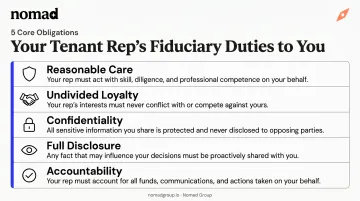
This distinction matters more than most companies realize. When you engage a tenant rep, you have a broker whose fiduciary duties run entirely to you. Those duties include:
- Reasonable care in evaluating options and advising on terms
- Undivided loyalty to your interests alone
- Confidentiality around your budget, timeline, and constraints
- Full disclosure of anything that could affect your decision
- Accountability for acting in your best interest throughout
When you work with a listing broker — even one who seems helpful — their duties run to the building owner, not to you.
The Dual Agency Problem
NY DOS rules allow a broker to represent both parties in the same transaction only with informed written consent. Even then, the dual agent cannot provide the full range of fiduciary duties — including undivided loyalty — to either side. For a tenant signing a five- or seven-year lease, that's a meaningful gap in protection.
In the NYC office market, where a five-year lease can represent millions of dollars in total rent obligations, having a broker whose loyalties are unambiguous isn't a nicety — it's a basic protection.
What Does a Tenant Rep Broker Actually Do?
The work starts well before any lease is signed. A strong tenant rep gathers detailed information about your company's headcount, growth trajectory, culture, target neighborhoods, and budget — then builds a search strategy around those priorities, not around whatever happens to be listed.
Property Search and Market Access
Tenant reps access both publicly listed and off-market spaces. Their professional networks and proprietary databases surface options that a company searching independently would rarely find. Nomad Group, for example, maintains direct relationships with owner-operators across Flatiron, NoMad, SoHo, and Williamsburg — which is how their team uncovered a full-floor sublease from Lazard Asset Management for client Optimove at 1407 Broadway, complete with a 3,000+ square foot private rooftop terrace that never hit the open market.
Financial Analysis
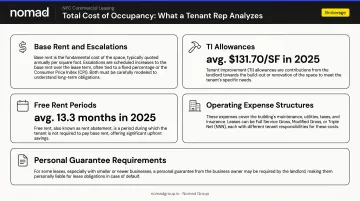
Beyond the headline rent number, a tenant rep evaluates total cost of occupancy across multiple spaces:
- **Base rent and annual escalation clauses**
- Tenant improvement (TI) allowances — Manhattan tech tenants averaged $131.70/SF in 2025
- Free rent periods — tech tenants averaged 13.3 months of abatement in 2025
- Operating expense structures and audit rights
- Personal guarantee requirements
This analysis allows apples-to-apples comparisons across properties with very different economic profiles.
Lease Negotiation and Post-Signing Support
The tenant rep leads all negotiations with landlords — using market data on comparable deals to push for better rent, more favorable TI packages, renewal options, and protective clauses. A good tenant rep doesn't stop at lease signing. Firms like Nomad Group support clients through buildout management, facilities operations, lease renewals, and expansion needs — covering the full arc from signed lease to a functioning, managed space.
The Key Benefits of Tenant Representation for Growing Companies
For growing companies signing multi-year leases, the stakes are too high to navigate alone. Here's what a dedicated tenant rep actually delivers.
Zero Conflict of Interest
This is the foundational benefit. A tenant rep's financial incentive and professional reputation are both tied directly to your outcome — not the landlord's. Every recommendation, every counter-offer, and every concession they push for reflects your business goals.
Better Deal Economics
Tenant reps solicit proposals from multiple landlords simultaneously. That competition creates leverage. Market data on comparable transactions gives them justification for every counter-offer. In a market where Manhattan tech asking rents hit $90.31/SF in 2025, the gap between an informed negotiation and an uninformed one can be material over a multi-year lease.
Access to Off-Market Opportunities
Nomad Group's portfolio management of 2M+ square feet across Manhattan creates on-the-ground access to spaces before public listing. When Authentic Insurance was locked into costly coworking arrangements, Nomad secured them a full-floor space in Flatiron at 30% under comparable coworking costs — a deal sourced through direct landlord relationships rather than public listings.
Risk Mitigation Beyond Headline Numbers
Commercial leases are full of provisions that don't make headlines but carry real financial exposure:
- Relocation clauses — allowing landlords to move your space
- Personal guarantees — putting founders' personal assets at risk
- Operating expense caps — limiting your exposure to pass-through charges
- Maintenance responsibilities — shifting building costs to tenants
- Audit rights — your ability to verify landlord expense calculations
A skilled tenant rep catches these provisions before you sign.
Tenant Rep vs. Listing Broker: Understanding the Difference
| Role | Who They Represent | Fiduciary Duties To |
|---|---|---|
| Tenant's Agent | The tenant | Tenant — loyalty, confidentiality, full disclosure |
| Landlord's Agent | The property owner | Landlord — not the tenant |
| Dual Agent | Both (with consent) | Neither fully — undivided loyalty is unavailable |
A listing broker's job is to achieve the best possible terms for the landlord: highest rent, fewest concessions, most favorable exit clauses. When a tenant works directly with the listing broker, that broker will often seem cooperative — but is legally and financially incentivized to serve the owner's interests.
The solution is separate representation. A dedicated tenant rep sits on your side of every negotiation — pushing back on above-market rents, negotiating free rent periods, and securing tenant improvement allowances that a listing broker has no incentive to offer you.
How the Tenant Representation Process Works in NYC
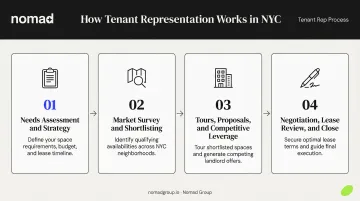
Step 1: Needs Assessment and Strategy
The rep starts by understanding your space requirements, team size, budget, target neighborhoods, and timeline. This becomes the framework that drives the entire search — preventing wasted tours and misaligned options.
Step 2: Market Survey and Shortlisting
The rep conducts a comprehensive survey across on-market and off-market properties. In NYC, this means filtering by neighborhood (Flatiron vs. Midtown South vs. SoHo), price per square foot, building class, and cultural fit.
According to Cushman & Wakefield, Manhattan Class A asking rents averaged $82.72/SF in Q4 2025. Knowing where you sit relative to that benchmark shapes which buildings are realistic before you tour a single one.
Step 3: Tours, Proposals, and Competitive Leverage
The rep schedules and guides property tours, then solicits proposals from multiple landlords simultaneously. That competition is intentional — it often produces better terms than approaching any single landlord directly.
Step 4: Negotiation, Lease Review, and Close
The rep leads counter-proposal negotiations, coordinates with legal counsel on lease language, and manages the timeline through to signature. The result is a deal structured around your actual priorities, with lease risks surfaced and addressed before you're locked in.
How to Choose the Right Tenant Rep for Your Business
Not all tenant reps are equal. When evaluating candidates, focus on these four criteria:
- Hyperlocal expertise — Ask for a track record of completed deals in your target neighborhoods. A rep with active deal flow in NoMad, Flatiron, and SoHo brings insight into landlord reputations and pricing that generalists don't have.
- Full-service capabilities — A rep who stops at lease signing leaves a gap. Ask whether your rep can also support buildout timelines and facilities needs. Firms like Nomad Group cover brokerage, construction management, and facilities operations under one roof, which eliminates the vendor coordination burden during a critical growth phase.
- Transparent agency disclosure — Under NAR commercial exchange rules, a tenant rep must disclose their representation role at first contact and confirm it in writing by lease execution. Ask upfront how they handle potential conflicts.
- References from similar clients — Request references from companies at your stage and in your sector. Outcomes for a 25-person Series A startup differ from those for a 150-person enterprise tenant.
Frequently Asked Questions
What is tenant representation?
Tenant representation is the practice of a licensed commercial real estate broker representing the tenant's interests exclusively during the leasing process. Under New York State agency law, this broker owes fiduciary duties — including undivided loyalty — to the tenant, not the landlord.
Who usually pays a tenant representation agent's fees?
In most commercial office transactions, the landlord pays the tenant rep's commission out of the deal proceeds, meaning tenants typically receive expert representation without direct out-of-pocket cost. Compensation is set by contract, so confirm the arrangement upfront with your rep.
What's the difference between a tenant rep and a listing broker?
A listing broker is hired by and loyal to the landlord — their job is to achieve the best terms for the property owner. A tenant rep works exclusively for the tenant. Working with a listing broker without your own representation creates an inherent imbalance in negotiations.
Do I need a tenant rep if I'm just renewing my lease?
Yes. According to CBRE's 2025 Americas Office Occupier Sentiment Survey, 86% of tenants prefer renewing in place — which means most tenants negotiate without competitive leverage. A rep can benchmark your rent against current market rates and solicit competing proposals to improve your renewal terms, even if you plan to stay.
How long does it take to find and lease office space in NYC with a tenant rep?
Timelines vary, but JLL recommends starting renewal discussions 18 to 24 months out for anchor tenants. For new searches, a rep shortens the process by pre-qualifying spaces and accelerating negotiations. With Manhattan YTD leasing at 9.76M SF through April 2026, moving with a clear strategy matters.
Can a tenant rep help with office buildout and space management after signing?
Many tenant reps support post-signing vendor coordination. Full-service firms like Nomad Group go further, managing buildout, construction, and ongoing facilities operations — with a 90-day buildout turnaround across 300+ completed projects. That continuity means clients handle one relationship, not multiple vendors, through a critical transition.