
Introduction
Picture this: you're a startup founder reviewing your first office lease in New York City. In a single paragraph, you encounter "NNN," "CAM reconciliation," "rentable vs. usable square footage," and "tenant improvement allowance." You nod along, sign the LOI, and only later realize you've committed to paying far more than the quoted base rent.
This scenario plays out constantly — and it's costly. Commercial real estate has a dense, specialized vocabulary that landlords and their brokers use fluently. Tenants who don't speak it are negotiating blind.
This guide breaks down the most essential CRE terms in plain language: lease administration basics, lease structures, square footage mechanics, and lifecycle milestones from LOI to renewal. Whether you're signing your first lease or your fifth, knowing what you're agreeing to puts you in a position to negotiate — not just accept.
Key Takeaways
- Commercial lease administration is ongoing — it covers critical dates, expenses, and compliance for the life of the lease, not just at signing.
- NNN leases shift property taxes, insurance, and CAM costs to the tenant — base rent is only part of what you'll pay.
- Rentable square footage is always larger than what you actually occupy, because it includes your share of common areas.
- Treat the LOI as a strategic document: it's where your negotiating leverage is highest, before the lease locks terms in.
- Start planning for lease renewal 12 to 24 months before expiration, per JLL's guidance.
What Is Commercial Lease Administration?
Commercial lease administration is the ongoing process of managing, tracking, and acting on the terms of a commercial lease. It's not something that ends at signing. It runs for the entire lease term: rent payments, operating expense obligations, critical date tracking, and compliance with lease conditions.
IREM defines commercial lease administration as covering complex, tenant-specific lease provisions, operating-expense language, gross-up calculations, and tenant reporting obligations.
Core Components of Lease Administration
A functional lease administration process typically includes:
- Lease abstraction — converting the full legal document into a structured summary of key terms and dates
- Critical date tracking — monitoring renewal notice windows, rent escalation triggers, and lease expiration
- Financial alignment — verifying that rent invoices and operating expense billings match actual lease terms
- Compliance monitoring — ensuring insurance certificates, signage rights, and maintenance obligations stay current
Many leases also grant tenants the right to review annual CAM reconciliations within a specific window. Cushman & Wakefield notes that review windows typically run 30 to 180 days after receipt — a deadline that's easy to miss without an active tracking system.
Lease Administration vs. Lease Accounting
These two functions are related but distinct. Lease accounting governs how lease obligations appear on financial statements — under FASB Topic 842, lessees must recognize assets and liabilities for leases with terms exceeding 12 months. Lease administration is the operational discipline: tracking what's owed, when it's due, and whether both parties are meeting their contractual obligations.
What Does a Lease Administrator Do?
On the landlord or property management side, a lease administrator handles:
On the landlord or property management side, a lease administrator handles:
- Abstracting leases and maintaining a summary of key terms
- Managing rent collection and billing schedules
- Overseeing CAM reconciliation
- Monitoring tenant compliance with insurance and maintenance requirements
The tenant side looks quite different. For growing companies, there's often no equivalent role — lease administration falls to an office manager, CFO, or outside counsel, typically without a formal system. That gap becomes costly as a company scales, adds locations, or moves into longer-term leases with complex operating expense structures.
Key Commercial Real Estate Terms Every Tenant Should Know
Lease Structures: Gross vs. NNN
Before comparing spaces, you need to understand what the quoted rent actually includes. The three primary structures:
| Lease Type | What Tenant Pays |
|---|---|
| Full-Service Gross (FSG) | Base rent only — landlord covers all operating expenses |
| Modified Gross (MG) | Base rent plus some operating expenses (negotiated) |
| Triple Net (NNN) | Base rent plus property taxes, building insurance, and CAM |
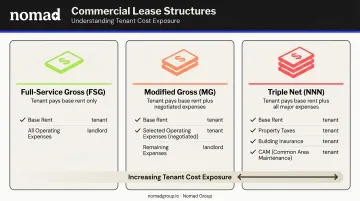
NNN leases are common in NYC office and retail markets. They shift significant financial exposure to the tenant, making it critical to model total occupancy cost — not just the headline rent figure.
Common Area Maintenance (CAM) Charges
CAM charges cover the tenant's proportionate share of maintaining shared spaces: lobbies, elevators, hallways, restrooms, and building systems. They're billed in addition to base rent and reconciled annually.
Key CAM concepts to understand before signing:
- CAM caps limit how much these charges can increase year over year — negotiate one
- Audit rights give you the contractual ability to review the landlord's CAM calculations directly
- Controllable vs. uncontrollable expenses — some leases exclude items like insurance or taxes from CAM caps, leaving those costs uncapped
Tenant Improvement Allowance (TIA)
Understanding CAM is one side of the cost equation — TIA is the other, and it's where tenants can win back real money.
TIA is the dollar amount a landlord offers to help fund your buildout, expressed as a per-square-foot figure. CBRE reported the U.S. office average fell to $87.51/SF in 2024, down from $97.55/SF in 2023. That national benchmark helps calibrate expectations, though NYC numbers vary by building and submarket.
TIA is one of the most negotiable concessions in a lease. Nomad Group's in-house construction team has completed 300+ buildouts — which means their tenant clients negotiate with actual cost data, not guesses.
Lease Abstract
Once a lease is signed, the abstract becomes the document your team actually lives by.
A lease abstract summarizes the essential terms — rent schedule, lease term, renewal options, permitted use, TIA amount, and landlord/tenant obligations. Without an accurate, current abstract, critical dates get missed and billing errors go unchallenged.
Understanding Square Footage and Pricing in Commercial Leases
Usable vs. Rentable Square Footage
This distinction directly affects what you pay — and it's one of the most misunderstood concepts in commercial leasing.
- Usable square footage — the space your team physically occupies
- Rentable square footage — usable space plus your pro-rata share of building common areas (lobbies, corridors, mechanical rooms, etc.)
The difference between the two is called the load factor or loss factor. You pay rent on rentable square footage, not usable.
BOMA standards govern how rentable area is calculated; REBNY's measurement rules apply specifically to New York City office buildings. Load factors vary by building, so two spaces with identical usable square footage can carry very different effective price tags.
Asking Rent vs. Effective Rent
Colliers reported Manhattan's average asking rent at $76.00/SF in Q4 2025. But asking rent is only the starting point.
Effective rent accounts for the full picture:
- Free rent periods (months where no payment is due)
- TIA value
- Other landlord concessions
Once you factor in those concessions, two spaces with the same asking rent can price out very differently. Always run the effective rent calculation before comparing options.
Rent Escalations
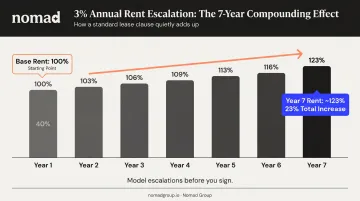
Escalation clauses — also called rent bumps — are contractual increases built into the lease term, typically triggered annually. The two most common structures:
- Fixed percentage increases — rent increases by a set percentage each year (e.g., 3%)
- CPI-indexed increases — rent increases tied to the Consumer Price Index
The compounding effect of escalations matters more than the annual rate. A 3% annual bump on a 7-year lease means your final year rent is roughly 23% higher than your starting rent. Model that out before you sign.
Lease Lifecycle Terms: From LOI to Renewal
Letter of Intent (LOI)
The LOI is a non-binding document that outlines the key proposed terms before the full lease is drafted: rent, lease term, TIA, commencement date, and any tenant-specific concessions. It's where negotiating leverage is highest — before attorneys are involved and before either party has invested deeply in drafting.
Landlords routinely treat LOI terms as anchors in the final lease. Terms that aren't fought for here rarely improve later — which is why tenants who treat the LOI as a formality often find themselves locked into unfavorable conditions before the negotiation even starts.
Renewal Options, ROFR, and ROFO
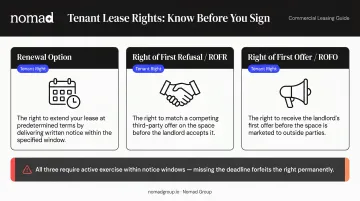
The same negotiating discipline that applies at the LOI stage carries through to lease signing. Renewal rights, first-offer rights, and first-refusal rights must be built into the original lease — they don't exist by default:
- Renewal option — the contractual right to extend the lease at predetermined terms, requiring written notice within the specified window
- Right of First Refusal (ROFR) — the right to match any competing offer before the landlord accepts it from a third party
- Right of First Offer (ROFO) — the right to receive the first offer before space is marketed externally
All three require active exercise within specific notice windows. Missing that window forfeits the right entirely — and it cannot be reinstated after the fact, which is a common and costly oversight for tenants without a structured lease tracking process.
Holdover
Holdover is what happens when a tenant remains in a space after lease expiration without executing a new agreement. Most leases include a holdover clause that allows landlords to charge elevated rent during this period — often substantially above the final contract rate.
The practical remedy is simple: start renewal planning early. JLL recommends beginning the renewal-or-relocation evaluation 12 to 24 months before lease expiration — a window that provides time to explore alternatives, negotiate from a position of strength, and avoid a last-minute holdover situation.
How a Tenant-Side CRE Broker Helps You Navigate the Jargon
The landlord's broker represents the building owner's interests. Full stop. A tenant rep broker — also called a tenant-side broker — represents yours. That means:
- Analyzing lease terms and flagging unfavorable clauses
- Benchmarking asks against current market conditions
- Negotiating concessions, free rent, and TI allowances on your behalf
Broker compensation in commercial real estate is negotiable and not set by law, per NAR's guidelines. How tenant rep fees are structured varies by transaction, so clarify the fee structure before engaging a broker.
That context matters when evaluating who you hire. For high-growth companies in Manhattan's most competitive submarkets — Flatiron, Union Square, NoMad, SoHo, Bryant Park — Nomad Group handles the full arc: space identification, lease negotiation, in-house buildout, and ongoing facilities management. The team that negotiates your lease also builds out your space and manages your operations — so institutional knowledge carries through every phase instead of starting over at each handoff.
With 2M+ square feet under management and 300+ buildouts completed, the pattern recognition built across those transactions informs every negotiation and every buildout decision.
Frequently Asked Questions
What is commercial lease administration?
Commercial lease administration is the ongoing process of managing lease agreements after execution — tracking critical dates, ensuring rent and expense obligations are met, monitoring compliance, and maintaining accurate records across a company's real estate portfolio.
What is the role of a lease administrator?
A lease administrator abstracts lease data, monitors key dates (renewals, expirations, rent escalations), ensures both landlord and tenant obligations are met, manages CAM reconciliations, and maintains accurate lease records.
What is a triple net (NNN) lease?
A NNN lease requires the tenant to pay base rent plus three operating expense categories: property taxes, building insurance, and common area maintenance (CAM). Total occupancy cost can be significantly higher than base rent, so model all-in costs — not just base rent — before you sign.
What is the difference between usable and rentable square footage?
Usable square footage is the space a tenant exclusively occupies. Rentable square footage adds a proportionate share of building common areas — lobbies, hallways, and shared facilities. Tenants pay rent on rentable square footage, with the difference expressed as a load or loss factor.
What is included in a lease abstract?
A lease abstract summarizes the key terms of a lease in an accessible format — including rent schedule, lease term, renewal options, TIA, permitted use, and landlord/tenant obligations — without requiring anyone to read the full legal document every time a question arises.
How far in advance should a tenant begin planning for lease renewal?
Industry guidance consistently points to starting renewal or relocation planning 12 to 24 months before lease expiration. That window provides the most negotiating leverage, time to evaluate alternatives, and enough runway to avoid missing renewal option notice deadlines.