Introduction
You sign the lease. The champagne comes out. Move-in day arrives, and the space looks exactly how you imagined it. Then, eight months later, a letter arrives from your landlord announcing a CAM reconciliation charge you weren't expecting. Eighteen months after that, a broker calls to tell you the renewal notice window in your lease closed three weeks ago — and you never sent notice.
For high-growth companies signing NYC office leases, this scenario plays out more often than it should. The lease isn't a finish line; it's the starting point for a multi-year set of financial and legal obligations that require active management long after move-in day.
Commercial real estate lease administration is the system that keeps those obligations from slipping through the cracks. This guide breaks down what lease administration actually involves, which obligations catch NYC tenants off guard most often, and what a functional system looks like in practice.
Key Takeaways
- Lease administration is the ongoing management of all financial terms, obligations, and rights in a commercial lease — it starts the day you sign and runs through the full lease term.
- Critical responsibilities include tracking renewal deadlines, reconciling operating expenses, monitoring rent escalations, and managing landlord obligations.
- Missing a single renewal notice deadline can forfeit your renewal right or lock you into automatic holdover rent, often at significantly higher rates.
- High-growth companies benefit most from structured lease administration — or a full-service CRE partner who knows your lease terms as well as you do.
What Is Commercial Real Estate Lease Administration?
Lease administration is the ongoing function that governs every right and obligation in a commercial lease from execution through expiration. CoreNet Global defines it to include lease abstracting, documentation administration, portfolio analysis, and performance reporting — an operating discipline, not a legal filing task.
The distinction from the leasing transaction matters. Signing the lease is a single event. Lease administration is the ongoing function that begins at execution and continues until the lease expires or terminates.
In practice, it covers two parallel tracks:
- Financial tracking — base rent, scheduled escalations, operating expense pass-throughs, and reconciliations
- Legal and operational tracking — notice periods, renewal options, termination rights, sublease restrictions, and landlord obligations like tenant improvement allowances
A single Manhattan office lease can run 75 pages or more. According to Commercial Observer, tech tenants in Manhattan averaged lease terms of 5.3 years in the first half of 2025, while AI firms averaged 3.5 years.
Even at those shorter terms, that's five-plus years of escalations, reconciliations, and option windows — in a document most tenants sign and never revisit.
Lease Administration vs. Property Management
These two functions get confused regularly. Here's the actual difference.
Property management is the landlord's function — maintaining the building, managing vendors, and operating the physical asset.
Lease administration is a contractual function — tracking what the lease requires of each party and ensuring those obligations are met. For tenants, that means protecting their rights and meeting their own obligations — paying the correct amount, sending notices on time. For landlords, it means accurate billing and monitoring tenant compliance.
Both functions can coexist in the same building, managed by different teams with different mandates — one focused on the physical asset, the other on the contractual record.
Key Components of Commercial Real Estate Lease Administration
A complete lease administration program covers several distinct functional areas. Each requires different expertise and different tracking cadences.
Critical Date Management
This is the highest-stakes component. Critical dates include:
- Lease commencement and rent commencement dates
- Renewal option exercise windows
- Renewal notice deadlines
- Rent escalation trigger dates
- Expansion option exercise periods
- Lease expiration date
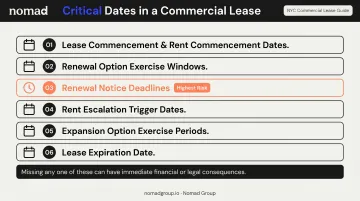
Missing a renewal notice deadline by even one day can forfeit a tenant's right to renew. In J.N.A. Realty Corp. v. Cross Bay Chelsea, the renewal option required six months' notice — and the tenant's failure to comply triggered litigation. Courts have occasionally granted equitable relief, but as SGR Law notes, that relief is never guaranteed.
For fast-moving companies where the team that signed the lease has since turned over, a critical date buried in section 42 of a 75-page document is genuinely at risk of being missed without a centralized tracking system.
Rent and Financial Obligation Tracking
Rent tracking isn't just confirming that the check goes out each month. It includes:
- Verifying that the rent amount matches what the lease stipulates at each escalation date
- Confirming whether escalations are fixed-dollar increases or CPI-linked, and applying the correct calculation
- Auditing invoices when landlords issue statements to ensure amounts align with lease terms
Billing errors are more common than tenants expect. Without referencing the original lease language, discrepancies can compound unnoticed across a multi-year term.
Operating Expense (CAM) Reconciliation
Most commercial office leases in NYC require tenants to pay a pro-rata share of the building's operating expenses — estimated monthly, reconciled annually. The annual reconciliation statement is where errors and disputes tend to surface.
Tenants should verify that expense categories billed are actually permitted under their specific lease. CoreNet Global's operating expense definition excludes items like capital expenditures, depreciation, mortgage payments, and insurance — but lease language varies, and what's excludable in your lease is what controls, not industry norms.
Don't accept a CAM reconciliation statement at face value. Match each line item back to your lease's operating expense definition before paying.
Lease Clause Compliance and Rights Tracking
Beyond rent, commercial leases contain rights that expire if not exercised on time. These include:
- Sublease and assignment rights (often requiring landlord consent within a specific window)
- Expansion rights and rights of first offer
- Early termination options and the notice required to trigger them
- Landlord obligations, such as tenant improvement allowances with defined draw periods
These rights have real financial value. A termination option that expires unexercised because no one was tracking it eliminates flexibility that was negotiated into the lease for exactly the moments when business needs shift.
Estoppel Certificates and Subordination Agreements
During the lease term, tenants may be asked to execute estoppel certificates — documents confirming the current status of the lease to a lender or prospective buyer. Subordination, Non-Disturbance, and Attornment (SNDA) agreements address the tenant's rights if the building is sold or refinanced.
These requests typically have short response windows. Lease administration ensures they're handled accurately and on time, rather than sitting in an inbox until someone asks why the building sale is delayed.
Common Lease Administration Mistakes to Avoid
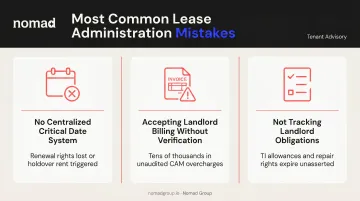
Most costly lease administration failures come down to three recurring patterns:
1. No centralized critical date system
When a lease is signed, the renewal notice deadline is usually noted and forgotten. Two or three years later, no one remembers the specific window — 9 or 12 months before expiration — and no automated alert was set. By the time someone checks, the window has closed.
2. Accepting landlord billing without verification
CAM reconciliations, operating expense pass-throughs, and real estate tax escalations all require cross-referencing back to the original lease language. Many tenants pay these charges without auditing them. Unaudited CAM errors alone can cost tenants tens of thousands of dollars over a seven-year term.
3. Not tracking landlord obligations separately
If the landlord owes a tenant improvement allowance, has agreed to specific repair responsibilities, or is required to perform certain capital work, those obligations need their own tracking. Tenants who don't document these commitments — and follow up proactively — often find the window to assert the right has already closed.
In some cases, landlords claim completion without fulfilling it. Without a paper trail, there's no recourse.
Best Practices for Managing Your Commercial Lease
Start with a Lease Abstract
A lease abstract is a condensed summary of every critical term, obligation, date, and right in the full lease document — pulled into one working document. Every company should create one immediately upon execution.
A solid lease abstract covers:
- Commencement and expiration dates
- All rent escalation dates and formulas
- Operating expense obligations and exclusions
- Renewal, expansion, and termination option windows with required notice periods
- Landlord obligations and deliverables (TI allowances, repair responsibilities)
- Sublease and assignment provisions
The abstract becomes the operating document your team actually uses. The 75-page lease is what the lawyers reference when there's a dispute.
Implement Centralized Critical Date Tracking
A lease abstract without a calendar system is only half the solution. Alerts should fire well in advance — at minimum 12 months, 6 months, and 90 days before any deadline with legal or financial consequences.
Platforms like CoStar Real Estate Manager, Visual Lease, and MRI ProLease are purpose-built for this. For companies without enterprise-level portfolios, a structured internal process with calendar automation can work — but it requires someone owning it consistently. The risk with spreadsheets is that no one owns the alerts when the person who built the spreadsheet leaves.
Build an Annual Lease Review Into Your Calendar
Automated alerts catch individual deadlines. An annual review catches everything else. Each lease year brings potential changes: rent escalations kick in, operating expense estimates reset, and certain rights approach their exercise window. A scheduled, recurring review ensures your finance and operations teams aren't surprised by changes that were always in the lease — just not top of mind.
Work with a CRE Partner Who Knows Your Lease
Nomad Group's full-service model covers the entire real estate lifecycle: initial brokerage and negotiation, construction management, facilities management, and asset management. That continuity means clients have a partner who knows their specific lease terms from day one — not someone reading the document cold for the first time.
The broker who negotiated your deal understands the intent behind every clause. That institutional knowledge translates into:
- Faster responses when landlord disputes arise
- Proactive flag-raising before deadlines, not after
- Consistent context across rent reviews, renewals, and space changes
The Role of a Commercial Real Estate Broker in Lease Administration
A broker's involvement shouldn't end at lease execution. The tenant rep who negotiated the deal is the most qualified person to help interpret ambiguous lease language, because they were in the room when those terms were agreed upon.
Ongoing broker support includes:
- Interpreting unclear clauses when landlord and tenant read them differently
- Advising on CAM reconciliations to confirm whether billed expenses are consistent with what was negotiated and with market norms
- Flagging option windows before they close and advising on whether exercising a renewal or expansion option makes strategic sense given current market conditions
- Evaluating exit and growth levers when business needs shift (subletting, triggering an early termination, or exercising an expansion right)
For high-growth companies in NYC, where headcount can double in a year and funding events change space requirements overnight, a broker who already knows your specific lease terms is a real advantage. Knowing whether a sublease is permitted without landlord consent, or whether your expansion right is still exercisable, requires reading your specific lease, not the market average.
This ongoing advisory relationship is core to how Nomad Group operates. Rather than closing a deal and moving on, the team stays involved as a long-term partner — available when a landlord disputes a CAM charge, an option deadline approaches, or a funding round forces a space rethink.
Frequently Asked Questions
What are the responsibilities of a commercial real estate broker?
A commercial real estate broker represents either a landlord or a tenant in leasing transactions, handling market analysis, property identification, lease negotiation, and deal structuring. Tenant rep brokers specifically focus on securing favorable terms and protecting the tenant's long-term interests — including advising on lease structure, concessions, and flexibility provisions.
How does a commercial real estate broker work?
A broker applies market knowledge, property data, and negotiating experience to guide clients from initial space search through lease execution. They identify suitable spaces, evaluate financial terms, negotiate directly with landlords, and coordinate with legal, construction, and other parties through to space delivery.
How much does a commercial real estate broker make on a $300,000 transaction?
NYC office leasing is measured in rent per square foot and lease term, not a sale-price-style transaction value. Commission structures are negotiable and agreement-specific — REBNY explicitly does not set standard rates. Confirm commission terms directly with your broker for any specific transaction.
What is the difference between lease administration and property management?
Property management is the landlord's function — maintaining and operating the building. Lease administration is the contractual function — tracking all obligations, financial terms, and critical dates within a specific lease agreement. Tenants are responsible for administering their own leases, regardless of how well the building is managed.
What happens if you miss a lease renewal deadline?
Missing a renewal notice deadline can mean losing the right to renew under negotiated terms or entering a holdover period — some NYC leases set holdover rent at 150% or 200% of base rent. At best, you're renegotiating from a position of weakness. Proactive tracking is the only reliable protection.