This guide covers the core responsibilities of a commercial property manager, actionable tips across maintenance, leasing, finance, and compliance, and when partnering with a full-service firm makes sense for owners and investors who want to maximize building performance.
Key Takeaways
- Proactive maintenance reduces costs by 25-30% and eliminates 70-75% of equipment breakdowns compared to reactive approaches
- Rigorous lease administration and tenant screening cut turnover costs — vacancies can cost 6-12+ months of lost rent
- Tracking NOI, occupancy rates, and capital reserves separates profitable properties from underperforming ones
- 91% of occupiers pay premiums for tech-enabled space — the right management partners help owners capture that demand without added operational burden
- In dense markets like NYC, local expertise and full-service support give property owners a measurable edge
What Is Commercial Property Management?
Commercial property management is the oversight, operation, and strategic administration of non-residential real estate—including office buildings, retail centers, industrial properties, and mixed-use developments—to maintain profitability, preserve asset value, and satisfy tenants. The U.S. property management services market reached $122.02 billion in 2025 and is projected to grow to $184.25 billion by 2033, reflecting the scale and complexity of this industry.
Core responsibilities include:
- Lease administration – Managing lease terms, renewals, CAM reconciliations, and tenant documentation
- Financial oversight – Budgeting, tracking NOI, collecting rent, and maintaining capital reserves
- Maintenance and repairs – Preventive maintenance programs, vendor management, and emergency response
- Tenant relations – Screening, onboarding, retention strategies, and conflict resolution
- Regulatory compliance – Building codes, fire safety, ADA accessibility, environmental regulations
- Vendor management – Contracting, performance tracking, and cost benchmarking
These responsibilities look different than what residential managers handle—and the stakes are higher. Commercial leases are more complex, with structures such as triple net (NNN) leases where tenants pay base rent plus property taxes, insurance, and maintenance costs, or CAM reconciliations that require year-end expense true-ups.
Tenant expectations are higher, lease terms are longer (often 3–10 years in NYC), and the margin for operational error is smaller. A single missed compliance deadline or delayed repair can trigger tenant departures that cost 6–12+ months of rent in combined turnover expenses.
Core Tips for Managing Commercial Property
Prioritize Proactive Maintenance Over Reactive Repairs
According to BOMA International's Q4 2025 report, run-to-failure maintenance programs cost 3 to 5 times more than proactive approaches. Predictive maintenance reduces costs by 25-30% and eliminates 70-75% of equipment breakdowns. The financial case is clear: investing $1 in preventive maintenance avoids $3-5 in reactive repair costs.
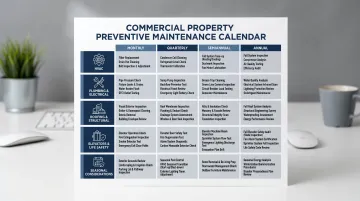
What a preventive maintenance calendar should include:
- HVAC systems – Quarterly filter changes, biannual tune-ups, annual full inspections (proper maintenance can extend equipment life by 5-10 years)
- Plumbing and electrical – Semiannual inspections, leak detection, panel testing
- Roofing and structural elements – Annual inspections, gutter cleaning, waterproofing checks (a neglected roof can fail at 15 years instead of its designed 20-year lifespan)
- Elevators and life safety – Monthly testing, annual certifications, code compliance documentation
- Seasonal considerations – Pre-winter boiler inspections, spring HVAC startup, snow removal contracts
Document every work order, track completion dates, and maintain vendor performance records. This creates an audit trail that protects you during inspections and helps identify underperforming contractors.
That documentation also makes lease disputes easier to resolve. In multi-tenant buildings with shared lobbies, elevators, and parking structures, ambiguity over responsibilities leads to friction. Under NNN lease structures, tenants typically handle interior maintenance while landlords manage structural and common area repairs. Spell out who covers HVAC repairs, plumbing issues, and seasonal upkeep before disputes arise.
Keep Properties Healthy, Safe, and Code Compliant
Compliance is not a one-time event. Regulations update constantly, and commercial property owners must stay current to avoid fines, liability exposure, and tenant disruption.
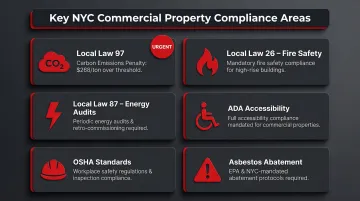
Key NYC compliance areas:
- Local Law 97 carbon emission limits – Buildings over 25,000 sq ft face penalties of $268 per metric ton of CO2 exceeding annual limits. First compliance period runs 2024-2029; stricter limits begin in 2030. Failure to file carries penalties of $0.50 per sq ft per month.
- Fire safety systems (Local Law 26) – Office buildings 100 feet or taller must have full automatic sprinkler systems installed.
- Energy audits (Local Law 87) – Buildings over 50,000 sq ft must complete energy audits and retro-commissioning studies on a 10-year cycle.
- ADA accessibility requirements – Commercial facilities must comply with ADA Standards for Accessible Design. Existing buildings must remove architectural barriers when "readily achievable."
- OSHA standards – Cover walking-working surfaces, fire safety, electrical safety, hazard communication, and ventilation (minimum 15-20 CFM of outdoor air per person for offices).
- Asbestos abatement – NYC buildings constructed before April 1, 1987 are presumed to contain asbestos. A Certified Asbestos Investigator must assess before renovation or demolition permits are issued.
The NYC Comptroller's April 2025 audit found DOB issued 95,387 violations in just two years. Total penalties reached $186 million across all property types. Proactive code adherence protects your NOI—treat it as a budget line, not an afterthought.
Manage Vendors and Contractors Strategically
Vet vendors based on commercial property experience, not just cost. The cheapest contractor is rarely the best choice when downtime costs thousands of dollars per day.
Key vendor management practices:
- Set clear scopes of work with performance benchmarks and timelines
- Require documentation: licensing, insurance certificates, safety training records
- Track vendor performance centrally—work order history, response times, cost benchmarks
- Build relationships with 2-3 vendors per category (HVAC, plumbing, electrical) to maintain competitive pricing and backup options
- Review vendor invoices against scopes to identify scope creep or billing errors
When a vendor consistently misses response windows or overruns budgets, centralized records give you the evidence to replace them—and the leverage to negotiate better terms with those who perform.
Lease Management and Tenant Relations
Understand commercial lease structures. Commercial leases vary widely in complexity:
- Gross leases – Landlord pays operating expenses; tenant pays base rent
- NNN (triple net) leases – Tenant pays base rent plus taxes, insurance, and maintenance
- CAM charge provisions – Common Area Maintenance costs are estimated monthly and reconciled annually against actual expenses
- Renewal options – Give tenants the right to extend at predetermined terms
- Tenant improvement allowances – Landlord-funded buildout budgets (NYC averages ranged from $77-$97 per sq ft in recent years)
- Early termination clauses – Define penalties or conditions for breaking the lease
Have a real estate attorney review every lease. One poorly worded clause can cost tens of thousands in disputes.
Screen tenants rigorously. A comprehensive screening process includes:
- Financial stability checks – Review balance sheets, cash flow statements, funding rounds
- Business credit review – Check Dun & Bradstreet scores and payment history
- References from prior landlords – Verify rent payment history and property condition at move-out
- Business type fit – Assess whether the tenant's operations align with building use and existing tenant mix
A peer-reviewed study of 2,906 U.S. office buildings found that a 1-point increase in tenant satisfaction (on a 1-5 scale) corresponds to 15.80% lower probability of move-out. Service quality of the management firm drives satisfaction more than inherent building quality.
Retention strategies beyond lease renewal:
- Proactive quarterly check-ins to address concerns before they escalate
- Fast response to maintenance requests (track and target 24-hour response times for non-emergencies)
- Transparent communication about building updates, planned maintenance, and policy changes
- Occasional goodwill gestures—waiving a late fee for a consistently reliable tenant builds long-term loyalty
Plan for vacancies. Maintain a financial reserve to cover lost rent during vacancies. CBRE data shows NYC tenant improvement allowances averaged $87.51 per sq ft in 2024, with an average of 8.9 months of free rent. Combined with leasing commissions and vacancy loss, turnover costs can equal 6-12+ months of rent per space.
Start preparing before the lease expires. Finding commercial tenants takes longer than most landlords expect—NYC office lease negotiations alone can span 6-12 months, even though the average lease term runs nearly a decade.
Keep these ready at all times:
- Current marketing materials and floor plans
- Professional photography of the space
- A defined leasing strategy with target tenant profiles and pricing parameters
In competitive submarkets like NoMad, Flatiron, and SoHo, brokers with deep neighborhood knowledge can match spaces to tenants faster—and to companies whose space needs fit the building's long-term profile.
Financial Management and Budgeting
Build a realistic annual operating budget. Include these line items:
- Routine maintenance and repairs
- Utilities (electricity, gas, water, sewer)
- Insurance premiums (general liability, property, loss of income)
- Property taxes
- Management fees (typically 3-5% of gross rent)
- Capital reserve fund for major system replacements
Industry benchmarks suggest maintaining $0.15-$0.25 per sq ft annually for Class A office buildings, or $0.10-$0.20 per sq ft for Class B/C properties in capital reserves. An alternative guideline is to keep three months' operating expenses on hand.
Track key financial metrics regularly:
- Net Operating Income (NOI) – Revenue minus operating expenses (excludes financing costs and capital expenditures). NOI is the single most important indicator of property performance.
- Occupancy rate – Percentage of rentable space currently leased
- Rent collection rate – Percentage of billed rent collected each month
- Cap rate – NOI divided by property value (NYC office cap rates averaged 7.06% in H1 2025, according to Cushman & Wakefield)
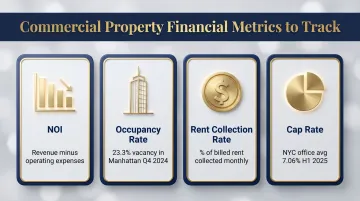
Manhattan overall vacancy was 23.3% in Q4 2024, down slightly from earlier in the year but still elevated. High vacancy environments make NOI tracking even more critical.
Strong NOI numbers only tell part of the story — a single uninsured loss event can erase months of operating income.
Risk Management and Insurance
Commercial property owners need:
- General liability coverage
- Property/hazard insurance covering structural damage
- Loss of income (business interruption) coverage to replace lost rent during covered events
Well-documented maintenance can influence premiums favorably. Buildings with comprehensive security systems and smart building technology typically qualify for insurance discounts. Under-insuring is a critical mistake — verify coverage limits annually against current property values.
Regulatory and Financial Compliance
Stay current with:
- Local zoning requirements
- ESG-related energy benchmarking mandates (NYC Local Law 97 imposes carbon emission limits with $268/ton penalties)
- Asbestos and lead abatement documentation for older buildings
- OSHA workplace safety standards
A single Local Law 97 violation, for example, can run tens of thousands of dollars annually for a mid-size Manhattan office floor — penalties that compound each year the property remains out of compliance.
Technology, Vendors, and When to Bring in a Full-Service Partner
Adopt commercial property management software. Centralized platforms deliver:
- Automated rent collection and payment tracking
- Digital work order systems that assign, track, and document repairs
- Financial reporting dashboards showing NOI, occupancy, and expense trends in real time
- Tenant communication portals for maintenance requests and announcements
- Lease tracking with automated renewal reminders and CAM reconciliation tools
JLL research shows 91% of occupiers are willing to pay a premium for tech-enabled space, yet fewer than 13% of CRE organizations describe themselves as "early adopters" of technology. This gap represents a competitive opportunity for tech-forward properties.
Invest in building security systems. Access control, surveillance cameras, smart lighting, and alarm systems serve dual purposes:
- Tenant retention – BOMA 360-designated buildings report 90% of tenants express a high overall sense of security, compared to lower rates in non-360 buildings
- Insurance discounts – Comprehensive security systems typically qualify owners for lower premiums
Technology and vendor choices only go so far. At some point, the operational complexity of managing a commercial asset—especially in a high-demand market like NYC—makes a case for outside expertise.
When to Work With a Full-Service Commercial Real Estate Partner
For landlords and property owners who want end-to-end support, full-service firms handle the full scope: tenant placement, lease negotiation, construction management, and ongoing facilities oversight. Everything operates under a single point of accountability.
This model is especially relevant for NYC office buildings serving high-growth companies, where tenant expectations and operational demands are both high. Nomad Group, for example, brings together strategic leasing, in-house construction teams, and facilities management through one integrated team—including their Flex by Nomad service model. With 300+ tenant buildouts completed and 2M+ square feet under management, the firm offers the kind of depth that individual vendors and software platforms alone can't replicate.

Frequently Asked Questions
What is the meaning of commercial property management?
Commercial property management is the professional oversight and operation of non-residential real estate—covering leasing, maintenance, finances, and tenant relations—with the goal of maximizing asset value and maintaining occupancy. It encompasses everything from day-to-day repairs to strategic financial planning and regulatory compliance.
What are the P's of property management?
The commonly referenced P's are People (tenants and staff), Process (systems and procedures), Property (the physical asset), and Performance (financial and occupancy metrics). These pillars guide how effective managers structure their approach to building operations and tenant relationships.
What is the 2% rule in commercial real estate?
The 2% rule is a quick investment filter suggesting a property's monthly rent should equal at least 2% of its purchase price. This rule is rarely applied to commercial properties, where cap rates and NOI are the primary metrics, and is more common in residential investing.
What does the 80/20 rule mean in property management?
The 80/20 rule (Pareto Principle) in property management suggests that roughly 80% of problems or maintenance costs come from 20% of tenants or systems. This helps managers prioritize their time and resources on the highest-impact issues rather than spreading attention evenly across all areas.
How hard is it to get a CPM?
The CPM designation from IREM requires 36 months of experience, 8 coursework modules, and a two-part capstone exam — typically a 2-3 year commitment. The credential carries real financial weight: CPM holders earn an average of $139,506 compared to $62,850 for non-designated managers.
Managing commercial property effectively takes strategy, disciplined systems, and strong tenant relationships. Proactive maintenance protects asset value while cutting emergency repair costs by 3-5x. Rigorous tenant screening and retention directly impact NOI by minimizing costly turnover. Financial discipline—tracking NOI, maintaining capital reserves, and staying compliant with evolving regulations—determines whether a property performs or stagnates. In markets as competitive as New York City, using technology and the right full-service partners can be the difference between prolonged vacancies and consistent, high-quality occupancy.