Most businesses approach lease review reactively, waiting until a document lands in their inbox before asking the right questions. By that point, significant leverage is already gone.
This checklist covers every layer of a commercial lease review: financial terms, critical clauses, space and infrastructure assessment, and landlord vetting. The goal is to help you enter any lease negotiation with clarity — and leave with terms that actually protect your business.
Key Takeaways
- Commercial leases carry costs far beyond base rent — CAM fees, tax escalations, insurance pass-throughs, and HVAC charges add up quickly
- Know your lease type (gross, net, triple-net) before agreeing to any price
- Negotiate renewal options, sublease rights, tenant improvement allowance (TIA), and early termination provisions before signing
- Vet the landlord and property as carefully as you review the lease document
- Engage a tenant rep broker before any verbal agreement to preserve your negotiating leverage
Before You Sign: Setting the Stage for Smart Negotiations
Most businesses lose negotiating leverage before they realize it. As Goodspeed Merrill notes, a letter of intent creates a psychological baseline — once numbers are written down, even informally, they become hard to move. That means due diligence must start during the space search phase, not after a price is agreed.
What to Prepare Before Your First Landlord Meeting
Before touring a single space, get clear on the following:
- Headcount and density needs — Aquila benchmarks average office density at 150–250 SF per employee; tech-heavy or server-dependent teams may need more
- Lease term flexibility — Know whether you need 3 years or can commit to 7, and what that tradeoff means for rent and concessions
- Buildout requirements — Raw space vs. pre-built vs. white-box each carry different TIA expectations and timelines
- Non-negotiables vs. flexible terms — Separate these before you sit across from a landlord
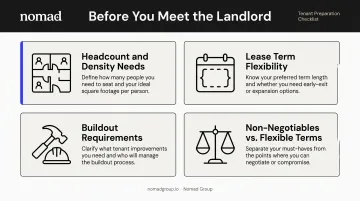
Those four categories become your negotiating framework. A tenant representative brings the market data to back it up — Nomad Group, for example, has leased over 2 million square feet across NYC and knows firsthand which landlords in Flatiron, NoMad, and SoHo regularly concede on CAM caps or TIA, and which ones hold firm.
Confirming Basic Lease Fundamentals
Verify these fundamentals before moving to financial terms:
- Entity name — Your LLC or corporation name, not a personal name
- Address and unit number — Matches what you toured
- Described square footage — Confirm it aligns with the actual space
- Permitted use clause — Must cover your current and anticipated business activities
- Lease term dates — Start date, end date, free rent period, and delivery conditions ("as-is," "broom clean," or with a defined buildout scope)
Errors on any of these basics — wrong entity name, mismatched square footage, a use clause that doesn't cover your actual operations — can void protections or trigger disputes long after you've moved in.
Financial Terms to Review in Your Commercial Lease
The financial picture goes well beyond base rent. This section is where most businesses underestimate total occupancy cost.
Base Rent and Escalation Clauses
Confirm the monthly base rent, payment due date, and any grace period. Then look at how rent escalates.
In NYC, the most common escalation method is a fixed annual percentage increase, typically around 3%. CPI-linked increases also exist, and tenants often prefer fixed increases when inflation could push CPI adjustments higher. Real estate tax escalations are a separate line to watch: many leases require tenants to pay a proportionate share of tax increases above a base year.
Model your total rent cost over the full lease term. A 3% annual escalation on a 7-year lease means year-7 rent is roughly 22% higher than year-1.
CAM Fees and Operating Expense Pass-Throughs
CAM (Common Area Maintenance) fees cover the tenant's proportional share of building-wide operating costs: janitorial, elevator maintenance, building security, landscaping, and HVAC maintenance. BOMA reported NYC office operating costs averaging $28.67/SF in 2022, adding meaningfully to your total occupancy cost on top of base rent.
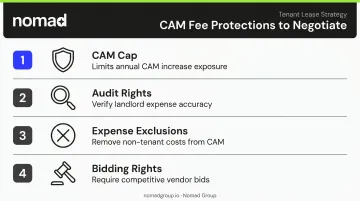
Key protections to negotiate:
- CAM cap: limits annual increases in controllable expenses
- Audit rights: Moss Adams recommends a 90-day window from receipt of the annual reconciliation to initiate an audit
- Expense exclusions: capital improvements, above-market management fees, and costs benefiting other tenants should not be passed through to you
- Bidding rights: some leases allow tenants to require competitive bids on major service contracts
Security Deposit and Upfront Costs
NYC commercial security deposits are commonly structured as a cash-secured letter of credit. Cresa cites an example where $100,000 in annual rent corresponds to a $50,000 letter of credit — roughly six months. Deposits vary based on tenant creditworthiness and lease term length.
Other upfront costs to budget for:
- First month's rent (sometimes first and last)
- Any required parking or storage deposits
- Guaranty exposure — limited guaranties may still cover TIA repayment and brokerage commissions if you exit early
Tenant Improvement Allowance (TIA)
Beyond upfront deposits, the TIA is often where the biggest financial negotiation happens. It's the landlord's contribution toward customizing the space, and for businesses that need a real buildout, it can significantly shift your total cost.
CBRE reported average TI allowances of $87.51/SF nationally in 2024, down from $97.55/SF in 2023 but still roughly 30% above pre-pandemic levels. In Manhattan, Bisnow cited citywide averages near $120/SF — against buildout costs that can run $150–$300/SF, meaning tenants often need to cover a meaningful gap.
Before signing, confirm in the lease:
- TIA dollar amount per square foot
- Disbursement conditions: after milestones, upon commencement, or reimbursement-based
- Scope approval process: most landlords require plan approval before releasing funds
- Timeline: when funds must be used by
Getting TIA funds disbursed on time depends on how clearly the lease defines each condition. Nomad Group's in-house construction team has completed 300+ tenant buildouts across NYC, with a 90-day standard turnaround and documented projects — including full HVAC builds — finished in as few as five weeks.
Key Lease Clauses Every Business Must Check
Beyond rent and escalations, lease clauses govern what you're permitted to do with your space — and what protections you have when circumstances shift.
Lease Term, Renewal Options, and Early Termination
Longer terms typically mean lower rent and more landlord concessions. Shorter terms mean flexibility — critical for high-growth companies whose headcount may double in three years.
On renewal options, check:
- How much notice is required (many leases require 6–12 months)
- At what rent rate the option is exercised (market rate vs. fixed)
- Whether the option is personal to the original tenant or transfers with an assignment
On early termination, confirm whether any buyout provision exists and under what conditions it applies — landlord breach, acquisition, or specific business events. Without a negotiated right, early exit typically means paying the remaining rent balance.
Sublease and Assignment Rights
If your company scales faster than expected or gets acquired, sublease and assignment rights determine your options.
NYC tenant-side guidance recommends negotiating for:
- Language stating landlord consent "shall not be unreasonably withheld"
- Carveouts permitting transfers to affiliates or successor entities without approval
- Assignment rights that survive a merger or ownership change
Without these provisions, a merger or office downsizing can leave you locked into paying for space you no longer need.
Maintenance, Repairs, and HVAC Responsibility
Responsibility allocation is frequently disputed. A reasonable split:
| Item | Typically Landlord | Typically Tenant |
|---|---|---|
| Roof and structure | ✓ | |
| Base building plumbing | ✓ | |
| HVAC maintenance | Negotiated | Negotiated |
| HVAC replacement | ✓ (push for this) | |
| Interior cosmetic repairs | ✓ | |
| After-hours HVAC charges | ✓ |
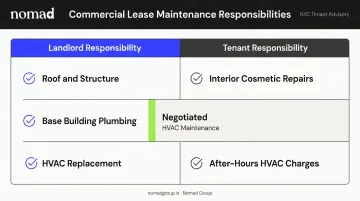
Some leases attempt to pass full HVAC replacement costs to tenants. Push back — replacement is a capital expense that should stay with the landlord. In Manhattan office buildings, after-hours HVAC charges are also a separate line item; confirm the hourly rate and service window in writing before signing.
Default, Cure Periods, and Landlord Remedies
A tenant-friendly default clause includes written notice and a reasonable cure period before the landlord can take action. NYC courts generally prohibit double recovery (collecting both accelerated future rent and rent from a replacement tenant for the same period) but the right to accelerate rent is still a real risk.
Look for:
- Written default notice requirement for both monetary and non-monetary defaults
- Defined cure periods before landlord can terminate
- Reciprocal landlord default provisions if the landlord fails to meet their obligations
Red Flags to Watch For — and Mistakes to Avoid
Knowing what to look for is only useful if you can recognize when a clause is a problem versus standard market practice.
Red Flags in Commercial Lease Terms
Stop and negotiate before signing if you see:
- No written notice or cure period before landlord can terminate
- No CAM audit rights or cap on controllable expense increases
- Full HVAC or roof replacement liability placed on the tenant
- Personal guaranty with no cap, no burn-down provision, and no good-guy clause (good-guy guaranties are common in NYC and typically require 60–90 days' notice to terminate guarantor liability upon surrender)
- Fixed annual escalations significantly above the NYC market norm of ~3%
- No sublease or assignment rights whatsoever
Common Mistakes Businesses Make
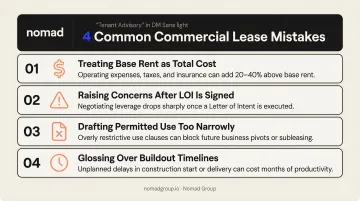
- Treating base rent as the total cost — CAM, insurance, escalations, and HVAC charges can add 20–40% on top of the quoted figure
- Raising concerns after the LOI is signed — that's when your leverage disappears; negotiate before numbers are locked in
- Drafting permitted use too narrowly — a clause covering only current activities can block you from pivoting or expanding services in the same space
- Glossing over buildout timelines and TIA disbursement conditions — vague triggers can delay space delivery and push your opening date back by weeks
When to Bring in Professional Help
This checklist equips you to spot problems. Avoiding them is a different skill set — and for complex leases (multi-floor deals, long-term commitments, high-value transactions), both a real estate attorney and a tenant rep should be at the table.
Engaging a broker like Nomad Group before a price is agreed — not after — keeps your negotiating position intact. Their team knows which landlords in specific NYC submarkets routinely concede on TIA, CAM caps, and sublease rights, and that intelligence shapes the deal before terms are set.
Frequently Asked Questions
What is the difference between a gross lease and a net lease?
In a gross lease, the landlord covers most operating expenses and the tenant pays a single monthly rent, which creates more predictable monthly costs. In a triple-net (NNN) lease, the tenant pays base rent plus a proportionate share of property taxes, insurance, and CAM fees, making total occupancy cost harder to forecast.
How long should a commercial lease term be for a startup or high-growth company?
Office lease terms typically range from 3–10 years. Startups favor shorter terms for flexibility; longer terms unlock better rent and more landlord concessions. Most high-growth companies land on 3–5 year terms with renewal options built in.
What are CAM fees and how are they typically calculated?
CAM fees cover the tenant's proportional share of building-wide operating costs (cleaning, landscaping, shared utilities, building management), calculated based on the tenant's percentage of total leasable space. They can vary significantly by building type and location.
Can I negotiate the terms of a commercial lease?
Yes — most commercial lease terms are negotiable. Items like rent escalations, TIA, sublease rights, renewal options, CAM caps, and cure periods are commonly negotiated. Leverage is highest before any number is committed to informally.
What is a tenant improvement allowance (TIA) and how does it work?
A TIA is a landlord contribution toward customizing the leased space. The amount is negotiated as part of the lease and is typically disbursed after construction milestones or lease commencement. It directly reduces your out-of-pocket buildout costs.
What happens if I need to exit a commercial lease early?
Most commercial leases impose significant penalties, often equal to the remaining rent balance. Tenants can negotiate early termination rights upfront, tied to specific business events like an acquisition or funding shortfall. Subleasing is another option if the lease permits it.