The issue isn't just complexity. Many tenants assume CAM is a minor administrative cost, a rounding error relative to rent. In reality, BOMA's 2022 Office Market Study reports operating expenses of $28.67 per square foot for the New York office market — in a city where Q1 2025 Class A asking rents averaged $80.78 per square foot, that's a meaningful add-on.
This article breaks down what CAM charges are, how they're calculated, what's typically included, and — most importantly — which protections tenants should secure before signing.
Key Takeaways
- CAM charges recover shared building operating costs from tenants — they're separate from and in addition to base rent
- Typical components include janitorial, shared utilities, property insurance, real estate taxes (in NNN leases), and property management fees
- Tenants pay monthly estimates throughout the year, then reconcile against actual costs at year-end as either a payment or a credit
- CAM provisions are negotiable — before signing, push to cap annual increases, exclude certain costs, and secure audit rights
- What "CAM" includes is defined by your specific lease — not by industry convention
What CAM Charges Represent in a Commercial Lease
CAM — Common Area Maintenance — is the mechanism landlords use to pass shared building operating costs through to tenants. Rather than absorbing those costs directly, landlords allocate a proportionate share to each occupant based on the square footage they lease.
NAIOP defines tenant occupancy cost as rent plus the tenant's pro rata share of operating costs, including taxes, insurance, and common area maintenance. That share is calculated simply: your leased square footage divided by the building's total rentable area.
A tenant occupying 5,000 square feet in a 50,000-square-foot building holds a 10% proportionate share — meaning roughly 10% of eligible CAM expenses lands on their ledger each year.
How Lease Structure Shapes Your CAM Exposure
Not every lease type handles CAM the same way:
| Lease Type | CAM Exposure |
|---|---|
| Full-Service / Gross Lease | Operating costs bundled into rent; no separate CAM line item |
| Modified Gross Lease | Some costs passed through; split negotiated at signing |
| Triple Net (NNN) | Tenant pays taxes, insurance, and maintenance on top of base rent |
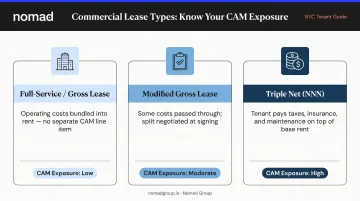
In Manhattan's multi-tenant office market, full-service gross and modified gross structures are common — Cushman & Wakefield's Q1 2025 Manhattan Office MarketBeat notes that Manhattan office rental rates are quoted on a full-service basis. That means many office tenants in neighborhoods like Flatiron, NoMad, or SoHo encounter CAM differently than retail or industrial tenants in NNN arrangements.
Knowing your lease type is the foundation — but it doesn't tell you which specific costs your landlord can pass through. That's where the details of what's actually included in CAM become critical.
What's Typically Included in CAM Charges
CAM is not a standardized list — it's whatever your lease says it is. That said, certain cost categories appear consistently across commercial leases.
Routine Maintenance and Janitorial
Cleaning of lobbies, hallways, restrooms, stairwells, pest control, and exterior maintenance are standard CAM line items. These are the most predictable costs in a reconciliation — and the least likely to generate disputes.
Shared Utilities
Electricity, water, HVAC operation, and elevator maintenance for common and shared spaces are allocated proportionally across tenants. These costs shift with energy prices or an inefficient building envelope.
Property Insurance and Real Estate Taxes
In NNN and some modified gross leases, the tenant's share of the landlord's property insurance premiums and real estate taxes may appear in CAM or as separate pass-throughs. In New York City, commercial office buildings fall under Class 4 property, which carried a tax rate of 10.848% for tax year 2026 — a non-trivial cost when passed through at pro rata share across a building.
Property Management Fees
This is one of the most contested CAM components. Landlords commonly charge 3–5% of total operating expenses as a management fee, and it can be included in the CAM pool. Tenants should confirm whether it's included, how it's calculated, and whether it can be capped.
Capital Expenditures
Major improvements (roof replacements, HVAC overhauls, structural work) are sometimes amortized and passed through as CAM over time. Whether they can be excluded depends entirely on how your lease defines allowable expenses — which is why the exclusion list below matters at negotiation.
Push to exclude from CAM at lease negotiation:
- Capital expenditures and structural improvements
- Costs related to vacant space
- Leasing commissions and landlord marketing expenses
- Landlord entity overhead and administrative costs
- Expenses covered by insurance proceeds or warranties
- Costs that disproportionately benefit other tenants
How CAM Charges Are Calculated and Reconciled
The Proportionate Share Formula
The core math is straightforward:
Tenant's CAM obligation = (Tenant SF ÷ Total Building SF) × Total Eligible CAM Expenses
One nuance worth understanding: gross-up provisions. Many office leases allow landlords to calculate variable operating expenses as if the building were at a stated occupancy level — commonly 95% or 100% — even when it isn't. The logic is that fixed-cost-like expenses (such as lobby cleaning or elevator maintenance) don't actually decrease when a building has vacancies, so remaining tenants shouldn't absorb a disproportionate share.
Gross-up provisions apply only to variable, occupancy-driven expenses. Fixed costs like property taxes and insurance should not be grossed up.
Monthly Estimates and the Year-End True-Up
At the start of each lease year, landlords provide a projected CAM budget and charge tenants a monthly estimated amount. These estimates are based on prior year actuals and anticipated increases — but they're projections, not guarantees.
At year-end (typically within 90–120 days after the close of the calendar or fiscal year), landlords tally actual expenses and compare them against what tenants paid. The result:
- Actual costs exceeded estimates → Tenant owes the difference
- Estimates exceeded actual costs → Tenant receives a credit
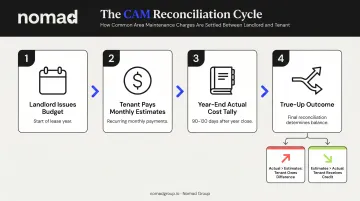
This true-up is where surprises happen. A tenant who hasn't budgeted for reconciliation may face a significant unplanned expense — particularly in buildings that undertook substantial maintenance or upgrades during the year. Factor this into your operating budget before the reconciliation statement arrives.
Audit Rights
Most commercial leases grant tenants the right to audit the landlord's CAM reconciliation statement within a defined window after receiving it. Use this right. Common errors include:
- Incorrect allocation percentages
- Inclusion of non-allowable costs (capital improvements, vacant-space expenses)
- Inflated or double-counted management fees
Audit rights should be clearly defined in the lease before signing — including what documentation the landlord must provide and the timeframe within which you can request an audit.
This is a protection worth negotiating upfront. At Nomad Group, we make audit rights a standard part of lease review for NYC clients, so the language is locked in before a reconciliation dispute ever comes up.
Common Misconceptions About CAM Charges
Three misconceptions trip up tenants more than any others:
- Monthly estimates are not final. Many tenants budget based on their CAM estimate and never account for year-end reconciliation. The actual annual obligation can run materially higher, especially in buildings with active maintenance programs.
- CAM is negotiable. Annual increase caps, specific exclusion lists, and audit rights are all standard asks that experienced tenant representatives secure regularly. Once a lease is signed, those protections are gone.
- Your lease's definition is what matters. "CAM" means something different in every document. Some leases define it narrowly; others are broad enough to include management fees, administrative overhead, and amortized capital costs. Before signing, confirm exactly what your specific lease includes — and excludes.
Frequently Asked Questions
What is included in CAM charges in a commercial lease?
CAM typically covers janitorial services, shared utilities, property insurance, real estate taxes (in NNN and some modified gross leases), and property management fees. The exact scope is defined by each individual lease — two buildings on the same block can have meaningfully different CAM definitions.
How are CAM charges calculated?
The formula is: tenant's leased square footage divided by total building square footage, multiplied by total eligible CAM expenses for the year. Tenants pay monthly estimates based on projected costs, which are reconciled against actual expenses at year-end.
Can tenants negotiate or cap CAM charges?
Yes — CAM provisions are negotiable at lease signing. Tenants can push for annual increase caps, specific cost exclusions, gross-up provisions, and audit rights. Working with an experienced tenant representative is the most reliable way to secure these protections before you sign.
What is a CAM reconciliation and when does it happen?
CAM reconciliation happens once a year: the landlord compares actual operating expenses against the monthly estimates tenants paid throughout the year. If actual costs ran higher, tenants owe the difference; if estimates overshot, the tenant gets a credit.
Are CAM charges the same in all commercial lease types?
No. NNN leases pass through the most costs directly to tenants. Gross leases bundle operating costs into a single rent figure with no separate CAM. Modified gross leases fall somewhere in between, with the specific cost-sharing split defined in the lease terms.
What CAM exclusions should tenants push for?
Common exclusions to negotiate include:
- Capital expenditures and major structural repairs
- Costs attributable to vacant space
- Leasing commissions and landlord overhead
- Expenses already covered by insurance or warranties
- Costs that primarily benefit other tenants or the landlord's ownership interests