For most NYC tenants, that reflex is expensive.
A commercial lease renewal option is one of the most misunderstood provisions in any commercial lease. Exercising it without scrutiny can lock you into a binding commitment before you know what your new rent will be — and it almost always means forfeiting the tenant improvement allowances, free rent, and negotiating leverage that a fresh deal would deliver.
Manhattan's office market recorded $9.05 million square feet of leasing activity in Q4 2025 alone, according to CBRE — 53% above the five-year quarterly average. Landlords are active, deals are getting done, and tenants who understand their options are in a stronger position than many realize.
This guide explains how renewal options actually work, when to use one, and when to treat your expiring lease as an opening for something better.
Key Takeaways
- Commercial security deposits in NYC typically range from 1–6 months of base rent, depending on tenant creditworthiness and lease length
- Landlords can hold deposits as cash or a letter of credit (LOC) — LOCs are often preferable for tenants with strong banking relationships
- Most leases include a burn-down schedule that reduces the deposit amount as you hit lease milestones without default
- Landlords must return your deposit within the timeframe specified in the lease; New York law does not set a universal deadline for commercial tenants
- Negotiating deposit terms upfront — amount, burn-down triggers, and return conditions — can free up significant working capital over a multi-year lease
What Is a Commercial Lease Renewal Option?
A renewal option is a clause negotiated into the original lease that grants the tenant the right — but not the obligation — to extend occupancy for an additional term. The conditions governing that extension (duration, rent mechanism, number of options) are defined at the time of signing.
Two things most tenants get wrong from the start:
- It's not automatic. A renewal option must be explicitly negotiated into the original lease. Many commercial leases don't include one.
- Vague terms can make it unenforceable. As Hinckley Allen notes, a provision stating rent will simply be "renegotiated" is often too indefinite to enforce. The option needs a defined rent mechanism and renewal duration to hold up.
How the Renewal Mechanism Works
The process follows a specific sequence — and the critical risk is buried in the middle of it:
- Tenant delivers irrevocable written notice of intent to exercise the option within the required window
- Landlord presents a new market rental rate based on the lease's rent determination method
- Tenant accepts, disputes, or negotiates the figure within a limited period
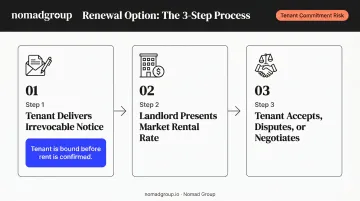
The problem: the tenant commits to renewing before the final rent is known. Once you exercise the option, you've surrendered the right to walk away — even if the landlord's rent proposal comes in well above your expectations.
If the parties can't agree on market rent, most leases trigger an arbitration or appraisal process. The NYC Bar Association's model clause requires each party to nominate a broker with at least 10 years of relevant office leasing experience; if those brokers can't agree, a third impartial broker is appointed — by REBNY under the model clause. The process is capped at two days of presentations and three business days for a determination, with fees split equally.
That's weeks of back-and-forth at exactly the moment your business needs to stay focused on operations, not real estate disputes.
Key Elements of a Commercial Lease Renewal Clause
Not all renewal clauses are written the same way. Before assuming yours protects you, review these five components carefully.
Notice Requirements
The NYC Bar Association's model commercial lease renewal clause requires written exercise notice no earlier than 18 months and no later than 12 months before the initial term expires — though the commentary notes these windows are negotiable.
Notice requirements are enforced strictly — courts rarely make exceptions. In Baygold Assoc., Inc. v. Congregation Yetev Lev of Monsey, Inc., New York's Court of Appeals denied equitable relief to a tenant who missed the certified mail deadline, finding no basis for an exception where the tenant lacked substantial improvements or goodwill at risk.
The same strict enforcement applies to the method of delivery. SGR Law cites 315 W. 48th St. Realty Corp. v. Maria's Mont Blanc Restaurant Corp., where a renewal was voided because the tenant sent email notice when the lease required certified mail.
Rent Adjustment Methods
Three structures appear most often:
| Method | How It Works | Risk Level |
|---|---|---|
| Fixed predetermined increase | Rent rises by a set percentage (commonly 2–3%) | Low — both parties know the number |
| CPI-linked adjustment | Rent adjusts based on the Consumer Price Index | Medium — depends on inflation trends |
| Fair market value | Rent set at market rate at time of renewal | High — disputes common; appraisal or arbitration often required |
"Fair market value" language is the most contentious. Landlords and tenants rarely agree on what it means — if your renewal clause uses this language, negotiate a clear definition upfront, or specify an appraisal process to resolve disputes.
Conditions and "As-Is" Delivery
Most renewal clauses include conditions that can disqualify you from exercising:
- Being in default at the time of notice
- Having assigned or subleased the space
- Occupying less than a minimum required footprint
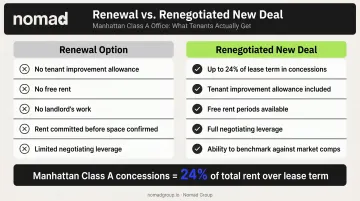
Beyond eligibility, understand what "as-is" delivery actually means: no tenant improvement allowance, no free rent period, no landlord's work. The NYC Bar model makes this explicit: the tenant accepts the premises in their existing condition at renewal. Comparable concessions factor only into the market rent calculation, not as direct benefits to the tenant.
Should You Exercise Your Option or Renegotiate?
For most tenants in most market conditions, simply exercising the renewal option is the least advantageous path. You commit before rent is confirmed, lose negotiating leverage, and receive no concessions.
When Exercising Makes Sense
There are cases where using the option is the right call:
- You've made significant, space-specific improvements — custom infrastructure, specialized buildouts, or technical installations — that can't be replicated cheaply elsewhere
- The location is genuinely irreplaceable to your business operations or client relationships
- Market research confirms your current space is priced well below comparable alternatives
If all three conditions apply, exercise the option. If not, renegotiating from scratch is likely the stronger move.
When Renegotiating Is Smarter
Rather than exercising the option, approach your expiring lease as an opening for a fresh negotiation — positioning yourself as a new tenant competing for the best available deal.
This is where market conditions matter. Manhattan's overall vacancy sits between 13.9% and 21.1% depending on the submarket and methodology (Colliers and Cushman & Wakefield, Q4 2025 respectively). In higher-vacancy submarkets like SoHo, where Cushman & Wakefield reports vacancy at 30.2%, landlords have real incentive to retain existing tenants rather than absorb vacancy costs and re-tenanting expenses.
The concession opportunity is substantial. Avison Young reports that Manhattan Class A concessions (combining free rent and tenant improvement allowances) equate to 24% of total rent over the lease term. A tenant paying $100 per square foot would effectively receive $24 per square foot per year in concessions through a negotiated new deal. The renewal option, by contrast, delivers none of that.
How to Negotiate a Stronger Lease Renewal
Start Earlier Than You Think Necessary
The NYC Bar's model clause sets the exercise window at 12–18 months before expiry. But that's just the notice deadline — your actual preparation should begin well before that.
Starting 18 months out gives you time to:
- Tour alternative spaces without urgency
- Complete a genuine market analysis
- Approach your landlord with real alternatives in hand, not just the threat of them
A tenant who has toured three comparable spaces in Flatiron and NoMad negotiates from a fundamentally different position than one who waited until six months before expiry. Urgency hands leverage to the other side of the table.
Benchmark with Real Data
Your landlord's renewal rent proposal won't come with a footnote explaining how they arrived at the number. Counter it with comparable transaction data — rent per square foot, concession packages, and lease structures for deals closed in your target neighborhoods.
Submarket pricing in Manhattan isn't uniform. Midtown South averaged $79.30 per square foot in Q4 2025 (Colliers), while Manhattan-wide asking rents ranged from $73 to $78 per square foot across major brokerage reports. Knowing where your building sits relative to recent comps — and what concessions those deals included — is the difference between negotiating and guessing.
Nomad Group tracks live deal comps across NYC's high-growth corridors, including Flatiron, NoMad, SoHo, and Union Square, giving tenants the specific market intelligence needed to counter a landlord's proposal with facts rather than instinct.
Modernize the Whole Lease
Renewal negotiations are an opportunity to fix provisions that no longer reflect how your business operates. Push for:
- Termination rights with defined notice periods
- Expansion and contraction options tied to headcount or business milestones
- Sublease flexibility that provides exit optionality
- Updated operating expense structures that reflect current building costs
A lease signed five years ago was written for a different version of your company. Renewal is the one moment you have genuine leverage to bring it current — use it.
Common Mistakes Tenants Make at Renewal
Missing or mishandling the notice deadline. Courts apply notice requirements strictly. Sending notice by email when the lease specifies certified mail, or delivering notice on day 179 when the window closes at 180 days before expiry — these errors can void the option entirely. Calendar the deadline and confirm the required delivery method in writing before acting.
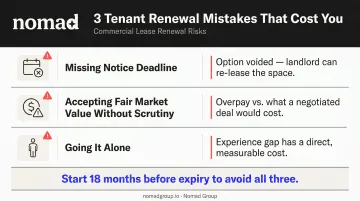
Accepting "fair market value" without scrutiny. The landlord's initial rent figure is not a neutral market determination. It typically excludes the concessions a new tenant would receive, and it reflects the landlord's interests, not yours. Tenants who accept the first number — or who don't understand what FMV excludes — often pay significantly more than a negotiated deal would cost.
Going it alone. Lease renewal involves legal, financial, and market knowledge that most business operators aren't equipped to handle without support. JLL's analysis of 750,000 global transactions found that tenant advisors meaningfully improve lease outcomes through market knowledge, landlord relationships, and structured negotiation.
Savills puts it plainly: an advisor can explain what the landlord is taking into account and help tenants push back rather than simply accepting the opening position. In a market like NYC, where landlords negotiate leases daily and most tenants don't, that gap in experience has a direct cost.
Frequently Asked Questions
What is an option to renew in a commercial lease?
A renewal option is a contractual right negotiated into the original lease that allows the tenant to extend their tenancy for an additional term. It is not automatic — it must be explicitly included, exercised within a specific window, and often comes with conditions the tenant must meet to keep the option valid.
How does a commercial lease renewal work?
The tenant delivers written notice within the required window, the landlord presents a new rental rate based on the lease's rent determination method, and the parties either agree or enter a dispute resolution process. The key risk: the tenant is typically bound to renew before the final rent figure is confirmed.
What is an example of a lease renewal clause?
A typical clause reads: "Tenant shall have one (1) option to renew the lease for a period of five (5) years at fair market rent, provided Tenant delivers written notice to Landlord no later than nine (9) months prior to lease expiration." This illustrates the core components: option count, renewal duration, rent method, and notice deadline.
How far in advance should you notify your landlord of lease renewal?
Most commercial leases require written notice 12–18 months before expiry. The NYC Bar Association's model clause uses that exact window. Start the process even earlier to leave room for market research and real negotiation leverage.
Can you negotiate the terms of a commercial lease renewal?
Yes. Rent, tenant improvement allowances, termination rights, and flexibility provisions are all negotiable. Tenants who treat renewal as a fresh deal rather than a formality consistently secure better outcomes than those who simply exercise the option.
What happens if you miss the renewal option deadline?
Missing the deadline causes the option to lapse — the landlord can then lease the space to another tenant when your term ends. New York courts have occasionally granted equitable relief, but the Baygold decision significantly narrowed that exception; don't rely on it. Post-expiration rent acceptance creates only a month-to-month holdover, not a renewed term.