Introduction
Not all office space is created equal — and in New York City, the gap between building classes can mean the difference between a space that holds your team back and one that helps it grow. Class A is the top tier, and understanding what that label actually means is the first step to leasing smarter.
BOMA's 2022 Office Market Study puts NYC office operating costs at $28.67 per square foot — nearly double the national average of $15.76/sf. Much of that premium flows directly into the amenities, systems, and services that define Class A buildings.
This article breaks down what Class A office space is, the different types available across Manhattan and beyond, and the specific features that set them apart.
Key Takeaways
- Class A is the highest office space tier, defined by premium location, modern infrastructure, and full-service amenities
- Typical features include 24/7 security, high-end lobbies, advanced HVAC, and on-site building management
- Class A rents run higher than Class B or C — in NYC, expect $70–$150+ per sq ft depending on neighborhood
- These spaces attract law firms, financial institutions, tech companies, and other tenants where image and environment matter
- Class A buildings vary in subtype: trophy towers, full-floor boutique spaces, and renovated Class A each serve different needs
What Are CAM Charges in Commercial Leases?
Common Area Maintenance (CAM) charges are additional fees tenants pay on top of base rent to cover the operating and upkeep costs of shared spaces. As Lowndes Law defines it, these costs cover the daily operation, maintenance, and repair of a commercial property.
What Counts as a "Common Area"?
In practice, common areas include:
- Hallways, lobbies, and stairwells
- Elevators and restrooms
- Parking lots and loading docks
- Landscaped grounds and outdoor areas
- Shared mechanical systems and infrastructure
CAM charges are standard in most multi-tenant commercial leases. The exact scope varies — often dramatically — from one lease to the next. Landlords typically negotiate for the broadest possible definition of common areas; tenants benefit from a narrower one. Left unchecked, an overbroad CAM definition can add thousands of dollars annually to your occupancy costs — which is why reviewing the exact scope before signing is non-negotiable.
Types of CAM Charges
Not all CAM charges work the same way. They fall into two categories with very different implications for tenants.
Controllable CAM Charges
These are expenses the landlord has discretion over — how a service is sourced, how often it's performed, how much gets spent. Because the landlord controls the spend, tenants can negotiate caps on annual increases.
Common examples include:
- Janitorial and cleaning services
- Landscaping and groundskeeping
- Parking lot maintenance and striping
- Common area lighting
- Security personnel
- Property management and administrative fees
According to Lowndes Law, tenants typically request caps of 3% to 5% per year on controllable expenses. Without a cap, a landlord could upgrade services, switch vendors, or increase management fees — and pass the full cost increase to you.
Uncontrollable CAM Charges
These are expenses driven by external factors the landlord can't meaningfully influence. They're harder to cap, but still worth scrutinizing.
Common examples include:
- Real estate property taxes
- Building insurance premiums
- Snow removal and emergency weather services
- Utility costs for common areas tied to market rates
The real risk with uncontrollable charges is misclassification. Landlords sometimes shift controllable costs into the "uncontrollable" bucket to sidestep negotiated caps. Your lease should define each category explicitly — and that definition matters just as much as the cap itself.
CAM Charges Across Different Lease Types
Your lease structure determines your total CAM exposure:
| Lease Type | CAM Exposure |
|---|---|
| Gross Lease | Landlord covers operating costs; tenants pay little to no CAM |
| Double Net (NN) | Tenants pay some operating expenses and CAM |
| Triple Net (NNN) | Tenants bear nearly full responsibility for CAM, taxes, and insurance |
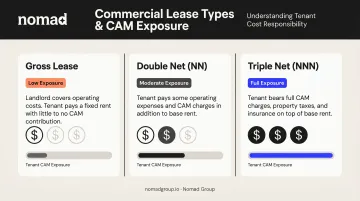
As Holland & Knight notes, NNN tenants pay a proportionate share of real estate taxes, insurance, and maintenance on top of base rent. If you're considering NNN space in Manhattan, run the full occupancy cost calculation before comparing it to gross lease options.
What's Typically Included in CAM Charges?
The specific line items vary by property and lease, but most commercial leases bundle some combination of the following categories. Before signing, request an itemized breakdown — and check that nothing looks duplicated or inflated.
Maintenance and Janitorial Services
This covers routine upkeep of shared spaces — the most universally included CAM line items. BOMA defines this category as encompassing:
- Hallway and common area cleaning
- Restroom maintenance
- Elevator servicing
- General repairs to shared infrastructure
- Materials, labor, and engineering costs
Utilities for Common Areas
Electricity, water, heating, and cooling consumed in shared spaces — not your private suite — fall here. Some leases allocate these costs proportionally based on square footage; others use flat estimates. Clarify the method upfront, since the difference can be significant.
Landscaping and Exterior Upkeep
Lawn care, tree trimming, seasonal plantings, and outdoor area maintenance fall into this bucket. It's more relevant for office parks and campus-style buildings than urban high-rises. For Manhattan tenants, this line item is often minimal or absent entirely.
Security Services
Surveillance systems, alarm monitoring, access control, and security personnel for common areas are typically bundled here. In NYC Class A buildings, security costs can run several dollars per square foot annually — confirm whether it's billed as CAM or invoiced separately.
Administrative and Property Management Fees
This covers property manager salaries, bookkeeping, and administrative overhead. Landlords charge it either as a percentage of total CAM costs or as a percentage of gross rents.
Watch this line closely. A landlord who self-manages may still charge an "industry standard" management fee as if a third-party manager were involved. If no external manager exists, the fee should reflect actual internal overhead — not a percentage-based proxy that inflates the total CAM pool.
How CAM Charges Are Calculated
The Pro-Rata Share Model
Each tenant pays a proportionate share of total CAM expenses based on the ratio of their leased square footage to the property's total rentable area. The formula:
CAM Charge = (Tenant's Leased SF ÷ Total Rentable SF) × Total Annual CAM Expenses
Example: A tenant leasing 2,000 SF in a 20,000 SF building with $50,000 in annual CAM costs:
- 2,000 ÷ 20,000 = 10% pro-rata share
- 10% × $50,000 = $5,000/year, or roughly $417/month
That $417/month comes on top of base rent — and it can change year to year.
Estimates, Actuals, and Reconciliation
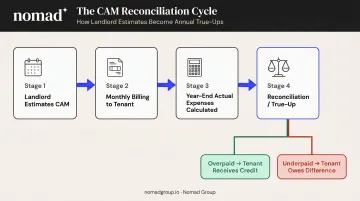
Landlords typically estimate CAM charges at the start of each year and bill tenants monthly as part of their rent. At year-end, a CAM reconciliation (sometimes called a true-up or billback) compares those estimates against actual expenses.
- If you overpaid → you receive a credit
- If you underpaid → you owe the difference
This annual true-up can create cash flow surprises — in NYC Class A buildings, shortfalls of $2,000–$10,000 are not uncommon depending on lease size. Build a buffer into your annual budget before signing.
Fixed vs. Variable CAM Structures
CAM charges can be structured in two ways:
- Fixed CAM: A flat rate that increases at a predetermined schedule, offering more predictable monthly costs
- Variable CAM: Tied directly to actual operating expenses, which fluctuates year to year
Fixed CAM is easier to budget around. Variable CAM may be lower in some years but leaves tenants exposed to cost spikes they can't control. In Manhattan Class A leases, variable CAM is more common — so ask your broker to clarify the structure before negotiations conclude.
Negotiating CAM Charges and Protecting Yourself
Most tenants accept a landlord's initial lease draft without scrutinizing CAM provisions — and end up overpaying for years. These are the specific protections worth pushing for.
CAM Caps
Negotiate a cap on annual increases for controllable CAM expenses. The standard range is 3–5% per year. But the structure of the cap matters as much as the percentage:
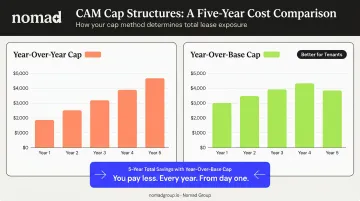
- Year-over-year cap: Limits each year's increase to a percentage of the prior year's actual charges
- Year-over-base cap: Ties each year's increase back to the original CAM amount at lease commencement — often more favorable long-term
Watch for the cumulative vs. non-cumulative distinction. A cumulative cap lets the landlord carry forward unused capacity and catch up on increases in future years. A non-cumulative cap limits each year independently — and typically protects tenants better. These two structures produce very different outcomes over a five- or ten-year lease.
Audit Rights
Negotiate the right to audit the landlord's CAM records annually. Audit rights let you verify that charges are legitimate, correctly allocated, and not duplicated. Management fees are where audits prove their value — a landlord billing a percentage-based management fee without an actual third-party manager in place is a recurring problem audits can catch and challenge.
Amortization Protections for Capital Improvements
If a landlord replaces the roof, installs a new HVAC system, or upgrades elevators, you don't want to absorb that full cost in a single year. Negotiate lease language that requires capital improvement costs to be amortized over the improvement's useful life. Without this protection, a tenant mid-lease could be billed for the entire cost of an infrastructure project that benefits future tenants long after their lease ends.
Expense Exclusions
Request exclusions for expenses that shouldn't be passed to tenants, including:
- Costs to lease vacant space
- Capital expenditures not amortized per above
- Depreciation of building equipment
- Landlord's income taxes or financing costs
- Marketing and leasing commissions
For tenants navigating commercial lease negotiations in NYC — particularly around total occupancy costs and CAM terms — working with an experienced tenant advisor like Nomad Group can help identify these provisions before they become problems. Their tenant representation team works across Manhattan — Flatiron, NoMad, SoHo, Union Square — and knows how CAM structures differ building by building, which makes a material difference at the negotiating table.
Frequently Asked Questions
What does CAM mean in a commercial lease?
CAM stands for Common Area Maintenance. It refers to fees tenants pay on top of base rent to cover the costs of operating and maintaining shared spaces — lobbies, hallways, parking lots, elevators — in a commercial property.
Do CAM charges apply to all commercial leases?
No. CAM charges are most common in multi-tenant buildings, particularly Triple Net (NNN) leases. In gross leases, the landlord covers operating expenses, so tenants typically pay no separate CAM. The structure depends entirely on the lease type negotiated.
What are common causes of CAM charges?
CAM charges arise from the ongoing cost of running shared building areas: janitorial services, utilities for common spaces, landscaping, security, and property management fees. In NNN leases, property taxes and insurance premiums are also passed through.
Can tenants negotiate CAM charges?
Yes. Caps on annual increases, audit rights, exclusions of specific expense categories, and amortization requirements for capital improvements are all negotiable. Tenants who engage an advisor and push back on the initial lease draft consistently secure better terms.
What is a CAM reconciliation?
A CAM reconciliation (also called a true-up or billback) is the annual process of comparing estimated CAM charges billed during the year against actual expenses. If you overpaid, you receive a credit; if you underpaid, you owe the difference.
Are CAM charges included in ASC 842?
Under ASC 842, variable CAM charges are expensed as incurred and excluded from the right-of-use asset and lease liability. Fixed or in-substance fixed CAM requires separate analysis — consult your accountant to confirm how your specific structure is treated.