Gross leases and net leases are the two most common commercial lease structures in the market — and they distribute operating costs very differently between tenant and landlord. For a scaling company managing runway or planning headcount growth, that distinction matters enormously.
This guide breaks down how each structure works, what you'll actually pay under each, and how to choose the right one for where your company is today.
Key Takeaways
- Gross lease: One flat rent payment; landlord covers operating expenses. High cost predictability.
- Net lease (NNN): Lower base rent, but tenants pay property taxes, insurance, and CAM separately. Total cost can match or exceed a gross lease.
- Modified gross lease: A hybrid structure (the NYC office standard): base rent covers expenses, but cost increases pass through to tenants.
- No universal winner: The right structure depends on your growth stage, budget flexibility, and how much operating cost variability your team can absorb.
Net Lease vs. Gross Lease: Quick Comparison
The core difference between these lease types comes down to one question: who bears the financial risk when operating costs fluctuate? Under a gross lease, that risk sits with the landlord. Under a net lease, it shifts to the tenant.
| Factor | Gross Lease | Net Lease (NNN) |
|---|---|---|
| Base Rent | Higher — bundles operating expenses | Lower — but expenses billed separately |
| Expense Responsibility | Landlord covers taxes, insurance, CAM | Tenant pays some or all of taxes, insurance, CAM |
| Budget Predictability | High — fixed monthly cost | Variable — costs fluctuate year to year |
| Typical Property Type | Multi-tenant office buildings | Retail, industrial, single-tenant properties |
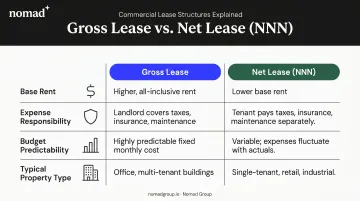
As BOMA's Green Lease Guide notes, all else equal, a gross or modified gross lease will carry a higher base rent than a net lease — the landlord prices in the risk of absorbing variable operating costs. The real comparison is total occupancy cost, not base rent.
What Is a Gross Lease?
A gross lease is a commercial lease where the tenant pays one all-in rent that covers base rent plus operating expenses — property taxes, insurance, and common area maintenance. The landlord uses that rent to pay building costs, and the tenant is insulated from fluctuations in those expenses year to year.
NAIOP defines a gross lease as one in which "the landlord receives stipulated rent and pays all property operating expenses and real estate taxes" — an arrangement that keeps monthly costs predictable for the tenant.
The Base Year Concept
Most commercial gross leases — particularly office leases — use a base year structure. The rental rate reflects operating expenses as of the base year (typically the year the lease is signed). Tenants pay for increases in operating costs above that base year level — not the base itself.
That distinction matters at signing. If the baseline is set in a low-assessment year, you may face steeper-than-expected escalations later in the lease term.
The gross rent formula breaks down like this:
Gross Rent PSF = Net Rent PSF + Insurance + Common Area Maintenance + Real Estate Taxes
That formula explains why gross rents run higher than net leases — landlords price in expense risk upfront. Here's what that trade-off looks like from a tenant's perspective.
Pros and Cons for Tenants
Advantages:
- Fixed monthly costs simplify financial planning
- No surprise bills for building-level expenses
- Easier to budget across departments — finance, ops, and leadership all work from the same number
Disadvantages:
- Higher base rent than net leases — landlords price in expense risk
- If operating costs drop, tenants still pay based on the base year
- Less visibility into what building expenses actually cost
Where Gross Leases Are Most Common
Gross leases dominate multi-tenant office buildings, co-working environments, and professional services spaces. In NYC, the modified gross lease (a close variant) is the standard structure for most office buildings across neighborhoods like Flatiron, NoMad, SoHo, and Bryant Park.
This structure suits companies that prioritize financial predictability — particularly those with lean finance teams or early-stage operations that can't absorb variable cost reconciliations each year.
What Is a Net Lease?
A net lease is a commercial lease where the tenant pays a lower base rent, then separately covers some or all of the property's operating expenses. The triple net (NNN) lease is the most common form — tenants pay property taxes, building insurance, and common area maintenance on top of base rent.
Per NAIOP's industry definitions, under a NNN structure the tenant is responsible for "taxes, maintenance, property insurance, and all operating costs associated with occupancy" — with landlords typically retaining responsibility for roof, HVAC, and structural elements.
How Expense Pass-Throughs Work
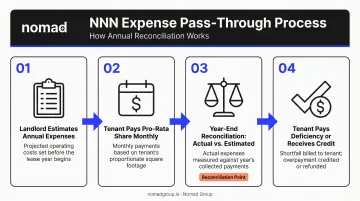
In a triple net lease, the process works like this:
- Landlord estimates annual operating expenses at the start of each year
- Tenant pays their proportionate share monthly, alongside base rent
- Year-end reconciliation compares actual vs. estimated costs
- Tenant pays the deficiency or receives a credit depending on actual expenses
The tenant's share is calculated as a pro-rata share — their leased square footage divided by the building's total net rentable area. Under BOMA's standard lease language, annual statements trigger either a deficiency payment or a credit, leaving tenants with real cash exposure at year end.
Pros and Cons for Tenants
Advantages:
- Lower base rent frees up cash for operations
- Direct visibility into how the building is run and maintained
- Ability to audit CAM charges (BOMA language typically grants audit rights)
Disadvantages:
- Year-over-year cost variability makes budgeting harder
- If building vacancies rise, remaining tenants pay a larger share of fixed costs
- Unexpected maintenance spikes pass directly to tenants
NNN leases are most common in retail and industrial properties, and less typical in NYC's multi-tenant office market. Startups evaluating NNN office space should factor in the reconciliation process as meaningful administrative overhead. So what does NYC office leasing actually look like? That's where the modified gross lease comes in.
The Modified Gross Lease: The NYC Office Standard
The modified gross lease sits between a pure gross and a net lease. Base rent covers operating expenses at the base-year level — but increases above that baseline are passed through to the tenant on a pro-rata basis.
As Practical Law's New York office lease form (structured specifically for multi-tenant buildings) confirms, the base-year modified gross is the dominant framework for NYC office leasing. Because each lease is negotiated property by property, what's included in base rent — and what gets passed through — varies significantly from building to building.
Key things to scrutinize in any NYC modified gross lease:
- Which expenses are included in base rent vs. passed through
- What base year is used and whether it reflects a stabilized assessment
- Whether the lease includes escalation caps on pass-throughs
- How utilities are handled (the NYC SBS Commercial Lease Guide notes electricity is typically billed as a separate additional charge)
One notable risk flagged by Herrick's NYC real estate attorneys: in new properties, real estate tax assessments may be artificially low before full stabilization — meaning base-year tax figures can understate what tenants will actually pay in years two through five.
Which Lease Type Is Right for Your NYC Office?
The right lease structure comes down to where your company is right now — your stage, your capacity, and what kind of cost predictability you need.
Match Your Lease to Your Stage
| Situation | Recommended Structure |
|---|---|
| Early-stage startup managing runway | Gross or modified gross lease |
| Small team without dedicated finance/ops | Gross or modified gross lease |
| Entering a multi-tenant Manhattan office building | Modified gross (market standard) |
| Leasing a freestanding single-tenant property | Net lease may apply |
| Larger company with real estate ops capacity | Either structure can work |
| Negotiating a long-term single-tenant arrangement | Net lease worth evaluating |
Always Calculate Total Occupancy Cost
Never compare leases based on base rent alone. A $55/sf gross lease and a $45/sf NNN lease are not directly comparable until you add up everything the NNN tenant pays.
A basic total occupancy cost framework:
- Start with base rent (annual PSF × leased square footage)
- Add estimated pass-throughs — taxes, insurance, CAM at your pro-rata share
- Add utilities — in NYC office leases, electricity is almost always a separate charge
- Model escalations — apply realistic annual increases to operating expense pass-throughs
- Compare both scenarios over the full lease term, not just year one
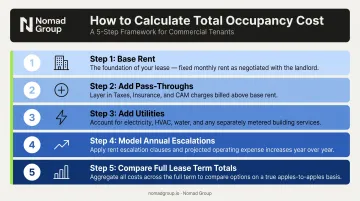
Year one might favor the lower base rent of a net lease. By year four, the escalation stack can flip the comparison entirely.
NYC-Specific Considerations
In Manhattan's office market, you will almost always be evaluating a modified gross lease. The variables that actually move the needle are:
- Base year terms — what's included and how it's calculated
- Escalation caps — whether year-over-year pass-through increases are capped
- Utility handling — direct meter, submeter, or rent inclusion
- Audit rights — your ability to review CAM reconciliation calculations
These terms are negotiable, and knowing which ones landlords in specific Manhattan buildings will move on makes a real difference. Working with a tenant-side advisor like Nomad Group means you have someone who understands the mechanics of these clauses before you sign anything.
Conclusion
Gross leases offer simplicity and cost certainty — valuable for growing companies without dedicated real estate teams. Net leases offer lower headline rent but come with real variability that can complicate financial planning. In NYC's office market, what you'll actually be evaluating is a modified gross lease, where the lease label matters less than the specific base year, escalation, and pass-through terms negotiated into the document.
Understanding lease structure is one of the most financially consequential decisions a company makes when committing to office space. The difference between favorable and unfavorable terms isn't always obvious from the face rent — it shows up in year three, when the reconciliation statement arrives.
Evaluate total occupancy cost. Read the base year provisions carefully. And if you're signing your first NYC office lease, having an experienced tenant rep at the table — someone who's negotiated these exact provisions before — can be the difference between a lease that works for your business and one that quietly costs you more each year. Nomad Group's tenant representation team has leased over 2 million square feet across Manhattan and can help you understand exactly what you're committing to before you sign.
Frequently Asked Questions
What is the difference between a gross and net lease?
In a gross lease, the tenant pays one flat rent and the landlord covers operating costs including taxes, insurance, and CAM. In a net lease, the tenant pays a lower base rent but is separately responsible for some or all of those operating expenses, which can make the total cost comparable to or higher than a gross lease.
Who pays for utilities in a gross lease?
In a full-service gross lease, utilities are included in rent. In a modified gross lease, the NYC office standard, electricity is typically billed directly to the tenant as a separate pass-through charge. Always confirm utility handling before signing.
What is a modified gross lease?
A modified gross lease is a hybrid structure where base rent covers operating expenses at a base-year level, but increases above that baseline are passed through to the tenant pro-rata. It's the dominant lease structure in NYC multi-tenant office buildings.
Which lease type is better for tenants?
Neither is universally better. Gross leases offer predictability for early-stage companies; net leases carry lower base rent but higher total costs as operating expenses rise. Your budget flexibility, team size, and property type should drive the decision.
What is included in a triple net (NNN) lease?
In a NNN lease, tenants pay base rent plus property taxes, building insurance, and common area maintenance costs, all reconciled annually against actual expenses. It's the most expense-intensive structure for tenants, and year-end reconciliations can result in five-figure true-up charges if costs ran high.
Are commercial lease structures negotiable?
Yes. Base year selection, escalation caps, pass-through definitions, and audit rights are all negotiable. A tenant representative brings the market knowledge to push back on landlord-favorable defaults and secure terms that protect your budget.