A lease that looks affordable based on base rent alone can carry a very different total cost once operating expenses, taxes, and maintenance are factored in. The NYC Bar Association notes that basic rent is only the beginning — and the American Bar Association identifies additional rent items including common charges, real estate taxes, and operating expense pass-throughs as standard features of commercial lease agreements.
This article breaks down the five main commercial lease types, explains how each distributes costs and risk, and helps you identify which structure fits your business before you sit down to negotiate.
Key Takeaways
- Commercial leases are not standardized — the lease type controls who pays for property taxes, insurance, utilities, and maintenance
- The five main types: Gross Lease, Modified Gross Lease, Triple Net (NNN), Absolute Net, and Percentage Lease
- Gross and Modified Gross leases bundle costs into base rent — net leases progressively shift those operating expenses onto the tenant
- The right lease depends on how much cost predictability you need, how much operational control you want, and your expected tenure
- Know the lease structure before you negotiate — that's where tenant leverage actually lives
What Is a Commercial Real Estate Lease?
A commercial real estate lease is a legally binding contract between a landlord and a business tenant specifying how rent is structured, what expenses each party is responsible for, and the duration of the tenancy.
Unlike residential leases, commercial leases are highly negotiable. The ABA confirms that commercial lease documents are not contracts of adhesion, meaning they're drafts, not fixed offers.
The NYC Bar warns that a landlord's standard lease is long, technical, and written to protect the landlord. That's the starting position. Where you end up depends on your leverage and preparation.
Understanding "Nets"
The word "net" in commercial leasing refers to costs the tenant pays on top of base rent. Those costs typically include some combination of:
- Property taxes — the landlord's annual tax obligation for the building
- Building insurance — premiums on the property itself
- Maintenance and operating expenses — repairs, common area upkeep, utilities, and building services
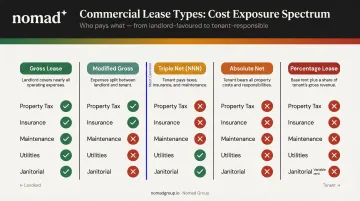
Different lease types stack these nets differently. A gross lease has zero nets for the tenant. A triple net lease has three. The sections below break down each lease type so you know exactly what you're agreeing to before signing.
Types of Commercial Real Estate Leases
No single lease structure is universally better. Each reflects a different allocation of financial responsibility between landlord and tenant — and the right choice depends entirely on your business's situation.
Gross Lease
A gross lease means one thing: you pay a single, all-inclusive rent amount and the landlord covers everything else. Property taxes, building insurance, utilities, maintenance — all handled from that payment.
NAIOP defines a gross lease as one in which the landlord receives stipulated rent and pays all property operating expenses and real estate taxes. For tenants, the result is maximum budget predictability.
Best suited for: Small businesses, early-stage startups, and companies transitioning from coworking into dedicated space who need clean, forecastable occupancy costs.
The trade-off: Simplicity has a cost. Gross leases typically carry higher base rent because the landlord is absorbing all operating risk. Tenants also have limited visibility into how property expenses are managed, which matters if costs spike unexpectedly.
Modified Gross Lease
A modified gross lease is a hybrid. Operating expenses, property taxes, and insurance are included in base rent for a defined base year — but cost increases above that threshold get passed through to the tenant, typically on a pro-rata basis.
The base year is typically the first full calendar year of the lease term. The ABA recommends gross-up provisions set at 95% or 100% occupancy — this prevents vacancy-distorted expense calculations from unfairly inflating what gets passed to tenants.
Best suited for: Professional services firms, tech companies, and scaling startups that want cost clarity in early lease years. This is the most common structure in Manhattan and major metro office markets.
The trade-off: The base year and gross-up language are where most tenants get burned. If you don't scrutinize these provisions carefully, years two and three can bring meaningful cost increases that weren't visible when you signed.
Triple Net (NNN) Lease
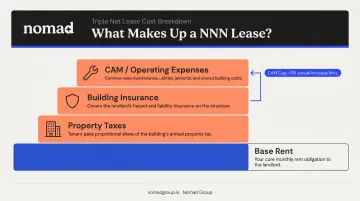
In a triple net lease, the tenant pays base rent plus three separate costs: property taxes, building insurance, and common area maintenance (CAM) or operating expenses. The landlord's rent is essentially "net" of those major operating costs.
NNN structures are most common in retail and industrial properties, though they appear in some office contexts. The key difference from gross and modified gross leases: fluctuations in taxes, insurance premiums, and maintenance costs fall directly on the tenant. Your monthly total can change year to year.
Best suited for: Established businesses leasing freestanding or single-tenant properties who want property control and can negotiate a meaningfully lower base rent to offset the added cost exposure.
CAM caps — why they matter: Without a cap on CAM charges, tenants have no ceiling on what landlords can pass through for operating costs. ICSC retail lease materials reference non-cumulative annual caps of around 5% over the prior year as an example structure. Whatever figure is negotiated, a cap protects against unexpected spikes in building expenses that are outside your control.
Absolute Net Lease (Bondable Lease)
This is the most tenant-intensive structure. In an absolute net lease, the tenant assumes full financial responsibility for everything, including structural repairs, roof replacement, and potentially rebuilding obligations, regardless of what happens to the property. These leases are typically non-cancelable.
The distinction from a standard NNN lease matters. A standard NNN lease may still leave major structural defects or capital expenditures above a certain threshold with the landlord. An absolute net lease, as Holland & Knight notes, transfers virtually every ownership-level obligation to the tenant.
CoStar notes that zero-cash-flow NNN investment structures of this type typically require tenants with a BBB credit rating or better and lease terms of 20 years or more.
Best suited for: National retailers and franchises (Walmart and McDonald's are commonly cited examples) entering long-term agreements. For most startups, tech companies, and scaling businesses, the risk profile and complexity of this structure make it a non-starter.
Percentage Lease
A percentage lease combines a base rent with a percentage of the tenant's gross sales above a defined revenue threshold, called the breakpoint. The landlord's income rises when the tenant performs well.
ICSC materials describe natural versus artificial breakpoints in the retail context, with an example of tenants paying 7% of gross sales above a $3M breakpoint. This aligns landlord income with tenant business performance.
Best suited for: Retail tenants in shopping malls and mixed-use environments with variable or seasonal revenues. The lower fixed base rent reduces downside risk, while landlords accept variable income for upside participation. This structure is uncommon in the NYC office market and rarely relevant for tech or professional services tenants.
Watch the details: Tenants must understand exactly how the breakpoint is calculated and which sales count toward the gross revenue definition. Expense responsibilities for taxes, insurance, and maintenance are negotiated separately, adding another layer of terms to manage.
How to Choose the Right Commercial Lease Type
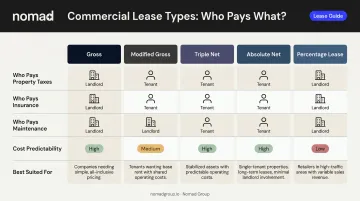
Your lease type should reflect your financial priorities, how you plan to use the space, and where your business is headed — not what's most common in a building or most convenient for a landlord.
Four factors that should guide your decision:
1. Cost predictability vs. control Tenants who need stable, predictable occupancy costs should favor gross or modified gross leases. Tenants who want direct control over property expenses — and can absorb variability — may benefit from net leases if the base rent is meaningfully lower.
2. Stage and size of the business Early-stage startups on tight budgets benefit from the simplicity of gross or modified gross structures. Established businesses with strong cash flow and long-term occupancy plans may be better suited to net lease arrangements where they can manage costs directly.
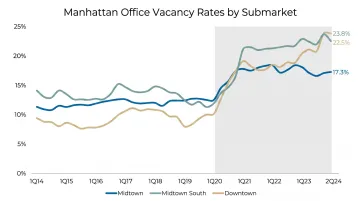
3. Length of commitment and flexibility needs NNN leases tend to come with longer terms — often 10 to 25 years for single-tenant assets. Companies that anticipate rapid headcount growth, space expansion, or business model shifts should weight lease flexibility heavily. Manhattan office availability sat at 18.5% in Q3 2024, with Midtown South at 22.8% — that level of available inventory creates real negotiating room on term flexibility if tenants know how to use it.
4. Working with a tenant-side advisor Lease type selection is inseparable from negotiation. An experienced tenant broker understands not just what lease structure is on the table, but which terms are negotiable and where landlords actually have flexibility.
Nomad Group has guided 300+ NYC tenant buildouts across 2M+ sq ft — that depth of deal experience means clients routinely secure expansion rights, improvement allowances, termination options, and sublease provisions that a standard lease negotiation would leave on the table.
Common Mistakes Tenants Make When Evaluating Lease Types
Focusing Only on Base Rent
Many tenants compare spaces based on the stated rent per square foot and stop there. A lower base rent on a NNN lease can easily exceed the total cost of a higher base rent gross lease once property taxes, insurance, and CAM charges are factored in. The ABA identifies these pass-through items as standard "additional rent" — not optional extras — in commercial lease agreements.
Before comparing spaces, model total occupancy cost for each option, not just the headline number.
Skipping the Base Year and Escalation Review
In modified gross leases, the base year definition and gross-up assumptions determine how much your rent increases over time. Tenants who don't scrutinize these provisions in years one and two often face costs in years three, four, and five that weren't visible at signing.
Before executing a modified gross lease, get ahead of these variables:
- Request a historical expense breakdown from the landlord to see how operating costs have trended
- verify the base year used in the lease against that history
- Review gross-up provisions carefully — whether set at 95% or 100% occupancy assumptions changes the numbers materially
Accepting the Lease Type as Non-Negotiable
Tenants often accept whatever structure a landlord presents without asking whether it can be changed. Lease structures are negotiable — particularly in markets where available inventory gives tenants real options. In Manhattan, that negotiability can extend well beyond base rent:
- Switching from NNN to modified gross to cap exposure on variable costs
- Negotiating a favorable base year in a modified gross lease
- Adding expense caps or audit rights on CAM reconciliations
- Requesting landlord-paid tenant improvement allowances tied to lease structure
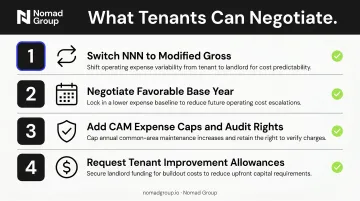
Knowing what's on the table before you sit down is what turns a standard offer into a deal that actually works for your business.
Frequently Asked Questions
Is a triple net lease a good idea?
It depends on your situation. NNN leases can offer lower base rent and direct control over property expenses, but tenants absorb the risk of fluctuating taxes, insurance, and maintenance costs. They work best for businesses with stable cash flow and long-term space commitments, not for early-stage companies that need cost predictability.
What does $35 NNN mean?
It means the base rent is $35 per square foot per year, and the "NNN" signals that property taxes, building insurance, and maintenance costs are charged separately on top of that rate. Your true cost per square foot will be higher once those additional expenses are added, sometimes by a substantial margin.
What is the most common type of commercial lease for office space?
Modified gross leases are the most common structure in urban office markets like New York City. They bundle base operating costs into rent but pass expense increases above a defined base year to tenants, balancing cost predictability for tenants with protection for landlords against rising costs.
What is the difference between a gross lease and a net lease?
In a gross lease, the landlord covers all operating expenses within your rent payment. In a net lease, you pay some or all of those expenses separately on top of base rent. The number of "nets" (single, double, triple) indicates how many expense categories shift to the tenant.
Can tenants negotiate the terms of a commercial lease?
Yes — commercial leases are highly negotiable. Tenants can often negotiate not just base rent but the lease structure itself, expense caps, base year definitions, and maintenance responsibilities. Working with a tenant-side broker is key to knowing what's negotiable in a specific market and building.
What are CAM charges in a commercial lease?
CAM (Common Area Maintenance) charges cover shared building spaces like lobbies, hallways, and parking areas, passed through to tenants in net and modified gross leases. Always request a detailed CAM breakdown before signing and negotiate a cap to limit exposure to unexpected cost increases.