Introduction
Signing a commercial lease in New York City is one of the most consequential decisions a growing company makes, and most teams go into it underprepared. The market throws competing variables at you at once:
- Dozens of available buildings across neighborhoods with very different cost profiles
- Quoted rents that bear little resemblance to actual occupancy costs
- Lease documents written to protect landlords, not tenants
- Terms that lock you in for 5–10 years with limited exit options
The result: companies lock themselves into 7-year commitments based on incomplete information, then spend years managing the fallout — overpaying for space they don't fully use, or fighting to sublease a floor they can no longer fill.
This guide is designed to close that gap. It covers:
- The types of commercial space available in NYC
- How to read the city's key office submarkets
- What lease structures and true occupancy costs look like
- How the leasing process works, step by step
- Which lease terms are worth negotiating before you sign
Key Takeaways
- NYC commercial space comes in three forms: direct leases, subleases, and flexible options — each with different cost and commitment trade-offs
- Rent varies dramatically by submarket: $45–$121/SF depending on neighborhood and building class (Q3–Q4 2025 data)
- Plan for 3–6+ months from search to move-in — the timeline stretches with buildout complexity
- Most negotiating leverage disappears after the Letter of Intent is signed; push hard on terms before attorneys get involved
Types of Commercial Space Available in NYC
Direct Leases, Subleases, and Flexible Space
Three distinct routes exist for tenants entering the NYC market:
Direct leases give you maximum control over space configuration, lease terms, and buildout — signed directly with the building owner. The trade-off is commitment: direct leases typically run 5–10 years, and landlords expect creditworthy tenants with financial staying power.
Sublease space lets you take over another company's unexpired lease, often at lower rates than direct market pricing. Manhattan carried nearly 15 million square feet of sublease supply in Q3 2025, creating real opportunities for cost-conscious tenants. The catch: you inherit the original lease's expiration date and terms, which may not align with your growth timeline.
Flexible/coworking space offers month-to-month or short-term managed offices — maximum flexibility, minimum commitment, but at a higher per-square-foot cost than direct or sublease. Nomad Group's Flex by Nomad sits in this category, built on in-house infrastructure rather than a third-party provider, which keeps costs more manageable.
Office Building Classes
BOMA defines three building classes that serve as the industry standard:
| Class | Definition | Typical Tenant |
|---|---|---|
| A | Most prestigious buildings, above-market rents, premium amenities | Enterprise, financial services, late-stage companies |
| B | Functional space at average market rents | Growth-stage startups, agencies, mid-market firms |
| C | Below-average rents, older stock | Cost-first tenants, early-stage companies |
Growth stage usually determines the right class. A Series A company with 25 employees doesn't need a Park Avenue address — but they might need Class B loft space that photographs well for recruiting.
Pre-Built "Plug-and-Play" Suites
A growing share of NYC landlords now offer pre-built suites — move-in-ready spaces with existing infrastructure and no custom buildout required. For Series A companies that need to be operational quickly, these are worth prioritizing. The downside is limited customization; you're working within whatever the landlord has already installed.
NYC Neighborhoods for Commercial Office Space
Where you lease matters as much as what you lease. Different submarkets carry different price points, building stock, transit access, and company cultures — and all of that affects hiring.
Midtown Manhattan
The Grand Central and Park Avenue corridor is NYC's most established office market. Financial institutions, law firms, and enterprise companies dominate here. Class A inventory is abundant, but rents reflect it.
According to Cushman & Wakefield's Q3 2025 data:
- Midtown overall: $75.58/SF asking rent, 21.1% vacancy
- Grand Central: $67.26/SF, 21.5% vacancy
- Park Avenue: $121.40/SF, 11.1% vacancy
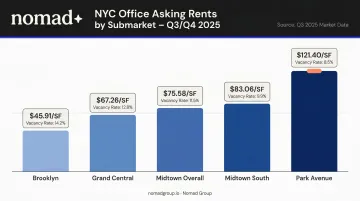
Park Avenue's vacancy is tight precisely because demand from prestige-driven tenants holds firm. If your business needs that address, expect to pay for it.
Midtown South (NoMad, Flatiron, Union Square)
This is where NYC's startup and tech ecosystem lives. The loft-style Class B buildings here — exposed brick, high ceilings, open floor plates — have defined "Silicon Alley" for two decades. Agencies, fintech companies, and high-growth tech firms concentrate here.
Midtown South overall asking rents came in at $83.06/SF in Q3 2025, with Class A space reaching $104.73/SF. Availability was 14.7% per Colliers' Q3 2025 data — tighter than other submarkets, which reflects sustained demand from the tech and creative sector.
That sustained demand means broker relationships and submarket knowledge matter here more than anywhere else in the city. Nomad Group's concentration in this corridor — placing clients like Optimove, deepIntent, and dbt Labs in Flatiron, Union Square, and NoMad — reflects how deeply the firm is embedded in exactly the neighborhoods these companies want.
Lower Manhattan and Brooklyn (Williamsburg)
Lower Manhattan offers the most competitive rents among Manhattan submarkets at $56.40/SF overall (Q3 2025), with improving amenities and strong transit access. It's an underrated option for companies that don't need to be in Midtown South but want a Manhattan address.
Williamsburg has become a credible option for creative, tech, and consumer brands that want a borough-native culture. Brooklyn overall sits at roughly $45.91/SF (Q4 2025 per Colliers). Nomad Group placed Flora, a generative AI company, at 300 Kent Avenue in Williamsburg — a Class A waterfront building by Two Trees. Within 30 days of move-in, Flora was working to double their footprint.
How to Choose a Neighborhood
Evaluate each option against these factors — not just the headline rent:
- Transit access for employee commutes (non-negotiable in NYC)
- Walkability and amenities near the building
- Neighboring tenant mix — the companies around you shape your recruiting culture
- Building amenity package — conference centers, bike storage, showers, roof decks
- Expansion potential within the building or immediate area
Understanding Commercial Lease Types and Costs in NYC
The Three Primary Lease Structures
| Structure | What It Means | NYC Prevalence |
|---|---|---|
| Full-Service Gross | One rent figure covers most operating expenses | Most common in Class A |
| Modified Gross | Base rent plus shared operating expenses | Typical in Class B |
| Net (NNN) | Base rent plus taxes, insurance, and maintenance | Less common for NYC office |
Full-service gross leases are the most tenant-friendly on paper: one number, fewer surprises. That simplicity comes at a higher face rent. Modified gross leases can be equally manageable if you understand the expense splits upfront.
Cost Layers Beyond Base Rent
The quoted rent is rarely the real rent. Budget for these additional items:
- Electricity — often billed separately in NYC, calculated per rentable square foot or metered directly
- Real estate tax escalations — in gross leases, tenants often pay increases above a base year, which can compound meaningfully over a 7-year term
- Common Area Maintenance (CAM) — covers lobbies, elevators, building management, and shared cleaning
- Annual rent escalations — typically 2–3% per year in NYC
In total, these "additional rent" items can push your all-in cost 15–30% above the face rent quoted in a listing — a gap that catches tenants off guard during budgeting.
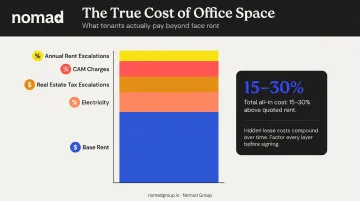
Beyond the cost line items, there's another number in every listing that deserves equal scrutiny: the square footage itself.
Rentable vs. Usable Square Footage
Rent is charged on rentable square footage, which includes your proportionate share of common areas — hallways, lobbies, mechanical rooms. The usable square footage is what your team actually occupies. The gap between the two is the loss factor (sometimes called the load factor).
Older Midtown buildings — with thick columns, irregular floor plates, and dated core configurations — can carry significantly higher loss factors than newer construction. A space quoted at 10,000 rentable square feet might only deliver 7,500–8,500 usable feet. Always convert to cost per usable square foot before comparing options.
Tenant Improvement Allowances and Free Rent
TI Allowances are landlord contributions toward your buildout costs. The amount varies by lease length, market conditions, and your company's creditworthiness. CBRE data from 2024 shows average U.S. office TI allowances of $87.51/SF — though NYC figures vary based on the specific deal. In a tenant-favorable market, this number rises. On a 7-year lease in a strong building, a well-negotiated TI allowance can fund a substantial portion of your buildout.
Free rent is separate — typically a period of zero rent at lease commencement, ranging from weeks to several months depending on lease length. On a 10,000 SF lease at $80/SF, three months of free rent equals $200,000 — a number that should factor directly into any cost comparison between competing spaces.
The NYC Commercial Leasing Process: Step by Step
Step 1 — Define Your Requirements
Before touring anything, build a clear brief:
- Target square footage — JLL's 2025 global benchmark puts average space targets at 132 SF per person, down from 165 SF; use this as a starting planning figure
- Preferred neighborhoods — narrow to 2–3 based on commute patterns and culture
- Lease term flexibility — how long are you comfortable committing?
- True budget — base rent plus electricity, taxes, CAM, and buildout amortization
Most tenants anchor to face rent and underestimate total occupancy cost by 20–30%. Budget for all-in costs from the start.
Step 2 — Engage a Tenant Representative Broker
A tenant rep broker works exclusively in your interest rather than the landlord's. They're compensated by the landlord as part of the transaction, so there's no direct cost to you as the tenant.
That distinction matters in practice. A listing agent protects the landlord's position; a tenant rep is contractually working against it on your behalf.
Nomad Group operates exclusively as a tenant representative and full-service partner. The same firm that finds and negotiates your space can also manage the buildout and ongoing facilities operations — eliminating the handoff friction that typically happens when brokerage and construction sit with separate vendors.
Step 3 — Tour, Shortlist, and Issue an RFP
Tour with a critical eye:
- Actual light and ceiling height (not just photos)
- Floor plate efficiency and column placement
- Building infrastructure — HVAC age, freight elevator access, telecom capacity
- Building management responsiveness
Then issue a Request for Proposal (RFP) to multiple landlords simultaneously. Competing proposals are your single most effective negotiating tool in NYC. Landlords know when they're competing, and terms tighten accordingly.
Step 4 — Negotiate the Letter of Intent (LOI)
The LOI is a pre-lease document that sets the major economic terms:
- Rent and free rent period
- Tenant Improvement (TI) allowance
- Lease term, renewal options, and expansion rights
Most tenants treat the LOI as a formality. It shapes the entire deal. Once you move into full lease drafting, leverage shifts to attorneys and momentum — walking away becomes costly. Push hard here while you still have real alternatives.
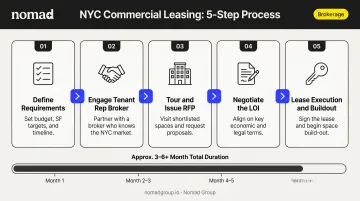
Step 5 — Lease Execution and Buildout
After the LOI, the full lease document goes to legal review. Always use a real estate attorney, not a general business attorney. Commercial lease language is specialized, and missing a problematic clause carries real financial risk.
Once signed, the buildout period begins. In well-negotiated leases, it runs concurrently with the free rent period — meaning you're building out the space without paying rent. Nomad Group's in-house construction management consistently delivers buildouts in approximately 90 days; one client went from white-box to fully operational in 5 weeks. Delays are where tenant timelines most commonly fall apart, particularly when brokerage and construction are handled by separate teams.
Key Lease Terms Every NYC Tenant Should Negotiate
Most NYC tenants focus on rent per square foot and miss the provisions that actually protect them over the life of the lease. These three areas are where experienced tenant reps earn their keep — and where the real leverage sits.
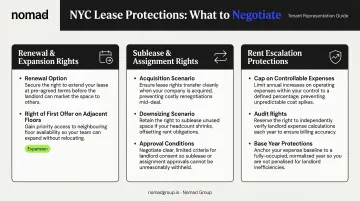
Renewal Options and Expansion Rights
A renewal option gives you the contractual right — not the obligation — to extend the lease at expiration, either at a predetermined rent or at market. For growing companies, this matters. Losing your space to a competing tenant at expiration forces a disruptive and expensive relocation.
A right of first offer or right of first refusal on adjacent floors protects you if you're anticipating headcount growth during the lease term. Negotiate these protections at LOI — landlords rarely offer them unprompted.
Sublease and Assignment Rights
NYC leases frequently restrict subleasing and lease assignment. For startups, this is worth fighting over. Two scenarios where it matters:
- Acquisition — an acquirer needs to step into the lease without triggering a full renegotiation
- Downsizing — falling headcount means you need to sublease excess space to cut occupancy costs
Push for the right to sublease or assign to affiliates and qualified acquirers without requiring landlord approval (or with approval not to be unreasonably withheld).
Rent Escalation and Operating Expense Protections
Annual escalations of 2–3% compound fast over a 7-year lease. On a $100/SF base, a 3% annual escalation adds roughly $23/SF by year seven. Push for these protections in the lease:
- Cap controllable operating expense increases year-over-year
- Secure audit rights to verify CAM and expense reconciliations each year
- Set base year protections that prevent landlords from using artificially low base years in tax escalation calculations
Frequently Asked Questions
How much does it cost to lease commercial office space in NYC?
Costs vary significantly by neighborhood and building class. Current asking rents (Q3–Q4 2025) range from roughly $45.91/SF in Brooklyn to $67–$75/SF in Midtown, $83/SF in Midtown South, and $121/SF on Park Avenue. Total occupancy cost — including electricity, tax escalations, and CAM — typically runs 15–25% above the face rent in most leases.
What is the difference between a gross lease and a net lease?
A gross lease bundles most operating expenses into a single rent figure, making it simpler to budget — though the face rent is higher. A net lease separates base rent from taxes, insurance, and maintenance, with lower starting rent but variable additional costs. Full-service gross leases are the most common structure in NYC Class A office buildings.
How long does it take to lease and move into commercial office space in NYC?
A plug-and-play space with minimal work can close in 60–90 days from search start to occupancy. A custom buildout typically adds 3–4 months post-lease-signing, putting total timelines at 5–7 months or more. Start the process earlier than feels necessary.
What NYC neighborhoods are best for startups and tech companies?
Flatiron, NoMad, and Union Square remain the most established corridors for NYC's startup and tech community — strong transit, loft-style Class B inventory, and talent-dense surroundings. Williamsburg has emerged as a viable alternative for companies seeking a different creative culture and lower asking rents.
Do I need a tenant representative broker to lease commercial space in NYC?
A tenant rep exclusively represents your interests, not the landlord's — and is compensated by the landlord, so there's no cost to you. Going direct to a landlord's listing agent means negotiating against someone whose job is to maximize rent and minimize concessions on the other side.
What is a typical commercial lease term in NYC?
Standard NYC commercial leases run 5–10 years for larger spaces. Shorter 3-year terms are available but come with fewer concessions — smaller TI allowances and less free rent. Early-stage companies should weigh flexibility against the real economic benefits that longer commitments unlock.