The problem is that NYC's commercial real estate market is genuinely complex. Options run from $39/day hot desks to decade-long direct leases, and the wrong choice at the wrong stage can either drain your runway or leave you locked into a space your team has already outgrown.
This guide covers the five main office solutions available to NYC startups, the top neighborhoods to consider, and the specific factors that separate good lease decisions from costly ones.
Key Takeaways
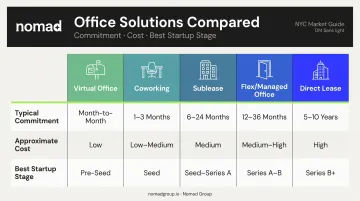
- NYC startups have five office solutions: direct leases, subleases, coworking, flex/managed offices, and virtual offices, each suited to a different growth stage.
- Coworking works for pre-seed to seed teams under 10; flex/managed offices are the natural next step after Series A.
- NoMad/Flatiron, SoHo, Union Square, and Williamsburg are the top startup neighborhoods, with meaningful rent gaps between them.
- The costliest early-stage mistakes: over-committing on space, ignoring buildout costs, and skipping flexibility clauses.
- A specialist tenant broker routinely wins better TI allowances, free-rent periods, and exit clauses than a founder negotiating alone.
The NYC Startup Office Market in 2025
According to Cushman & Wakefield's Q4 2025 Manhattan Market Report, Manhattan office vacancy sits at 21.1% — down 90 basis points in a single quarter and the lowest combined vacancy since Q1 2022. New leasing volume in 2025 reached nearly 31 million square feet, up 32.3% over 2024. The market is tightening after years of post-pandemic softness.
For startup founders, this means two things:
- More negotiating leverage than five years ago, but a shrinking window as demand recovers
- Shorter lease terms — landlords are now offering 2–3 year commitments that were nearly impossible to get pre-pandemic
- Pre-built suites and move-in-ready options — a direct response to founders who can't wait 6 months for a buildout
Flexible office supply now represents 4.2% of total NYC office inventory, per JLL's 2026 Flexible Office Report. That's still a minority share, but the category has expanded steadily as more founders move away from the traditional 10-year direct lease.
The five options below cover the full spectrum — from day-one flexibility to post-Series B dedicated headquarters. Where you land depends on your current headcount, runway, and growth trajectory, not your best-case projections.
The 5 Best Office Space Solutions for NYC Startups
Each of these five options serves a different stage, budget, and growth trajectory — knowing which fits your situation can save you months of wrong turns and wasted capital.
Traditional Direct Lease
A direct lease means signing with the building's landlord for raw or white-box space, building it out yourself, and committing to that space for the long term. You get maximum control — custom layout, full branding, no shared amenities — but you also absorb the full capital requirement.
The numbers that trip up founders: buildout costs, tenant improvement allowances, and security deposits. The national average TI allowance dropped to $87.51 per square foot in 2024, down from $97.55 the year prior, meaning landlords are offering less just as construction costs remain elevated. The gap between what landlords offer and what buildouts actually cost falls on the tenant.
| Factor | Details |
|---|---|
| Typical Lease Term | 5–10 years; some flexibility in outer boroughs |
| Midtown South Asking Rent (Class A) | ~$105.64/sf/year (Q4 2025) |
| Midtown South Overall Asking Rent | ~$83.58/sf/year (Q4 2025) |
| Best For | Series B and beyond; teams of 30+ with stable headcount |
Subleased Office Space
Subleasing means renting from an existing tenant who has surplus space. The space is almost always already built out and furnished, which eliminates construction timelines and front-loaded capital. Pricing runs significantly below direct-market rates.
That discount hasn't disappeared, even as the market tightens. Manhattan sublease inventory has fallen from 20.5 million square feet in 2024 to 13.5 million square feet by Q4 2025 — a six-consecutive-quarter decline — so selection is narrower, but the pricing advantage remains. CBRE data from March 2025 shows Midtown South sublease asking rents at $60.81/sf against direct rents of $84.42/sf — roughly 28% below direct market.
The real limitations: customization is minimal, your term is tied to the primary tenant's expiry, and you have no direct relationship with the building.
| Factor | Details |
|---|---|
| Typical Lease Term | 1–3 years (tied to remaining primary lease) |
| Midtown South Sublease Rent | ~$60.81/sf/year vs. ~$84.42/sf direct (28% discount) |
| Best For | Seed to Series A teams needing ready-to-use space without long-term risk |
Coworking Space
Coworking is the most accessible entry point — fully amenitized, month-to-month, no buildout required. Manhattan coworking memberships average $339/month, with day passes at $39 and meeting rooms around $67/hour, per CoworkingCafe's 2026 data. Brooklyn runs slightly lower, averaging around $320/month.
Manhattan coworking accounts for 2.28% of total office inventory, with locations averaging 41,440 square feet — enough to house dozens of competing companies under one roof.
For growing teams, the math shifts quickly: per-desk costs escalate as headcount grows, privacy is minimal, and branding is nonexistent. Coworking works as a launchpad, not a permanent base.
| Factor | Details |
|---|---|
| Typical Commitment | Month-to-month or annual |
| Manhattan Membership | ~$339/month per desk |
| Brooklyn Membership | ~$320/month per desk |
| Best For | Pre-seed to seed; teams under 10 evaluating longer-term options |
Flex / Managed Office Space
Flex offices occupy the space between coworking and a traditional lease. You get a private, dedicated suite that's move-in ready and fully managed — your own space, your own branding — without the capital burden of a buildout or the operational complexity of managing vendors and construction timelines.
Nomad Group's flex offering, Flex by Nomad, is built specifically for high-growth companies that want a real office without committing to a direct lease. Authentic Insurance, for example, moved from a costly coworking setup into a 5,500 sq ft full-floor space in Flatiron — delivered at 30% below comparable coworking costs, with room to scale built in.
The tradeoffs are real — terms are more structured than coworking (typically 1–3 years) and customization varies by operator — but the absence of buildout burden and faster move-in timeline make flex the default choice for many post-Seed companies.
| Factor | Details |
|---|---|
| Typical Commitment | 1–3 years; more stable than coworking, more flexible than direct |
| Best For | Series A to Series B startups wanting a turnkey private office with room to scale |
Virtual Office
A virtual office provides a professional NYC business address, mail handling, and on-demand meeting room access — without the cost of full-time physical space. NYC virtual office plans range from as low as $9.99/month for a basic address (iPostal1) to $79/month for full-service plans at premium Midtown addresses like 420 Lexington Avenue (Alliance Virtual Offices). Regus offers New York State options starting around $2/day.
The key limitation: no dedicated workspace for daily team use, and limited ability to build in-person culture. For investor-facing startups, the address matters — a premium Midtown or Flatiron address reads differently than a generic mailbox service.
| Factor | Details |
|---|---|
| Typical Commitment | Month-to-month |
| NYC Price Range | $9.99–$79+/month depending on service level |
| Best For | Remote-first or pre-revenue startups; international companies establishing a US presence |
Best NYC Neighborhoods for Startup Offices
Neighborhood selection affects talent recruitment, investor proximity, transit access, and company culture — not just the rent line on your P&L.
| Neighborhood | Overall Asking Rent | Class A Asking Rent | Best For |
|---|---|---|---|
| NoMad / Flatiron | ~$83.58/sf | ~$105.64/sf | Series A–C tech, fintech; highest startup density |
| SoHo | ~$74.87/sf | ~$59.24/sf | Creative-tech, media, design-forward brands |
| Union Square / Madison | ~$74.27/sf | ~$98.55/sf | TAMI companies; strong transit hub |
| Grand Central / Midtown | ~$66.96/sf | ~$70.66/sf | Enterprise-adjacent startups; East Side access |
| Williamsburg (Brooklyn) | Below Manhattan averages | — | Cost-conscious companies; creative-tech talent |
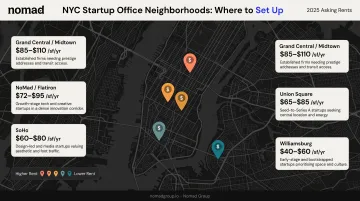
Rent data: Cushman & Wakefield Q4 2025 Manhattan Office Report
NoMad / Flatiron: NYC's Startup Corridor
Nomad Group calls this stretch "Unicorn Lane," and the leasing data backs it up. TAMI sector companies (Technology, Advertising, Media, Information) represented 33.9% of all new leasing activity in Midtown South in 2025 for deals of 10,000 sf or larger. The area has strong transit access (multiple subway lines converging at 23rd, 28th, and 33rd streets) and the highest concentration of Series A–C companies in the city. For funded startups, this is where your peers, investors, and recruits are already spending their days.
Williamsburg: Brooklyn's Best Startup Option
For companies where culture and creative talent matter more than investor proximity, Williamsburg offers a real alternative. Rents run meaningfully below Midtown South, and the ecosystem spans multiple blocks along Kent Avenue — Nomad Group placed Flora (FloraFauna AI) at 300 Kent Avenue in the Refinery at Domino, and within 30 days of move-in, the company came back to double their footprint. The neighborhood draws a different talent pool and delivers a different brand signal than Manhattan, which for some startups is exactly the point.
How to Choose the Right Office Space for Your NYC Startup
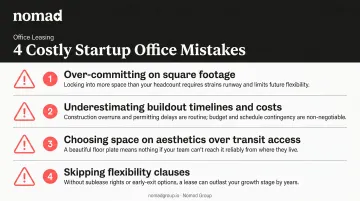
The Four Mistakes That Cost Founders the Most
Before getting into tactics, name the patterns that show up repeatedly:
- Over-committing on square footage for a headcount projection that never materialized
- Underestimating buildout timelines and costs — the gap between TI allowances and actual construction costs is frequently significant
- Choosing space on aesthetics while ignoring transit access and commute patterns for your actual team
- Skipping flexibility clauses because the term seemed short enough to feel safe
Total Occupancy Cost vs. Headline Rent
The sticker rent per square foot is the starting point, not the full story. Founders need to budget for:
- Buildout and construction costs (which TI allowances rarely cover in full)
- Furniture, fixtures, and equipment
- IT infrastructure and cabling
- Security deposits — often substantial for early-stage companies without established financials
Pre-built subleases and flex offices eliminate most of this exposure. When comparing options, model the total first-year cost including one-time setup expenses, not just the monthly rent figure.
Lease Flexibility Clauses That Matter
NYC commercial landlords have no legal obligation to mitigate damages when a tenant breaks a lease early — a rule that has been in place since 1995, according to Cadwalader. That makes protective clauses non-negotiable, not nice-to-have.
Push for these terms from the start:
- Good Guy Guarantee — limits personal liability if the company exits cleanly with proper notice
- Expansion / contraction rights — defined options to grow or shrink within the building
- Subletting rights — ability to sublease if circumstances change
- Early-termination options — tied to business milestones rather than arbitrary dates
Landlords in the current market are more receptive to these terms than they were pre-pandemic, though receptivity varies as Midtown and downtown vacancy rates continue to shift quarter to quarter.
Space Sizing: Plan for 18–24 Months
Right-sizing space is one of the harder judgment calls. The most common error is planning for current headcount rather than where the company will be in 18–24 months.
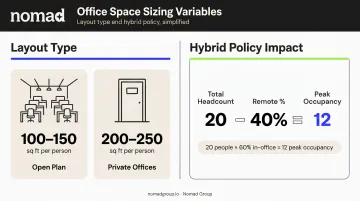
Two variables that shift the number significantly:
- Layout type — open-plan configurations typically require 100–150 sq ft per person; private offices push that to 200–250 sq ft
- Hybrid policy — if 40% of your team is remote on any given day, your true peak occupancy is lower than your total headcount suggests
Work With a Specialist Broker
The clause negotiations, cost modeling, and sizing decisions above are manageable in isolation — but they interact in ways that are easy to underestimate without daily market exposure. A tenant-side broker who works specifically with high-growth companies understands those interdependencies. They know which landlords are flexible on TI allowances, which buildings have expansion optionality, and how to structure a deal that protects the tenant against the scenarios a founder hopes will never happen.
Nomad Group has completed 300+ tenant buildouts and leased 2M+ square feet across Flatiron, NoMad, SoHo, and Williamsburg. Their team covers the full cycle — market analysis, property tours, lease negotiation, and move-in coordination — which matters most when you're negotiating against a landlord whose legal team does this every week.
Conclusion
The lease terms a founder signs today — length, flexibility, expansion rights — will either support or constrain growth for the next several years. That makes the office decision one of the most consequential calls an early-stage team will make.
Whether you need tenant representation to find the right space, a flexible private office through Flex by Nomad, or a full buildout delivered on a defined timeline, Nomad Group covers each part of that process. Reach out to get started and discuss your specific situation with the team.
Frequently Asked Questions
How much does office space cost for startups in NYC?
Direct leases in Midtown South run $83–$105/sf annually for Class A; subleases in the same area average around $61/sf — roughly 28% below direct rates. Coworking memberships run $320–$339/month per desk in Manhattan and Brooklyn. Budget beyond headline rent for buildout, furniture, IT, and security deposits.
What type of office space is best for early-stage startups in NYC?
Coworking is the most accessible option for pre-seed to seed-stage teams under 10 — low commitment, no buildout, immediate availability. At Series A, when privacy, branding, and culture matter, flex/managed offices are the natural next step — without the capital burden of a direct lease.
Which NYC neighborhoods are best for tech startups?
NoMad, Flatiron, and Union Square form the densest startup corridor in Manhattan, with strong transit access and a high concentration of TAMI-sector companies. Williamsburg is the top Brooklyn alternative for companies seeking lower rents, creative talent, and a different brand positioning than Midtown South.
What is a flex office and is it right for my startup?
A flex office is a fully managed, move-in-ready private suite with shorter terms than a direct lease. It's designed for Series A to Series B startups that want a branded, dedicated space without committing capital to construction or managing vendor relationships — a real office without the buildout burden.
How long are typical office leases for startups in New York City?
Direct leases typically run 5–10 years; subleases usually match the remaining primary term, often 1–3 years in the current market. Flex and coworking run month-to-month or annual — and a startup's stage and financial history are the primary factors landlords weigh when setting terms.
What hidden costs should startups watch out for when leasing NYC office space?
Watch for buildout and fit-out costs above the TI allowance, furniture and IT setup, and security deposits (which can be substantial for early-stage companies with limited operating history). Some lease structures also pass through property taxes — and the gap between TI allowances and actual construction costs catches first-time tenants off guard more than anything else.