NYC's commercial leasing market operates differently from every other city. Loss factors inflate your actual cost. Good guy clauses are non-negotiable. Security deposit expectations for early-stage companies can run to a year of rent. Generic leasing guides miss all of this.
This checklist walks through six phases every NYC founder should complete before signing: sizing and budgeting, neighborhood selection, lease structure, tour due diligence, negotiation, and buildout planning.
Key Takeaways
- Start your search 9–12 months before your target move-in date — the NYC market doesn't wait
- Budget for total cost of occupancy, not just face rent — operating expenses and buildout costs add 30–40% on top
- Negotiate startup-protective lease clauses — good guy guarantee, expansion rights, and clean assignment language are non-negotiable
- NYC's core startup corridors — Flatiron, NoMad, SoHo, Union Square, Williamsburg — each carry different rent economics and talent signals
- A tenant rep broker costs you nothing; landlords pay the commission
Before You Start: Define Your Space Needs and Budget
Determine How Much Space Your Startup Actually Needs
NYC tech and startup tenants in open-plan or hybrid configurations typically plan for 100–150 square feet per person — well below the traditional 250 sq ft benchmark still cited in older benchmarks. The North American average dropped from 176 sq ft per person in 2012 to approximately 138 sq ft by 2017, and dense tech offices continue to push that lower.
Your space target should account for:
- Current headcount at a realistic density (125–150 sq ft/person for open plan)
- Projected headcount at 12–18 months, not just today's team
- A growth buffer of 15–20% above your 18-month projection
Over-leasing carries as much risk as under-leasing for early-stage companies. Locking into 8,000 sq ft when you need 5,000 today ties up capital and creates subletting complexity if growth stalls.
One adjustment that catches founders off guard: always convert usable square footage to rentable square footage before comparing spaces. NYC buildings carry loss factors of 20–30% (more on this below), meaning a 5,000 sq ft usable target may require leasing 6,250+ rentable square feet.
Build Your True Budget Before Touring Anything
Base rent represents only 60–70% of your total occupancy cost over a lease term. The rest comes from:
| Cost Component | Typical Range |
|---|---|
| Operating expense pass-throughs (taxes, insurance, CAM) | $8–15/sq ft annually |
| Electricity | Metered separately or included in OpEx |
| Security deposit | 3–6 months (creditworthy); 6–12 months (startups) |
| Buildout beyond TI allowance | $100–250/sq ft for standard NYC buildouts |
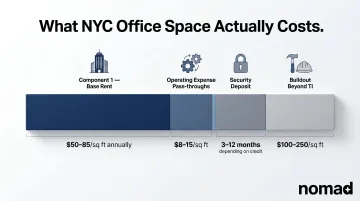
For startups without operating history, NYC landlords typically require elevated security deposits. Expect to provide:
- Two years of tax returns and current financial statements
- Personal guarantees from principals
- Investor commitment letters or proof of funding
- Proof of insurance
A Good Guy Clause (covered in the negotiation section) can help reduce deposit requirements by lowering the landlord's eviction risk exposure.
Decide: Direct Lease vs. Flexible Space
The decision comes down to where you are in your growth trajectory. Each path has a clear use case.
Coworking/flex space makes sense when:
- You're pre-Series A with high uncertainty about headcount
- You need less than 12–18 months of runway before your next inflection point
- You're not yet ready to commit capital to a buildout
Once your team stabilizes and growth becomes more predictable, the calculus shifts.
A direct lease typically wins when:
- Your team exceeds 15–20 people and growth is predictable
- You need brand control over your space design
- You're post-Series A with enough operating history to negotiate from a position of strength
Direct leases in NYC typically run 3–5 years for startup-sized tenants (under 10,000 sq ft), with AI and tech firms averaging just 3.5 years. Coworking costs $500–1,000 per desk per month — often more expensive per square foot than a direct lease, but without the buildout commitment.
Nomad Group's Flex by Nomad model sits between these two options: a fully managed, move-in-ready space built on in-house infrastructure, priced more competitively than standard coworking.
NYC Neighborhood Guide for Startups
Midtown South — covering Flatiron, NoMad, Chelsea, Union Square, and SoHo — is NYC's primary startup hub, capturing 69% of all AI office leasing citywide and representing the corridor historically known as Silicon Alley. Choosing a neighborhood affects recruiting, client perception, and long-term lease economics.
| Neighborhood | Avg Asking Rent | Transit | Culture Signal |
|---|---|---|---|
| Flatiron / NoMad | $70–85/sq ft | N/R/W/Q, F/M, 6 | Premium tech; scaling credibility |
| Union Square | $70–85/sq ft | 4/5/6, N/Q/R/W, L | Accessible, collaborative, high foot traffic |
| SoHo | $75–90/sq ft | C/E, N/R/W, 6, B/D/F/M | Creative, design-forward, client-facing |
| Chelsea | $70–80/sq ft | A/C/E, 1/2/3, L | Media and tech crossover |
| Williamsburg | ~$46/sq ft (Brooklyn avg) | L train, NYC Ferry | Creative energy, work-life integration |
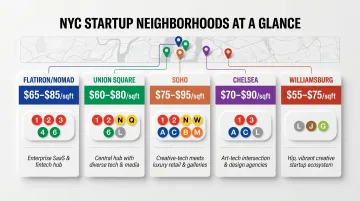
What each neighborhood signals beyond the commute:
- Flatiron/NoMad — known along the corridor as "Unicorn Lane" — concentrates venture-backed companies and landlords comfortable with startup tenants. Owner-operators like Kaufman Organizations and Justin Management regularly accommodate non-standard buildout requests
- Union Square combines premium transit connectivity with unparalleled natural light in many buildings, and sits at the intersection of engineering and finance talent pools
- Williamsburg draws AI and culture-forward startups to industrial-modern buildings like 300 Kent Avenue (The Refinery at Domino), at a significant cost discount to Manhattan
Off-market availability and landlord context in these corridors rarely surfaces on CoStar or LoopNet. Nomad Group has completed 300+ tenant buildouts across all five neighborhoods, which translates directly into relationships and deal intelligence that public listings can't replicate.
Understanding NYC Lease Types and Key Terms
Direct Lease vs. Sublet
A direct lease runs between your company and the building landlord. You have full negotiating leverage, clear rights to buildout, and no dependency on a third party's lease staying in good standing.
A sublet comes from a departing tenant who still holds the master lease. The upsides: shorter terms, furnished space, and often below-market rent. The risks are real, though — your rights depend entirely on the master lease terms, sublease consent is required, and if the master tenant defaults, you may face eviction regardless of your own payment history.
If you're signing a lease longer than 18 months and plan to build out the space, go direct — the added protection is worth it.
Gross vs. Modified Gross vs. Net Leases
Most NYC startup-sized office tenants sign modified gross leases. Here's how the structures compare:
- Modified gross (most common): You pay base rent plus electricity and your proportionate share of operating expense increases above a base year amount. Predictable, with some exposure to expense escalations
- Full gross: All expenses included in base rent. Simpler, but rare in NYC office
- Triple net (NNN): You pay taxes, insurance, and maintenance directly. Less common for small tenants in Manhattan, but it does appear — read carefully
NYC-Specific Cost Variables That Inflate the Real Number
Loss factor is the most misunderstood line item in NYC leasing. NYC landlords use REBNY measurement standards, which include a proportionate share of lobbies, hallways, and elevator banks in your rentable square footage. Class A buildings carry loss factors of 20–30%; Class B runs 18–25%. A 10,000 rentable sq ft lease with a 25% loss factor delivers only 7,500 usable square feet — meaning you're effectively paying 33% more per usable foot than the asking rent implies.
Annual escalation clauses typically run at approximately 3% per year in NYC, which adds up to roughly 16% more in base rent by year five. Some leases use CPI adjustments or Porter's Wage escalations (tied to NYC union labor costs) — model both before signing.
The Good Guy Clause: A NYC-Startup Essential
The Good Guy Guarantee (GGG) is a NYC-specific lease provision that limits a personal guarantor's liability. Instead of being on the hook for the entire remaining lease term if the company fails, the guarantor is released from future obligations if the tenant:
- Provides 3–6 months of advance written notice to vacate
- Remains current on all rent through the vacate date
- Returns the space in broom-clean condition with keys delivered
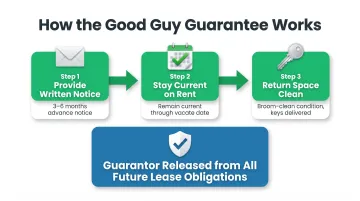
Without a GGG, a personal guarantee on a 5-year lease means you're on the hook for every remaining month of rent — even after the company shuts down. Negotiate this clause before signing, not after.
Startup Lease Negotiation Checklist
Tenant Improvement Allowance (TI)
TI is the per-square-foot contribution landlords make toward your buildout costs. Manhattan TI allowances substantially exceed national figures — Midtown and Midtown South averaged $148/sq ft in 2023, versus a national average that dropped to $87.51/sq ft in 2024.
Standard NYC buildout costs run $100–250/sq ft, with higher-end finishes reaching $300/sq ft. The gap between TI allowance and actual buildout cost comes out of your capital — plan accordingly.
To negotiate higher TI: offer a longer lease term, come in with stronger credit backing (investor letters, funded balance sheet), or work with a broker who has relationships with the building's ownership.
Permitted Use: Write It Broad Enough
The permitted use clause defines what activities are legally allowed in your space. A narrow clause — "general office use only" — can become a problem within 12 months if your company runs client demos, light product testing, R&D work, or hosts events.
Push for language that explicitly covers:
- General and administrative office use
- Research and development
- Client demonstrations and product showcases
- Light testing and prototyping
- Any other reasonably related activities
Narrow permitted use is easy to overlook during negotiation and hard to fix once you're in the space.
Expansion Rights and Right of First Offer
Growth-stage companies should negotiate expansion rights before signing — not after. Once you're operating in the building, your leverage disappears.
- Right of First Offer (ROFO): The landlord must offer available adjacent space to you before marketing it externally
- Right of First Refusal (ROFR): You can match any third-party offer on adjacent space before the landlord accepts it
Both provisions are valuable. ROFO gives you first look; ROFR gives you last right. In practice, ROFO is more landlord-friendly and therefore easier to negotiate.
Assignment, Subletting, and Change-of-Control
This section is mission-critical for VC-backed companies. Standard commercial lease forms often treat a significant equity ownership shift as a "deemed assignment," which can trigger a lease default during a financing round, merger, or acquisition.
Negotiate explicitly for permitted transfers that cover:
- Equity financing rounds at any stage
- Mergers and acquisitions (whether your company is the acquiror or target)
- Transfers to affiliates and subsidiaries
- Subleases to collaboration partners
Watch separately for recapture clauses: provisions that let the landlord terminate your lease and reclaim the space the moment you request a sublease. These can eliminate your ability to sublet even when the lease nominally permits it.
Free Rent and Concession Packages
Free rent is standard in NYC for direct leases. Manhattan Class A tenants have recently received an average of 17 months of free rent as part of lease packages, though this reflects larger deals.
For 3–5 year startup leases, expect 2–6 months depending on market conditions and your negotiating leverage.
Free rent is most commonly structured as upfront abatement at lease commencement , covering the buildout period before you're operational. Some landlords distribute free months across the term instead, which lowers the effective rent while preserving the building's face rent for valuation purposes.
Calculate your effective monthly rent by spreading concessions across the total lease term before comparing spaces.
Buildout, Timeline, and Finding the Right Real Estate Partner
NYC buildouts involve permitting requirements, union labor, and multi-party coordination that most founders significantly underestimate.
Realistic timeline from lease signing to occupancy:
| Phase | Duration |
|---|---|
| DOB permit approval | 2–8 weeks (standard); 3–6 months (complex/landmark) |
| Physical buildout | 3–6 months |
| Full project (design through completion) | 6–18 months |
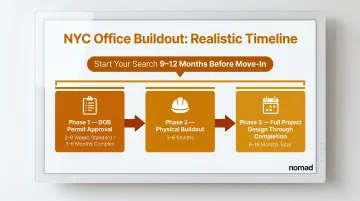
Union labor requirements in Manhattan buildings add 20–30% to construction costs compared to non-union projects. Buildings in landmark historic districts add Landmarks Preservation Commission review on top of DOB permitting.
The sequencing risk is real: if your buildout runs long and your old lease has already expired, you're paying double rent. Plan to start your search 9–12 months before your target move-in date. That's not a conservative buffer — it's what the math actually requires.
Nomad Group's in-house construction management team has completed over 300 tenant buildouts, with a standard 90-day turnaround. In one documented project, the team transformed a white-box space at 135 West 29th Street — full HVAC installation included — into a fully operational office in five weeks, working directly with building management throughout.
For founders who want to skip vendor coordination entirely, Flex by Nomad delivers a fully managed, move-in-ready solution.
On tenant representation: the right broker is also your first line of defense against a bad buildout deal. A dedicated tenant rep works exclusively for you — and in NYC, landlords cover 100% of brokerage commissions, so the representation costs you nothing.
What that gets you in practice:
- Access to off-market availability before spaces hit listings
- Current concession data so you know what the market is actually giving
- A broker who's seen the common mistakes firsthand — missing TI, accepting weak good-guy clauses, signing longer terms than your runway supports — and knows how to avoid them
Frequently Asked Questions
How much office space does a startup need per employee in NYC?
NYC tech and startup offices in open-plan or hybrid configurations typically run 100–150 sq ft per person — well below the traditional 250 sq ft benchmark. Plan for your current headcount plus 12–18 months of projected growth, then adjust upward by the building's loss factor to get your rentable square footage target.
What is a good guy clause in a NYC office lease?
A Good Guy Guarantee limits a personal guarantor's liability to the period the tenant actually occupies the space. Provide 3–6 months' written notice, stay current on rent, and return the space in good condition, and the guarantor is released from all future obligations — no personal liability for the remaining lease term.
How far in advance should a NYC startup begin searching for office space?
Most founders should start 9–12 months before their target move-in date. The search itself takes 2–4 months, lease negotiation and execution adds another 1–2 months, and buildout permitting plus construction runs 3–6 months from signing. Starting late limits your options and weakens your negotiating position.
What is a typical security deposit for a startup leasing in NYC?
Creditworthy tenants typically post 3–6 months of rent as a security deposit. Startups without established operating history should expect 6–12 months, along with personal guarantees from founders. Investor letters and proof of funding can help close the credibility gap with landlords.
What NYC neighborhoods are best for tech and AI startups?
Flatiron, NoMad, SoHo, and Union Square form the core Midtown South startup corridor, capturing 69% of all NYC AI leasing. Williamsburg is a growing option for culture-forward companies willing to trade Manhattan transit access for lower rents and a more creative environment.
Should a NYC startup sign a direct lease or use coworking space?
Coworking works best for pre-Series A companies with genuine uncertainty about headcount and direction. A direct lease typically makes more economic and operational sense once your team exceeds 15–20 people and your growth trajectory is predictable enough to commit to a 3–5 year term. The per-desk cost of coworking consistently exceeds direct lease economics at meaningful team sizes.