This guide is written for seed-stage through Series B companies preparing to lease their first or second dedicated space in NYC. It covers how much space you actually need, which neighborhoods make sense at different budgets, how to choose between coworking, sublease, and direct lease, and how to negotiate terms you can live with as your team scales.
Key Takeaways
- Start your direct lease search at least 6 months out — subleases close faster, but NYC sublease inventory has dropped nearly 50% since 2023
- Plan space using 125–150 sq ft per person based on projected headcount, not current headcount
- Manhattan's startup-preferred submarkets run $86–$102/sq ft annually; Brooklyn offers 35–40% savings
- Coworking works well up to ~10–15 people — beyond that, a direct lease or sublease is typically more cost-effective
- Your tenant rep broker is paid by the landlord — engaging one costs you nothing and gives you expert negotiating leverage
Before You Start: Space Needs, Budget, and Timeline
How Long Does This Actually Take?
Most founders underestimate the clock. According to SquareFoot, startups looking for spaces under 10,000 sq ft should begin their search at least 6 months before their target move-in. Larger requirements warrant 12 months or more.
Here's why the math adds up fast:
| Phase | Typical Timeline |
|---|---|
| Requirements + broker engagement | 2–4 weeks |
| Search and tours | ~1 month |
| Proposal negotiation | 1–3 months |
| Lease legal review | 1–4 weeks |
| Build-out (minor) | 2–3 months |
| Build-out (full) | 3–6 months |
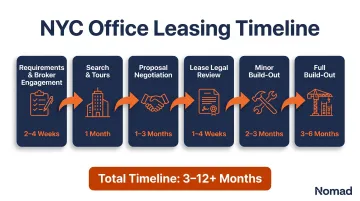
For a sublease with an existing build-out, you can compress some of these phases — but landlord consent can add another 1–3 months. Plan on 3–6 months minimum for a direct lease, from first tour to first day in the office.
How Much Space Do You Actually Need?
The standard planning benchmark for collaborative, open-plan offices is 100–150 sq ft per person, down sharply from the old 250 sq ft standard. JLL data puts the current corporate average at 165 rentable sq ft per person.
For most NYC startups operating on hybrid models, 125–150 sq ft per person is a practical planning figure.
Two rules that matter more than the benchmark:
- Plan for 18–24 months of projected headcount, not day-one occupancy. A team of 20 today could be 45 in two years.
- Over-leasing is expensive; under-leasing is worse. Having to renegotiate mid-term or sublease excess space both carry real costs — financial and operational.
Setting a Realistic Budget
Rent in NYC is quoted annually per square foot. A 2,000 sq ft space at $90/sq ft costs $180,000/year, or $15,000/month before anything else.
Beyond base rent, budget for:
- Operating expenses: $8–$15/sq ft annually, covering building services, taxes, and insurance
- Electricity: Often billed separately in NYC commercial leases
- Security deposit: Varies by landlord; early-stage companies without revenue history should expect requests for 3–6 months of rent, sometimes secured by a letter of credit
- Build-out costs: NYC office renovations typically run $80–$150/sq ft, per Cushman & Wakefield's TI data
Tenant Improvement (TI) allowances are the landlord's contribution toward your build-out, expressed in dollars per square foot. In NYC Class A spaces, TI regularly reaches $100–$150/sq ft. The catch: TI scales with lease length. A 7-year lease unlocks significantly more landlord capital than a 3-year term.
Always evaluate offers on net effective rent — factoring in free rent periods and TI — not gross asking rent. Two spaces at the same headline rate can have dramatically different true costs once concessions are modeled.
Lease Length Trade-offs
| Lease Term | TI Allowance | Flexibility | Best For |
|---|---|---|---|
| 2–3 years | Lower | High | Seed / pre-Series A |
| 4–5 years | Moderate | Moderate | Series A–B with clear headcount trajectory |
| 7–10 years | High ($100–$150/sq ft) | Low | Post-Series B, stable headcount |
A shorter lease preserves optionality but requires more of your own capital for build-out. A longer lease unlocks landlord-funded improvements and free rent periods — often 10–12 months on long-term commitments — but creates real exit risk if your company's growth trajectory changes.
Match lease length to your funded runway plus one renewal cycle, not your optimistic growth plan.
Best NYC Neighborhoods for Startups
NYC has distinct startup clusters where lease economics, transit access, and company culture converge. Nomad Group calls the corridor spanning NoMad, Flatiron, and SoHo "Unicorn Lane" — and the concentration of venture-backed companies in that stretch reflects a decade of network effects.
According to Newmark's Q4 2025 Manhattan Office Report, Midtown South hit an all-time high average asking rent, with overall availability falling to 15.0% — down from 19.5% just seven quarters earlier. The window for aggressive tenant concessions is narrowing.
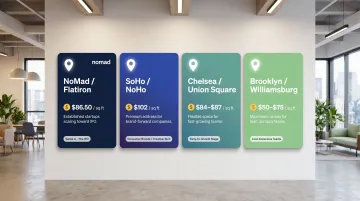
Here's how the major startup submarkets stack up:
| Submarket | Avg. Asking Rent (Q4 2025) | Best Fit |
|---|---|---|
| NoMad / Flatiron | ~$86.50/sq ft | Series A–pre-IPO; investor proximity |
| SoHo / NoHo | ~$102/sq ft | Consumer brands; creative-tech |
| Chelsea / Union Square | ~$84–$87/sq ft | Early-stage to growth-stage |
| Brooklyn (Williamsburg/DUMBO) | ~$50–$75/sq ft | Cost-conscious; culture-forward teams |
NoMad and Flatiron: ~$86.50/sq ft
The Flatiron/Union Square submarket averages $86.50/sq ft as of Q4 2025. This is the most established startup address in Manhattan. Investors are nearby, transit access spans multiple subway hubs, and the concentration of Series A through pre-IPO companies makes talent recruitment measurably easier.
Nomad Group's clients like Extend AI specifically targeted this corridor, ultimately landing at The Haymarket Building at 135 West 29th Street. The team went from white-box to fully built out — HVAC and all — in five weeks.
SoHo and Hudson Square: ~$99–$102/sq ft
SoHo commands a premium: $102.07/sq ft for NoHo/SoHo as of Q4 2025. The draw is real — loft-style spaces with high ceilings, concrete floors, and natural light that consumer brands and creative-tech companies find difficult to replicate in conventional office buildings.
The trade-off: limited availability of large floor plates (5,000+ sq ft), and rents that approach some Midtown trophy buildings. Best suited for teams that value design identity and don't need room to scale in place.
Union Square and Chelsea: ~$84–$87/sq ft
A value play within the Midtown South corridor. Chelsea averages $84.89/sq ft — slightly below Flatiron — with strong transit connectivity and a mix of building types that works for both early-stage and growth-stage companies. Authentic Insurance made exactly this trade-off, moving from a costly coworking setup into a full-floor office at 30 West 21st Street — on the Flatiron/Chelsea border — achieving costs 30% below comparable coworking rates.
Williamsburg and Brooklyn: ~$50–$75/sq ft
Brooklyn's overall average sits at $49.72/sq ft per Colliers Q1 2025 data — roughly 35–40% below Manhattan. Williamsburg and DUMBO trade at premiums ($73–$75/sq ft), but still represent meaningful savings for early-stage companies.
The case for Brooklyn isn't just financial. FloraFauna AI chose 300 Kent Avenue specifically because the team wanted space close to where they lived, in a Class-A building with room to expand. They doubled their footprint within a month of moving in. That proximity-to-talent advantage shows up in recruiting — it's harder to ignore when your office is in the same neighborhood your team already lives in.
Types of NYC Office Space: Coworking, Sublease, or Direct Lease?
The Three Options, Compared
| Option | Cost (approx.) | Flexibility | Capital Required | Best Stage |
|---|---|---|---|---|
| Coworking/flex | ~$425/person/month | Month-to-month | Minimal | Pre-seed to ~15 people |
| Sublease | ~27% below direct | Remaining term | Moderate | Seed–Series A |
| Direct lease | $86–$102/sq ft (Manhattan) | 3–10 years | Significant | Series A–B+ |
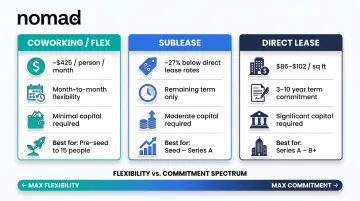
Coworking offers zero upfront capital and maximum flexibility, but the per-seat economics deteriorate fast. At $425/person/month for a dedicated desk, a team of 15 is paying $76,500/year — before private office premiums.
Sublease is the middle path. Manhattan direct asking rents average **$80.64/sq ft vs. $58.54/sq ft for sublease space** — a 27% discount. The trade-off: the space comes as-is with the previous tenant's build-out, and you're working within whatever term remains on the prime lease. The sublease window is also narrowing — availability has dropped 49.2% from its Q1 2023 peak.
Direct lease gives you the most negotiating leverage: custom build-out, TI allowance, free rent periods, and the ability to put your own imprint on the space. The cost is commitment — typically 3–7 years — and more legal complexity up front.
The Coworking Threshold
Each option has a natural ceiling. For most NYC startups, somewhere around 10–15 people is where the per-seat math tilts toward a direct lease or sublease. At that scale, the monthly coworking bill often exceeds what a proportionally equivalent direct lease would cost on an annualized basis — with no dedicated address or purpose-built space to show for it.
Flex by Nomad: A Hybrid Path
For teams that want professionally managed, built-out, private space without the full capital burden of a traditional direct lease, Nomad Group's Flex by Nomad service offers an alternative. Built on the firm's in-house infrastructure and direct neighborhood relationships across NYC's key submarkets, it gives startups dedicated, professionally managed space — without the capital commitment or operational overhead of a conventional long-term lease.
How the NYC Office Leasing Process Works
Step 1: Hire a Tenant Rep Broker
Unlike residential real estate, tenant representation in commercial leasing is paid by the landlord — not by you. The standard commission is approximately 4% of aggregate base rent. This means a startup can access expert representation at no direct cost.
What a good tenant rep does that you can't replicate alone:
- Translates your requirements into a formal RFP issued to multiple landlords simultaneously
- Surfaces off-market options and established landlord relationships
- Represents your interests exclusively (the landlord has their own broker doing the same)
- Benchmarks proposed terms against current market data
Nomad Group focuses specifically on high-growth startups across NYC's key neighborhoods, having completed 2M+ sq ft of leases for companies at every stage — seed through enterprise.
Step 2: Tour Spaces and Issue an RFP
During tours, look past finishes and furniture. The things that matter most:
- Ceiling height and natural light (hard to fix post-build-out)
- HVAC control (many NYC buildings have limited after-hours capabilities)
- Internet infrastructure — fiber availability and redundancy
- Build-out condition (white-box vs. already built)
- Landlord reputation — ask your broker directly
Issuing an RFP to multiple landlords simultaneously creates competition — and competing offers give your broker real ammunition to push rents down or negotiate better TI allowances before you're ever committed to a space.
Step 3: Negotiate the Letter of Intent (LOI)
The LOI is the most consequential document in the process, and most first-time tenants underestimate it. It locks in the headline economics — base rent, free rent, TI allowance, lease term, renewal options, and subletting rights — before attorneys draft the full lease.
What gets agreed in the LOI is very difficult to reopen later. Startups that rush this step routinely leave six-figure concessions on the table.
Step 4: Legal Review and Execution
Once the LOI is signed, attorneys draft the full lease — and what you agreed economically is now being encoded in landlord-favorable language. A real estate attorney (separate from your broker) should review the document before you sign.
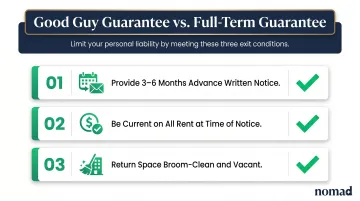
One issue to address directly: personal guarantees. Many NYC landlords require founders to personally guarantee startup leases. The standard NYC structure is a Good Guy Guarantee (GGG) — a guarantee that applies only while the tenant occupies the space, not for the full remaining lease term.
To exit the guarantee cleanly, you'll need to satisfy three conditions:
- Provide 3–6 months advance written notice
- Be current on all rent at the time of notice
- Return the space broom-clean
Push for a GGG rather than a full-term guarantee — the difference in personal exposure is significant.
Step 5: Build-Out and Move-In
A typical NYC commercial build-out runs 3–6 months depending on scope and permitting. Free rent periods are often structured to run concurrently with build-out — meaning you're not paying rent while construction happens, but that free rent clock starts ticking the moment you execute the lease.
For startups that can't absorb a 3–6 month delay, Nomad Group's 90-day build-out turnaround changes the math. One client, Extend AI, went from a white-box at 135 West 29th Street to fully built out in five weeks.
Key Lease Terms Every Startup Founder Should Know
| Term | What It Means |
|---|---|
| Base Rent | The headline rent, quoted annually per sq ft in NYC |
| Gross Rent | All-in cost including operating expenses (vs. net, where OpEx is separate) |
| Escalation Clause | Annual rent increases, typically 2–3% or tied to CPI |
| Free Rent (Abatement) | Months at the start of the term when no rent is owed — often 2–12 months |
| TI Allowance | Landlord contribution toward your build-out, in $/sq ft |
| Personal Guarantee | Founder liability for lease obligations; negotiate for a Good Guy Guarantee |
| Subletting Rights | Your ability to sublease excess space if your team shrinks or relocates |
Net effective rent is the real comparison metric — not the headline number. To calculate it, subtract three things from the gross rent:
- The TI allowance, amortized over the lease term
- The value of any free rent period
- Any other landlord concessions
That gives you an apples-to-apples number across competing offers. Never compare leases on headline rent alone.
Common Mistakes Startups Make When Leasing in NYC
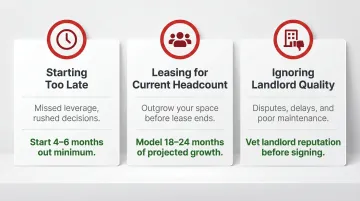
Three mistakes come up repeatedly with first-time NYC tenants — and each one is avoidable with the right preparation.
1. Starting too late. Founders who begin their search 6–8 weeks before they need space are negotiating from urgency — and landlords notice immediately. Leverage disappears when the clock is running. Start your search at least 4–6 months out.
2. Leasing for current headcount. Office rent typically runs 10–15% of operating costs, making it the second-largest expense after payroll. Size it wrong and you're either cramped and facing an expensive renegotiation, or carrying dead space you'll need to sublease at a discount. Model for 18–24 months of projected growth from day one.
3. Ignoring landlord quality. Building ownership, financial stability, and responsiveness to tenant requests vary significantly across the NYC market. Before signing, ask your broker for a candid read on the landlord — a favorable rent number doesn't mean much if TI work stalls or maintenance requests go unanswered.
Frequently Asked Questions
How much does office space cost per square foot in NYC for startups?
Startup-relevant Manhattan submarkets range from $86.50/sq ft (Flatiron/Union Square) to $102/sq ft (SoHo/NoHo) as of Q4 2025. Brooklyn averages roughly $50/sq ft borough-wide, though Williamsburg and DUMBO trade closer to $73–$75/sq ft. Costs vary further based on floor, building class, and lease structure.
What's the difference between a sublease and a direct lease in NYC?
A sublease means renting from an existing tenant — usually at below-market rates (currently about 27% below direct asking rents), shorter remaining terms, and with the space delivered as-is. A direct lease is negotiated with the building's landlord and typically includes TI allowance, customization options, and longer terms.
How long does it take to lease and move into office space in NYC?
For a direct lease with build-out, budget 3–6 months from search to occupancy. Furnished subleases and pre-built flex spaces can move faster — sometimes 4–8 weeks — but availability in those categories fluctuates with market conditions.
What is a tenant improvement allowance and how much can a startup negotiate?
TI is landlord-funded money toward your build-out, expressed in dollars per sq ft. NYC Class A spaces typically offer $100–$150/sq ft. The amount is negotiable and scales with lease length — a 7-year commitment unlocks far more than a 3-year term.
Do startup founders have to personally guarantee a commercial lease in NYC?
Many NYC landlords require a personal guarantee from founders, especially for early-stage companies without significant revenue history. The standard structure is a Good Guy Guarantee, which limits liability to the occupancy period — not the full lease term — and can sometimes be paired with a letter of credit to reduce the upfront cash deposit.
What NYC neighborhoods are best for early-stage tech startups?
The NoMad/Flatiron/Union Square corridor is the most established startup cluster, with strong transit access, VC proximity, and a deep talent pool. Williamsburg suits teams seeking lower rents and a distinct culture — particularly consumer brands and creative-tech companies. SoHo/NoHo is a strong third option for design-forward or media-adjacent startups, though at a premium. The right choice depends on your sector, team size, and how central NYC office culture is to your recruiting pitch.