Office relocation is one of the most consequential operational decisions a scaling startup will make. In NYC, where leases are long, buildout timelines stretch months, and your neighborhood choice signals something real to recruits and investors, getting this wrong costs more than money. It costs momentum.
This guide walks through the complete relocation playbook: when to move, where to go, how to structure the lease, and how to execute the transition without losing team morale or burning unnecessary runway.
Key Takeaways
- Start your space search 9–12 months before your target move date — NYC leases average 6+ months from tour to execution
- Neighborhood choice directly affects talent recruitment and company identity — treat it as a strategic decision
- Plan space for 18–24 months of projected headcount growth, not just your current team size
- Build-out costs in Manhattan run $140–190/SF for a standard startup office — budget accordingly
- Lock in expansion options, sublease rights, and capped rent escalations during lease negotiation — not after
When Is the Right Time to Relocate Your NYC Office?
Most startups move too late. They wait until the conference rooms are permanently occupied, hiring slows because there's nowhere to put new people, and the lease expiration is six months out. At that point, the negotiating leverage is gone.
Triggers That Signal It's Time
Three situations typically force the conversation:
- Consistent over-capacity — team members working from home or cafes not by choice, but because there's no desk space
- A new funding round — fresh capital that unlocks a hiring plan requiring 40–60% more headcount within 12 months
- Lease expiration within 12–18 months — the window where proactive tenants still have options
The problem with reactive planning is structural. According to AQUILA Commercial, proactive tenants can "create a competitive environment by leveraging landlords against one another" to secure better lease terms. Reactive tenants face limited inventory, higher rates due to urgency, and the risk of expensive holdover penalties.
The Right Planning Horizon
The lead time you need depends on how much space you're targeting:
| Space Required | Recommended Lead Time |
|---|---|
| Under 5,000 SF | 6–9 months |
| 5,000–10,000 SF | 9–12 months |
| 10,000–25,000 SF | 12–18 months |
| Over 25,000 SF | 18–24 months |
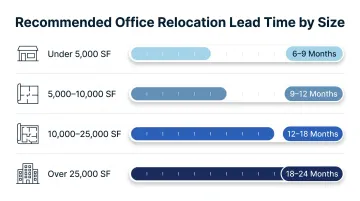
Most Series A–C startups fall in the 5,000–25,000 SF range, meaning 9–18 months of lead time is the minimum you should plan for.
Plan for where your headcount will be in 18–24 months, not today. Signing a lease sized for your current team and running out of room two years in means repeating this entire process — on an even tighter timeline.
Choosing the Right NYC Neighborhood for Your Startup
Neighborhood selection isn't just about finding available square footage. It shapes your ability to recruit talent, signal brand positioning, and access the startup ecosystem. A fintech company in Williamsburg and a fintech company in Flatiron communicate different things to candidates and investors. Both choices are valid. Both should be intentional.
Where NYC Startups Actually Cluster
The Flatiron District is the historic center of Silicon Alley, NYC's concentration of high-growth tech companies anchored around southern Manhattan. Nomad Group refers to this corridor (spanning NoMad, Flatiron, and Union Square) as "Unicorn Lane," reflecting the concentration of venture-backed companies that have scaled here.
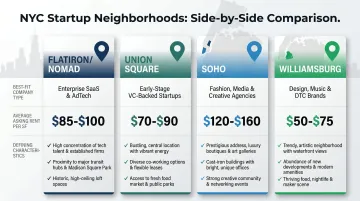
Here's how the primary startup neighborhoods break down:
| Neighborhood | Best For | Avg. Asking Rent |
|---|---|---|
| Flatiron/NoMad | Series A–C tech, fintech, AI | ~$78–79/SF |
| Union Square | Companies wanting transit hub access | ~$78–80/SF |
| SoHo | Creative-leaning tech, media, design | ~$75–80/SF |
| Williamsburg | Culture-first, non-corporate identity | Lower than Manhattan |
Transit matters for retention. The 14th Street–Union Square station connects the 4/5/6, N/Q/R/W, L, and F/M lines — one of the system's busiest hubs. NYC Department of City Planning data shows one-third of NYC workers commute from another borough, making subway access a direct factor in how your team gets to the office.
Nomad Group's placements illustrate the pattern: Authentic Insurance (25–40 person team) chose Flatiron for talent density and investor proximity; Flora (FloraFauna AI), a 30–50 person generative AI company, chose Williamsburg's Refinery at Domino to match their creative identity. They doubled their footprint within 30 days of moving in.
Calculating Your Space Requirements
Once the neighborhood is set, the next question is how much space you actually need. JLL's 2025 Occupancy Planning Benchmark Report puts the current average at 165 rentable square feet per person, down from 171 the prior year. For practical planning:
- Open-plan / high-density: 100–150 SF per person
- Hybrid with collaboration zones: 150–200 SF per person
- Traditional with private offices: 250+ SF per person
Add 20–30% buffer for planned headcount growth during your lease term. A 25-person team planning to reach 35 should size for at least 35 people from day one — ideally 40.
Flex vs. Direct Lease
The decision comes down to company stage and headcount certainty:
- Flex/coworking ($400–$1,200/month per desk) works for teams under roughly 10 people, or for companies with less than 12 months of runway and uncertain growth trajectories
- Direct lease (Class B: $33–$80/SF/year) becomes the better economic choice at 15–20+ people. A 20-person team paying $600/desk/month in flex spends $144,000/year; a 3,000 SF Class B lease at $65/SF runs $195,000 but delivers significantly more space per person, full customization, and no per-desk premium
Post-Series A or B, with 18+ months of runway and a defined hiring plan, the economics consistently favor a direct lease.
Building a Realistic Relocation Timeline and Budget
The Timeline Working Backwards
Here's how to think about the phases from search to occupancy:
- Space search and shortlisting (9–12 months out) — strategy, neighborhood selection, touring
- LOI negotiation (6–9 months out) — typically 1–3 weeks
- Lease drafting and legal review (5–8 months out) — 3–8 weeks depending on deal complexity
- Build-out design and permits (4–6 months out) — DOB permitting alone can take 4–12 weeks; using Professional Certification (Pro-Cert) can compress this to 1–2 weeks
- Construction (8–14 weeks) — Nomad Group's in-house construction team has completed 300+ buildouts with a 90-day turnaround for qualified spaces
- IT setup and move logistics (2–4 weeks before occupancy)
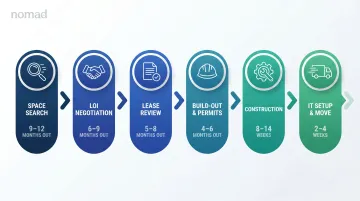
Each phase above depends on the one before it. If your target move-in is 5 months out and you haven't signed a lease, you're already behind — and rushing any phase in NYC means paying for it, one way or another.
The Full Cost Picture
Rent is the visible line item. These are the others that catch startups off guard:
- Build-out costs: $95–140/SF (basic), $140–190/SF (standard professional), $190–260+/SF (high-finish or tech-heavy), per Ariel Construction's Manhattan guide
- Security deposit: Startups without established credit are frequently asked for 6–12 months of rent upfront. Negotiate burn-down clauses and Letters of Credit to preserve cash
- Tenant improvement allowance (TIA): NYC TIAs typically range $50–150/SF. Longer lease terms and Class A buildings yield higher TIA — but TIA rarely covers the full build-out cost
- Broker fees: In NYC, tenant representation brokers are paid by the landlord, not the tenant — working with a tenant rep costs you nothing
- Moving costs, IT infrastructure, furniture: These aren't small — a 5,000 SF office move with infrastructure setup can run $150,000–$300,000 before you factor in build-out
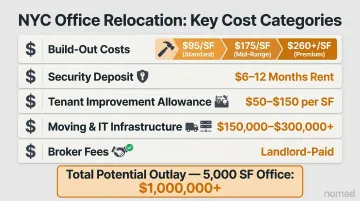
A 5,000 SF office at standard build-out can easily exceed $1 million in total capital outlay before the first employee sits down. Model this against your runway, not just your monthly burn.
The Contingency Rule
Budget a 10–15% contingency on top of your total project cost. For renovation and retrofit work — which describes virtually every NYC office build-out — construction project managers typically recommend 10–20%.
Legacy buildings in particular introduce surprises: permit delays, mid-project scope changes, and hidden conditions like asbestos, dated HVAC, or structural limitations. Treat contingency as required, not optional.
With your contingency modeled and total costs in view, timing matters too. The best moment to execute a relocation is 3–6 months after a funding close — capital is confirmed, the team has context, and you're not mid-fundraise when a landlord needs a signed lease.
Negotiating a Startup-Friendly Office Lease in NYC
What "Startup-Friendly" Actually Means in a Lease
Standard NYC commercial leases run 5–10 years, with five years being the most common term. For a startup, signing a 7-year lease based on today's team size is a real risk — you may outgrow it in year three or need to sublease half the space if the market shifts.
Target these provisions in every negotiation:
- Shorter initial term: 3–5 years rather than 7–10
- Expansion options: Right of first offer or first refusal on adjacent space as you grow
- Early termination clause: Defined notice requirements and termination fees — this limits liability if circumstances change
- Sublease rights: The ability to sublease a portion of space without full landlord consent, or with a streamlined approval process
Many NYC landlords resist sublease clauses — they want control over who occupies their building. The standard workaround is negotiating clear approval standards (reasonable consent, defined timeline for response) rather than full sublease freedom. Landlords will often accept this framing when it's positioned as protecting the building's tenant quality rather than undermining their control.
Rent Escalation and Key Clauses
Per Metro-Manhattan's analysis, the most common escalation structure in NYC is a fixed annual increase of approximately 3%. Lock this in rather than accepting CPI-linked escalations — if inflation runs hot, CPI indexing can deliver 5–7% annual increases.
Other clauses startups routinely overlook:
- Operating expense pass-through caps: Class A buildings often pass operating cost increases to tenants; cap your exposure
- TIA clawback provisions: Understand what happens to tenant improvement allowances if you break the lease early
- Personal guarantee limits: Negotiate caps on duration or total liability, or push for a Good Guy Guarantee that limits personal liability to rent paid through the date of surrender

Review all of this with a tenant-side attorney before signing. The lease is where startups make expensive mistakes that take years to surface.
Why Tenant Rep Brokers Matter
That clause complexity is exactly why having the right representation matters before you reach the negotiating table.
A tenant representation broker costs you nothing (they're paid by the landlord) and they bring market comparables, recent deal data, and relationships that create real negotiating leverage.
Nomad Group has completed this work across more than 2 million square feet of NYC office space, with active landlord relationships in Flatiron, NoMad, Union Square, SoHo, and Williamsburg. Because they work exclusively on the tenant side — without shareholder pressure or volume quotas — their incentives stay aligned with yours through every round of negotiation.
Planning Your Build-Out and Move Logistics
Pre-Built vs. Raw Space
Two paths exist for every build-out:
Pre-built/plug-and-play: Faster occupancy (weeks, not months), lower upfront cost, less customization. Right for teams with urgent timelines or simpler space requirements.
Raw or second-generation space: Full design control, longer timeline (4–6 months minimum), higher cost. Right for companies where space design is a culture and recruiting tool.
To see what this looks like in practice: Nomad Group's in-house construction team took Extend AI's space at 135 West 29th Street from white-box to fully built — HVAC included — in five weeks. That was an accelerated case; Nomad's standard turnaround is 90 days for qualified spaces, with a single team handling architecture, contracting, and project management in-house.
NYC Move-Day Logistics
Manhattan move logistics have tripped up plenty of well-prepared teams. Watch for these:
- Freight elevator reservations: Most Manhattan buildings limit move-in windows — confirm availability before scheduling movers
- Certificate of Insurance (COI): Approximately 90% of NYC buildings require a COI before movers can access the building. Standard minimums are $1M general liability, $2M aggregate — request it 5–10 business days out, or risk same-day cancellation
- DOT compliance: Movers must follow strict loading zone rules; confirm your moving company understands Midtown and Lower Manhattan restrictions
- Appoint an internal move coordinator: One person, single point of contact, accountable for everything
Before or immediately after move-in, complete your address change checklist: Google Business Profile, banks, vendor contracts, marketing collateral, email signatures, USPS and state filings.
Keeping Your Team Through the Transition
Employees interpret an office move through the lens of what leadership communicates. Without context, an unannounced relocation signals instability. With the right framing, it signals growth.
Announce 6–8 weeks in advance. Share the rationale: growth, better space, improved neighborhood access. Involve key team members in decisions about desk layout and amenity priorities — giving people input early converts skeptics into advocates.
Make the first day count. Host a team event at the new space. Design the environment to reflect company values — collaborative zones, natural light, branded touches that feel intentional rather than generic.
Logistics matter just as much. When Optimove faced a three-month gap between their coworking expiration and new office availability, Nomad Group arranged temporary swing space at 11 East 44th Street so the team never broke their in-office rhythm — keeping culture intact during what could have been a disruptive stretch.
Collect ongoing feedback in the first 30 days post-move. Small friction points become outsized grievances when ignored:
- Coffee machine and kitchen placement
- Phone booth and focus room availability
- Noise levels and acoustic zoning
Address these quickly. Fast fixes after a move signal that leadership is paying attention.
Frequently Asked Questions
How much does it cost to relocate an office in NYC?
Costs vary widely based on company size, neighborhood, and build-out scope. A 5,000 SF standard office can easily exceed $1 million in total outlay when you factor in build-out ($140–190/SF), security deposit (often 6–12 months of rent for startups), IT setup, and moving costs. Budget a 10–15% contingency on top of all estimated costs.
How do you prepare for an office move?
Start 9–12 months out and appoint an internal move coordinator on day one. Align on space requirements and 18–24 month headcount projections early, negotiate the lease before locking in a build-out timeline, and communicate transparently with your team throughout.
When should a startup consider relocating its NYC office?
The main triggers are consistent overcapacity, a new funding round enabling headcount growth, and lease expiration within 12–18 months. Proactive timing — starting the search 9–12 months out — preserves negotiating leverage and gives you access to a broader inventory of available spaces.
What NYC neighborhoods are best for tech startups?
Flatiron, NoMad, Union Square, and SoHo are the primary startup corridors — strong transit access, talent density, and proximity to the investor community. Williamsburg suits companies that want a creative, non-corporate identity. Choose based on your recruiting profile and culture priorities.
Should startups sign a short-term or long-term office lease in NYC?
Aim for 3–5 year terms with built-in expansion options and sublease rights. Shorter terms offer flexibility but carry a rent premium and less TIA; longer terms unlock more landlord concessions but commit you to space your headcount may outgrow — or no longer need.