
NYC's commercial real estate market makes all of this harder. Pricing is opaque, neighborhoods shift block by block, and the gap between what landlords advertise and what tenants actually pay is significant. Manhattan availability has fallen for eight consecutive quarters, dropping from 19.5% to 14.6% — meaning your options are narrowing while landlord leverage grows.
This guide covers what actually matters for startup founders navigating this search: the key decision factors, a neighborhood breakdown, space sizing math, lease structure basics, and how to avoid the mistakes that cost companies months of runway.
Key Takeaways
- Base rent is just the starting point — utilities, build-out costs, furnishings, and operating expense escalations make total occupancy cost significantly higher in NYC
- Size for your team 18 months out: 125–175 sq ft per person for traditional setups, less for hybrid-first teams
- NoMad/Flatiron, SoHo, Union Square, and Williamsburg each pull different talent pools, cultures, and investor signals — neighborhood is a strategic choice
- Lease flexibility beats a marginal rent discount at the pre-Series B stage, almost every time
- A broker who specializes in the NYC startup market can cut months off your search and negotiate concessions you wouldn't know to ask for
Key Factors When Searching for Your NYC Startup Office
NYC's commercial real estate market doesn't operate like other cities. What works for a law firm in Midtown won't work for a 20-person Series A startup in SoHo. These factors are weighted specifically for high-growth companies.
Budget and Total Cost of Occupancy
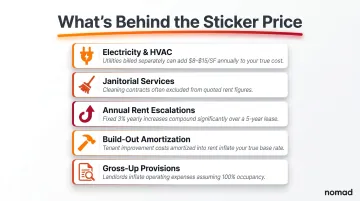
The sticker price per square foot is rarely the full story. A space listed at $80/SF can cost significantly more once you account for:
- Electricity and HVAC (after-hours usage is often billed separately)
- Janitorial services (sometimes excluded from gross leases)
- Annual rent escalations of 2–3% per year, compounding over a multi-year term
- Build-out amortization if the landlord isn't covering TI costs upfront
- Gross-up provisions, which allow landlords to bill operating expenses as if the building were fully occupied — even when it isn't
Set a monthly budget ceiling as a percentage of burn or revenue before you start touring. Use that ceiling to filter neighborhoods and building classes early, not after you've fallen in love with a space you can't afford.
The good news: Manhattan tenants are currently receiving concessions averaging 24% of total rent value, including free rent and TI allowances. Effective rent is materially lower than asking rent — but only if you negotiate.
Location and Proximity to Talent
For NYC startups, office location is a recruiting tool. The neighborhoods where your target hires actually live — and the subway lines they use — directly affect offer acceptance rates and retention.
Locating in a startup-dense corridor — Flatiron, NoMad, SoHo — also puts you within walking distance of investors, accelerators, and peer companies. That concentration has real consequences: chance conversations, referrals, and co-investment opportunities that don't happen over Zoom.
Lease Flexibility and Term Length
Once you've narrowed your location, the lease structure matters just as much as the address. Early-stage startups should prioritize shorter initial terms (2–3 years) or built-in expansion options — headcount projections before Series B are inherently uncertain, and a hiring surge can outpace your space within 18 months.
NYC landlords will often negotiate on:
- Free-rent periods (commonly 1–6 months on multi-year deals)
- Tenant improvement allowances that offset build-out costs
- Shorter initial terms paired with renewal options
These concessions often deliver more value than shaving a few dollars off monthly rent. A Good Guy Guaranty — a NYC-specific provision that releases personal guarantors once the tenant vacates and surrenders the space — is also worth pursuing in any direct lease negotiation.
Space Size and Growth Planning
Size for where you'll be in 18 months, not where you are today. Relocating in NYC is expensive and disruptive — carrying a few extra desks almost always beats a mid-lease move.
The layout should reflect how the team actually works:
- Open collaboration zones for cross-functional work
- Private focus areas for deep work and sensitive calls
- Enough meeting rooms that back-to-back calls don't bottleneck the floor
Best NYC Neighborhoods for High-Growth Startups
New York has dozens of distinct micro-markets. Choosing the wrong one costs real money — and shapes your culture in ways that are hard to reverse.
NoMad and Flatiron — The Startup Corridor
This corridor — sometimes called "Unicorn Lane" — is the densest concentration of high-growth startups in the city. Companies across tech, fintech, media, and AI cluster here for a reason:
- Class A and B buildings with strong infrastructure
- Direct access to major transit lines
- An ecosystem density that accelerates recruiting and deal flow
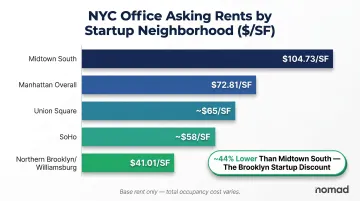
Midtown South leasing demand hit 4.29M SF in Q3 2025 — 47.8% higher year-over-year — the strongest quarter since Q4 2019. Class A asking rents in this submarket reached $104.73/SF, the highest in Manhattan. For companies at Series A and beyond where talent density and investor proximity drive real value, that premium is often justified.
Nomad Group's portfolio is anchored along this corridor, with placements including Extend AI at 135 West 29th Street in NoMad and Authentic Insurance at 30 West 21st Street in Flatiron — both companies that used their office as a deliberate culture and recruiting signal.
SoHo
SoHo suits consumer brands, creative agencies, and companies where office aesthetics matter. Cast-iron loft buildings offer high ceilings and distinctive character that resonate with design-forward cultures. Transit access is strong, though tourist foot traffic is a factor.
SoHo tends to skew toward established companies rather than seed-stage startups. If your brand identity and client-facing impressions are central to the business, it's worth the premium.
Union Square
A strong mid-market option. Multiple subway lines converge here, the surrounding neighborhood has a dense lunch and after-work scene, and pricing sits between the Flatiron and SoHo corridors. For teams that want proximity to the startup ecosystem without paying peak NoMad rates, Union Square often delivers the best value per dollar.
Williamsburg
The go-to for companies prioritizing Brooklyn-based talent, creative industries, and a non-corporate culture. Post-pandemic, office quality in Williamsburg has improved significantly — and Brooklyn residency among NYC tech workers has grown.
Northern Brooklyn asking rents average $41.01/SF versus Manhattan's $72.81/SF overall — roughly a 44% discount. For a 20-person startup needing 4,000 SF, that difference approaches $130,000 per year in base rent. Nomad Group placed FloraFauna AI at 300 Kent Avenue in Williamsburg, where the team doubled its footprint within 30 days of moving in.
Grand Central / Midtown South
Ideal for fintech, professional services, and enterprise-facing startups that need proximity to financial institutions, out-of-town clients arriving by train, or Class A infrastructure. Supply here is large, which can mean more negotiating leverage — but pricing at the Class A level is the highest in the city.
How to Calculate How Much Office Space You Need
This is both a math problem and a strategy question. Getting it wrong in either direction is costly.
Start With the Per-Person Baseline
| Work Model | Target Sq Ft Per Person |
|---|---|
| Traditional assigned desks | 125–175 sq ft |
| Hybrid-first, activity-based | 75–100 sq ft |
| Shared desks / hot desking | 50–75 sq ft |
The key variable: how many people are physically in the office on your peak day — typically Tuesday through Thursday — not your total headcount. Global office utilization has climbed to 54% in 2025, meaning even hybrid companies are feeling density pressure faster than expected.
Account for Shared and Collaborative Spaces
Meeting rooms, phone booths, kitchen areas, and reception zones are consistently underestimated. A practical framework:
Core workstations + meeting room allocation + amenity buffer = total target sq ft
Shared and collaborative spaces typically add 20–30% on top of your per-desk baseline. A 20-person team targeting 150 sq ft per desk (3,000 sq ft) should plan for a 3,600–3,900 sq ft total target.
Plan for 18-Month Headcount Growth
Model headcount at least 18 months forward and size the space to fit that projected team — not the team at signing. In NYC, a mid-lease relocation typically runs $15,000–$50,000+ in moving costs, broker fees, and lost productivity — far more than the rent on a few empty desks for six months.
If you're planning to grow from 20 to 35 people over the next 18 months, size for 35. Practical steps to protect your flexibility:
- Size the space for your projected headcount at month 18, not day one
- Negotiate expansion rights on adjacent floors or suites during lease execution
- Request right-of-first-refusal on neighboring spaces before they hit the open market
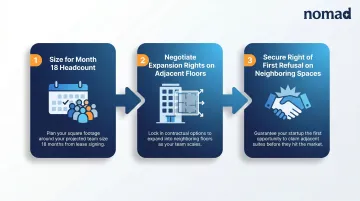
Getting the math right before you sign sets the foundation for everything else in your office search.
Understanding NYC Commercial Lease Types
NYC commercial leases come in more flavors than most founders expect — and the structure you sign determines far more than just monthly rent. Knowing these distinctions before you tour a single space will shape every comparison you make.
Direct Lease vs. Sublease
| Direct Lease | Sublease | |
|---|---|---|
| Counterparty | Building owner | Existing tenant |
| Term length | Typically longer (5–10 years) | Shorter, tied to existing lease |
| TI allowances | Often available | Rarely included |
| Customization | Higher | Lower (existing build-out in place) |
| Speed | Slower | Faster |
| Cost | Market rate | Often at a discount |
Subleases work well for startups that need to move quickly at lower cost, with furniture and infrastructure already in place. When Nomad Group helped Optimove find space, the search turned up a sublease from Lazard Asset Management: a full-floor, fully built space with a 3,000+ sq ft private rooftop terrace that wouldn't have surfaced through a standard direct lease search.
Gross vs. Net Lease Structures
- Gross (full-service) lease: One predictable monthly number that bundles base rent and most operating expenses. Common in NYC office buildings.
- Net lease: Base rent is separated from the tenant's share of taxes, insurance, and maintenance — additional rent that varies annually.
- Modified gross: A hybrid where some expenses (typically utilities or janitorial) are passed through separately.
Always calculate total occupancy cost under each structure before comparing spaces. A lower base rent on a net lease can easily exceed a higher gross lease once operating expenses are added.
Free Rent and TI Allowances as Cash Value
Once you've got a true apples-to-apples cost comparison across lease structures, concessions are the next lever. Treat them as equivalent to cash:
- Free-rent periods average approximately 17 months across Manhattan submarkets
- TI allowances have averaged $147/SF in recent years, with Midtown and Midtown South at $148/SF
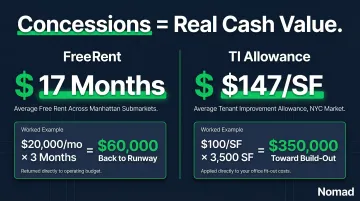
A space with 3 months of free rent on a $20,000/month lease puts $60,000 back into your runway. A space with a $100/SF TI allowance on 3,500 SF is $350,000 toward your build-out. Run both calculations before you rank any space on your shortlist.
How Nomad Group Helps NYC Startups Find and Build the Right Space
Nomad Group is a NYC-based commercial real estate firm built specifically for high-growth companies. With 300+ tenant buildouts completed and 2M+ sq ft leased across the city, the team covers the full lifecycle — from first tour through lease execution, buildout, and ongoing operations.
Their end-to-end model covers:
- Brokerage and site selection across NoMad, Flatiron, SoHo, Union Square, Williamsburg, and beyond
- Lease negotiation on behalf of the tenant — free-rent periods, TI allowances, expansion rights, and exit protections
- In-house construction management with a 90-day build-out turnaround (the Extend AI build-out went from white box to fully functional — HVAC included — in five weeks)
- Facilities management post-move-in, so your ops team isn't fielding calls about cleaning vendors and HVAC tickets
For founders who don't want to spend months managing a build-out, Flex by Nomad provides a faster path: a private, branded office with the speed and flexibility of a managed solution, built on Nomad's in-house infrastructure and on-the-ground market access.
Because the team isn't working against volume quotas or shareholder pressure, they have room to give each client the attention the deal actually requires — not just the attention it takes to close.
Conclusion
The right NYC office shapes your culture, influences who you can hire, and affects how efficiently your team operates — for the entire length of your lease. Treat it accordingly.
Start with clarity on budget, headcount trajectory, and the neighborhoods that match your culture. Then work with a team that knows the NYC startup ecosystem, not just the listings. In a market where availability is tightening and AI companies alone are driving 22% of tech sector demand, local expertise matters. Nomad Group has leased over 2 million square feet across NYC's high-growth neighborhoods — from Flatiron to SoHo to NoMad — and can help you move faster and negotiate smarter from day one.
Frequently Asked Questions
How do you determine how much office space you need?
Plan for 125–175 sq ft per person for a traditional assigned-desk setup, or 75–100 sq ft per person for hybrid-first teams with known peak-day utilization. Add 20–30% for shared spaces like meeting rooms and kitchen areas, and size for your projected headcount 18 months from now — not your team at signing.
What is the average cost of office space per square foot in NYC?
Manhattan overall asking rents average $72.81/SF (all classes) and $81.89/SF for Class A as of Q3 2025. Midtown South commands the highest rents at $104.73/SF Class A, while Downtown Manhattan runs $61.28/SF Class A. Brooklyn's Northern submarket (including Williamsburg) averages $41.01/SF — and total occupancy cost exceeds all these figures once operating expenses, escalations, and utilities are factored in.
What is the difference between a direct lease and a sublease for NYC startups?
A direct lease is signed with the building owner and offers longer terms, TI allowances, and full customization, making it better suited for Series A+ companies establishing a longer-term headquarters. A sublease is signed with a tenant exiting their space, often at a discount and with existing build-out in place — faster and less expensive upfront, and a natural fit for earlier-stage startups that need to move quickly.
Should my startup choose coworking or a private office in NYC?
Coworking works well for teams under 10 or companies still in early validation. A private office makes more sense once you reach 10–15 people and culture-building becomes a real priority. Flex solutions like Flex by Nomad now bridge the gap — private and branded, but faster to occupy than a traditional direct lease build-out.
Which NYC neighborhoods are best for tech startups?
The NoMad/Flatiron corridor is the primary startup cluster, with the highest density of tech companies, investors, and peer networks. Union Square offers strong mid-market value with excellent transit access. SoHo suits design-forward consumer brands. Williamsburg is the top option for Brooklyn-based teams and creative-culture companies, with Class A asking rents around $41/SF compared to $82/SF in Manhattan.
How long does it typically take to find and move into office space in NYC?
The typical timeline from search to occupying a built-out private office is 3–6 months — longer for traditional direct leases, where NYC permitting alone can take 2–4 months. Subleases and flex spaces can move in weeks. Start your search at least 6 months before your target move-in date.