Introduction
For startups and small businesses, finding the right office space is one of the most consequential decisions you'll make—yet most founders approach it underprepared. Commercial real estate is nothing like renting an apartment. The lease structures are unfamiliar, the costs extend well beyond monthly rent, and the terms you agree to can either support your growth or lock you into constraints for years.
Early missteps are costly. Signing a five-year lease when your headcount could double in 18 months, or overlooking buildout costs that drain your working capital, can set a growing company back in ways that take years to recover from.
This guide covers everything you need: how to define your requirements before you search, the types of space available, lease fundamentals every founder should know, and the mistakes most commonly made—and how to avoid them.
Key Takeaways
- Define headcount projections, all-in budget, and timeline before touring spaces
- Four main space types suit different growth stages: traditional lease, coworking, flexible workspace, and sublease
- Gross and modified gross leases give cash-constrained startups more predictable monthly costs than NNN structures
- Tenant brokers cost you nothing directly and provide market access, negotiating power, and deal expertise
- Most failures come from underbudgeting hidden costs, locking into leases that are too long, or going it alone without representation
What to Define Before You Start Your Search
Founders who tour spaces without firm parameters on budget, team size, and timing waste months and end up making reactive decisions under pressure. Nail these four inputs before you start.
Headcount and True Space Requirements
Calculate space needs using current benchmarks: modern offices typically allocate 150-175 square feet per person, though the range spans 135-225 square feet depending on workplace density and layout philosophy.
For hybrid teams, plan around peak occupancy—not total headcount. Research shows hybrid work reduces long-term space requirements by 20-40% for most organizations. If you employ 25 people but only 15 come to the office daily, design for 15 workstations plus collaboration space.
One number to watch: landlords quote rentable square footage (RSF), which includes your proportional share of common areas like lobbies and hallways. In NYC, loss factors typically run 27-40%, so you pay for considerably more space than you physically occupy. Always confirm both usable and rentable figures before signing.
Budget: Base Rent Plus the Real Costs
Commercial rent is quoted annually per square foot. Use this formula:
Monthly Cost = (Price per SF × Total RSF) ÷ 12
Example: 3,000 RSF at $75/SF = $225,000/year = $18,750/month
NYC rates vary widely by neighborhood:
- Midtown Manhattan: $82-84/SF
- Midtown South (Flatiron/NoMad): ~$85/SF
- SoHo: ~$80/SF
- Williamsburg: $50-65/SF
Base rent represents only part of your true occupancy cost. Budget for:
- Security deposits of 4-6 months for established companies, 12-18 months for startups without strong financials
- Annual rent escalations of 1-3% per year
- Operating expenses: utilities, garbage, and water (often $500+/month combined)
- Buildout costs of $40-100 per square foot if the landlord's TI allowance doesn't cover your needs
- Furniture, IT infrastructure, and moving costs
Timeline
The full search-to-move-in process typically takes 90-180 days in NYC, depending on buildout complexity:
- Requirements definition: 1-3 weeks
- Search and tours: 2-6 weeks
- Negotiation and lease review: 3-5 weeks
- Approvals and due diligence: 2-4 weeks
- Buildout and move-in: 0-16+ weeks (zero for turnkey spaces, 12-16 weeks for heavy construction)
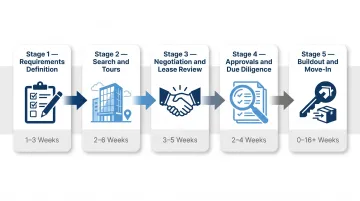
Starting your search too late forces rushed decisions and weakens negotiating leverage. Begin at least four months before your target move-in date.
Must-Haves vs. Nice-to-Haves
Before touring a single space, write out two columns:
- Non-negotiables: location radius, private offices vs. open plan, minimum conference room capacity, move-in date
- Preferences: exposed brick, rooftop access, specific floor level, natural light
No space checks every box. Having this list in hand stops you from second-guessing every option when real trade-offs appear in a competitive market.
How to Find Office Space: A Step-by-Step Process
Step 1: Use Listing Platforms to Build a Long List
Commercial listing platforms provide baseline market visibility:
- LoopNet — the most-visited CRE listing site, free for tenants
- Crexi — fast-growing marketplace with 5+ million monthly users
- CommercialCafe — office-focused search by size, rate, and availability
These platforms show direct lease and sublease inventory, but they don't capture off-market deals or spaces not yet publicly listed. Supplement online searches by walking target neighborhoods and noting "for lease" signage—still a legitimate tactic in dense markets.
Step 2: Engage a Commercial Tenant Broker
Tenant brokers deliver structural advantages: they're paid by the landlord via commission (typically 4-6% of total lease value), meaning their services cost you nothing directly. In return, you gain access to off-market listings, local expertise, and professional negotiating power.
Important caveat: Because brokers are compensated by landlords, use their recommendations alongside your own research—not as a replacement.
In NYC, firms like Nomad Group focus exclusively on tenant representation—with 300+ buildouts completed and 2M+ square feet leased across neighborhoods like Flatiron, NoMad, and SoHo—giving scaling companies both market access and negotiating depth.
Step 3: Tour and Evaluate Your Shortlist
Assess beyond aesthetics:
- Natural light quality and window access
- HVAC reliability and zone controls
- Floor plate layout—does it support your work style?
- Building access hours (24/7 or restricted evenings/weekends?)
- Freight elevator access for moving equipment
- Cell signal strength throughout the space
Ask listing agents directly: What's included? What's the buildout status? Are tenant improvement allowances available? What operating costs will we be responsible for?
Step 4: Issue a Letter of Intent (LOI)
An LOI is a non-binding document outlining agreed-upon terms before formal lease drafting: rent, lease duration, TI allowance, rent abatement period, and any special provisions. It signals serious interest and establishes the negotiation framework without legal commitment.
Step 5: Lease Review, Negotiation, and Signing
Hire a real estate attorney for any lease exceeding 12 months. Commercial leases are complex, terms are negotiable, and the stakes are high.
Critical clause: The personal guarantee. Even when the lease is in your company's name, most landlords require founders to personally guarantee rent—meaning your personal assets are at risk if the business cannot pay. Understand this exposure before signing.
Types of Office Space for Startups and Small Businesses
Traditional (Direct) Lease
You lease directly from the landlord, gaining full control over the space and the ability to customize your environment. Best suited for companies with:
- Stable headcount projections
- Capital reserves to fund a buildout
- Willingness to commit to a multi-year term (typically 3-7 years)
Coworking and Flexible Workspace
Move-in-ready spaces with shared amenities, month-to-month or short-term agreements, and built-in community. Flexible office now represents 4.2% of total office stock in New York, with projections that 30% of all office space will be consumed flexibly by 2030.
Best for early-stage companies, teams with fluctuating headcount, or businesses testing a new market. Major operators offer volume discounts for committed memberships.
For NYC-based companies that want flexible terms without relying on a third-party coworking network, Nomad Group's Flex by Nomad offers a full-service model built on in-house infrastructure across Manhattan's key neighborhoods.
Sublease
An existing tenant rents part or all of their space to you. Manhattan subleases currently trade at approximately a 29.5% discount compared to direct leases, with discounts reaching 50% in some submarkets.
Key considerations before signing a sublease:
- Cost: Typically 20-50% below direct lease rates, often move-in ready
- Risk: The sublessor's master lease may expire or terminate, forcing relocation
- Due diligence: Review the master lease terms and confirm the landlord's written consent
Shared Office Space
Two complementary businesses split a single space and rent. Works for very small teams with tight budgets, but requires careful vetting of compatibility and written agreements clarifying responsibilities, access, and cost allocation.
Understanding Commercial Leases: Types and Key Terms
Three lease structures exist, each allocating operating cost responsibility differently. Knowing which you're signing matters — especially for early-stage companies managing tight budgets.
| Lease Type | What You Pay | Best For |
|---|---|---|
| Gross Lease | One flat rent amount; landlord covers taxes, insurance, maintenance | Predictable cash flow planning |
| Modified Gross Lease | Base rent + share of operating cost increases above a baseline ("expense stop") | Frequently used in NYC office leases, particularly in Midtown and Flatiron |
| Triple Net (NNN) | Base rent + property taxes, building insurance, and CAM charges | Established businesses with stable cost forecasting |
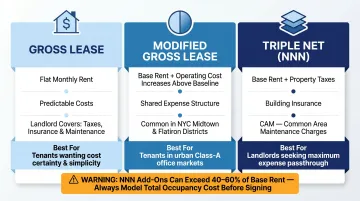
NNN add-ons routinely exceed 40-60% of base rent in markets where this structure is common — a meaningful exposure risk for Series A and early-stage companies.
Key Terms Every Founder Must Understand
CAM (Common Area Maintenance): Your proportional share of lobby upkeep, elevator maintenance, security, and shared space costs.
TI (Tenant Improvements): Landlord-provided buildout allowance, typically $40-100 per square foot in NYC. Longer lease terms unlock higher allowances — worth negotiating hard if you need significant buildout work.
Rent Abatement: Free or reduced rent for a negotiated period, usually at lease commencement. Typical in competitive markets or for tenants signing longer terms.
Break Clause: Contractual right to exit the lease early under specified conditions. If your headcount could double or contract in three years, this clause is non-negotiable.
Usable vs. Rentable Square Footage: Usable is what you physically occupy; rentable includes common area load factor. Always confirm both figures.
Common Mistakes Startups Make When Finding Office Space
Underestimating the True Cost
The most common financial mistake: signing based on quoted rent without budgeting for deposits, CAM charges, IT infrastructure, buildout overages, and moving costs.
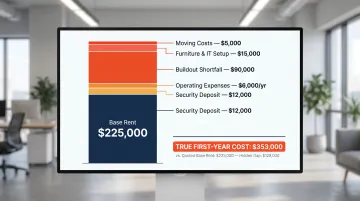
Example: A space quoted at $75/SF with 3,000 RSF costs $18,750/month in base rent. Add:
- $12,000 security deposit (assuming 5 months upfront)
- $500/month operating expenses
- $90,000 buildout shortfall ($30/SF gap between need and TI allowance)
- $15,000 furniture and IT setup
- $5,000 moving costs
Your true first-year cost isn't $225,000—it's closer to $350,000.
Overcommitting on Lease Term
Locking into a five- or seven-year lease when headcount could scale rapidly (or contract) creates serious operational risk. Class A Manhattan buildings often require minimum 5-year commitments, but shorter terms preserve flexibility during high-growth phases.
Break clauses and shorter initial terms are worth paying a higher monthly rate for when the future is uncertain.
Skipping Professional Representation and Legal Review
Many founders assume they can negotiate directly with a landlord's broker to save time. But listing brokers represent the landlord—not you. Without your own broker and attorney, you're negotiating without an advocate. According to Oxford CRES, tenant representation consistently reduces total lease costs — often by more than founders expect.
Letting Perfect Be the Enemy of Good
No space checks every box. Founders who stall waiting for the ideal option often miss strong opportunities — particularly in NYC, where a well-priced Flatiron or SoHo floor can draw multiple LOIs within days of listing. Nail down your non-negotiables, rank everything else, and move when something clears the bar.
Frequently Asked Questions
How to find office space for a small business?
Start by defining budget, headcount, and space type needs. Use commercial listing platforms like LoopNet and Crexi alongside a tenant-side broker to source and evaluate options. Engage a real estate attorney before signing any lease.
How to lease an office space?
The process follows five stages: search and shortlist, tour and evaluate, issue a Letter of Intent, negotiate lease terms with legal counsel, and sign. Expect 3-6 months from initial search to move-in, depending on buildout requirements.
How much should a business spend on office space?
A commonly cited guideline suggests keeping occupancy costs within 5-10% of gross revenue. Ratios exceeding 15% indicate high occupancy risk. Remember that true cost includes base rent plus deposits, CAM, buildout, and setup—not just the quoted per-square-foot rate.
How much to rent a desk in an office per month?
Coworking hot desks in Manhattan typically run $400–600 per month, with dedicated desks and private offices costing significantly more. Pricing varies by neighborhood, amenities, and operator.
Is there a site like Zillow for commercial property?
While no single platform dominates commercial real estate the way Zillow does residential, LoopNet, Crexi, and CommercialCafe serve similar functions. However, off-market deals and sublease inventory often only surface through a commercial broker with local relationships.
Is renting office space a tax write-off?
For most businesses, office rent qualifies as a deductible business expense under IRC Section 162. However, tax treatment varies by business structure and jurisdiction—consult a CPA to understand how it applies to your specific situation.