This guide breaks down the five best office space solutions available to NYC and Brooklyn startups, the neighborhoods worth targeting, and the key criteria every founder should evaluate before signing anything.
Key Takeaways
- NYC startups have five primary office solutions: traditional direct leases, subleased offices, coworking spaces, flex/managed offices, and virtual offices
- The right choice depends on team size, budget, growth trajectory, and how much your physical space needs to reflect your brand
- NoMad, Flatiron, SoHo, Union Square, and Williamsburg dominate NYC's startup landscape
- Don't over-commit to long lease terms early: buildout timelines, hidden costs, and scalability all affect the right fit
The NYC & Brooklyn Startup Office Space Landscape
New York City ranks as the #2 global startup ecosystem, hosting over 2,000 AI startups, 150 active unicorns, and 40,000 AI professionals. NYC tech companies raised $28 billion in venture capital in 2025 alone, with the city's total ecosystem value reaching $621 billion. Brooklyn's startup scene has grown 356% since 2008, cementing the borough's role as a legitimate alternative to Manhattan.
Having a physical NYC address still matters. Despite remote work trends, most VC-backed companies maintain offices to facilitate investor meetings, support recruitment in a competitive talent market, and build the in-person culture that drives early-stage execution.
The post-pandemic market has reshaped what startups expect. Founders now demand shorter lease terms, move-in-ready conditions, and flexible arrangements that can scale with unpredictable growth.
NYC landlords have responded with more diverse product types than ever before. Manhattan vacancy fell to 13.1% in Q1 2026 — well below the 17.8% national average — while flexible office locations grew 11.9% in a single quarter.
The five office solutions below cover the full range of what's available, from day-one flexibility to post-Series A dedicated space, matched to where your company actually is right now.
Best Office Space Solutions for NYC & Brooklyn Startups
Each option below maps to a different stage, budget, and growth trajectory. Understanding the tradeoffs upfront will save you from costly missteps — whether you're signing your first office or outgrowing your third.
Traditional Direct Lease
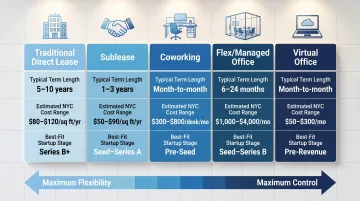
A direct lease means signing directly with a building landlord, typically for raw or white-box space that you customize from scratch. This option offers maximum control and customization but requires significant capital, long-term commitment (typically 5–10 years in NYC), and the ability to manage a full buildout process.
When this makes sense: Series B and beyond, teams of 30+, companies with stable headcount projections and a desire to build a branded headquarters.
Common pitfalls: Founders frequently underestimate buildout timelines and costs. NYC fit-out costs exceeded $212/SF in 2024, among the highest in the US. Tenant improvement allowances generally don't keep pace with these costs, meaning startups must fund the gap out of pocket. Landlords typically require 3–12 months of rent as a security deposit for companies without established profit records.
| Metric | Details |
|---|---|
| Typical Lease Term | 5–10 years in most NYC markets; some shorter options exist in outer boroughs |
| Estimated NYC Cost Range | Class A (NoMad/Flatiron): $86–$122/SF/year Class B (Midtown South): $62–$76/SF/year |
| Best For | Growth-stage or Series B+ startups with stable team size and a long-term NYC commitment |
Subleased Office Space
Subleasing means renting space from an existing tenant who has excess capacity on their lease. NYC has a historically large sublease market offering more favorable pricing, shorter terms, and already-built-out space compared to direct leases.
Manhattan sublease inventory shrank from 17.4M SF to 14.9M SF in just five months as demand surged 64% year-over-year. Sublease rents typically run 20–40% below direct lease asking rents for comparable space, with the primary savings coming from avoiding expensive buildouts, wiring, and furniture costs.
Key advantages: Faster move-in, lower rent, furnished or partially fitted options.
Limitations: Limited customization rights, dependency on the original tenant's lease expiry, and less negotiating power with the landlord.
| Metric | Details |
|---|---|
| Typical Lease Term | Usually mirrors the remaining term of the primary lease; often 1–3 years in the current NYC market |
| Estimated NYC Cost Range | 20–40% below direct lease asking rents in comparable buildings |
| Best For | Seed to Series A startups needing ready-to-use, cost-efficient space without a long-term commitment |
Coworking Space
Coworking represents the most accessible entry point for NYC startups — shared, fully amenitized environments available on monthly memberships, with options ranging from hot desks to private offices for small teams. NYC coworking spans 15.3 million SF or 2.6% of total office inventory, above the 2.3% national average.
Coworking delivers genuine value for early-stage teams: zero buildout cost, networking access, professional address, and amenities included. Coworking is cheaper than leasing in 97% of US cities for small teams.
Reality check: Cost per desk climbs fast as teams grow. Manhattan private office per-desk asking prices averaged $785/month in Q1 2026. Limited privacy, minimal branding opportunity, and no long-term security of tenure make coworking a short-term solution for most startups.
| Metric | Details |
|---|---|
| Typical Commitment | Month-to-month or annual; no long-term lease required |
| Estimated NYC Cost Range | Manhattan: $785/desk/month (private office) Brooklyn: $716/desk/month Hot desk: $400–$550/month |
| Best For | Pre-seed to Seed stage startups, teams under 10, or companies needing a professional base while evaluating longer-term options |
Flex / Managed Office Space
Flex or managed office sits between coworking and a traditional lease — a dedicated, private office suite that is move-in ready and managed by a third party, but designed to feel like your own space. The key distinction from coworking: you get a fully private suite, custom buildout, and a single all-in invoice — without negotiating directly with a landlord or managing construction.
Flex by Nomad exemplifies this approach: a managed office model built on in-house infrastructure and on-the-ground NYC access, designed specifically for high-growth companies that want a real office experience without the capital commitment of a direct lease. Nomad Group handles day-to-day operations, maintenance, and buildout management, so your team isn't managing contractor timelines or vendor contracts.
Key advantages: Private, branded space with no buildout burden, faster move-in than a direct lease, and predictable all-in monthly costs.
Things to know: Terms are more structured than coworking (typically 1–3 years), and customization options vary by operator and suite size.
| Metric | Details |
|---|---|
| Typical Commitment | Generally 1–3 years; more flexible than a direct lease, more stable than coworking |
| Estimated NYC Cost Range | $716–$785/desk/month all-in, depending on location and buildout level |
| Best For | Series A to Series B startups needing a turnkey private office with room to customize and scale |
Virtual Office
A virtual office provides a professional NYC business address, mail handling, and access to on-demand meeting rooms without the cost of a full-time physical space. This solution is relevant for remote-first startups, international companies entering the NYC market, or solo founders who need credibility without overhead.
Virtual office plans in NYC start at $49–$65/month for a business address with mail handling, rising to $250/month for packages that include physical space access and Google My Business-compliant lease agreements.
Limitations: No dedicated workspace for daily team use, limited ability to build in-person culture, and the importance of choosing a reputable NYC address — not a generic mailbox service — if your goal is to impress investors or enterprise clients.
| Metric | Details |
|---|---|
| Typical Commitment | Month-to-month; minimal financial commitment |
| Estimated NYC Cost Range | $49–$250/month depending on service level and address prestige |
| Best For | Remote-first or pre-revenue startups, international companies establishing a US presence, or solo founders building initial credibility |
Best NYC & Brooklyn Neighborhoods for Startup Offices
Location in NYC affects talent attraction, proximity to investors and clients, and your company's day-to-day culture. The neighborhoods below represent the highest concentration of VC-backed startups, tech companies, and supporting ecosystems in the metro.
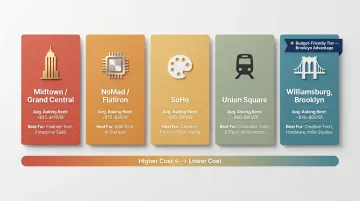
| Neighborhood | Avg. Asking Rent | Best For |
|---|---|---|
| NoMad / Flatiron | $94/SF (Class A), $62/SF (Class B) | Tech, fintech, SaaS — Series A–C |
| SoHo | $89/SF | Consumer brands, media, creative agencies |
| Union Square | Mid-range, mixed inventory | Early-stage startups, edtech, healthtech |
| Midtown / Grand Central | $95/SF (Plaza District) | Enterprise-facing, financial services |
| Williamsburg, Brooklyn | ~$41/SF (North Brooklyn) | Creative tech, lifestyle, cost-conscious growth |
NoMad & Flatiron District
NoMad and Flatiron form the most startup-dense corridor in NYC — home to a high concentration of Series A through Series C companies, with strong transit access and a professional atmosphere that appeals to tech, fintech, and SaaS companies.
AI startups leased 486,000 SF in Manhattan through Q3 2025, with most activity concentrated in this corridor. Asking rents in Chelsea/Flatiron average $94/SF for Class A space and $62/SF for Class B, and landlords here are increasingly flexible on term length for high-growth tenants. This stretch — sometimes called "Unicorn Lane" — has produced some of NYC's most successful startups.
SoHo
SoHo is a premium, design-forward neighborhood popular with consumer brands, media companies, creative agencies, and tech startups that want their physical space to reinforce a distinctive brand identity. Asking rents averaged $89/SF in Q1 2026.
Rents can exceed Flatiron equivalents, but the neighborhood's density of creative talent, proximity to Tribeca, and cachet with investors makes it compelling for the right type of startup.
Union Square
Union Square sits at the convergence of multiple subway lines, giving it some of the best transit connectivity in Manhattan. Established tech companies and growing startups share the neighborhood — spanning edtech, healthtech, and consumer apps.
The mix of building types and price points makes it viable for earlier-stage companies that aren't ready to commit to premium NoMad or SoHo rents.
Midtown / Grand Central
The Grand Central corridor is ideal for startups that frequently host enterprise clients, need proximity to financial institutions, or want to leverage the prestige of a Midtown address. Asking rents in the Plaza District average $95/SF, but sublease availability is often higher here due to enterprise tenant downsizing.
While rents can be competitive on a per-square-foot basis given available sublease inventory, the corporate atmosphere may not suit all startup cultures.
Williamsburg, Brooklyn
Williamsburg is NYC's fastest-growing startup neighborhood outside Manhattan — with rents well below Midtown South, strong access to creative and tech talent, and a character that fits consumer, lifestyle, and creative tech companies.
Brooklyn overall asking rents averaged $54/SF in Q2 2025 versus Manhattan's $70/SF — roughly a 22% discount. North Brooklyn (including Williamsburg) goes further at approximately $41/SF. AI-powered startup RillaVoice signed a 10-year lease at 25 Kent Avenue for $76/SF, Williamsburg's biggest office lease in over a year.
The L train and improved connectivity have reduced the commute barrier — making Williamsburg a practical choice for companies that want Brooklyn economics without sacrificing access to Manhattan talent.
How to Choose the Right Office Space for Your NYC Startup
Founders commonly make these mistakes when choosing office space:
- Over-committing on square footage too early
- Underestimating buildout timelines and costs
- Choosing based on aesthetics over location and transit access
- Failing to negotiate lease flexibility clauses from the start
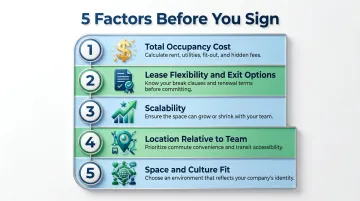
Each of those mistakes is avoidable. Before you commit to a space, work through these five factors:
Total occupancy cost — not just rent. Include buildout, furniture, IT, and amenities. With NYC fit-out costs exceeding $212/SF, pre-built or sublease space can eliminate six-figure buildout exposure.
Lease flexibility and exit options — NYC commercial landlords have no legal duty to mitigate damages when a tenant defaults. Push for "Good Guy Guarantee" clauses, expansion/contraction rights, and early-termination options tied to your business milestones.
Scalability — Can you expand or contract within the building? Companies are targeting 132 SF per person, down from the current 165 SF average. Plan for 125–150 SF per person in open-plan layouts to optimize cost.
Location relative to where your team lives — Transit accessibility matters more than prestige. A Union Square address with direct access to six subway lines may outperform a Midtown East address that requires two transfers for most of your team.
Location shapes culture, but so does the space itself. Your office is a hiring and retention tool — a space with natural light, flexible furniture, and a mix of collaborative and focus zones directly affects who joins and who stays.
In NYC's market, an experienced tenant representative pays for itself. The right broker routinely pulls additional tenant improvement allowances, extends free rent periods, and structures lease terms that a solo negotiator rarely achieves against a landlord's attorney.
Conclusion
NYC and Brooklyn offer a genuinely diverse set of office space solutions for startups — from virtual offices and coworking desks for early-stage teams to flex managed offices and direct leases for scaling companies. The best choice is always the one that aligns with your company's current stage, not an idealized future state.
Treat the office search as a strategic decision. The terms you sign today — length, flexibility, expansion rights — will either support or constrain your growth for the next two to five years. Working with advisors who specialize in high-growth companies makes that difference tangible.
Nomad Group has helped 300+ NYC companies find, build, and manage office space — from early-stage startups to enterprise tenants — across NoMad, Flatiron, SoHo, Union Square, and Williamsburg. Whether you need tenant representation, a flexible office through Flex by Nomad, or a full buildout delivered in 90 days, the team is built to support every stage of growth. Reach out to Nomad Group to talk through your options.
Frequently Asked Questions
How many people can fit in a 1,000 sq ft office?
The standard range is 100–150 SF per person for open-plan layouts, with higher allocations for private offices. NYC startups often plan for 80–100 SF per person in dense configurations, meaning a 1,000 SF office typically fits 10–12 people comfortably.
How do I create a welcoming office space for my startup?
Focus on natural light, flexible furniture, and a mix of collaborative and focus-friendly zones. Small brand touches that reflect company culture — like custom art, branded signage, or curated design elements — make the space feel authentic and support both retention and recruiting.
What is the average cost of office space for startups in NYC?
Costs vary significantly by neighborhood and lease type:
- Class A (NoMad/Flatiron): $86–$122/SF/year
- Class B: $62–$76/SF/year
- Subleases: 20–40% below market
- Coworking: $400–$800/desk/month
Budget beyond headline rent — buildout, furniture, and amenities add meaningfully to all-in costs.
What neighborhoods in NYC are best for tech startups?
NoMad, Flatiron, and SoHo are the most startup-dense areas in Manhattan, offering proximity to investors, talent, and peer companies. Williamsburg is the top Brooklyn option for companies seeking lower costs and creative talent access, with rents roughly 40% below Midtown South.
What is a flex office and is it right for my startup?
A flex office is a fully managed, move-in-ready private office suite with shorter terms than traditional leases. It's most suitable for Series A and B startups that want a branded, dedicated space without the capital commitment of a direct lease. Flex combines the speed of coworking with the privacy and customization of a traditional office.
How long are typical office leases for startups in New York City?
Direct leases typically run 5–10 years, though tech sector deals average around 4.6 years. Subleases run 1–3 years, matching the remaining term on the primary lease. Flex and coworking are usually month-to-month or annual — startup stage and financial stability are the main factors landlords weigh.