Introduction
High-growth companies face a fundamental mismatch: team size and workplace needs evolve quarterly, while traditional Manhattan office leases lock you in for three to ten years. When you sign a five-year lease for 30 desks but adopt a Tuesday-Wednesday-Thursday hybrid policy six months later, you're paying for empty space every Monday and Friday—and probably underutilizing the office mid-week as headcount fluctuates.
52% of U.S. remote-capable employees now work hybrid, and 77% of companies maintain hybrid models as standard policy. The physical office hasn't disappeared—but the one-desk-per-employee, five-days-a-week model has.
Flex office space is the structural response to that shift: a workplace model that decouples your real estate footprint from rigid long-term commitments, letting you pay for, configure, and scale space around actual use rather than forecasted headcount.
This guide explains what flex office space is, the main types available across NYC, how it compares to traditional leases, and the decision framework to determine if it fits your business stage and growth trajectory.
TLDR:
- Flex office combines adaptable layouts with short-term leases (daily to annual terms vs. multi-year commitments)
- Main types: coworking, hot desking, serviced offices, managed offices, and virtual offices
- Reduces real estate waste: average space per employee dropped 27% since 2021 as companies right-size for hybrid
- Strongest fit for scaling companies, early-stage teams, and hybrid-first policies; traditional leases still win for stable headcounts with firm culture or brand requirements
- NYC's flex inventory grew 16% in one year to 161 million sqft, with Manhattan leading at 12.8 million sqft
What Is Flex Office Space?
Flex office space is a workplace model that combines adaptable physical layouts with flexible lease structures, giving businesses the ability to pay for, configure, and scale space around actual need rather than a fixed long-term commitment.
The flexibility operates on two dimensions:
Physical flexibility: Open plans, hot desks, quiet zones, and shared amenities allow employees to choose environments based on task—focus pods for deep work, collaboration areas for group projects, bookable conference rooms for client meetings.
Contractual flexibility: Lease terms range from daily passes to month-to-month agreements to annual memberships, rather than the three-to-ten-year terms standard in Manhattan direct leases. This removes the financial exposure of committing to square footage before your headcount or work model has stabilized.
Common synonyms include flexispace, flexible workspace, managed office, and agile workspace—terms used interchangeably across the market, though each can carry subtle differences in service level and operator model.
What started as a niche solution for freelancers and early-stage startups has become a core real estate strategy for scaling companies and enterprises alike—largely because hybrid work made the old model obsolete. JLL projects 30% of all office space will be consumed flexibly by 2030, up from just 2.2% of total U.S. inventory at the start of 2026.
The market numbers reflect that momentum: the global flex office sector was valued at $45.24 billion in 2025 and is projected to reach $194.75 billion by 2034.
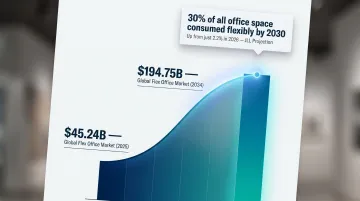
For companies in high-growth markets like Manhattan, that trajectory matters—flex space gives you a path to right-size your footprint as headcount shifts, rather than carrying underutilized square footage through a five-year lease.
Types of Flex Office Space
Coworking Spaces
Coworking spaces are shared work environments where professionals from multiple companies work side by side, typically in open-plan layouts with shared amenities like conference rooms, high-speed internet, kitchens, and common lounges.
These spaces are membership-based, offering hot desks (first-come, first-served), dedicated desks (assigned to one person), and private offices within a larger shared building. Coworking emphasizes community and networking—many operators host events, workshops, and social gatherings to foster interaction among members.
Ideal for:
- Freelancers and solo entrepreneurs
- Early-stage teams (2-10 people) testing a new market
- Companies exploring NYC presence before committing to a lease
- Teams that value networking opportunities and cross-industry exposure
Freelancers and self-employed professionals represent 40-42% of coworking users, while established company employees account for approximately 36%.
Hot Desking and Desk Hoteling
Hot desking is a non-reservation system in which any workspace is available to any employee at any time—first-come, first-served. No one has a permanently assigned desk.
Desk hoteling adds a layer of planning: employees reserve specific desks, meeting rooms, or other resources in advance through a booking system, similar to reserving a hotel room.
Both models address the same challenge: when most staff are in the office only a few days a week, maintaining a one-to-one desk-to-employee ratio wastes space and money. Hot desking and hoteling let companies shrink their footprint to match actual peak attendance rather than total headcount.
According to CBRE, 69% of organizations report more than 40% of their workers do not have a designated desk, and no organization targets a one-to-one seating ratio anymore.
Serviced and Private Offices
Serviced offices are fully furnished, move-in-ready private spaces managed by a third party. Rent, utilities, internet, furniture, and maintenance are bundled into one monthly fee, with no need to manage multiple vendors.
Lease terms typically range from three months to one year, with some operators offering monthly rolling contracts. Move-in can happen within 24 hours.
Serviced offices provide the privacy and focus of a traditional office without the capital expenditure, buildout timeline, or long-term lease commitment. They're well-suited to:
- Companies needing confidential work environments (legal, finance, healthcare)
- Teams that want dedicated space without sharing with dozens of other companies
- Businesses scaling rapidly and unwilling to commit to multi-year terms
Managed Flex Offices
Managed flex offices take the serviced office model a step further: a provider handles buildout, facilities management, and day-to-day operations on behalf of the tenant, but the tenant has greater input on branding, layout, and design than in a standard serviced office. Lease terms typically run one to three years, with a fit-out period of four to eight weeks.
The result is a custom-branded space that feels like a company headquarters—without the capital burden of owning the infrastructure or the distraction of day-to-day facilities oversight.
Nomad Group's Flex by Nomad service is built on this model: on-the-ground NYC market access paired with in-house construction and facilities management. Companies get dedicated, custom-branded space without managing the build or the building.
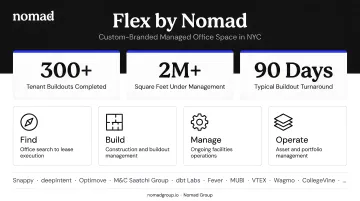
This model suits:
- Scaling companies (20-100 employees) that need space to reflect their culture
- Teams transitioning out of coworking but not ready for a traditional ten-year lease
- Companies that want the flexibility to expand or contract without renegotiating a lease or managing buildout logistics
Virtual Offices
Virtual offices provide a professional business address and mail handling without a physical workspace. Some include occasional access to meeting rooms or day offices.
This is the lightest-weight option, suited to:
- Fully remote companies that need a credible NYC presence for client communications and legal registration
- Businesses testing a new market before committing to physical space
- Teams that operate entirely distributed but require a local address for compliance or branding purposes
Flex Office Space vs. Traditional Office Space
Lease Terms
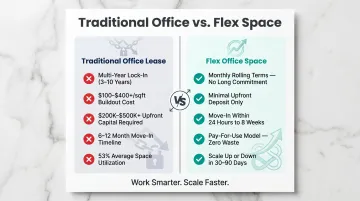
Traditional office leases in NYC typically run three to ten years. Seven-to-ten-year terms are standard when landlords offer high tenant improvement allowances. Average flex operator lease lengths have dropped from 11 years (2015–2019) to 8 years (2020–2024).
Flex spaces offer arrangements from daily passes to annual memberships. Most flex operators provide monthly rolling contracts or six-to-twelve-month minimums.
A five-year lease locks in a fixed footprint—whether your headcount doubles, halves, or your hybrid policy shifts. Flex terms let you adjust square footage quarterly or annually without breaking a lease or navigating a sublet process.
Cost Structure and Setup
Traditional offices require separate management of:
- Base rent (negotiated per square foot annually)
- Utilities (electric, gas, water)
- Furniture, fixtures, and equipment (FF&E): $1,500 to $10,000+ per employee
- IT infrastructure (cabling, networks, phone systems)
- Maintenance and cleaning contracts
- Tenant improvements: $100–$400+ per square foot in NYC, with buildout timelines of 6–12 months
Total upfront capital for a traditional NYC office buildout can easily reach $200,000 to $500,000+ for a mid-sized team.
Flex spaces consolidate most costs into a single monthly fee:
- Rent, utilities, internet, furniture, and maintenance included
- Move-in ready: serviced offices available within 24 hours; managed offices ready in 4–8 weeks
- Minimal upfront capital—typically first month, last month, and a security deposit
NYC flex pricing (Q1 2026): Per-desk asking price for private offices averaged $778/month. Premium markets see hot desks at $400–$600/month, dedicated desks at $700–$1,200/month, and private offices starting at $2,000+/month.
Scalability
Flex spaces allow companies to add or reduce desks and square footage quickly—often with 30 to 90 days' notice. Traditional leases lock in a fixed footprint, meaning companies often pay for space that sits empty during off-peak days (Mondays and Fridays under hybrid policies) or face a complex subletting process when they need to downsize.
That subletting burden shows up in the data: global average office utilization reached 53% in 2025, up from 38% in 2024 but still well below the 65% most organizations target. That 12-point gap is wasted rent under a traditional model—space you're paying for but not filling.
Benefits of Flex Office Space
Cost Efficiency
Companies pay only for space they actually use, avoiding the financial waste of underutilized square footage. Average space per employee has dropped 27% since 2021—from 292 to 205 square feet—as companies align footprint with hybrid attendance patterns.
CBRE estimated that hybrid work could reduce office space demand by 9% to 15%, representing roughly 700 million square feet of surplus space across the U.S.
Scalability Without Risk
Flex space lets growing companies expand incrementally as headcount increases and contract just as quickly if a project ends or team structure shifts. You're not locked into a five-year commitment made when your business model, funding stage, or work policy may look entirely different 18 months from now.
Cost control and headcount flexibility tend to move together — which is why most scaling companies treat them as a single decision rather than two separate ones.
Productivity and Collaboration
Activity-based layouts—quiet focus zones alongside open collaboration areas and bookable conference rooms—allow employees to match their environment to their task rather than defaulting to a single assigned desk regardless of the task. That shift alone has measurable impact: 84% of remote workers report that coworking improves their engagement.
Talent Attraction and Employee Wellbeing
Offering workspace flexibility signals trust and directly affects whether people stay. 60% of remote-capable employees want hybrid arrangements; less than 10% prefer fully on-site. And 60% of exclusively remote employees are "extremely likely" to seek a new job if remote flexibility is removed.
Access to Premium Amenities
Flex spaces typically provide conference rooms, event spaces, high-end common areas, and on-site staff that would be prohibitively expensive for a small or mid-sized company to build and maintain under a traditional lease. You get Class A building amenities at a fraction of the capital cost.
Potential Drawbacks to Consider
Limited brand and culture expression: Without a dedicated, customized office, companies can struggle to reflect their culture and values in the physical workspace. Employees who share space with dozens of other companies may feel less connected to the organization's identity. Client meetings in generic coworking lounges lack the brand reinforcement of a custom-designed headquarters.
Logistics and operational complexity: Managing desk availability, ensuring enough space on high-attendance days (typically Tuesday through Thursday), and maintaining a consistent workplace experience across a shared environment requires planning and dedicated tooling.
70% of respondents report employees are in the office less than leaders expect, while average peak utilization hits 80%. That gap means real crowding on popular days and wasted space the rest of the week — poor execution leads to friction that erases the productivity benefits flex models are supposed to deliver.
Privacy and confidentiality constraints: Open coworking layouts are not well-suited to teams handling sensitive client data, legal work, or confidential business discussions. One legal analysis of coworking security risks calls open-office designs an "eavesdropper's paradise," citing:
- Shared networks vulnerable to cyberattacks
- Hot desks that make physical document control difficult
- Short-term occupancy relationships that increase exposure to information theft
Serviced or managed private offices address these concerns but at a higher cost than shared coworking desks.
Is Flex Office Space Right for Your NYC Business?
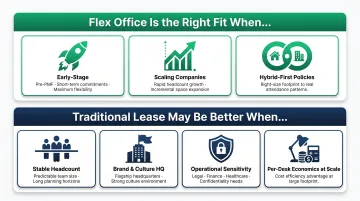
Flex office makes the most sense in three scenarios:
Early-stage companies need professional space without multi-year financial exposure before product-market fit or Series A funding is secured. Month-to-month or six-to-twelve-month terms let you maintain a credible NYC presence without committing capital or long-term liability.
Scaling companies that are adding headcount faster than a traditional lease cycle allows can expand incrementally—adding desks quarterly rather than committing to 10,000 square feet you may not need for two years. Optimove and Authentic Insurance both used Nomad Group to transition from coworking into dedicated offices as they scaled, avoiding premature commitments while securing space that reflected their brand.
Established companies running hybrid policies can right-size their footprint to match actual peak attendance rather than paying for desks that sit empty. 69% of organizations report more than 40% of workers do not have a designated desk, and 33% target more than 1.5 people per seat.
When a traditional or hybrid-flex lease may be the better fit:
Some companies are better served by a well-negotiated traditional lease. This is typically true when:
- Headcount is stable and space planning is predictable 12–24 months out
- Brand and culture requirements demand a custom-designed headquarters for client-facing work
- Operational sensitivity (legal, finance, healthcare) requires tighter access control and dedicated infrastructure
- Per-desk economics favor it — at scale, a traditional lease often costs less than premium coworking rates
Whichever direction fits your stage, the NYC market adds another layer of complexity. Midtown South leasing demand reached 4.29 million sqft in Q3 2025, up 47.8% year-over-year, with availability dropping to 14.7%—the lowest since February 2021. Navigating flex options across NoMad, Flatiron, Union Square, and SoHo in a tightening market requires on-the-ground relationships that match space type, location, and lease structure to your growth stage.
Nomad Group advises high-growth companies on exactly this across NYC's key commercial corridors. Through Flex by Nomad, the firm pairs in-house construction and facilities management with flexible lease structures that scale as your business evolves.
Frequently Asked Questions
What is the difference between a flex space and a coworking space?
Coworking is one type of flex office space. Flex space is the broader category encompassing coworking, hot desking, serviced offices, managed offices, and virtual offices, while coworking specifically refers to shared open environments where professionals from different companies work together.
What are flexible lease terms?
Flexible lease terms are rental agreements shorter and more adaptable than traditional multi-year office leases. They range from daily or weekly passes to monthly rolling agreements, allowing companies to scale space up or down without long-term financial exposure.
What is a flex room in an office?
A flex room is a multipurpose space within an office that can be quickly reconfigured for different uses. For example, a meeting room might double as a focus pod, or a lounge might serve as an informal workspace depending on the day.
What does "flexi desk" mean?
A flexi desk (also called a hot desk) is an unassigned workstation that any employee can use on a given day rather than being allocated to one person permanently. It's common in hybrid offices where not everyone is in the office at the same time.
What is another word for flexible office space?
Common synonyms include flexispace, flexible workspace, agile office, managed office, and serviced office. Each term describes variations of the flex office model, though they carry distinct differences in scope and service level.
Is flex space a good investment?
The global flex office market was valued at $45.24 billion in 2025 and is projected to reach $194.75 billion by 2034, reflecting strong demand driven by hybrid work adoption. For investors, it can offer higher occupancy rates and revenue per square foot than traditional leases, though it does require more active management and higher operating costs.