Introduction
Traditional fixed office layouts weren't built for how fast companies move now. Headcount swings, hybrid schedules, and shifting team structures can make a carefully planned space feel wrong within a year — sometimes less.
The modern office has to handle focused solo work, spontaneous collaboration, distributed video calls, and informal hallway conversations. Often on the same day, within the same footprint.
Flexible workspace design offers a strategic solution. Rather than locking into a single configuration that becomes obsolete within 18 months, flexible design plans space around how work actually happens — using adaptable layouts, modular furniture, and purpose-built zones so the environment evolves with your team instead of working against it.
This guide walks through the core strategies, essential zones, and implementation steps to help you build a space that keeps up.
Key Takeaways
- Flexible workspace design adapts to changing team needs through modular layouts, distinct zones, and tech-enabled infrastructure—no costly renovations required
- Key benefits: smarter space utilization, lower renovation costs, stronger retention, and faster response to growth or contraction
- Core strategies span activity-based zoning, modular furniture, tech integration, acoustics, lighting, and biophilic design
- Effective layouts balance open collaboration areas with quiet focus zones and private call spaces
- Start with a work pattern audit, then select furniture and infrastructure that match how your team actually works
What Is Flexible Workspace Design?
Flexible workspace design is the deliberate planning of office space to support multiple work modes—focused individual work, team collaboration, video calls, and informal interaction—without requiring structural changes each time needs shift. This contrasts sharply with the traditional assigned-desk model, where every employee has a permanent seat and space is locked into one static configuration.
The shift away from the open-plan trend of the 2000s-2010s has given rise to the "dynamic office" model. Today's offices focus less on ensuring every employee has a desk and more on providing purpose-built zones employees can choose based on the task at hand.
The data backs this up. According to WeWork's 2024 Global Office Trends Report, lounge and collaborative space grew from 12% to 19.3% of total office area post-pandemic, while meeting rooms fell from 18% to 9.3% and executive office requests dropped 80% between 2018 and 2022.
Understanding the terminology:
- Hot desking: Unassigned seats where employees choose any available desk daily
- Activity-based working (ABW): Designing distinct zones for different work modes (focus, collaboration, social) and letting employees select settings based on tasks
- Hybrid-ready layouts: Offices designed for fluctuating in-office headcount rather than 100% daily attendance
These terms are often used interchangeably, but they describe very different things. Activity-based working is a full workplace strategy; hot desking is just one tactic within it.
Why Flexible Workspace Design Matters for Scaling Companies
For high-growth startups and scaling teams, space needs change faster than lease terms. A company that doubles headcount in 18 months shouldn't need to gut and rebuild its entire office. Building flexibility into your space from the start protects your investment and allows you to respond to change without friction.
The link between workspace quality and retention is well-documented. Gensler's 2025 Global Workplace Survey of 16,000+ workers across 15 countries found that employees in great workplaces are nearly 3x more likely to stay with their company. Those with high autonomy in choosing where and how they work are 2.5x more likely to say their workplace supports productivity. Flexible offices signal trust — employees choose where to work based on their task, not where they're assigned.
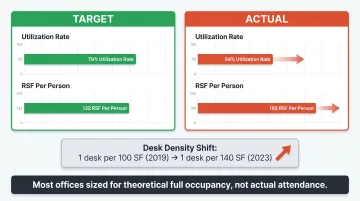
The cost case is just as compelling. Fixed, over-built offices waste money on space that sits empty. Traditional 1:1 desk-per-headcount ratios rarely reflect how people actually work today — WeWork's data shows office density shifted from 1 desk per 100 SF pre-pandemic to 1 desk per 140 SF by 2023, a 40% reduction in space per person.
The utilization gap is even sharper at scale. JLL's 2025 Occupancy Planning Benchmark Report found global office utilization reached only 54% against a target of 79%, with space per person averaging 165 RSF versus a target of 132 RSF. The numbers point to the same conclusion:
- Most offices are sized for theoretical full occupancy, not actual attendance
- Space per person is consistently over-allocated across industries
- Utilization targets are missed by 25+ percentage points on average
Flexible design lets companies plan around real attendance patterns — so they're not paying for square footage that goes unused most of the week.
The 6 Core Flexible Workspace Design Strategies
Activity-Based Zoning
Activity-based zoning is the foundation of flexible design. Instead of assigning every employee a desk, you design distinct zones that match types of work: focused work, collaboration, social interaction, private calls, and learning.
Each zone should have:
- Clear purpose — defined by the work mode it supports
- Appropriate furniture — tables for collaboration, quiet carrels for focus, lounge seating for informal chats
- Acoustic treatment — sound-absorbing materials in quiet zones, hard surfaces in collaborative areas
- Visual cues — lighting, color, or layout that signals the zone's intended use
According to CBRE, nearly 30% of employees value flexibility to work in different places within the office, and 88% of highly engaged employees value having the option to choose where and how they work.
Flexible and Modular Furniture
Furniture is the mechanism for flexibility. The right modular kit lets teams rearrange a space in hours, not weeks — no construction required. WeWork's report notes that 76% of companies now request height-adjustable desks, and 26–35% of all work points in modern offices are informal settings, not traditional desks.
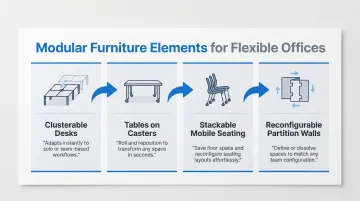
Key modular elements to build in:
- Desks that cluster for team sprints or separate for individual focus
- Tables on casters for fast reconfiguration
- Stackable and mobile seating
- Reconfigurable partition walls that redefine zones without permanent walls
Technology Integration Throughout
Without reliable tech infrastructure, flexible zoning falls apart fast. Employees need:
- Reliable wireless coverage in every zone
- In-room video conferencing capability
- Screen-sharing tools accessible from any seat
- Easily accessible power and data points
Steelcase research describes the goal as technology that works behind the scenes — real-time translation, smart lighting adjustments, seamless connectivity — so employees focus on the work, not the setup.
Acoustic Design and Sound Zoning
Acoustic failures are the #1 reason flexible offices break down in practice. An open collaboration area next to quiet focus work creates constant distraction and complaints.
Practical solutions:
- Sound-absorbing panels in quiet zones
- Carpeted quiet areas vs. hard-surface collaborative areas
- White noise systems to mask distracting sounds
- Enclosed phone/video call booths
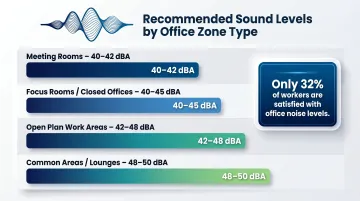
Acoustics research from Soft dB recommends:
- Meeting rooms (video-equipped): 40-42 dBA
- Closed offices/focus rooms: 40-45 dBA
- Open plan work areas: 42-48 dBA
- Common areas (cafeterias, lounges): 48-50 dBA
Only 32% of workers report satisfaction with office noise levels, ranking acoustic comfort among the lowest-rated workplace attributes. Acoustic interventions improve focus and task accuracy by 20-30% vs. untreated spaces.
Lighting Optimization
Lighting does two jobs in a flexible workspace: it supports task performance with well-lit, glare-free surfaces, and it sets the tone for each zone — warmer light in lounge areas, cooler light where deep focus happens.
Maximizing natural light improves both wellbeing and energy efficiency. Cornell University research studying 313 office workers across 5 locations found workers in daylit environments reported an 84% drop in eyestrain, headaches, and blurred vision, plus a 10% decrease in drowsiness and 2% increase in productivity—estimated at approximately $100,000 per year for every 100 workers.
Layered lighting approaches:
- Ambient lighting — general overhead illumination
- Task lighting — adjustable desk lamps for individual work
- Accent lighting — highlighting architectural features or defining zones without hard walls
Biophilic Design Elements
Biophilic design connects people to nature inside the office — through plants, natural materials, outdoor views, and natural light. The performance data behind it is hard to ignore.
The Human Spaces Report (Interface, 2015) surveyed 7,600 office workers across 16 countries and found offices with natural elements deliver:
- +15% higher wellbeing
- +6% higher productivity
- +15% higher creativity
Yet 47% of workers report having no natural light in their office, and 58% have no live plants in their workspace.
Biophilic elements don't require a full renovation. Plants, natural wood finishes, and seating positioned near windows make a measurable difference in how a space feels — and how long people stay engaged.
Essential Zones in a Flexible Office
Collaboration and Open Work Areas
Well-designed open collaboration zones include large communal tables, writable surfaces (whiteboards or glass walls), shared screens or displays for group brainstorming, and positioning that encourages organic interaction.
These areas should represent a targeted percentage of total floor space rather than the entire footprint. Gensler research found that 65% of workers prefer a model combining open areas for working with others and private spaces for individual deep focus—not one or the other.
WeWork's 2024 data shows 68% of enterprise design requests are for spaces to improve productivity (focus rooms, customized boardrooms), while 32% are for spaces enhancing culture and wellbeing (all-hands spaces, wellness rooms).
Focus and Quiet Zones
Quiet zones are where individual focus actually happens—and employees rank them as essential. "To focus on my work" is the #1 ranked reason employees come into the office across all industries and generations, according to Gensler.
What makes these zones work:
- Visual separation from busy areas
- Acoustic treatment (carpet, sound-absorbing panels)
- Lower-stimulus design (neutral colors, minimal foot traffic)
- Clear social norms or signage reinforcing the quiet expectation
Private Phone and Video Call Spaces
Once focus zones protect individual work, the next gap to close is private call space. Enclosed, bookable rooms are non-negotiable in hybrid offices—video calls from open floors disrupt everyone nearby and put the caller at a disadvantage.
Steelcase research (2025) found:
- 69% of middle managers lack needed privacy
- 50% of people resort to video calls at their desks when no private areas are available
- 56% of meetings now include remote participants, requiring acoustic and visual separation
WeWork's report confirms the demand: 50% of new enterprise buildout requests now include focus pods. A practical rule of thumb: plan one pod per every 10-15 employees to avoid chronic booking conflicts.
Social and Lounge Areas
Well-designed social spaces retain employees and reinforce company culture. The right mix of elements makes a lounge feel like a destination rather than an afterthought:
- Comfortable, varied seating (sofas, bar stools, lounge chairs)
- Proximity to the pantry or kitchen for informal gatherings
- Natural light and greenery to reduce workplace fatigue
- Informal layouts that invite unplanned conversation
WeWork's data shows lounge space grew from 12% to 19.3% of total office area post-pandemic, reflecting this strategic shift. Gensler's 2025 survey found 40% of global workers prioritize access to natural light and operable windows, and 36% prefer workspaces enhanced with greenery—often concentrated in lounge areas.
Team Neighborhoods
Team neighborhoods are semi-defined clusters of workstations and nearby collaboration space assigned loosely to a team or department. This gives teams a consistent home base without assigning permanent individual desks.
The model threads a needle that pure hot desking misses. Each neighborhood typically includes:
- A cluster of unassigned workstations sized to the team
- A small collaboration table or huddle space within the zone
- Shared storage for personal items
- Proximity to the team's most-used amenities (printer, whiteboards)
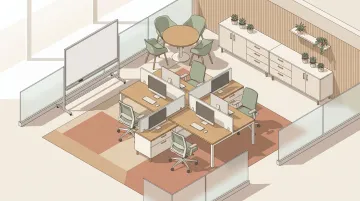
This keeps teams physically near each other day-to-day while preserving the seat flexibility that reduces wasted real estate.
How to Plan and Implement Flexible Workspace Design
Step 1 – Audit Your Current Space and Work Patterns
Before moving a single piece of furniture, map how your team actually uses the space:
- Which areas are underused?
- Where do bottlenecks occur?
- What work modes happen most frequently?
- What is typical in-office headcount on different days?
This audit is the evidence base for every design decision that follows. JLL's 2025 report notes that 90% of organizations now use badge swipe data, 49% use reservation systems, and 41% use visual observations to track utilization—evidence that most organizations have moved well beyond gut-feel space planning.
Step 2 – Define Your Zone Mix and Space Ratios
Based on the audit, determine the right ratio of collaboration to focus to private space for your team's work patterns. There is no universal formula—a product and engineering team will have very different needs than a client-facing sales team.
A practical starting point:
- List your most common work modes (solo deep work, team brainstorming, client calls, informal collaboration, learning)
- Estimate hours per week each mode occupies
- Map that to zone types and space volumes needed
Gensler emphasizes designing for "degrees of openness" tailored to each organization's work patterns rather than applying a one-size-fits-all formula.
Step 3 – Select Furniture and Infrastructure for Adaptability
When sourcing furniture, prioritize mobility and reconfigurability over aesthetics. Modular systems that can be rearranged without tools are significantly more cost-effective over a 3-5 year lease than fixed built-ins.
Similarly, invest upfront in tech infrastructure—wiring, power access, AV—that will enable the space to flex without requiring expensive retrofits later. WeWork's report emphasizes "reconfigurable layouts" and "furniture bundles" (reconfigurable soft seating, rugs, mobile AV kits, space dividers) as cost-effective strategies for dynamic offices.
Step 4 – Pilot, Measure, and Adjust
Implement changes in phases and treat the first 4-8 weeks as a learning period:
- Measure actual zone utilization
- Gather employee feedback
- Observe where people naturally gravitate vs. where they avoid
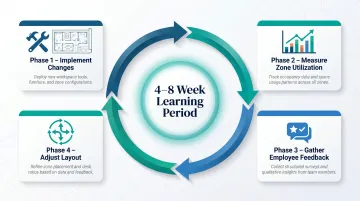
Use this data to make targeted adjustments before committing to the full layout. A flexible workspace should itself be designed flexibly—expect to iterate.
Step 5 – Partner with Experts Who Know Buildout and Leasing
Once iteration informs your final layout direction, execution becomes the hard part: coordinating lease terms, construction management, furniture procurement, and timeline management across multiple vendors.
For NYC-based companies, Nomad Group handles this as a single integrated process rather than a vendor relay. Their team identifies floor plates that support flexible layouts—open configurations, natural light distribution, structural flexibility for partitions—and executes buildouts in as little as 90 days through in-house construction and design.
The firm has completed over 300 tenant buildouts and manages more than 2 million square feet across neighborhoods like Flatiron, NoMad, SoHo, and Williamsburg. That depth of experience means they understand both the real estate and operational sides of flexible workspace design—not just how to find the space, but how to make it work.
Frequently Asked Questions
What does "flexible office space" mean?
A flexible office space is one designed to adapt to changing work needs—featuring movable furniture, shared zones, and bookable private spaces rather than fixed assigned desks for every employee. It supports multiple work modes within the same footprint.
What are the most important design elements of a flexible workspace?
The key elements are activity-based zones (focus, collaboration, social, private), modular furniture, integrated technology, acoustic treatment, and natural light. All five work together. Remove any one element and the others lose effectiveness.
How does flexible workspace design support hybrid work?
Hybrid work creates uneven daily attendance, so flexible design plans for variable occupancy. It optimizes space for collaboration on peak days while still supporting focused individual work for smaller groups on quieter days, eliminating wasted space.
What's the difference between hot desking and activity-based working?
Hot desking simply means seats aren't pre-assigned. Activity-based working is a broader strategy where different zones are designed for different work modes, and employees choose their setting based on the task at hand.
How do I evaluate whether a potential office space is suited for flexible design?
Prioritize these structural qualities during your search:
- Open floor plates that can be zoned without major construction
- Good natural light distribution throughout
- Structural flexibility for partitions and movable walls
- Adequate ceiling height and power/data infrastructure for tech-enabled zones
Spaces with excessive structural columns or limited windows are harder to retrofit effectively.
How long does it typically take to build out a flexible office in NYC?
Timeline varies based on scope and landlord terms. For small-to-mid-size companies, well-managed NYC buildouts typically complete in 60–90 days when working with a team that handles design, permitting, and construction under one roof — Nomad Group's in-house model is built around exactly that turnaround.