Introduction
For early-stage startups, choosing the wrong office space isn't just inconvenient—it's a runway problem. Many early-stage companies struggle with the tension between unpredictable headcount projections and binding long-term real estate commitments. According to Cushman & Wakefield, 55% of global occupiers now use flexible office solutions, with 17% planning to increase their use. In a market where Series A startups must stretch 18-24 months of runway while maintaining the optionality to scale or contract quickly, workspace decisions carry real financial consequences.
The companies aligning their physical environment with operational needs are gaining an edge. As hybrid work becomes the default and pressure to operate lean intensifies, demand for smarter, more adaptive office solutions keeps growing. The gap between traditional lease structures and how startups actually scale has never been more visible.
Key Takeaways
- AI-powered environments personalize workspaces in real time, cutting energy costs by 20-30%
- Modular design lets teams scale without costly rebuilds — setups finish 30-75% faster than traditional construction
- Hybrid-ready infrastructure removes friction for distributed teams—78% of workers rank reliable connectivity as their #1 space requirement
- Wellness features drive retention and productivity, with biophilic design reducing sick days by 20%
- Managed flex offices compress move-in timelines to 90 days and eliminate six-figure upfront buildout costs
AI-Driven Smart Office Environments
AI-driven workspace environments integrate IoT sensors, machine learning, and occupancy data to auto-adjust lighting, temperature, acoustics, and desk configurations based on actual usage patterns. For startups, that means smart conference rooms that modify settings based on meeting size, AI systems that identify underutilized zones, and platforms that eliminate wasted square footage by tracking real-time occupancy.
Why this matters for resource-constrained startups:
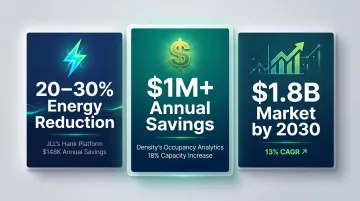
- JLL's AI-powered HVAC platform Hank typically delivers 20-30% energy reductions, with one Royal London case study hitting 21% lower consumption and $148,000 in annual savings
- Density's occupancy analytics helped a top e-commerce company save over $1M annually and increase office capacity by 18%
- The AI-based occupancy analytics segment is projected to reach $1.8B by 2030 at a 13% CAGR
Workspace platforms that combine AI with space analytics now offer occupancy dashboards, ghost meeting detection, and amenity preference tracking as standard features. Small teams can operate with the spatial efficiency of organizations 3-4 times their size.
Modular Design & Flexible Space Configuration
Modular workspace design uses movable walls, reconfigurable furniture, and adaptable layouts to transform a single floor plate from collaboration hub to focus zone within hours. For startups that routinely restructure teams or outgrow headcount projections, this flexibility prevents spaces from becoming operational liabilities.
Real-world adoption examples:
- Soundproof pods that reconfigure for 1:1s or all-hands meetings
- Mobile partition systems that create private offices without construction permits
- Multi-functional common areas with writable walls and rolling furniture
Financial impact:
Those configuration options translate directly to cost. Traditional Manhattan buildouts run $140-$260/sqft, with a 6,000 sqft tech office costing $1.2M-$1.5M and requiring 18-32 weeks. Modular approaches complete in 4-12 weeks—30-75% faster—and reduce material costs by up to 15% through precise manufacturing.
Why this matters for scaling startups:
Every time a startup scales a function or shifts to hybrid, traditional spaces require expensive tenant improvement re-builds. In NYC, where lease terms often run 5-7 years, a team that doubles in year two can't afford to wait 6 months and spend $500K reconfiguring a space. Modular systems absorb that growth without touching walls or triggering a new buildout cycle.
Hybrid-Ready Tech & Device-Agnostic Infrastructure
Hybrid-ready infrastructure covers high-speed redundant internet, video-conferencing-equipped rooms, smart AV systems, and cloud-connected environments. The goal: everything works the same whether an employee is in-office with a laptop or dialing into a board meeting from a mobile device.
For distributed teams and remote engineers, that consistency is what keeps work moving.
78% of office workers rank reliable internet as their top priority when selecting office space—above location, amenities, and views. When connectivity fails, 61% stop working entirely, with productivity dropping 60% during outages.
Current hybrid landscape:
- 51% of US remote-capable employees worked hybrid as of May 2025
- Employers expect 3.2 days/week in-office; actual attendance averages 2.9 days
- 96% of organizations still struggle to adapt office setups for hybrid work
Those gaps point to a real opportunity. Spaces built with device-agnostic infrastructure close them.
What device-agnostic looks like in practice:
Booking systems, office management platforms, and AV tools that run across iOS, Android, Windows, and Mac without IT troubleshooting. For startups without a dedicated IT team, that means new hires are up and running on day one—regardless of what device they bring.
Wellness Integration & Sustainable Workspace Features
Wellness-integrated workspaces have shifted from nice-to-have perks to baseline talent expectations. For startups competing for top hires, features like quiet zones, biophilic design, natural light optimization, air quality monitoring, and dedicated recharge areas now directly influence whether candidates accept offers—and whether employees stay.
Proven Productivity Impact
- Workers in offices with optimized natural daylight reported an 84% drop in eyestrain and headaches, plus a 2% productivity increase worth ~$100,000 annually per 100 workers
- Employees in biophilic environments report 15% higher well-being and take 20% fewer sick days
- 67% of employees say healthy environments make them more productive; over two-thirds would accept or stay at a job based on environmental quality
The productivity data makes a strong case for wellness features on their own. But for startups raising capital or recruiting in competitive markets, the sustainability angle adds another layer of value.
Sustainability as a Signal
ESG-aligned features—energy-efficient HVAC, motion-sensor lighting, sustainable materials—let startups demonstrate their values to employees and investors alike. JLL research shows an average green premium of 7.1% in North America, with 78% of tenants prioritizing energy-efficient buildings.
Flexible Lease Structures & Managed Turnkey Office Solutions
The structural innovation: replacing 5–10 year traditional leases with short-term agreements and all-inclusive managed offices where furniture, tech, and buildout are bundled into one predictable monthly cost.
Why This Matters for Series A Startups
Capital is constrained, headcount projections are uncertain, and leadership cannot afford to lock up runway in real estate deposits or get distracted by construction management.
Timeline Comparison
| Lease Type | Total Timeline | Breakdown |
|---|---|---|
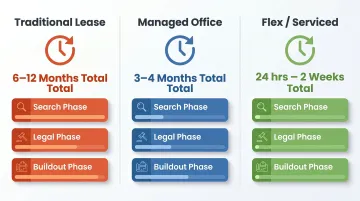
| Traditional lease | 6–12 months | Search: 3–6 mo, Legal: 1–2 mo, Fit-out: 2–3 mo |
| Managed office | 3–4 months | Search: 1–2 mo, Legal: 2–4 wk, Buildout: 4–8 wk |
| Flex/serviced | 24 hrs – 2 weeks | Contracts same-day, move-in within 24 hrs |
That speed gap is exactly what Nomad Group's managed flex model was designed to close.
The Flex by Nomad Model
Nomad Group's managed flex service is built on in-house infrastructure, handling everything from buildout to facilities management with timelines compressed to 90 days from signed lease to occupancy. This model sits between coworking and traditional leases — offering private, brandable space with flexibility built in.
For Series A companies in NYC that have outgrown shared desks but aren't ready to sign a 5-year lease, managed flex is the practical middle ground: dedicated space, no six-figure upfront costs, no extended terms locking up runway before the next funding round.
What's Driving These Innovations—And What Startups Should Watch Next
Core market forces:
- Hybrid work normalization—85% of organizations now require at least 3 days/week in-office
- Post-pandemic talent expectations around environmental quality and wellness features
- Rising Manhattan buildout costs ($140-$260/sqft) pressuring startups to maximize every square foot
- Smart building technology becoming more accessible and affordable
Demand signals:
The global flexible workspace market was $14.91B in 2023 and is projected to reach $40.47B by 2030—a 15.7% CAGR. Among companies planning workspace expansion in the next two years, 59% are choosing flexible space over traditional offices.
Those numbers reflect where demand is already moving. The technologies below show where the market is heading next.
Watch in the next 1-3 years:
- Spatial computing and AR overlays for collaborative work—connecting remote and in-office teammates in shared visual workspaces
- AI-powered lease optimization tools that match companies to spaces based on actual usage patterns, not headcount estimates—companies using AI in real estate already report 23% faster transaction times and 18% more accurate valuations
- Unified workspace operating systems consolidating property management, booking, analytics, and facilities into a single platform
Strategic note:
Startups that treat workspace as an operational and cultural asset—not just a line item—tend to make smarter decisions earlier. That means selecting providers who understand growth trajectory: what a 20-person Series A team needs from a Flatiron buildout looks very different from what that same company needs at 60 people. Getting ahead of that curve is where the real advantage lies.
Frequently Asked Questions
Which flexible workspace brands are most innovative?
Innovation varies by use case. Coworking platforms like WeWork and Industrious lead in network scale and amenity density, while managed private flex providers excel in customization and dedicated space. At this point, tech integration and design-forward spaces are baseline expectations — the real differentiator is how well a provider adapts to your specific growth stage.
What are the top flexible workspace brands and coworking companies in the US?
Major players include IWG/Regus, WeWork, Industrious, and Spaces, which offer broad national networks. Beyond the nationals, boutique managed office providers deliver more tailored experiences and dedicated private space for startups outgrowing shared desk environments.
What do startups look for most in a flexible office space?
The priorities that consistently rise to the top:
- Lease flexibility and scalability without renegotiation
- Fast move-in timelines (under 90 days)
- Reliable tech infrastructure
- Professional brand identity without long-term capital commitments
- Predictable all-in costs with minimal operational overhead
What is the difference between a flexible workspace and a traditional office lease?
Traditional leases require multi-year commitments (typically 5-10 years), upfront buildout costs of $140-$260/sqft in Manhattan, and fixed square footage. Flexible workspaces offer shorter terms, included amenities and furniture, and the ability to scale headcount up or down as business conditions change.
How does a flexible workspace support a startup during rapid growth?
Flexible workspaces remove facilities management overhead, allow headcount expansion without lease renegotiations or costly re-builds, and free leadership to focus on product and revenue rather than real estate logistics. This operational simplicity becomes critical when capital and attention are scarce.