Introduction
Early-stage startups face a fundamental tension: they need professional workspace immediately, but traditional office leases demand 6-12 months of buildout, significant capital outlays, and long-term commitments that don't match startup timelines or financial realities.
The milestone of "getting an office" often gets framed as a symbol of growth. But the real question isn't whether to get an office — it's what type, and whether that choice will support or sabotage your runway.
The wrong decision shows up fast: construction delays push hiring timelines back by months, buildout costs consume capital better spent on product development, and inflexible leases lock startups into space they can't fill or exit without penalty.
This article breaks down the specific, operational reasons why move-in ready office spaces are built for how startups actually operate — and what to look for when evaluating your options.
Key Takeaways
- Move-in ready offices allow startups to begin working within days, skipping the 6–12 month buildout process entirely
- Capital expenses become one predictable monthly cost — no surprise contractor invoices or fit-out overruns
- Flexible lease terms let startups scale up or down without financial penalties
- A professional address in Flatiron or NoMad makes fundraising conversations easier and helps close competitive hires
- Traditional buildouts can consume 3–6 months of runway before a single hire starts — a cost most early-stage teams can't absorb
What Is a Move-In Ready Office Space?
A move-in ready office — also called plug-and-play or pre-fitted space — is a fully furnished, equipped workspace that a startup can occupy and begin operating from immediately upon signing. No construction phase. No furniture procurement. No IT infrastructure setup. You sign the lease, hand out keys, and get to work.
This sits between two extremes in the office spectrum. On one end, coworking hot desks offer flexibility but lack privacy, brand control, and dedicated space. On the other end, raw-shell leases give you total customization but require full buildouts that take months and consume significant capital. Move-in ready offices occupy the middle ground: dedicated, private space that happens to be already built.
CBRE defines plug-and-play offices as spaces with "little to no capital expenditure when starting," delivered furnished and wired so tenants can "sit down and get right to work."
Unlike coworking, you get your own entrance, kitchen, conference rooms, and branding. Unlike subleases with shared internet, you control your IT infrastructure — the wiring is pre-installed, but you choose and manage your own service provider.
The result: real estate stops competing with the business for time, capital, and attention — and starts working alongside it.
Key Advantages of Move-In Ready Office Spaces for Startups
The advantages below aren't abstract benefits. They're grounded in the operational realities of running a startup: burn rate, team velocity, investor perception, and the ability to pivot without being locked into fixed overhead.
Speed and Operational Momentum
Move-in ready offices eliminate the 6-12 month buildout timeline typical of traditional NYC office projects. A startup can sign and move in within days or weeks, keeping the team productive without disruption.
What you avoid:
- 6-10 weeks of space planning and design
- 8-16 weeks of permitting and approvals (longer for landmark buildings)
- 8-20 weeks of construction execution
- 2-4 weeks of punch list and closeout
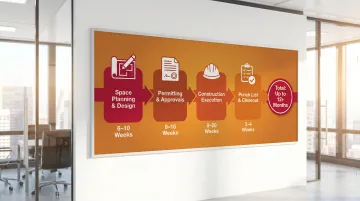
Every hour a founder would spend coordinating a buildout (managing architects, expeditors, DOB permits, FDNY reviews, contractor schedules) is instead spent on product development, sales conversations, or hiring. That's time measured in hires made and revenue conversations started.
29% of startups fail because they ran out of cash, per CB Insights analysis of 483 post-mortems. Multi-month buildout delays ripple directly into team onboarding, execution timelines, and the milestones investors expect between funding rounds. For pre-Series B companies — immediately post-funding, when hiring speed and early traction matter most — a 6-month non-productive interval is a liability they can't absorb.
In one example, Nomad Group completed a full buildout for Extend in just 5 weeks, transforming a white-box space into a functional office. But even that accelerated timeline is slower than the instant occupancy a move-in ready space provides.
Capital Efficiency and Cost Predictability
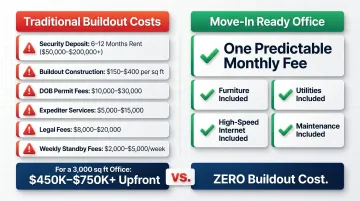
Speed savings and capital savings compound together. Traditional custom buildouts require significant upfront capital — and in NYC, office buildout costs range from $150-$250 per square foot for mid-range professional finishes, with high-end projects exceeding $400 per square foot. For a 3,000-square-foot office, that's $450,000 to $750,000 before furniture, fixtures, or equipment.
Add to that:
- Security deposits of 6-12 months' rent for startups without established credit history
- DOB permit fees (approximately 2% of construction costs)
- Expediter services ($5,000-$25,000)
- Legal and administrative fees ($2,000-$5,000)
- Standby fees for construction delays ($2,000-$5,000 per week)
Move-in ready spaces consolidate these costs into a single monthly fee that includes furniture, utilities, internet, and often maintenance. Unpredictable capital expenditures become predictable operating expenses, which matters when every dollar of runway has a job to do.
There's also a structural financial reason to prefer this model: VCs favor OpEx-heavy businesses. SaaS companies (OpEx-driven) trade at an average of 3.0x EV/Revenue versus hardware companies (CapEx-heavy) at 1.4x. Office rental qualifies as OpEx with an immediate 100% tax deduction in the year incurred — versus CapEx, which gets amortized over several years.
KPIs impacted:
- Monthly burn rate (lower, more predictable)
- Runway length (preserved capital extends runway)
- Capital available for hiring and product development
- Cost per employee for workspace
When Nomad Group helped Authentic Insurance transition from coworking to a dedicated office in Flatiron, the company achieved 30% cost savings compared to their previous coworking setup while gaining infrastructure for 40+ desks and a space that reinforced their brand.
Flexibility and Scalability Without Penalty
Startups grow, and sometimes shrink, faster than traditional 5-10 year leases allow. Move-in ready offices typically come with shorter lease terms (1-3 years or flexible structures), allowing companies to right-size their space as their team evolves.
The practical upside: A team of 10 can move into a space designed for 10. When they hire 15 more employees, they can transition to a larger suite without the financial penalty of breaking a long-term lease or sitting in underutilized, expensive custom-built space.
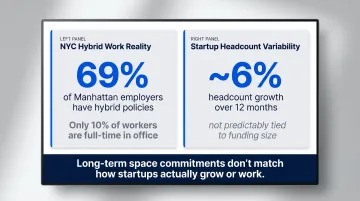
Analysis of startup hiring data found that top-quartile fundraisers (Seed through Series C) grew headcount by approximately 6% over twelve months — with no statistically significant difference from lower-quartile fundraisers. Headcount is highly variable and not predictably tied to funding size, making long-term space commitments a real gamble.
Add to this: 69% of Manhattan employers now have hybrid office policies, and only 10% of workers are in the office full-time. Locking into a lease based on pre-pandemic space assumptions creates expensive inefficiency.
Early lease termination penalties in NYC can include loss of security deposit, remaining rent obligations for the full lease term, and litigation costs. Move-in ready offices with flexible terms eliminate this risk.
What Happens When Startups Choose Traditional Leases Instead
Startups that commit to raw-shell or long-term traditional leases too early face compounding consequences: buildout costs that exceed initial estimates, delays that push move-in dates back by months, and lease obligations that outlast the company's current headcount requirements.
The less visible cost is management bandwidth. Overseeing a buildout project pulls founders and operations leaders away from core priorities at exactly the wrong time:
- Coordinating contractors and subcontractors
- Navigating design approvals and change orders
- Managing DOB permits and FDNY reviews
- Securing certificates of occupancy and insurance documentation
McKinsey analysis of large-scale construction projects found that projects take 20% longer than planned and can exceed budgets by up to 80%. While these figures reflect large capital projects ($100M+), the pattern holds for commercial tenant improvements too — especially in NYC's regulatory environment.
Real-world example: Knotel, a NYC-founded flexible workspace startup, signed long-term master leases (often 10-15 years) and subleased to tenants on shorter terms. When COVID-19 reduced demand, the company filed for Chapter 11 bankruptcy with massive lease obligations while revenue from sub-tenants evaporated. The company had reached a peak valuation of $1.6 billion. Newmark acquired its assets for $70 million.
Knotel's collapse was extreme — but the underlying miscalculation isn't unique to unicorns. Nomad Group has seen the same dynamic play out at the startup level: teams that lock into inflexible leases before validating their space needs face a binary choice between staying cramped as they scale or absorbing costly early-termination fees. A move-in ready office removes that decision entirely.
How to Get the Most Value from a Move-In Ready Office Space
A move-in ready office delivers its full value when startups treat the space decision strategically.
Match size to current headcount with a 12-18 month growth projection: Don't over-build for a future team that may look very different. Right-size now, with the understanding that you can transition to larger space when growth justifies it.
Clarify exactly what is included in the lease before signing: Furniture, internet, utilities, cleaning, and building amenities vary significantly between providers. Unexpected add-ons erode the cost advantage that makes move-in ready appealing in the first place.
Key questions to ask:
- Is high-speed internet included, or is it a separate contract?
- Are meeting rooms shared or dedicated?
- What cleaning and maintenance services are covered?
- Are there after-hours HVAC fees or parking costs?
- Can you customize branding elements (signage, wall colors)?
Those questions matter more than most startups realize — and having the right advisor to walk through them changes outcomes. Nomad Group's Flex by Nomad model is built specifically for this. Startups get access to move-in ready spaces across NoMad, Flatiron, SoHo, and Williamsburg, with full transparency on what's included. With 300+ tenant buildouts and over 2 million square feet leased, the guidance comes from real execution.
When Optimove needed a new headquarters, Nomad Group found a sublease with a high-end buildout and a 3,000+ sq ft private rooftop. The new space wasn't available for three months — so Nomad arranged temporary swing space to ensure zero downtime. That kind of continuity reflects operational infrastructure most brokers simply don't have.
Conclusion
Move-in ready offices protect the two resources early-stage startups can least afford to lose: capital and time.
A startup that moves fast, controls costs, and retains flexibility in its early years is better positioned to scale on its own terms. Choosing a move-in ready space is one of the most direct ways to keep the office working for the business, not against it.
Months spent waiting on a buildout are months not spent hiring or shipping product. Construction costs that tie up capital are dollars pulled away from customer acquisition and R&D. For most early-stage startups, the right office decision isn't complicated — it's the one that keeps momentum going from day one.
Frequently Asked Questions
What are the benefits of coworking spaces for startups?
Coworking spaces offer low-commitment, flexible desk access with shared amenities and networking opportunities. For teams that need privacy, focus, or a stable home base, a move-in ready private office is typically the better fit.
How is a move-in ready office different from a coworking space?
Coworking spaces offer shared, flexible desk environments while move-in ready offices are private, dedicated spaces that happen to be pre-furnished and immediately occupable. You get the focus and brand presence of a traditional office without the buildout timeline.
What is typically included in a move-in ready office space?
Most move-in ready offices include furniture, high-speed internet, utilities, building amenities (meeting rooms, common areas), and maintenance. Inclusions vary by provider — dedicated IT support and phone systems are commonly excluded, so confirm the full scope before signing.
How quickly can a startup actually move into a move-in ready office?
Most move-in ready spaces allow occupancy within days to a few weeks of signing. Custom buildouts, by contrast, typically take 6–12 months — making move-in ready offices the faster path to a functioning workspace.
Is a move-in ready office the right choice for every startup?
Move-in ready offices work best for startups that need speed, low upfront costs, and room to scale — generally from founding through Series B. Companies with stable headcount and a defined brand identity often find custom buildouts worth the investment.
What should a startup look for when evaluating a move-in ready office in NYC?
Evaluate what's included in the lease (furniture, utilities, IT), lease term flexibility, and location relative to your talent pool and clients. Working with a specialist like Nomad Group gives you access to vetted options across NYC's top startup neighborhoods — Flatiron, NoMad, SoHo, and beyond.