The stakes are high. Manhattan logged nearly 39.8 million square feet of office leasing in 2025, up over 4% year-over-year, with availability tightening to 15%. That's a seller's market — and it moves fast.
This guide covers everything a high-growth company needs to navigate it: space types, key neighborhoods, current pricing benchmarks, lease structures, and a step-by-step approach to securing the right space without costly mistakes.
Key Takeaways
- NYC commercial spaces span office, retail, restaurant, medical, and industrial categories — each with distinct zoning requirements
- Prime neighborhoods include Midtown, NoMad, Flatiron, SoHo, and Williamsburg, each serving different industries and budgets
- Q4 2025 asking rents range from ~$58/SF downtown to ~$85/SF in Midtown and Midtown South
- Lease structure (gross, net, modified gross) significantly affects your true monthly cost beyond base rent
- A specialized NYC tenant's broker costs you nothing — landlords pay the fee — and you'll almost always walk away with better terms
Types of Commercial Spaces Available for Lease in NYC
Office Space
The broadest category, covering traditional corporate offices, creative loft environments, and everything in between. Buildings are typically classified as:
- Class A — premium finishes, full-service amenities, institutional landlords
- Class B — functional, well-located, lower cost than Class A
- Class C — older stock, minimal amenities, value-driven tenants
For scaling startups and tech companies, Class B buildings in Midtown South — particularly NoMad and Flatiron — offer the right balance of quality and cost.
Other Commercial Space Categories
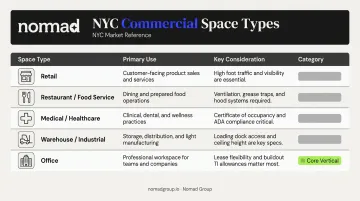
| Space Type | Primary Use | Key Consideration |
|---|---|---|
| Retail | Storefronts, pop-ups, flagship locations | High foot traffic areas command significant premiums |
| Restaurant/Food Service | Dining, ghost kitchens, food production | Requires specific zoning and ventilation infrastructure |
| Medical/Healthcare | Clinical offices, therapy practices | Community facility zoning required in many cases |
| Warehouse/Industrial | Storage, light manufacturing, distribution | M-district zoning; limited Manhattan availability |
Zoning and Certificate of Occupancy: Verify Before You Sign
NYC's Department of City Planning classifies districts as Commercial (C1–C8), Manufacturing (M1–M3), or Special Mixed Use (MX). The zoning district determines what uses are legally permitted — a space that looks right may not be legally usable for your specific business.
Restaurant, medical, and industrial tenants should verify both zoning designation and Certificate of Occupancy before signing anything. A C of O mismatch — where the listed use doesn't match your business type — can trigger costly remediation, delayed openings, or forced relocation.
Flexible and Hybrid Office Space
Post-Series A companies increasingly opt for spaces that blend private offices with shared infrastructure — dedicated without the overhead of a full custom buildout. Nomad Group's Flex by Nomad service was built for exactly this stage: private, fully managed space with in-house construction and operations support, at costs well below what traditional coworking operators charge for comparable square footage.
Top NYC Neighborhoods for Commercial Leasing
Midtown Manhattan
NYC's most established commercial hub: Grand Central, Bryant Park, and the Penn Station corridor. Midtown is the default address for enterprise companies, financial services firms, and professional services organizations that need Class A infrastructure and maximum transit access.
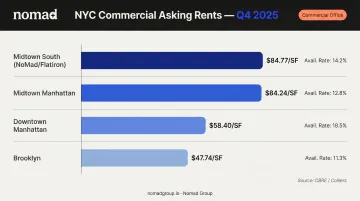
CBRE reported Midtown asking rents at $84.24/SF in Q4 2025, with availability at 13.4%, among the tightest in the city. Inventory is wide, but competition for large contiguous blocks is real.
NoMad and Flatiron District
This corridor has become the default destination for high-growth tech companies, AI startups, and creative agencies. The building stock skews toward design-forward, character-rich spaces: high ceilings, generous natural light, and floor plates that actually support collaborative work.
Nomad Group refers to this stretch as "Unicorn Lane," a reference to the concentration of venture-backed, high-growth companies that have planted headquarters here. Clients including Authentic Insurance (30 West 21st Street), Extend AI (135 West 29th Street), and dozens of others across the firm's 2M+ square feet of completed deals call this corridor home.
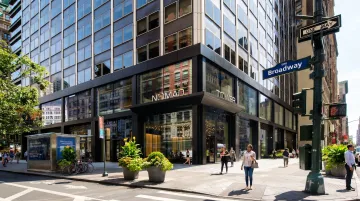
Midtown South (the CBRE submarket that encompasses NoMad and Flatiron) posted Q4 2025 asking rents of $84.77/SF with full-year leasing up 80% year-over-year. That 80% YoY leasing surge is the strongest of any Manhattan submarket.
SoHo and Hudson Square
SoHo attracts media companies, fashion brands, and consumer businesses that need their office to double as a brand statement. Loft-style floor plates, exposed brick, and high ceilings are common. The trade-off is premium asking rents and limited availability for larger footprints.
Hudson Square, just west of SoHo, offers a quieter alternative with similar aesthetics and a growing roster of tech and media tenants.
Union Square and Chelsea
Union Square sits at one of NYC's busiest transit intersections (N/Q/R/L/4/5/6 lines), making it accessible for employees coming from every borough. Rents are generally more competitive than SoHo or Midtown, and the neighborhood attracts a broad mix of industries.
Chelsea trends toward creative studios, tech firms, and art-adjacent businesses, with building stock that ranges from converted warehouse spaces to newer commercial developments.
What draws tenants to this corridor:
- Competitive rents relative to SoHo and Midtown
- Unmatched transit access across six subway lines
- Diverse building stock from converted warehouses to modern commercial product
Williamsburg, Brooklyn
For startups and scaling companies priced out of Manhattan, or simply unwilling to pay Manhattan rates, Williamsburg has become the outer-borough answer. Colliers reported Brooklyn-wide asking rents at $47.74/SF in Q3 2025, with quarterly absorption turning positive.
Nomad Group placed FloraFauna AI at 300 Kent Avenue (The Refinery at Domino) on the Williamsburg waterfront. Within 30 days of move-in, the company came back to double their footprint.
The neighborhood draws a young, technically skilled workforce and delivers Class A product at roughly 45% less than comparable Manhattan space.
How Much Does Commercial Space Cost to Lease in NYC?
Understanding How Rent Is Quoted
NYC commercial rents are typically expressed as an annual per-square-foot rate ($/SF/year). To get to a monthly cost:
(Square footage × Annual $/SF) ÷ 12 = Monthly base rent
A 3,000 SF space at $84/SF/year = $252,000/year, or $21,000/month.
Current Market Rate Benchmarks (Q4 2025)
| Submarket | CBRE Asking Rent | Availability |
|---|---|---|
| Midtown Manhattan | $84.24/SF | 13.4% |
| Midtown South (NoMad/Flatiron) | $84.77/SF | 18.3% |
| Downtown Manhattan | $58.40/SF | 18.8% |
| Brooklyn (borough-wide) | $47.74/SF | 20.1% |
For building class benchmarks, Avison Young's Q4 2025 data shows Class A direct asking rents at $88.68/SF and Class B/C at $64.11/SF across Manhattan.
These figures are asking rents — your actual occupancy cost will be higher once additional expenses are factored in.
Beyond Base Rent: What You're Actually Paying
Base rent is the starting point, not the full picture.
Depending on your lease structure, tenants are commonly responsible for:
- Operating expenses — real estate taxes, insurance, building maintenance
- Utilities — electric, HVAC (sometimes separately metered)
- CAM charges — common area maintenance fees, primarily in retail leases
These costs can add $15–25+/SF annually depending on the building and lease type.
Tenant Improvement Allowances and Concessions
A TI allowance is a landlord contribution toward your buildout costs, expressed in $/SF. This is negotiable and varies based on lease length, tenant creditworthiness, and current market conditions.
National data from CBRE shows average TI allowances declined to $87.51/SF in 2024 from $97.55/SF in 2023 — though gateway markets like NYC have historically skewed higher. Anchoring your TI expectations before the LOI is signed gives you far more leverage than trying to negotiate them in after.
Free rent periods — months at lease commencement where no rent is owed — are another concession available in the right circumstances. These reduce your total occupancy cost and are easiest to secure before the LOI is signed, when landlords still have strong incentive to close.
Understanding Commercial Lease Structures in NYC
The Three Main Structures
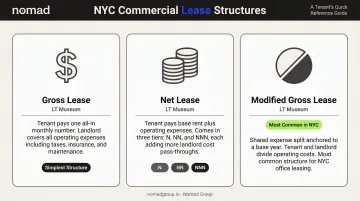
Gross Lease: You pay one all-in monthly number. The landlord covers operating expenses — taxes, insurance, and maintenance — giving you maximum cost predictability.
Net Lease: You pay base rent plus some or all operating expenses separately. Single net (N), double net (NN), and triple net (NNN) leases assign increasing cost responsibility to the tenant. More common in retail than office.
Modified Gross Lease: The most common structure in NYC office leasing. The landlord and tenant split specific operating costs, typically anchored to a "base year" — the landlord covers expenses up to that threshold, and the tenant absorbs any increases above it.
Key Lease Terms That Affect Long-Term Cost
These terms directly shape your total cost exposure:
- Lease duration — Manhattan averages range from ~92 months (Class B/C) to ~120 months (Trophy), per Avison Young Q4 2025 data. Startups should stress-test their headcount plans before committing to the longer end of this range
- Escalation clauses — Annual rent increases, typically tied to CPI or a fixed percentage
- Renewal options — The right (not obligation) to extend at pre-agreed terms
- Sublease and assignment rights — Critical optionality if your space needs change
- Personal guarantees — NYC commercial leases frequently include a "Good Guy Guarantee," limiting personal liability provided you give proper notice and vacate by the agreed date
Terms First-Time Tenants Frequently Overlook
Three clauses that often catch inexperienced tenants off-guard:
- Permitted use clause — Defines exactly what activities are allowed in the space. Overly narrow language can create problems as your business evolves
- Landlord work letter — Specifies precisely what condition the landlord will deliver the space in before occupancy
- Exclusivity provisions (retail) — Prevents the landlord from leasing nearby space to a direct competitor
How to Find and Secure Commercial Space for Lease in NYC
Step 1 — Define Your Requirements
Before searching, establish a clear brief:
- Current headcount and projected growth over 3 years
- Must-have neighborhoods vs. acceptable alternatives
- Budget ceiling (occupancy costs, not just base rent)
- Lease term preference
- Any operational requirements — loading access, ceiling heights, specific zoning
Projecting 3 years out matters because most NYC commercial leases run well beyond that. Underestimating growth is one of the most common and expensive mistakes a tenant can make.
Step 2 — Search the Market Strategically
Public listing platforms like CoStar and LoopNet show a fraction of what's actually available. Off-market opportunities and landlord-direct deals are only accessible through established broker relationships — particularly in high-demand corridors like NoMad and Flatiron.
Nomad Group's 300+ completed buildouts and 2M+ square feet leased across these neighborhoods has built direct working relationships with ownership groups like Justin Management and Kaufman Organizations. Those relationships surface deals and terms that never appear on any public platform.
Step 3 — Tour, Evaluate, and Compare
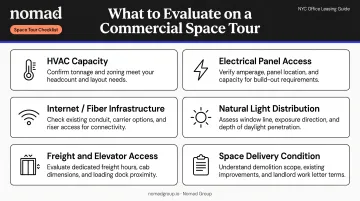
Aesthetics are easy to assess. Focus your tour checklist on what's harder to see:
- HVAC capacity and individual unit control
- Electrical capacity and panel access
- Internet/fiber infrastructure and provider options
- Natural light and its distribution throughout the floor
- Freight and elevator access
- Current space condition (white box vs. built out) and what the landlord will deliver
Step 4 — Negotiate the Letter of Intent (LOI)
The LOI establishes the key economic terms before the full lease is drafted. This is where deals are made, and where inexperienced tenants leave the most money on the table.
Key terms to nail in the LOI:
- Base rent and any phased increases
- Lease term and renewal options
- TI allowance amount and delivery conditions
- Free rent period
- Sublease and assignment rights
Nail these terms before the LOI is signed. Once it's executed, your negotiating leverage drops significantly — and landlords know it.
Step 5 — Manage Buildout and Move-In
The lease signing starts the clock. The buildout phase (permitting, construction, furniture, IT installation) is where timelines slip and budgets overrun.
Nomad Group's in-house construction and design teams handle this phase directly. The Extend AI buildout at 135 West 29th Street went from white box to fully operational (including HVAC) in five weeks. Nomad Group targets a 90-day turnaround — a real advantage when buildout delays can mean months of paying double rent.
Frequently Asked Questions
How much is commercial rent in NYC?
NYC commercial rent is quoted as an annual per-square-foot rate. For Q4 2025, CBRE reported asking rents of $84.24/SF in Midtown and $84.77/SF in Midtown South — both among the pricier submarkets. Downtown Manhattan offers a lower benchmark at $58.40/SF, and Brooklyn averages $47.74/SF borough-wide.
What is considered a commercial building in NYC?
A commercial building in NYC is any property zoned for business use under the NYC Zoning Resolution — offices, retail, mixed-use buildings with commercial ground floors, and industrial structures. Permitted uses vary by district classification: C1–C8 for commercial, M1–M3 for manufacturing.
Can you live in a commercial space in NYC?
Generally, no. Living in a commercially zoned space without a residential Certificate of Occupancy is illegal and puts tenants at risk of fines and eviction. A limited exception exists for qualifying professional fine artists who may reside in specific manufacturing-zoned lofts under NYC's Artist Certification program administered by the Department of Cultural Affairs.
What is the difference between a gross lease and a net lease in NYC?
A gross lease bundles rent and operating expenses into one payment (the landlord covers taxes, insurance, and maintenance); a net lease requires tenants to pay base rent plus some or all of those costs separately. Most NYC office leases use a modified gross structure, splitting specific expense categories between landlord and tenant.
Do I need a commercial real estate broker to lease space in NYC?
There's no legal requirement, but NYC's market is opaque and relationship-driven. A specialized tenant's broker costs you nothing — commissions are paid by the landlord — while providing access to off-market deals, negotiation expertise, and market intelligence that typically results in better economic terms than going direct.