This guide covers everything a business needs to make a confident leasing decision in NYC — from understanding lease structures and building classes to navigating the step-by-step process of finding, negotiating, and building out an office.
Key Takeaways
- Commercial real estate (CRE) refers to any property used for business purposes — office, retail, industrial, or multifamily. This guide focuses on office space.
- Manhattan holds nearly 450–500M SF of office inventory, with asking rents ranging from ~$64/SF (Class B/C) to $143/SF (Trophy).
- Gross, modified gross, and NNN leases produce very different monthly costs — even at the same base rent.
- The leasing process runs from defining requirements through buildout, typically spanning 3–9 months from search to move-in.
What Is Commercial Real Estate? Types and Key Differences
Commercial real estate covers any property used primarily for business or income-generating purposes — not residential living. According to NAIOP, this includes office buildings, retail spaces, industrial facilities, and multifamily investment properties.
The table below breaks down the main CRE property types — but for most NYC businesses actively searching for space, office is where the decision-making happens.
Main CRE Property Types
| Type | Description | NYC Relevance |
|---|---|---|
| Office | Dedicated workspaces for companies | Highest demand for business tenants |
| Retail | Storefronts, restaurants, service businesses | Key for consumer-facing brands |
| Industrial | Warehouses, distribution, manufacturing | Limited in Manhattan; growing in outer boroughs |
| Multifamily | Apartment buildings (investment context) | Relevant for investors, not typical business tenants |
| Hospitality | Hotels, short-term accommodations | Niche; separate market dynamics |
How CRE Differs from Residential
Business tenants face three key differences from residential agreements:
- Lease length: Commercial leases typically run 3–10 years vs. one year for residential
- Pricing: NYC office space is quoted per square foot annually (e.g., $80/SF/year), not as a monthly flat rate
- Negotiation: Commercial leases are business-to-business agreements with no standard consumer protections — every term is negotiable, from free-rent periods and tenant improvement allowances to early termination rights and renewal options
NYC Commercial Real Estate Market: What You Need to Know
Scale and Inventory
Manhattan's office market is one of the largest in the world. Avison Young's Q1 2026 Manhattan Office Report puts total Manhattan office inventory at nearly 501 million square feet, with Midtown accounting for roughly 310M SF, Midtown South at 94M SF, and Downtown at 95M SF.
That scale means there is almost always space available, but finding the right space at the right terms requires knowing where to look.
Vacancy and the Opportunity for Tenants
Post-pandemic hybrid work patterns pushed office vacancy to the highest levels in decades. For tenants, that translates directly into negotiating leverage.
Avison Young reports Q1 2026 Manhattan availability at 14.6%, though the picture varies sharply by submarket:
- Midtown: 13.6% availability
- Midtown South (Flatiron/NoMad): 15.2%
- Downtown: 17.5%
The exception is Trophy-class space, where Midtown direct availability has fallen to 3.4% — a near-full occupancy level that reflects the ongoing flight to quality.
Asking Rents by Building Class and Submarket
Those vacancy gaps show up directly in pricing. NYC office rents span a wide range depending on building quality and location:
| Category | Avg. Annual Asking Rent (Q1 2026) |
|---|---|
| Trophy | $143.04/SF (Full Service) |
| Class A | $88.80/SF (Full Service) |
| Class B/C | $64.22/SF (Full Service) |
| Midtown overall | $98.82/SF (Full Service) |
| Midtown South overall | $87.88/SF (Full Service) |
| Downtown overall | $70.52/SF (Full Service) |
Source: Avison Young Q1 2026 Manhattan Office Report
Key Market Trends Right Now
Several shifts are defining what tenants want in the current market:
- Shorter, smaller leases: Commercial Observer reported in July 2025 that average Manhattan office lease terms dropped to 6.5 years, with average deal sizes falling to 12,500 SF
- Flight to quality: Class A+ buildings are drawing occupancy closer to pre-pandemic levels, while Class B availability remains elevated
- Move-in-ready demand: Tenants increasingly want pre-built or furnished spaces to compress timelines
- Amenity expectations: Direct subway access, outdoor space, wellness infrastructure, and modern HVAC have moved from nice-to-have to table stakes
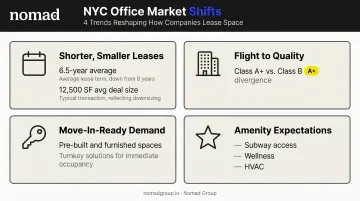
Nomad Group's team sees this pattern in nearly every active search right now: companies are asking what their space says about their culture and growth plans, not just how many desks they can fit.
Top NYC Neighborhoods for Commercial Office Space
Neighborhood choice isn't just about geography — it's about culture, cost, and the kind of company you want to be perceived as. Two buildings six blocks apart can represent entirely different tenant communities, price points, and daily work experiences.
Midtown Manhattan (Grand Central / Park Avenue Corridor)
The traditional home of enterprise-scale companies, financial institutions, and professional services firms. Key characteristics:
- Prestige addresses that signal stability and credibility to clients
- Predominantly Class A and Trophy towers
- Highest average asking rents in the city (~$98/SF full service)
- Best suited for client-facing businesses where address recognition matters
Flatiron / NoMad / Union Square — "Unicorn Lane"
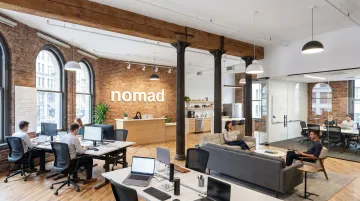
This Midtown South corridor has become NYC's go-to address for high-growth tech, venture-backed startups, and creative companies. Nomad Group has built its core expertise here, completing over 300 tenant buildouts along what the team calls "Unicorn Lane."
Companies like Authentic Insurance (30 West 21st St), Extend AI (135 West 29th St), and Nirvana Health (821 Broadway) all found the corridor's pre-war loft buildings, flexible floorplates, and strong peer ecosystem ideal for scaling teams. Average asking rents run around $87/SF full service — competitive relative to Midtown, with more architectural character than Class B alternatives.
SoHo and Lower Manhattan
The right fit for media, fashion, consumer-facing brands, and creative agencies. Key draws:
- Loft-style spaces with exposed brick and high ceilings — largely concentrated here
- Strong street-level identity that reinforces brand positioning
- Average rents around $70/SF — a meaningful discount to Midtown without sacrificing quality
Brooklyn — Williamsburg and DUMBO
Brooklyn continues to draw startups and creative firms that want more square footage per dollar, proximity to a strong local talent pool, and a neighborhood culture that supports employee retention. Key advantages:
- Average asking rents around $44/SF — roughly half of Midtown
- Access to a deep tech and creative talent pool in North Brooklyn
- Class-A waterfront options like The Refinery at Domino (300 Kent Ave, Williamsburg)
Nomad Group placed FloraFauna AI at The Refinery, a Two Trees Management building in Williamsburg. The company scaled so quickly that within 30 days of move-in, they were ready to double their footprint — a strong signal of what the right space in the right neighborhood can do for a growing team.
Understanding Commercial Lease Types in NYC
The Four Main Structures
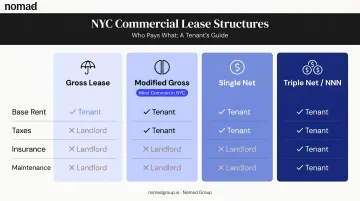
| Lease Type | Who Pays Operating Expenses | Common In NYC? |
|---|---|---|
| Gross Lease | Landlord covers all operating costs | Less common in office |
| Modified Gross | Costs split between landlord and tenant (varies by deal) | Most common in NYC office |
| Single Net (N) | Tenant pays base rent + property taxes | Occasional |
| Triple Net (NNN) | Tenant pays base rent + taxes + insurance + maintenance | More common in retail/industrial |
For most NYC office tenants, a modified gross lease is what you'll negotiate. Base rent is agreed upon, and certain operating expenses — electricity, after-hours HVAC, cleaning — are either included or passed through separately depending on the deal.
Key Lease Terms to Understand Before You Sign
- Asking rent vs. effective rent: Landlord concessions reduce the true cost of a lease. A space asking $85/SF with 6 months free rent and a $100/SF TI allowance often costs less than one asking $80/SF with no concessions.
- Escalation clauses: Most NYC leases include annual rent increases, typically 2–3% per year. At 3% annually, an $80/SF lease reaches roughly $92/SF by year five.
- Personal guarantees: Landlords often require a personal guarantee from founders or a security deposit equivalent to 3–6 months' rent, particularly for early-stage companies without substantial balance sheets.
Calculating Your True Occupancy Cost
Use this formula to find your true annual cost:
(Base Rent/SF × Square Footage) + Operating Expense Pass-Throughs = Annual Occupancy Cost
A 3,000 SF space at $80/SF with $15/SF in annual operating expense pass-throughs costs $285,000 per year — or $23,750/month. Run it across every option you're evaluating, net of concessions, before making any final comparison.
How to Lease Office Space in NYC: Step by Step
Step 1 — Define Your Space Requirements
Before contacting any broker or touring any space, get alignment internally on:
- Headcount: Current team size plus projected growth over 2–3 years
- Space per person: NYC modern layouts typically run 100–175 SF per person, depending on how collaboration-heavy your culture is
- Must-haves: Private offices, conference rooms, phone booths, kitchen, natural light
- Preferred neighborhoods: Based on where your team lives, where you recruit, and the culture you want to project
- Budget: Monthly rent ceiling, plus realistic buildout cost expectations
Skipping this step wastes weeks on tours that don't fit.
Step 2 — Engage a Tenant-Side Broker or Full-Service CRE Partner
Tenant representation costs you nothing — brokers are compensated by landlords. But the right broker works exclusively for your interests, not the landlord's.
Nomad Group operates as a full-service CRE partner — involvement doesn't end at lease signing. After the deal closes, their in-house construction team handles the buildout and facilities management covers day-to-day operations, giving clients a single point of accountability from search through move-in. For growing companies managing multiple priorities, that structure removes a significant coordination burden.
Step 3 — Tour, Shortlist, and Submit an LOI
Tour shortlisting involves real trade-offs: location vs. price, pre-built vs. white box, short-term flexibility vs. landlord concessions. Once you've weighed those priorities and identified a preferred space, a Letter of Intent (LOI) initiates formal lease negotiation.
In competitive situations — particularly in the Flatiron/NoMad corridor where quality inventory moves quickly — a clean, fast LOI submission can be the difference between securing a space and losing it to another tenant.
Step 4 — Negotiate the Lease and Landlord Concessions
NYC leases are negotiable, especially in markets with elevated vacancy. Key concession items:
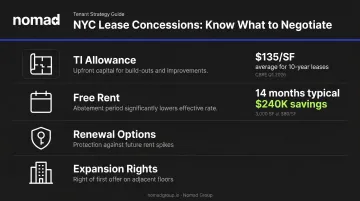
- Tenant Improvement (TI) Allowances: CBRE's Q1 2026 Manhattan Office report shows average TI allowances of $135/SF for new leases over 10 years, with 14 months of free rent as a typical concession package
- Free rent periods: A 12-month free rent concession on a $80/SF, 3,000 SF space represents $240,000 in effective savings
- Renewal options: Locking in the right to renew at a defined rate protects against future rent spikes
- Expansion rights: For growing companies, right of first offer on adjacent floors is often more valuable than the initial square footage
Step 5 — Buildout and Move-In
Once the lease is signed, the buildout begins — space planning, design, permits, and construction. For companies on tight timelines, execution speed often determines whether you hit your move-in date.
Nomad Group's construction team targets a 90-day buildout turnaround as standard. With Extend AI, they completed a full white-box-to-operational buildout — including HVAC installation — in just 5 weeks at 135 West 29th Street. The company raised a $17 million Series A shortly after move-in.
Frequently Asked Questions
What does commercial real estate mean?
Commercial real estate covers any property used for business or income-generating purposes — office buildings, retail spaces, industrial facilities, and multifamily investment properties. For most NYC businesses, the relevant category is office space.
Is there money in commercial real estate?
For investors, CRE generates returns through rental income and property appreciation. For businesses as tenants, the value isn't financial return — it's securing space that supports growth, attracts talent, and reinforces company culture in a location that works for your team and clients.
What are typical commercial lease terms in NYC?
NYC office leases typically run 3–10 years. Average lease terms have trended shorter recently — Commercial Observer reported a 6.5-year average in mid-2025 — though longer commitments generally unlock greater landlord concessions like free rent and higher TI allowances.
What is the average cost of office space in NYC?
Rates vary by neighborhood and building class. Midtown averages around $98/SF (full service), Midtown South around $87/SF, Downtown around $70/SF, and Brooklyn around $44/SF. Class A runs roughly $89/SF citywide vs. $64/SF for Class B/C. (Source: Avison Young / Colliers Q1 2026)
What is the difference between Class A, B, and C office space?
BOMA International defines Class A as the newest, best-located, and most expensive buildings; Class B as functional and moderately priced (popular with growth-stage companies); and Class C as the oldest and most affordable, though often requiring upgrades to meet current standards.
How long does it take to find and build out office space in NYC?
From starting a search to move-in, expect 3–9 months depending on market conditions and buildout complexity. Teams with in-house construction management, such as Nomad Group's 90-day buildout program, can compress that timeline considerably for companies on tight schedules.